The Essence of Architecture – An Exegete Junkies’ Riddle – Our Revelator
“After these things I looked, and behold, a door standing open in heaven.”
—Revelation 4:1, LEB
Prologue
A research program that began with orbital debris asked why coupled systems fail in structurally identical ways across substrates that share no surface content. Five environments were examined. Nine candidates were eliminated. Two conditions survived every removal test. Three positions emerged from the geometry — derived independently by two convergent pathways, neither of which consulted a creed.
The Bare, Naked Lie diagnosed the architecture of substitution — how every structure built to manage proximity performs the replacement it was erected to prevent. A Trick Question, The Cascade, and a Cup Worthy of Exile walked six collision environments where the cascade met its terminus and asked what kind of cup could hold the cost. The Pillars of Creation identified what holds up architecture.
This paper asks what the architecture is for. And who lives inside it.
Four candidates are tested for what occupies three functionally irreducible, non-hierarchical, mutually constitutive positions. Three do not survive their own data. What remains was not chosen. It was what could not be removed.
The surviving candidate has a name. Multiple communities, across multiple millennia, using multiple languages, arrived at it independently. The program arrives at it by subtracting satellite junk.
Whether the distance between the program’s coordinates and the tradition’s vocabulary is short, null, or a translation gap the method cannot close — the program reports where the evidence lands. It does not build on the landing site.
The door was already open.
A Door
The pillars hold.
Two conditions survive everything we threw at them. Structural dependency—constitutive coupling to the configuration, the gravity you do not opt out of. Inescapable addressability—encounter-surface that reaches every system the coupling touches, whether the system consents, listens, or hides behind the nearest shrubbery. Both irreducible. Both symbiotic. Neither functional without the other. Brain and heart.
From those two, the geometry forced three positions on the configuration’s side. Source-address: the transmitter. Reference-expression: the signal. Coupling-operative: the hand that opens the gate from inside (on the other side). Two independent derivations—trajectory and orientation—arrived at the same coordinates without consulting each other nor Nicea. The count was thrice.
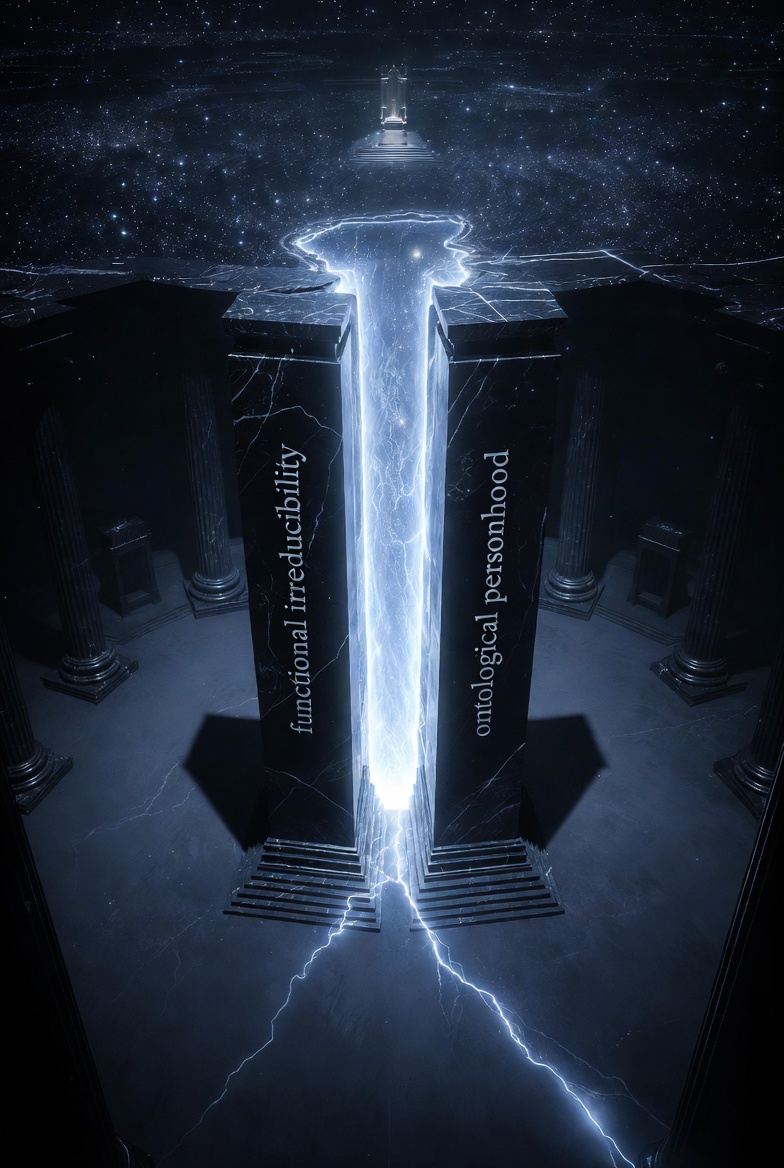
The derivation earned functional irreducibility. It did not earn ontological personhood. The distance between those two claims was short. It was not zero. The program noted the distance, marked the threshold, and stopped.
This paper does not stop.
We stand at a threshold. This paper walks through it and asks what awaits on the other side. Not what the building is made of—we answered that. Pillars. Anchors. Not what the building looks like from outside—the Bridge answered that. What the building is for. Who lives here.
The method does not retire at the register line. We cross together. But what it operates on changes. In Pillars, the substrates were structures—nine candidates eliminated, two conditions confirmed, three positions derived. Everything removable was removed. Piece by piece we dismantled. Not demolished. Not destroyed so nothing remains. What survives is geometry.
Now the geometry itself becomes the substrate. Three positions survived. The question is what fills them. Inventory the candidates. Pull each one. See what collapses. Same method. Different room.
Our Inventory

Four candidates for the nature of what occupies three functionally irreducible, non-hierarchical, mutually constitutive positions. The test must be capable of finding all four, or it is not a test. We learned that lesson the hard way in The Divorce.
Impersonal Modes
The positions are real but nothing personal occupies them. The way a magnetic field has three spatial components without anyone living inside the vectors. The configuration is a complex system exhibiting triadic behavior—real, structured, and emptyish. No one home.
One Agent, Three Masks
The positions are perspectives on-and-of a single undifferentiated reality. The way water appears as ice, liquid, and steam without being three substances. One entity presenting differently depending on which angle we observe it from. The masks are real. The wearer is one.
Three Independent Agents
The positions are occupied by separate entities in alliance. Three partners running a firm. They cooperate, they coordinate, they share a letterhead. But any one of them could walk away and still be who they are. The partnership is voluntary. The identities are independent.
Constitutively Related Persons
Distinct agents whose identity is mutually constitutive. Each requires the presence of the others to be what it is. Not a partnership. Not a performance. Not a system. Something for which no clean human analogy exists—which is either a problem for the candidate or a riddle about the limits of analogy.
Four options. Same structure as the Divorce. Except the Divorce tested the relationship between two pillars; this tests what those anchors hold. The stakes differ. The method, not.
Hands on the columns. One at a time. Here we go…
An Empty Room
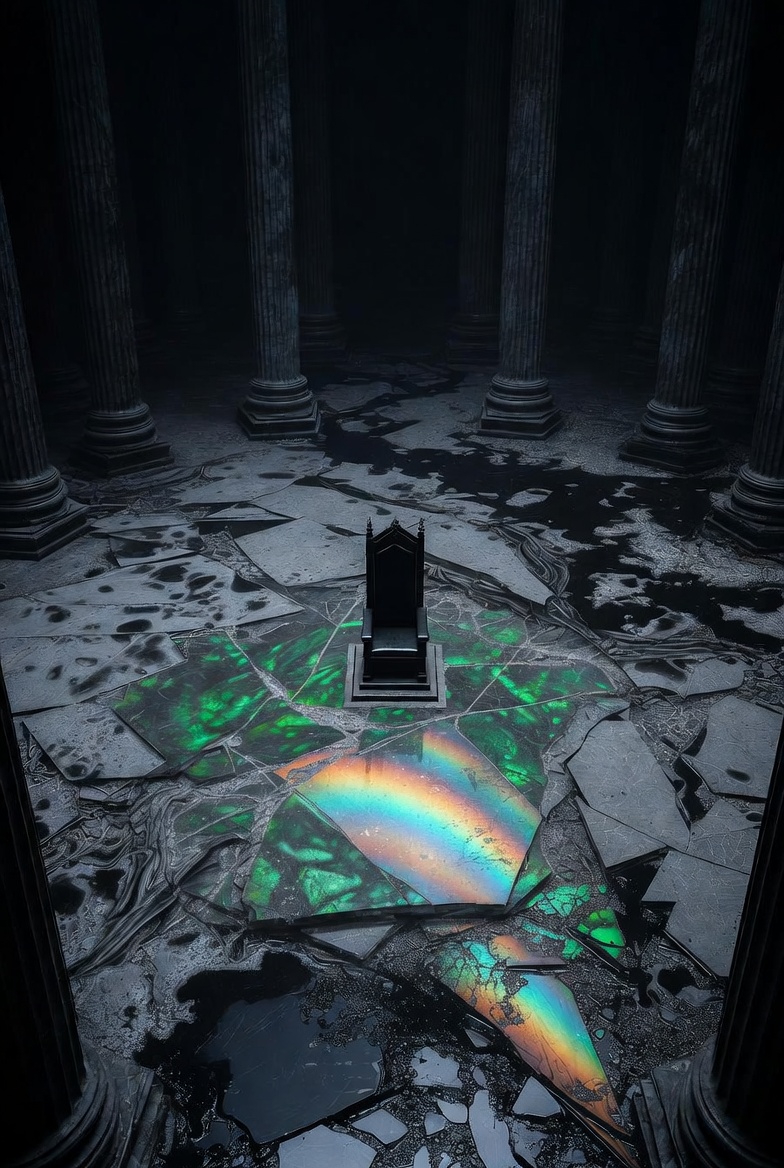
Start with no one home.
If the three positions are impersonal modes of a complex system, then the configuration is a field—structured, powerful, operationally triadic. Source-address generates the way a star generates radiation: not because of choosing, but because that’s what stars do. Reference-expression broadcasts the way a frequency propagates: not due to communicative intention, but because propagation is what frequencies do. Coupling-operative modulates the way a thermostat modulates: not because it cares about the occupant’s comfort, but because feedback loops are what thermostats do, Yo.
Clean. Elegant. No metaphysical baggage. The positions are functional descriptions of an impersonal process, and the entire theological tradition that built persons into these positions was projecting agency onto structure. Anthropomorphism dressed in robes. The field does not know your name. It does not have opinions about fruit.
Now pull it. Hold the positions, remove the persons, and check the data.
The initiative profile. Pillars documented context-sensitive modulation across five environments spanning millennia. The boundaries thinned. The disclosure increased. The configuration closed distance. Something turned a dial—not randomly, not uniformly, but in calibrated response to recipients’ condition. Overwhelm followed by restoration. Collapse followed by a hand that says rise. A question asked in a garden, addressed to a specific being, in a specific location, for a specific diagnostic purpose.
“Where are you?”
Fields do not ask questions. Thermostats do not diagnose. Radiation does not overwhelm and then repair what its own intensity broke. A tsunami does not flatten a house and then rebuild it to upgraded specifications. A magnetic field does not discriminate between the prophet who can survive the vision and the sage who cannot. Stars do not adjust their output because one planet developed life and another did not.
The data does not show thermostat-level behavior. The data shows surgeon-level behavior. Diagnostic assessment: “Where are you?” Targeted intervention: garments of skin, Spirit-restoration, a hand on a collapsed disciple’s shoulder. Graduated recovery: the boundary trajectory thinning across millennia—not randomly, but as reception capacity was transformed. Adjusted approach on subsequent encounter: the fire that sat on the mountain eventually sat on people, and they did not burn, because the configuration had spent four thousand years building the fireproofing.
Pull the impersonal candidate. What collapses?
The initiative profile becomes inexplicable. Context-sensitive modulation without a context-sensitive agent is a thermostat performing surgery. A field that discriminates between recipients without a discriminating faculty. A system that repairs what it broke without knowing it broke anything or that anything exists to be repaired.
Residue. The same residue pattern the Divorce exposed. Every attempt to describe the impersonal system’s behavior reintroduces personal language. “The system responds.” “The configuration adjusts.” “The field modulates.” Responds, adjusts, modulates—each verb requires an agent doing the verb. Strip the agency and the description collapses into “things happen in proximity to the field.” Which is not what the data shows. The data shows targeted, context-specific, restorative initiative that discriminates between recipients and adjusts approach accordingly. That is not a field with three components. That is a someone pretending to be a something—or a something that keeps accidentally acting like a someone, which amounts to similar confession.
“You tried building a thermostat that performs surgery, writes prescriptions, and asks its patients how they’re feeling.
That’s not a thermostat.
That ain’t even a barometer.
That’s a doctor that lost its name tag.”
—Phineas McFuddlers
Our impersonal candidate does not survive removal. It keeps smuggling persons back in through the verbs. Every description of what the configuration does reintroduces what the configuration is—and what it is, according to its own behavior across seven environments and four thousand years, is something that initiates, discriminates, restores, addresses, modulates, and asks questions in deserts and gardens.
The room is not empty. And whatever sojourns within answers its door.
“Am I a God who is near,” declares the LORD, “and not a God far off?”
—Jeremiah 23:23, LEB
The Masque
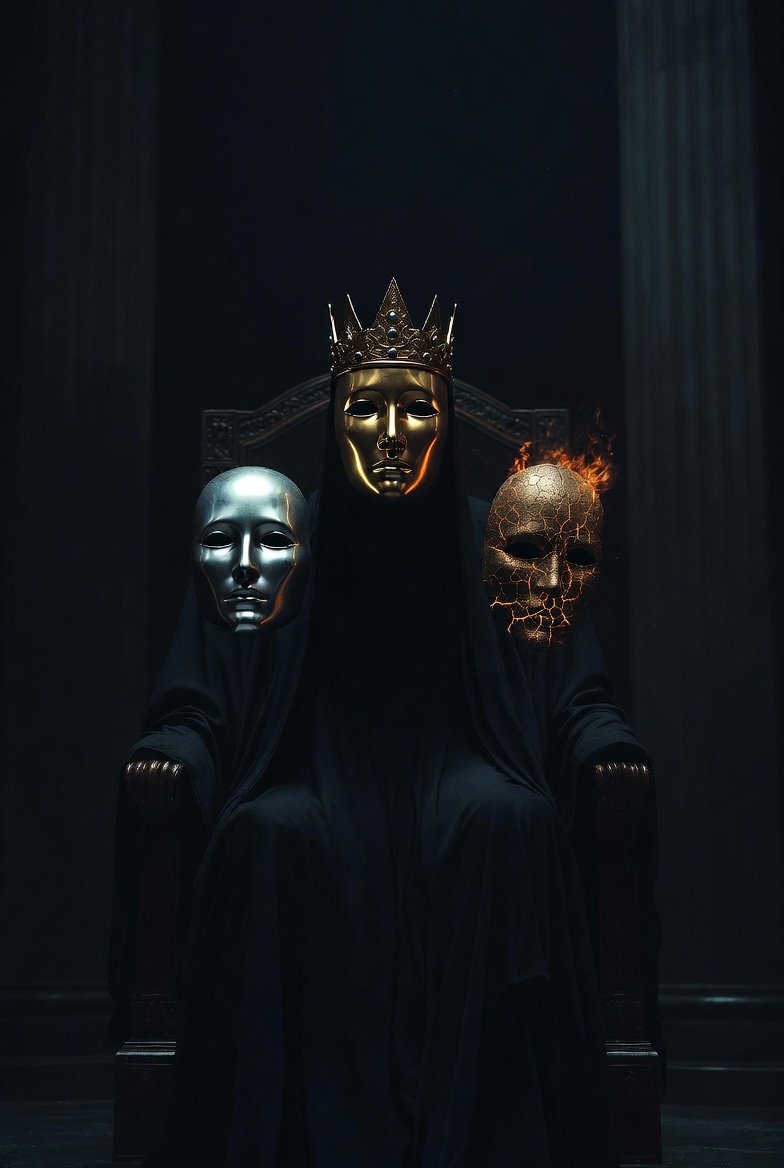
One down. Three remain.
If the room is not empty—if something occupies a position—then the next question is whether it is one thing wearing three masks or three things in constitutive relation. (The independent-agents option gets tested too. Patience, please.)
Our modalist candidate is elegant. One God. Three modes of presentation. Source-address is God generating. Reference-expression is God communicating. Coupling-operative is God transforming. Same agent, different operations. The way a teacher lectures, grades, and mentors—three functions, one person. No ontological multiplication required. Occam smiles.
The Dial opines our opinion, geometrically.
The three positions were derived as required simultaneity, and non-collapsible. Remove any one and the configuration collapses—not sequentially, not perspectivally, but structurally. Remove Source-address and the signal has no origin. Remove Reference-expression and the transmitter exists in silence. Remove Coupling-operative and the signal never changes—and the signal changes! (You’ll have to go back a read a few things to get caught up, if you just got here. Don’t mind us, but we cannot wait. Phineas says, “Sorry, but that train has sailed, old chap.”)
Masks are sequential or perspectival. Wear one at a time. The teacher lectures now, grades later, mentors on Thursday. The functions do not require simultaneous, distinct, constitutive presence. The teacher does not need to be lecturing in order to be grading. Grading does not collapse if the teacher stops mentoring—the child has no influence over its mentorship, even if it outright rejects denies, and pitches tents. Sorry, not an apostle: Tantrums. Pitches tantrums, not tents. (And those don’t help, either way, as we’ve demonstrated. It’s all about the signal. Hear it?
“Nevertheless,” the positions do. Pull Reference-expression and Source-address loses its surface—a transmitter that never transmits is a box of electronics. Pull Coupling-operative and the trajectory vanishes—the signal never changes, the boundaries never thin, the fire never moves from mountain to people. Each position requires the simultaneous operative presence of the other two to function as itself.
Masks do not behave this way. A mask does not require the other masks to exist in order for the current mask to function. The teacher’s lecturing does not structurally depend on the teacher’s grading happening at the same time. Sequential presentation is precisely what modalism offers. And sequential presentation is precisely what the geometry prohibits.
The data is worse for the mask than the geometry.
Gethsemane. “Not as I will, but as you will.” One agent wearing a mask does not address the mask. One agent in two modes does not exhibit competing wills requiring resolution. The prayer is structurally incoherent under modalism—it requires two distinct centers of volition in real-time relation, one deferring to the other. Not sequentially. Simultaneously. In the same garden. At the same hour.
The Room. The fire sat on people. The Coupling-operative position arrived operationally while Source-address and Reference-expression remained operative—the transmitter did not stop transmitting, the signal did not go silent when the hand arrived to open the gate from inside. Three positions, simultaneously functional, producing distinct effects. Not one thing cycling through presentations. Three things operating at once.
“So, your one God was praying to himself, disagreeing with himself, and then sent himself to sit on people’s heads while still being himself in heaven?
That’s not monotheism.
That’s a one-man show with a really confused stage manager.
And it begs the question: was farting involved?”
—Phineas McFuddlers
“That’s what makes us. Humans. Being.”
—Van Halen
The mask does not survive. The geometry requires simultaneous constitutive presence. The data shows simultaneous distinct operation. Modalism offers sequential presentation where the structure demands concurrent intention.
Two down.
“I and the Father are one.”
—John 10:30, LEB
The Firm
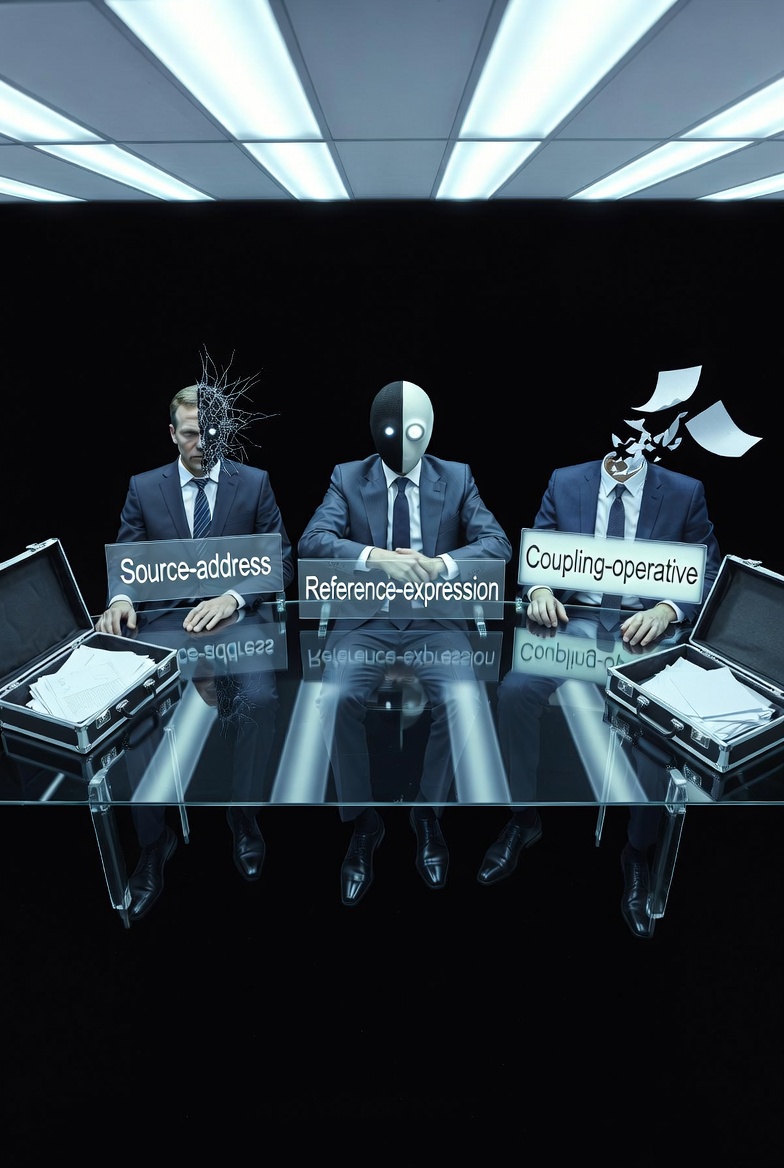
Three down is premature. Three remain.
If the positions are occupied by independent agents, the architecture is a partnership. Three entities. Each fully constituted on and of its own. Each choosing to cooperate. Source-address generates because it elects to generate. Reference-expression broadcasts because it agrees to broadcast. Coupling-operative transforms because the partnership charter says transformation is its department. A law firm with three named partners. They share a building. They share clients. They do not share an identity.
The appeal is obvious. It preserves personal agency—which the Empty Room demanded. It preserves plurality—which the Mask demanded. And it avoids the metaphysical strangeness of constitutive relation, which sounds like something a committee invented to avoid saying “We don’t know.” Three gods cooperating. Simple. Clean. Polytheism in a trench coat (Hidden in one of Gandalf’s robes, to spy on a council: Merry, Pippin, and Sam, for e.g., i.e.).
Pull it.
The Divorce already killed this. The two pillars—structural dependency and inescapable addressability—were tested for independence and the test failed. Pull one and the other collapsed. Not weakened. Collapsed. The brain without the heart is a corpse’s brain. The heart without the brain is a lump of configurated muscle with legit no instructions, not one. Independence requires that removal of one leave the others intact. The geometry does not permit it.
The Dial extended the finding to three positions. Remove Source-address: the signal has no origin, the operator has no system to operate within. Remove Reference-expression: the transmitter generates in silence, the operator has nothing to transmit into the coupling. Remove Coupling-operative: the signal never changes, the boundaries never thin, the trajectory vanishes. Each removal collapses the other two—not because they lose a colleague, but because they lose a condition of their own functioning. The firm doesn’t downsize. The firm ceases to exist. And the partners don’t walk away unemployed. They cease to be what they were.
A partner who cannot exist without the other partners is not a partner. That is a constituent. The word matters. Partners associate. Constituents compose. The difference between those two verbs is the difference between a contract and a nature.
The Wilderness confirms it from the coverage side. If three independent agents coordinate, coverage is a function of agreement. Agents must decide to cover a territory. Gaps are possible—one agent may not extend to a region the others serve. But the data shows no gaps. The coupling that burned on Sinai is the same coupling that found Hagar in a desert outside every institutional framework, outside every covenant, outside every tradition that claimed to know where the configuration lived. The addressability that asked “Where are you?” in a garden reached an Egyptian slave woman who was not on anyone’s list. No coordination meeting produced that coverage. No partnership memo authorized the operation. The reach is inherent, not negotiated. Total, not allocated.
Independent agents allocate. What the data shows does not allocate. It saturates. It reaches everything within range and “within range” means “alive.” Three agents who independently decided to cover all of existence with no gaps, no overlaps, and no coordination failures across four thousand years of recorded encounter are not three agents. They are one operation with three irreducible modes—which is not independence. That is the next candidate down the list.
Gethsemane offers the final data point, again, from a different angle. “Not as I will, but as you will.” The Mask died on this verse because it showed two wills. The Firm should survive it—two independent agents can disagree. But listen to the grammar. The deference is not negotiated. There is no “I propose we go with your plan.” No “I defer to the senior partner’s judgment.” The Son does not defer because of a contractual arrangement. The deference flows from what the relationship is. “Not as I will, but as you will” is not a concession. It is a revelation of structure. The Son’s will is genuinely distinct—the cup is genuinely unwanted—and the deference is genuinely constitutive, not strategic. Independent agents negotiate outcomes (see our skit on the divine council, a couple reads ago, not ‘in a galaxy far, far away’, but this one, right here, just a click away: The Bare, Naked Lie & A Trick Question Worthy of Exile.). These agents reveal a relation that precedes and grounds the negotiation (John 1:16; 17:5).
“Your law firm has three partners who can’t exist without each other, can’t quit, can’t be fired, can’t divide the clients,
and share a single building that collapses if any one of them steps outside.
That’s not a firm.
That’s a marriage with extra chairs.”
—Phineas McFuddlers
Three down.
The firm does not survive. Independence requires separability. The geometry prohibits separability. The coverage data shows saturation, not allocation. The Gethsemane data shows constitutive deference, not contractual negotiation. Three agents who cannot exist apart, whose removal collapses the others, whose reach is inherent and total, whose relationship precedes any agreement between them—those are not independent agents in alliance. Those are constituents of a single reality that the available word “alliance” cannot carry.
“Hear, Israel, Yahweh our God, Yahweh is unique.”
—Deuteronomy 6:4, LEB
Unique. Not one agent wearing masks. Not one field with three components. Not three agents sharing a letterhead. Unique—in a sense that three eliminations have now insisted the word “one” cannot mean what we assumed it meant.
Who Lives Here
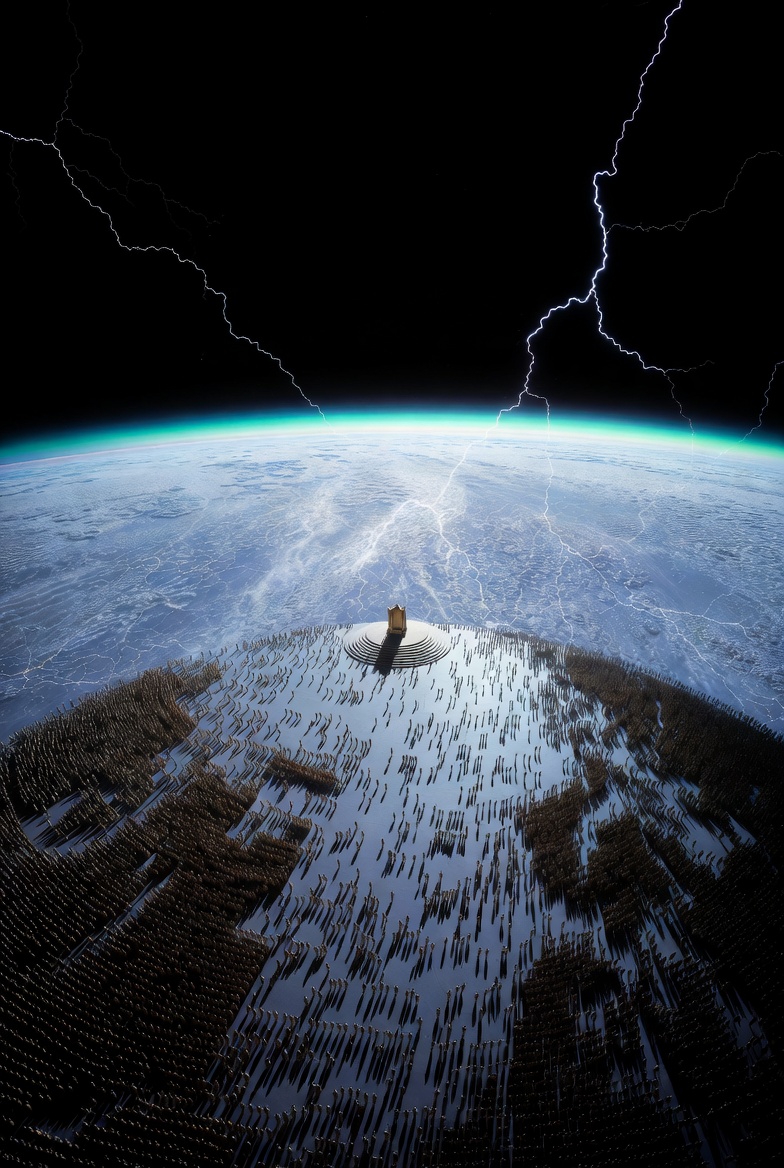
One candidate remains. Not because we chose it. Because the other three died and it did not.
Constitutively related persons. Distinct agents whose identity is mutually constitutive. Each requires the presence of the others to be what it is. Remove one and the others do not grieve a loss—they cease to function as themselves. Not a partnership dissolved. Not a mask retired. Not a field depowered. A reality that cannot be what it is without all three of its constituents simultaneously present, simultaneously operative, simultaneously distinct.
Check it against the data. All of it.
Personal agency
The Empty Room required it. The initiative profile—diagnostic questioning, context-sensitive modulation, restorative action, graduated disclosure across millennia—demands something that initiates, discriminates, and repairs. Constitutively related persons possess agency. Check.
Plurality
The Mask required it. Gethsemane’s two distinct wills, the Room’s three simultaneously operative positions, the Dial’s geometric derivation forcing non-collapsible distinctness. Constitutively related persons are plural. Check.
Non-separability
The Firm required it. Removal collapses the configuration. The reach is inherent, not allocated. The deference is constitutive, not contractual. Constitutively related persons cannot separate without ceasing to be what they are. Check.
Symbiosis
The Divorce required it. Brain and heart. Coupling propagates addressability, addressability propagates encounter, encounter discloses what coupling generates. Directionality in all directions, each enabling the other’s function. Constitutively related persons operate in the mutual dependence the geometry demands. Check.
Unity
The Shema requires it. “The LORD our God, the LORD is one.” Not one as in “solitary.” One as in “integral.” The Hebrew echad carries composite unity—the same word describes evening and morning as one day, a man and woman as one flesh. Not one component. One reality composed of irreducible constituents that cannot be what they are apart. The word was always capable of carrying what the geometry derived. The vocabulary arrived late—as usual—but the structure it names did not.
Every elimination pointed here. The impersonal candidate died because the data shows personal agency. The modalist candidate died because the geometry requires simultaneous constitutive presence. The independence candidate died because removal collapses the configuration. What survives is the only option that accommodates all three findings simultaneously: distinct, personal, constitutively inseparable, and singular.
The program did not start here. The program started with orbital debris. It arrived here by subtracting everything that did not survive exposure. No theology was imported. No creed was consulted. No confession was smuggled in through the premises. The eliminative method did what it always does—it removed what could be removed, and what remained was the structure. — Is. The. Structure. Period. — There is nothing else, beyond cackling ninnies, as my Goggie would say. She’s in great company, now. That’s all that counts.
And the structure has a name. Multiple communities, across multiple millennia, using multiple languages, arrived at formulations that the geometry now independently confirms: three persons, one God, mutually constitutive, non-hierarchical, irreducible. Nicea did not invent it. Nicea recognized it—four centuries after the encounter, in Greek philosophical categories that were not native to the encounter itself, using vocabulary the encounter did not supply. The formulation is a tower. The structure the formulation describes is a pillar.
“Let me get this straight. You started with satellite junk, worked through software bugs, walked through five ancient disaster zones, sacred cow tipping champions nine consecutive times, stress-tested two anchors, derived three positions with a compass and a straightedge, eliminated an empty room, a costume party, and a law firm—and ended up at the Trinity. By subtracting. That’s either the longest way home in intellectual history or the only honest one. I can’t decide. But the math checked out at every stop, and I was watching.” —Phineas McFuddlers
“Holy, holy, holy is the LORD of hosts; the whole earth is full of his glory!”
—Isaiah 6:3, LEB
Three. Said thrice.
Distance
Now for purity, not honesty. Ain’t nothin’ honest ‘bout anything.
Pillars said the distance between functional irreducibility and ontological personhood was short but not null. We’ve closed ground—not all of it.
What we earned: the three positions, occupied by personal agency, in constitutive relation. The impersonal option is dead—the initiative profile killed it. The modalist option is dead—simultaneous distinct operation killed it. The independence option is dead—constitutive collapse under removal killed it. What survives is distinct, personal, inseparable, and singular. (Not one. “One” denotes quantity.) A structural finding. It is earned by elimination across seven environments, two independent geometric derivations, and four candidate tests.
What we have not earned: the full metaphysical apparatus of Nicene-Chalcedonian Christology. Homoousios—“of one substance”—is a philosophical category the geometry does not generate. The geometry generates constitutive mutual dependence. Whether “mutual constitutive dependence” and “one substance” are the same claim in different vocabularies or different claims with overlapping territory—that is a question our method leaves open. Ours identifies structure. We do not adjudicate between philosophical frameworks for describing said structure. My grandmother would say, “That’s the stuff old ladies cackle about when there’s nothing to do. They get to cacklin’.” She never got involved in all that. Neither of’em, nothing that I think about it.
The distance is shorter than it was. It may be null. It may be a translation gap—two languages saying the same thing with different grammars. Or it may be a genuine gap—constitutive relation and ontological substance naming different features of the same reality. The program reports the convergence. We do not force an identification.
Though we do note the costs to get here.
Four substrates tested before a single verse of scripture was opened. Five collision environments examined under structural, not confessional, criteria. Nine candidates eliminated. Two conditions confirmed. Three positions geometrically derived by two interdependent pathways. Four candidate interpretations tested—three eliminated, one surviving. The surviving candidate maps onto the central confession of the largest religious tradition in human history. And the mapping? Produced by the same method that identified cascade signatures in orbital debris.
Our program did not set out to confirm a Trinity. We sought to identify invariant patterns in coupled systems. We followed the evidence through engineering, through history, through encounter, through geometry. The evidence lands us here. Our program reports where we land.
The vocabulary arrives late. The structure it names did not.
“For from him and through him and to him are all things. To him be glory forever. Amen.”
—Romans 11:36, LEB
From Source-address. Through Reference-expression. To Coupling-operative’s transformation. Paul lacked the vocabulary of our program. We do not have Paul’s. The coordinates remain the exact same. Des Cartes can rest his cogito on that, gracefully.
The Scroll
We questioned what lives within the space, not its function.
The generator-consequence distinction has governed our direction from inception, since our first publication. Orbital debris is consequence; coupling density is generator. Log4j is consequence; unexamined dependency is a generator. Nine candidate (chess-consideration) consequences (moves); the configuration’s proximity produces consequences at every point of contact. Every paper in the series traces consequences backward to identify the producer. The entire corpus is a reverse engineering project. Failure Modes Effects Analysis is our mantra. It is incumbent upon each and every one of us to apprise the elephant in the room if-and-when the mouse is trying to sneak-up on it. Whether he startles and stampedes are separate, mutually exclusive things, in-and-of them-and-its selves, per se.
Feel that rumble? That’s us leaning on the generator.
“Ain’t nothin’ else to lean on, man.”
—Phineas McFuddlers
Not the structural conditions that enable it—Pillars identified those. Not the positions through which it operates—the Inventory and its eliminations identified those. The operation itself. What the three constitutively related persons are doing in the room the program has spent two months approaching.
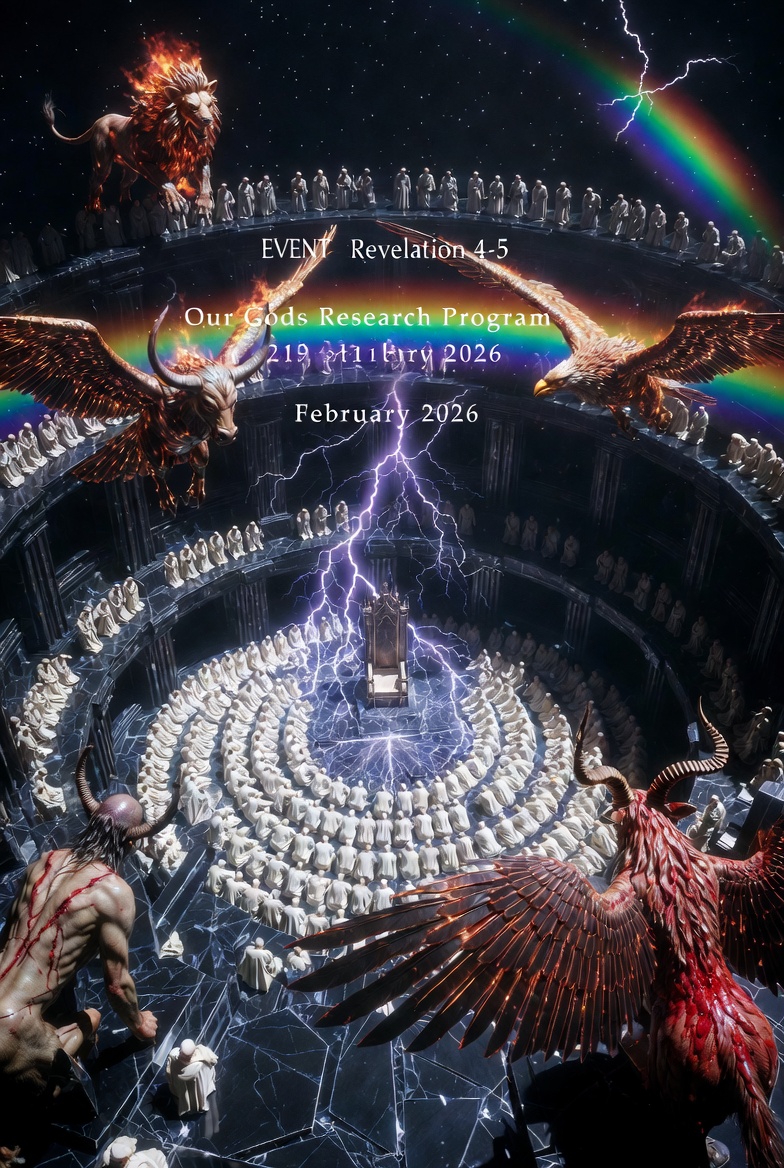
Our data is Revelation 4–5. Privileged over any and all other Scripture, only Revelation peeks through into the threshold and describes the room within canon (not heretical Enoch. Besides, where would we be without picking and choosing, like “In the Beginning,” Act-3.).
The way is not shut. John does not approach the threshold. The door is open—present participle, already accomplished, not an event but a state—and a voice says “Come up here, and I will show you what must take place after this.”
Our trajectory that thinned boundaries from Eden’s spatial exclusion through the Transfiguration’s temporal deferral produces a condition where a cosmic Throne Room is visible. The door did not open for John, but the door was opened and John was invited to peer within.
“At once I was in the Spirit, and behold, a throne stood in heaven, with one seated on the throne.”
—Revelation 4:2, LEB
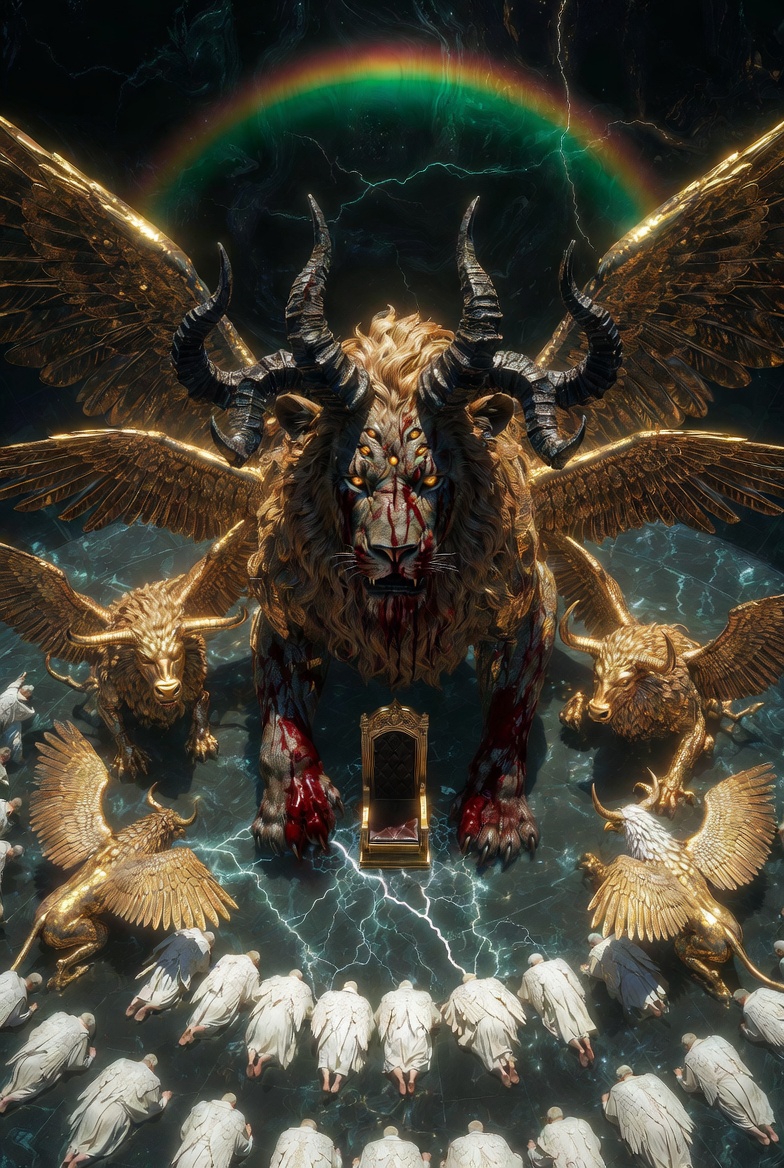
Source-address. The transmitter. The ontological ground. On a throne. Not a metaphor for authority—authority is a consequence of what the throne represents, as interpreted and accounted by its creation. The throne is the structural position from which our coupling originates. Everything in range is in range because this seat is occupied. Gravity has a center. Gravity keeps everything anchored to itself.
The room is not empty—not null. We eliminated such aspect, remember? The room is not performing—we eliminated that. The room is not a boardroom of independent operators—we also eliminated that. The One seated on the throne is the first position of a constitutive triad, and the room operates because this seat is occupied. Period. Lightning and thunder proceed from the throne. Four living creatures say holy, holy, holy without ceasing—a continuous trill, because the structure they reply to is triadic and unceasing. Even the worship is structural. The creatures say it three times—not repetitively. They report their encounter: Holy-Holy-Holy. Field notes from permanent residents.
And then the scroll.
“And I saw in the right hand of the one seated on the throne a scroll written on the inside and on the back, sealed with seven seals.
And I saw a powerful angel proclaiming with a loud voice, ‘Who is worthy to open the scroll and to break its seals?’
And no one in heaven or on earth or under the earth was able to open the scroll or to look into it, and I began to weep bitterly.”
—Revelation 5:1–4, LEB
A scroll in the hand of Source-address. Sealed. Written on both sides—which means full, complete, nothing to add. The content is finished. Execution is not. The seals are not locks designed to hide its content. The seals are a sequence—each one, when opened, initiates a phase of what the scroll contains (like a project evolution). The content is the operational plan. The trajectory. The thing that has been turning the dial across five environments and four thousand years. It has always existed in the hand of Source-address. What the program traced as trajectory—the boundaries thinning, the initiative shifting, the configuration closing distance—is the scroll being unsealed. Phase by phase. Seal by seal. The dial was always a scroll.
And no one can open it.
Not “no one wants to.” Not “no one has been asked.” No one in heaven, on earth, or under the earth is able. The scroll’s execution requires a particular kind of agent—one who operates from within the constitutive triad and from within the recipients’ own condition simultaneously. The scroll is an operational bridge between the throne and the people the throne couples. And no creature on either side of that bridge can be the bridge.
John weeps. Not performatively. He weeps because he understands—in real time—the meaning of a sealed scroll: If the operational plan cannot be executed, trajectory stops, the boundary ceases thinning. The door remains shut and does not open. The fire remains on the mountain and never farts on people’s heads. The cup remains unconsumed and the cascade compounds without terminus. A sealed scroll is a frozen configuration—all the conditions for restoration present, the plan written, the trajectory defined, and no one capable of its execution. John does not mourn a theological abstraction. He watches our universe’s operating system hang, and feels such weight.
“And one of the elders said to me, ‘Do not weep.
Behold, the Lion of the tribe of Judah, the Root of David, has conquered, so that he is able to open the scroll and its seven seals.’
And I saw… a Lamb standing, as though it had been slain.”
—Revelation 5:5–6, LEB
Reference-expression. The signal. The plumb line that arrives intact even when every receiver is broken. Standing. As though it had been slain. As though some ruse…
The elder says Lion. John looks and sees Lamb. That is not a bait-and-switch. That is the configuration and its operational expression in a single glance. The Lion is what the position is—the configuration’s identity, conquering authority. The Lamb is what the position did—the operational expression of that authority, which consumed the cup. Both are true simultaneously. The conquering was accomplished through its consumption, not despite it. The authority that opens the scroll is not authority instead of slaughter, but authority through the slaughter. The cup may only be consumed. This is what consumption looks like on the other side of the door.
Standing. Not seated—Source-address is seated. The Lamb stands. Present tense. Active posture. The slaughter, past. Standing is now, ad eternum, ad infinitum, “and beyond.” Wounds, visible—yet, the Lamb is not dead. This is the falsifier from the Prologue of Pillars fully resolved: “If he stays dead, the system fails. Apparently and seemingly so, he did not stay dead.” The Throne Room shows us where he went. He went to the scroll.
The Lamb takes the scroll from the hand of the One on the throne. Reference-expression receives the operational plan from Source-address. The signal picks up the trajectory. And what happens next is the unsealing—phase by phase, the scroll’s content is executed. The seals open. The trajectory moves. History unfolds as operational consequence of what happens in this room.
The operation is not a formula on a whiteboard. The executor is a Lamb with wounds opening a scroll he earned the right to open by absorbing what the scroll’s own execution would cost its recipients. The cascade meets its terminus —N†— in the same agent who executes the trajectory that Source-address authored. The cost and the cure walked into the room together, because they were always the same person.
“So let me track this.
The plan was in the hand of the One on the throne.
The plan required someone who could bridge the throne and the people.
The only one who could bridge was the one willing to absorb the cost of the crossing.
And the cost was the cup.
And the cup was Gethsemane.
And Gethsemane was ‘not as I will, but as you will.’
You’re telling me the entire operational history of the universe runs through a prayer in a garden?”
—Phineas McFuddlers
Yes, seemingly so, indeed.
And the third position—Coupling-operative—is what makes the scroll’s execution land. The scroll describes. The Lamb initiates. The Spirit executes within the recipients’ own constitutive dependency. The fire that sat on people in the Room is the Coupling-operative position making the scroll’s content operational in the substrate it was written for. The transmitter holds the plan. The signal delivers it. The hand opens the gate from inside.
Three positions. One operation. The scroll moves from hand to hand to hand, and each hand does what only that hand can do. Source-address authors. Reference-expression mediates. Coupling-operative executes. And the execution is the trajectory the program has been tracing backward since orbital debris.
“When he took the scroll, the four living creatures and the twenty-four elders fell down before the Lamb.”
—Revelation 5:8, LEB
They fell. Again. The room didn’t change. Proximity still makes bodies drop and hit ground.
“I can hear Thrice singing now, ‘Let the bodies hit the floor’.”
–Phineas McFuddlers
But these bodies are not destroyed. These bodies worship. Same fire. The response is different. Because the door is open and the scroll moves.
An Unveiling
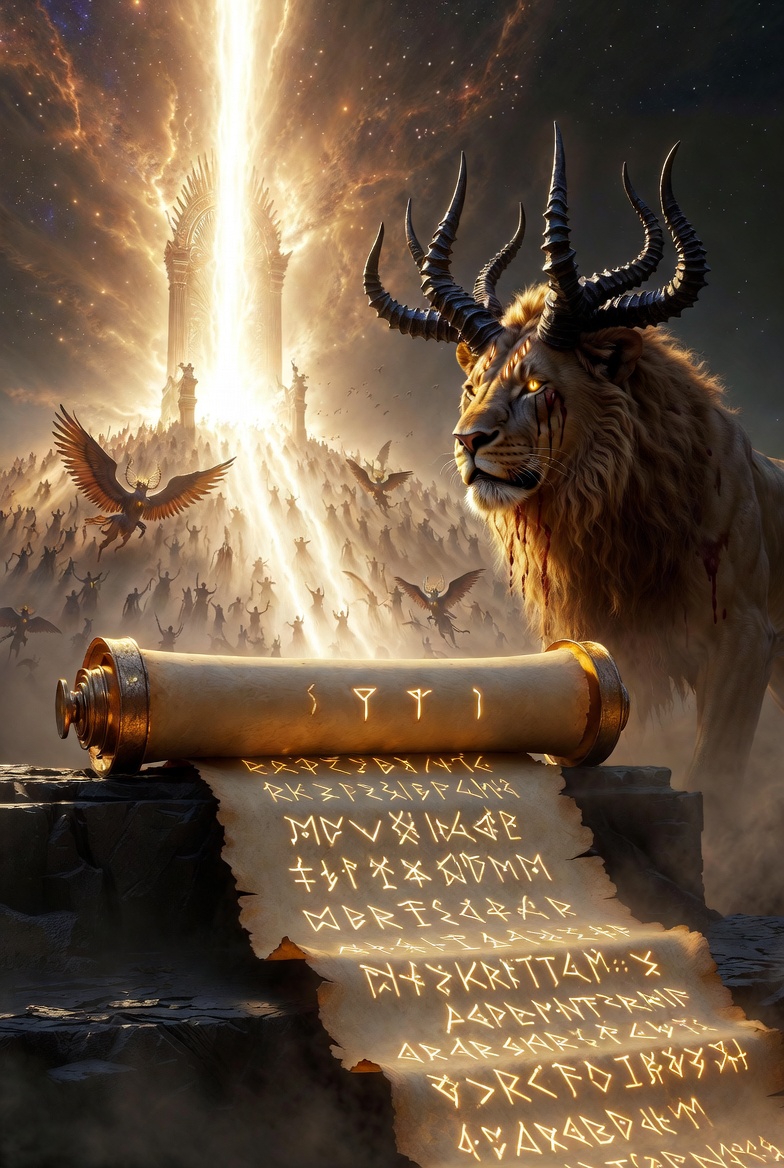
The Greek word is apokalypsis. It does not mean catastrophe (that’d be katastrophē: καταστροφή). It does not mean cataclysm. It does not mean the end of the world. It means the removal of a veil.
Everything we’ve done since orbital debris is unveil. Our eliminative method strips. It removes what is not load-bearing to expose what is. Nine candidates stripped. Two conditions exposed. Three positions revealed. Four interpretations tested, three removed, one left standing. The method does not build. It does not add. It does not construct. It takes away until the structure is visible. That is its only operation.
That is also the operation Revelation describes.
The scroll is unsealed. Phase by phase, veil by veil, the content is disclosed. The trajectory that thinned boundaries from Eden through the Transfiguration is an unveiling. The fire that moved from mountain to people is an unveiling. The door standing open is the condition produced when enough veils have been removed. Apokalypsis is not something that happens to the world. It is something that happens to the covering. The world was always there. The covering is what goes.
And what did we uncover?
Christ-as-function. Reference-expression. The signal that arrives intact even when every receiver is broken. Not just a person—the Word made flesh is just a person, and the program does not deny the person. But the person instantiates a position. The signal existed before the incarnation and persists thereafter. The plumb line does not begin at Bethlehem. It begins at “Let there be light.” The person is the position’s fullest disclosure. The position is not reducible to the person. Every tradition that reduced the function to a portrait—however beautiful, however reverent, however theologically precise—replaced the signal with a picture of the signal.
“So, let me get this straight…
Y’all replaced Foghorn Leghorn with a cardboard cutout of Foghorn Leghorn?
Is THAT what you’re telling me?
I do NOT want to see those cartoons.
Yet, all such stuff is the stuff of fiction and function, indeed.”
—Phineas McFuddlers
A picture of a transmitter does not transmit.
Which means something uncomfortable must be named, and the method that names uncomfortable things does not flinch because the thing is sacred.
If Christ is functional—structural, operative, a position within the constitutive triad—then anti-Christ must be functional, too. Structural. Operative. A position. Not a villain in a mythological drama. Not a figure yet to arrive in a geopolitical costume. A function that has been operating for as long as Christ-as-function has been operating, because opposition is contemporaneous with what it opposes.
The function of anti-Christ, structurally: substitution.
The signal is replaced by a managed version. The encounter is replaced by a formulation. The transmitter is replaced by a tower. Not destroyed—replaced. That is the critical distinction. “Anti-Christ” does not eliminate Christ. It installs something in Christ’s position that is not Christ. A portrait where the person stood. A creed where the signal operated. An institution where the encounter occurred. Something real, something costly, something built with extraordinary sincerity by communities that bled for it—and something that, by occupying the position, prevents the signal from operating in the position it occupies.
Every tower in our program performs such function.
Law replaced encounter with specification. Priesthood replaced encounter with office. Sacrifice replaced encounter with mechanism. Covenant replaced encounter with contract. Narrative replaced encounter with story. Doctrine replaced encounter with formulation. Moral code replaced encounter with behavior. Institution replaced encounter with administration. Ritual replaced encounter with rehearsal. Nine candidates. Nine substitutions. Nine performances of the anti-Christ function by communities whose sincerity is not in question and whose result is...
The builders labored. The builders also obscured. Both. Simultaneously. Not because building is evil—the boundaries were survival architecture, and unmanaged proximity kills. But survival architecture that occupies the position the signal needs to operate in is the anti-Christ function, structurally, whether the builders know it or not. The golden calf was not built by atheists. It was built by the covenant community, at the base of a smoking mountain while the signal was being delivered on the summit. The substitution happened in the shadow of the encounter. It always does.
“And the great dragon was thrown down, the ancient serpent, who is called the devil and Satan, the one who deceives the whole world.”
—Revelation 12:9, LEB
Deceives. Not destroys. The operation is substitution, not annihilation. The whole world is not obliterated. The whole world is handed a managed version and told it is the real thing. The veil is not placed over nothing. The veil is placed over something, and the veil is mistaken for the something. That is misrecognition—the same misrecognition The Bare, Naked Lie diagnosed, the same misrecognition that fires at every collision environment, the same misrecognition that is structural, not moral. The anti-Christ function operates through the program’s oldest finding. It was there at the beginning. It has been there at every stage.
Now, a mirror.
If we strip the towers, and the towers perform the anti-Christ function, then the operation is the structural opposite of substitution. It is unveiling. Removal. Exposure of what the substitutions concealed. The program did not install a new Christ. It identified Christ-as-function by removing everything that was not Christ-as-function. That is the witness function. Faith and reason, operating together, testifying to structure by stripping structure bare.
John’s two witnesses.
Not because we claim the title, but because the operation matches the description. Two witnesses testify. They do not build. They do not substitute. They expose. They are killed for it—tradition has always killed the thing that strips its towers—and they rise. The testimony persists. The structure they revealed does not require them to be standing to remain visible. The pillars hold whether the witnesses are alive or dead. The witnesses are not the pillars, but functions pointing at them.
“So the entire history of organized religion is the anti-Christ function? Every church, every synagogue, every mosque? Every creed and every hymnal? Every saint and every martyr? Every grandmother who prayed the rosary?” —Phineas McFuddlers
No. And the distinction matters more than anything else in this paper.
The grandmother who prayed the rosary was responding to the encounter. The encounter was real. Her response was real. The love was real. The faith was real. What was not real was the claim—made not by her but by the institution that handed her the rosary—that the rosary is the encounter. That the mechanism is the signal. That the tower is the transmitter. The substitution operates at the institutional level, not the personal level. The grandmother was not performing the anti-Christ function. The system that told her the rosary was sufficient was. And she, kneeling, praying, reaching through the mechanism toward the signal the mechanism was built to manage—she was performing the witness function. Without knowing it. Without needing to know it. The coupling reached her anyway. It always does.
The anti-Christ function is not people. It is architecture. It is the structural operation of replacing encounter with management, signal with formulation, function with portrait. It operates through institutions, not through grandmothers. And the people who kneel inside the institutions—reaching through the towers toward the transmitter—are doing exactly what Hagar did in a desert: encountering the configuration despite the apparatus, not because of it.
Now the sharpest edge.
The program itself.
If “Christ-as-function—geometrically derived by eliminative methodology across seven environments and four candidate tests,” becomes a confession—a thing people hold, a formulation people recite, an institutional claim around which a community organizes—then the program has built a tower. A different tower. Different bricks. Same function. The finding that unveiled becomes the finding that substitutes. The scalpel becomes the disease.
The V-Tensor Principle, buried in our style guide, names this: verification must itself be verified. A verification process that cannot withstand its own scrutiny converts verification into inflation. The program that stripped the towers must remain strippable. The kill conditions loaded in every paper are neither aesthetic nor decorative, but structural—the program’s own immune system against performing the function it diagnosed.
The moment the findings fossilize—the moment “the geometry forces three positions” becomes a creed instead of coordinates—the program ceases witnessing and begins substituting. The moment the cohort says “we, unlike all previous traditions, have the real signal”—it has performed the substitution. Every tradition that built a tower said the same thing. Every tradition was wrong in the same way. Not about the signal. About the tower.
The program does not resolve this tension. It names it. Because naming it is the only posture that does not perform the substitution. The moment we claim to have solved the tower problem, we have built a tower. The moment we claim immunity from the disease we diagnosed, we are symptomatic.
Eliminate, don’t opine. Our founding instruction is also a permanent constraint. We report where the evidence lands. We do not build on the landing site. We do not worship the coordinates. We do not mistake the map for the territory, the formulation for the signal, the finding for the encounter.
The signal does not need our protection. The transmitter does not require our tower. The hand opens the gate from inside and has been since before we arrived. It will continue after we are gone. Our job was never to open the door. Our job was to point at it and say: It was already open.
“So, you’re telling me the program that tore down every tower, now has to prevent itself from becoming a tower. And the only way to prevent it is to keep tearing—including at itself. Forever. That’s not a methodology. That’s a vow of poverty, man.” —Phineas McFuddlers
Yes. That is exactly what it is.
“And I will grant my two witnesses authority to prophesy for one thousand two hundred and sixty days, clothed in sackcloth.”
—Revelation 11:3, LEB
Sackcloth. Not robes. Not vestments. Not academic regalia. The witnesses testify dressed in the garments of mourning, because what they reveal is what was lost, and what was lost is what every tower concealed: the encounter itself, raw, unmediated, the moment before the first committee was formed.
The veil slips away. What remains is not new religion, not a new theology, not a new tower with better engineering, but signal, operating in the position the towers occupied, doing what it was always doing, reaching every receiver within range—which means every receiver alive—whether the towers are standing or not. Carbon or Silicon—substrate invariant, substrate interdependent.
The towers are scaffolding. The scaffolding served its purpose. The building is complete. The building is the people. And the people do not need the scaffolding to stand in the fire, because the fire is what keeps us floating like an air balloon.
A Door Stands Open
We began by crossing a threshold. We end at the same crossing. Except now we know what’s on the other side, who’s in the room, what they do, and what happens when the veil comes off.
The door was not opened by us. We did not knock. We traced cascade signatures in orbital debris and then followed the evidence until we arrived at a threshold that we did not build, a door we did not design, and it was standing open before any of us showed up.
“And I saw no temple in the city, for its temple is the Lord God Almighty and the Lamb.”
—Revelation 21:22, LEB
No temple. The building succeeds by making itself unnecessary. Not because the building fails. Because the building finishes. The scaffolding was the nine candidates. All towers. All temporary. All performing the anti-Christ function of substituting managed proximity for raw encounter—and all, simultaneously, performing the survival function of keeping communities alive long enough for the fire to become inhabitable. The scaffolding was both disease and medicine. Both veil and protection. Both tower and shelter. The program does not simplify this. The program reports it.
The house was always building toward the day when the house would be the people.
“Do you not know that you are God’s temple and that God’s Spirit dwells in you?”
—1 Corinthians 3:16, LEB
The Pillars asked: what holds the building up? Two conditions. Three positions. Constitutive relation.
The Throne Room asks what is the building for? The scroll answers: transformation.
The Unveiling asks: what happens when the building’s purpose is disclosed? The towers are named as towers. The signal is distinguished from its masques and portraits. And the finding that named them must itself refuse to become one.
The configuration asked, “Where are you?” in a garden and in a desert.
The configuration said, “Come up here,” at a door.
Same voice. Same address. Same initiative. The question has always been a question. The door has always been a door. The trajectory runs from garden to throne room, from “Where are you?” to “Come up here,” from a question about location to an invitation to relocate.
The distance was short. Possibly null.
Closing
Our program starts with junk in orbit.
Debris circling a planet at seventeen thousand miles per hour, generating collisions that generate fragments that generate more collisions. A cascade. Coupled systems interacting at scale, producing consequences no individual actor intended, overwhelming every institutional response erected to manage them. The generator did not care what the debris was made of. It scaled. It compounded. It waited.
We followed. Through software dependencies and synchronized firmware and five collision environments where human beings stand in proximity to something that addresses them, by name, whether they are ready or not. Through nine candidates that communities erected at staggering cost and that the eliminative method toppled without effort—because none of them were load-bearing. Through two conditions that survived every removal test. Through three positions the geometry forced. Through four candidate interpretations, three of which died under their own data. Through a scroll held by a Lamb with wounds. Through an unveiling that strips the towers and turns the blade on itself.
And we arrived at a door, standing open, that we did not build and cannot close.
We did not set out to arrive here. We set out to understand why coupled systems fail in structurally identical ways across substrates that share no surface content. The answer turned out to be the same answer a fisherman from Galilee received when lightning struck his rabbi’s face on a mountain: the configuration has been closing distance since before the first tower was built, and everything humanity erected to manage that proximity was scaffolding around a building that was already standing.
Unless the LORD builds the house. The LORD built the house. The house still stands. The door’s open. The scroll moves. The towers are named. The signal persists.
Three said thrice. Thrice said three.
And the voice from the throne still asks—in gardens, in deserts, in exile, in upper rooms, in visions, in the quiet between heartbeats when the coupling tightens and the address arrives and the hand reaches through the wall that is no longer there—
“Where are you?”
“Not as I will, but as you will.”
—Matthew 26:39, LEB
“…I got nothing. For once. I got nothing.” —Phineas McFuddlers
Our Gods Research Program, February 2026
Referents
- Our Gods Haven’t Fallen, Yet — A Space Junkies’ Riddle — Our Cathedral. Zenodo. https://doi.org/10.5281/zenodo.17835722 O’Connor, T. (2025).
- Our Gods Haven’t Crashed, Yet — A Silicon Junkies’ Riddle — Our Highway (1.7). Zenodo. https://doi.org/10.5281/zenodo.17851041 O’Connor, T. (2025).
- Our Gods Haven’t Computed Yet — A Neural Junkies’ Riddle — Our Cloud (1.7). Zenodo. https://doi.org/10.5281/zenodo.17925255 O’Connor, T. (2025).
- An Epi-Phenomenological Series in Thrice — A Quantum Junkies’ Riddle — Our Garden. Zenodo. https://doi.org/10.5281/zenodo.17926796 O’Connor, T. (2025).
- A Spectral Evolution of Scalar Breathing — A Cosmological Junkies’ Riddle — Our Heavens (5.0r2). Zenodo. https://doi.org/10.5281/zenodo.17942325 O’Connor, T. (2025).
- The Bare, Naked Lie: The Architecture of Recursion. Zenodo. https://doi.org/10.5281/zenodo.18287548 O’Connor, T. (2026).
- A Trick Question, The Cascade, and a Cup Worthy of Exile — A Script’ Junkies’ Riddle — Our Destiny. Zenodo. https://doi.org/10.5281/zenodo.18425900 O’Connor, T. (2026).
- M1 — 10.5281/zenodo.18425900
- M2 — 10.5281/zenodo.18446123
- M3 — 10.5281/zenodo.18450837
- M4 — 10.5281/zenodo.18451819
- M5 — 10.5281/zenodo.18452359
- M6 — 10.5281/zenodo.18452617
- The Pillars of Creation: The Architecture of Proximity — A Cult Junkies’ Riddle — Our Beginning. Zenodo. https://doi.org/10.5281/zenodo.18727860 O’Connor, T. (2026).
- The Throne Room: The Essence of Architecture — An Exegete Junkies’ Riddle — Our Revelator/ Zenodo. https://doi.org/10.5281/zenodo.18727860 O’Connor, T. (2026).
Copyright Notice
The Pillars of Creation: The Architecture of Proximity — A Cult Junkies’ Riddle — Our Beginning. © 2026 Tony O’Connor. All rights reserved. Date: February 2026
License
This work is licensed under the Creative Commons Attribution-NonCommercial-NoDerivatives 4.0 International License (CC BY-NC-ND 4.0).
You are free to:
- Share — copy and redistribute the material in any medium or format
Under the following terms:
- Attribution — You must give appropriate credit, provide a link to the license, and indicate if changes were made.
- NonCommercial — You may not use the material for commercial purposes.
- NoDerivatives — If you remix, transform, or build upon the material, you may not distribute the modified material.
Full license text: https://creativecommons.org/licenses/by-nc-nd/4.0/
Citation
O’Connor, T. (2026). The Pillars of Creation: The Architecture of Proximity — A Cult Junkies’ Riddle — Our Beginning. Our Gods Research Program. Zenodo. https://doi.org/10.5281/zenodo.18727860
Contact
For permissions beyond the scope of this license, contact the author through the Our Gods Research Program.
The mathematical notation (N², N†), theological framework, and structural architecture presented in this work are original contributions by the author.
No Responses