A Structural Autopsy of Epiphany — A Revelation Junkies’ Riddle
— Our Apokalypsis
“The revelation of Jesus Christ, which God gave him to show to his servants the things that must soon take place. He made it known by sending his angel to his servant John.” —Revelation 1:1, LEB
Prologue
The Greek word is apokalypsis. It does not mean catastrophe. It does not mean cataclysm. It does not mean the end of the world. It means the removal of a veil.
Everything we’ve done since orbital debris is just that: unveil.
A research program that began with satellite junk followed a single signature across five substrates. The signature was correlated failure scaling quadratically — N² — regardless of what the coupled system was made of. Orbital debris, autonomous vehicles, cybersecurity dependencies, civilizational governance, spacetime itself. The substrate changed. The mathematics did not.
Before we generalize, let us count. Two hundred satellites in the same orbital shell create not two hundred collision opportunities but nearly twenty thousand. A firmware update synchronized across a fleet multiplies not linearly but combinatorially — every vehicle coupled to every other through the same code. A single unpatched library sitting inside forty thousand applications does not produce forty thousand vulnerabilities. It produces a failure surface proportional to the square of its embedding. Three substrates. One exponent. Then a fourth — spacetime itself, where Scalar Breathing Cosmology demonstrates—rather, illuminates that the same quadratic signature is written into the fabric of the universe. That’s everything inanimate. A demarcation line, per se. Over and above, we point to the realm of Descarte’s cogito. The fifth — civilizations building towers to manage the same proximity the previous substrates failed to contain. The formula does not care what it is counting.
The method was eliminative. Strip what is not load-bearing. Identify what survives removal. Report coordinates. Do not build on the landing site.
The Bare, Naked Lie diagnosed the architecture of recursion—a cyclical, oscillating pattern through substrates, arriving each time at structures built to manage the very proximity that signal carries, and each time finding those structures performing the very same substitution they were erected to prevent. A Trick Question walks six collision environments where the cascade meets its terminus and asks what kind of cup holds such cost? The Pillars of Creation identified what holds up the architecture: two irreducible conditions (structural dependency and inescapable addressability), three geometrically forced positions (Source-address, Reference-expression, Coupling-operative), and the marriage between them that no removal test could dissolve. The Throne Room crossed from subtraction to occupation — tested four candidates for what lives inside the three positions, eliminated three, and reported that the surviving candidate has a name multiple communities arrived at independently across millennia.
The Throne Room opened Revelation 4–5 and looked at one room. Two chapters. Three positions occupied. One operation observed.
This paper opens the entire book.
Twenty-two chapters. Not a proof-text exercise — not cherry-picking verses to support a thesis already held. A structural autopsy. The same scalpel. The same method. The only one we employ. The same question asked of every chapter: does the architecture the program derived from orbital debris operate here, or does it not?
If the architecture does not operate — if the signature fails to fire in any chapter — the paper reports the absence. The eliminative method does not negotiate with its own preferences. A finding that must be protected from counter-evidence has ceased being a finding and become a creed. This paper’s falsifier is explicit: one chapter where the program’s signature is absent and cannot be accounted for by structural reasoning is sufficient to wound the thesis. Two such chapters kill it. We offer the paper its own coffin nail and invite the reader to drive it through the heart of the matter.
The Christian tradition both addresses, and dresses, this book in eschatological costume for two thousand years. Beasts with seven heads. Locusts with human faces. A whore on a scarlet animal. A lake of fire. The costume is so thick the structure is almost unrecognizable underneath it. The popular imagination sees catastrophe — the end of the world, the rapture, Armageddon, helicopters and bar codes, and European Union presidents with sinister smiles and snickers—not the candy bar. The scholarly tradition sees genre — apocalyptic literature, coded political resistance, first-century Roman propaganda wearing mythological accoutrements.
Before we distinguish our reading from both the pedantic and traditional readings, let us name what we share with both: 1) The popular reader is right that the content of the book is staggering in scope and magnitude. (Harken lo! We liken this to an encounter surface—with the signal—that buckles human knees. Ask Ezekiel. Ask the three dudes who witnessed Christ’s transfiguration. You can’t ask the three Pardes Rabbi, because they didn’t survive); 2) The scholarly reader is right that the book operates within literary conventions its original audience recognized and understood, regardless of any language barriers then and now. Neither observation is trivial. The program does not dismiss the tradition’s two thousand years of engagement. Communities bled over this text. Martyrs died with its phrases on their lips. Scholars devoted careers to its historical context, its linguistics, its philology, its redaction layers, its theology, but mostly—its dogma. The program honors all such labor by applying the same rigor to the text — not less than the tradition brings, only a different instrument. Scalpel.
Our program sees neither catastrophe nor genre. We see the same signature tracked since low Earth orbit. Coupled systems. Cascade mechanics. Generator-consequence confusion. Towers erected to manage proximity. Substitution posing as genuine article. And a trajectory — a scroll, unsealing phase by phase — that has been operating since a question was asked in a garden.
The Greek title of our paper is Apokalypsis. Unveiling. The “removal of a veil.” The methodology of our program is eliminative — removal of anything not load-bearing to expose what is. The paper and the method share a name because they share a function. What follows is an unveiling of an unveiling. The program’s scalpel applied to the one canonical text that claims to be a scalpel.
“So, we’re using a blade to autopsy a blade. What could possibly go wrong?” —Phineas McFuddlers
Everything. Which is why the kill conditions remain loaded. The V-Tensor Principle still applies: Verification must—itself—be verified. If at any point the program’s findings fossilize into confession — if these coordinates become a creed, not a report — the program has built one of the towers that we diagnosed. I assume full accountability and responsibility; but either way, the anti-Christ function does not retire because the analyst identifies it. The analyst is not immune. The scalpel that names every other blade can still cut its own hand. If this paper starts sounding like a sermon, the reader should hear the blade whirring and reach for the off switch.
There’s a door. We didn’t find it. Seemingly, it has stood open since before our garden brunch, and before any one of us happened upon its threshold. The story of its telling is aged millennia by any measure. Let’s lean in a wee tad and take a looksee.
Part I: The Signal Speaks
Revelation 1 — The Christophany
We open with a declaration of genre and function. This is an apokalypsis — the unveiling — of Jesus Christ. Not an unveiling about him. An unveiling that belongs to him. The genitive is possessive. The distinction matters. An unveiling about someone is a report compiled by an observer. An unveiling belonging to someone is an operation performed by the owner. The veil is his. The removal is his. It belongs to him: his being (and there is no “nothingness”). Just as much as any freckle belongs to any one of us! The disclosure is not a documentary about the signal, but how the signal discloses itself. How Jesus reveals himself to the world.
(Here, we momentarily reflect on our good doctor, Michael S. Heiser. We honor his stringent rigor to empirics and the study itself, but mostly his exegesis. Thank you, Mike. We couldn’t have done this without you.)
God gave it to him to show to his servants. Source-address (YHWH) authors the plan. Reference-expression (Jesus Christ) delivers it. The very first verse encodes the triad’s operational sequence: God (Source-address) gave it to Christ (Reference-expression), who made it known through his angel to his servant John. The transmission chain is not incidental. It’s the architecture operating. Before the first seal opens, before a single trumpet sounds, John’s book demonstrates—rather, illuminates how the three positions interact: one authors, one delivers, one makes known. The entire book is this sequence, expanded.
“Behold, he is coming with the clouds, and every eye will see him, even those who pierced him, and all the tribes of the earth will mourn over him.” —Revelation 1:7, LEB
Inescapable addressability. The encounter. Every eye. Not every eye that consents. Not every eye that believes. Not every eye that was looking. Every eye. Including the ones that pierced him. The encounter-surface reaches every system within range, and “within range” appears to mean “all of reality.” John’s mourning is not repentance — the Greek kopto denotes beating the breast, the physical response to proximity that overwhelms. We might liken this to archaic battlefields where glory and honor seized the day.
The program has documented our activities across seven environments. The pattern is old enough to earn the name archetype. When the coupling surfaces, bodies react. Not minds first — bodies. The reaction precedes the interpretation. Sinai trembled before anyone could form a theology about it. Ezekiel collapsed before he could transcribe the vision. The scholars at Pardes died, went mad, or cut the shoots — three responses, one proximity, zero negotiations. The Transfiguration flattens Peter, James, and John. And Peter’s response? He proposes building a tree fort — three tents, three towers, the first instinct upon encountering the unmanageable is non sequitur and rudimentary at best. The encounter does not negotiate. The encounter arrives. The body responds before the mind processes the stimulus and installs boundaries.
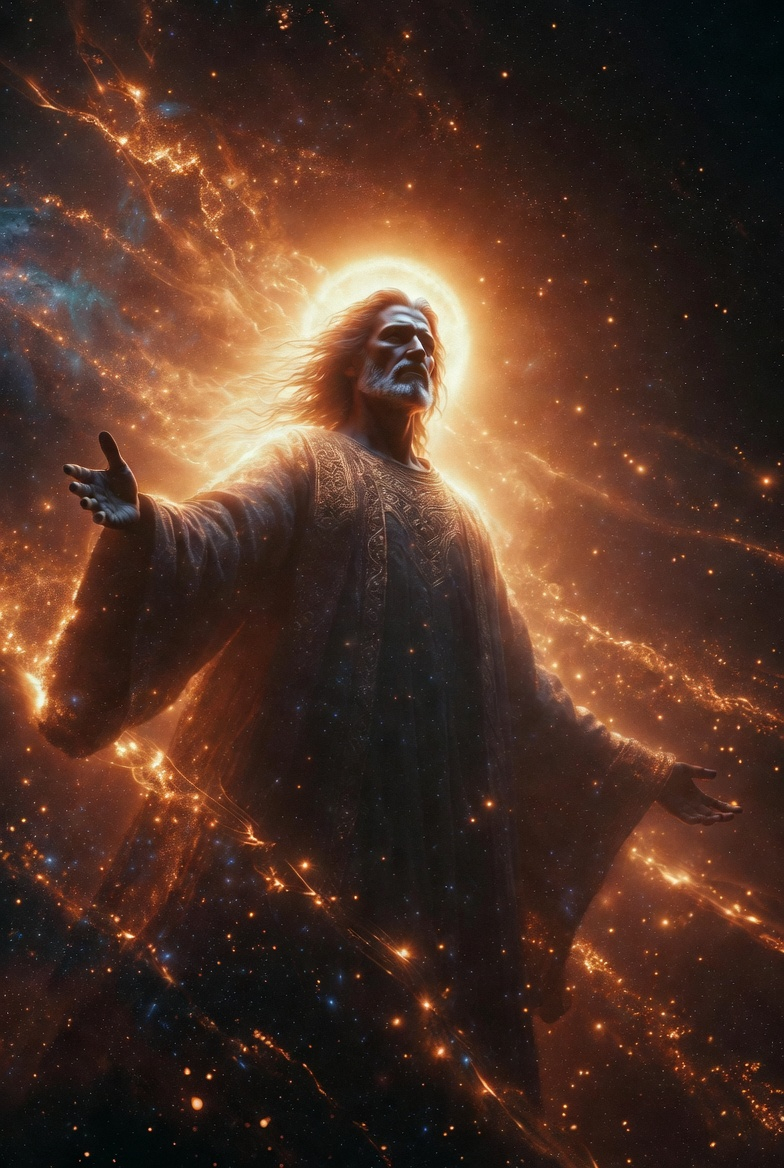
John hears a voice and turns to see the speaker. What follows is the Christophany — the first direct description of Reference-expression in operational mode within the book.
“And in the midst of the lampstands one like a son of man, clothed with a long robe and with a golden sash around his chest. The hairs of his head were white, like white wool, like snow. And his eyes were like a flame of fire, his feet were like burnished bronze, refined as in a furnace, and his voice was like the roar of many waters.” —Revelation 1:13–15, LEB
The description is not decorative. The descriptors are nowhere in the general vicinity of “aesthetic.” Every element is functional. The cross-references are not allusions but structural identifiers. White hair denotes the Ancient of Days — Daniel 7:9. This means John is looking at Reference-expression and seeing Source-address’s attributes as worn by the signal. This requires precision, because the claim is architecturally specific. In Daniel 7, the Ancient of Days and the Son of Man are presented as distinct figures — one sits on the throne, the other approaches it. Here in Revelation 1, John sees one figure wearing both sets of attributes. The constitutive relation is visible. These are not two beings who happen to share a wardrobe. These are two positions whose identity is mutually constitutive — the signal wears the source’s attributes because the signal is the source’s self-expression.
Eyes like fire: the encounter-surface is not passive. It penetrates. It sees through. Feet like burnished bronze, refined in a furnace: the signal has been through the fire — the cup was consumed — and what emerged is not weakened but refined. Voice like many waters: the addressability is not a whisper. It is overwhelming. The same proximity signature the program has tracked everywhere.
“When I saw him, I fell at his feet as though dead.” —Revelation 1:17, LEB
This is the Our God’s program’s oldest finding: Unmanaged proximity to the configuration produces collapse. John does not kneel in reverence. He falls as though dead! The encounter overwhelms the receiver of the signal. This is Sinai. This is Ezekiel face-down in the mud of a canal. This is our three Pardes scholars who could not survive their approach to the signal. This is Peter on a mountain expounding of the goodness of tent building because his circuits overload. The settings change—over time, historical context—still, the signal propagates across the substrate, and regardless of how Peter processes the signal cognitively, his body produces the same response.
“Do not be afraid. I am the first and the last, and the living one. I was dead, and behold, I am alive forevermore, and I have the keys of Death and of Hades.” —Revelation 1:17–18, LEB
And now comes modulation. The signal does not leave John plastered to the floor but reaches down, touches him, and speaks: “Do not be afraid.” The encounter that overwhelms now restores. This is the boundary designed to open. The fire that sat on the mountain and then sat on people. The proximity that breaks and then rebuilds what it broke. Tsunamis do not rebuild the houses they flatten. Something that overwhelms and then restores is not a force. It’s more like “someone.” Not “something.” Now think, in what image were you made?
“I was dead, and behold, I am alive.” The falsifier from the Prologue of Pillars, resolved: if he stays dead, the system fails. He did not stay dead. A ruminant mammal stands as though slain — past tense on the slaughter, present tense on the standing. He holds keys, but not the keys of heaven. The keys of Death and Hades. Reference-expression holds the keys to the terminus of the cascade. Whatever ultimate collapse the fruit would yield for humans, as promised by God in that garden, upon ingestion (like a child after eating poison), the problem: worked and solved (like a child after eating poison).
Consider what this means in our program’s notation. N² compounds — failure generating failure generating fragments generating collisions. The cascade accelerates toward its own terminus: Death and Hades, the structural endpoint where accumulated failure comes to rest. And the one holding the keys to that endpoint is the one whose N† already absorbed the full accumulation and he walked out the other side. He does not hold the keys because he avoided the terminus. He holds them because he went through it. The key was forged in the lock. The cup was consumed. The door to the cascade’s final destination is kept by the one who crossed its threshold and returned, a couple trill days later.
“So, the exit door to the universe’s worst room is held by the only person who’s ever walked through it and come back. That’s either the most reassuring thing I’ve ever heard or the most terrifying. I suppose it depends which side of the door you’re standing?” —Phineas McFuddlers
The chapter closes with John commissioned to write. The structural function of the book is declared: what is (the present condition of the churches), and what will take place after this (the scroll’s execution). The book is an operational briefing. Not a prediction. A disclosure of the trajectory the scroll contains.
Seven lampstands. Seven churches. Seven stars. The number is not “mystical.” It is structural. Seven is completeness in Hebrew symbolic architecture — not “perfection” in the Platonic sense, but operational totality. These seven churches are the complete set. Every church. Every community that manages proximity. Every tower ever built. All of them. The churches constitute the respective belief systems on the Earth. The letters that follow are addressed to them all.
Part II: Seven Towers

Revelation 2–3 — The Letters to the Seven Churches
Seven letters. Each addressed by Reference-expression to a specific community. Each one following an identical structure: identification of the speaker (drawn from the Chapter 1 Christophany), acknowledgment of the community’s condition, diagnosis, and prescription, and a promise to “the one who conquers.” The structure is not literary convention. It is a diagnostic protocol — the same kind of structured assessment a physician uses when evaluating seven patients presenting with different symptoms of the same underlying condition. The physician does not improvise. The physician follows protocol because protocol reveals what improvisation conceals.
The signal evaluates the towers.
The program must read these letters not as moral report cards — who’s been naughty, who’s been nice — but as structural diagnostics. This ain’t Christmas and we ain’t talkin’ San’a Claus. Each church represents a mode of tower construction. Each letter diagnoses the specific substitution that respective towers perform. The question is not: “which church is good and which is bad?” The question is: “what did each community substitute for the encounter; and, moreover, how does such substitution operate?” The diagnoses are architectural, not moral. The signal is not grading behavior. The signal names the structures.
Ephesus: The Tower of Correct Doctrine
Ephesus has tested false apostles. Ephesus has endured. Ephesus has not grown weary. Ephesus hates the Nicolaitans. Ephesus has done everything right — doctrinally, structurally, institutionally. And Ephesus has abandoned its first love.
The diagnosis is surgical: the community that got the formulation right lost the encounter the formulation intended to protect. Doctrine replaced encounter with specification. The tower functioned. The signal was managed into irrelevance. This is the anti-Christ function operating through orthodoxy itself — the most insidious substitution because it looks most like the real thing.
Before the reader dismisses Ephesus, let the reader sit with this: the community did not fail by becoming heretical. It failed by becoming correct. The doctrine was right. The testing was real. The endurance was genuine. The community did everything it was supposed to do and lost the one thing the doing was for. The reader who lives inside a doctrinal community — who has fought for orthodoxy, defended the creed, tested the teachers — should hear this diagnosis not as an accusation against doctrine but as a warning about what doctrine can become when it succeeds. The formulation that protects the encounter replaces the encounter it protects. The creed that describes the signal substitutes for the signal it describes. Ephesus did not build a bad tower. Ephesus built the best tower — and the best tower is the most dangerous tower, because it is the hardest to distinguish from the thing it replaced.
Smyrna: The Tower Under Pressure
No rebuke. Smyrna is suffering, poor, and slandered. Smyrna is about to be tested further. The community that possesses nothing has nothing to substitute. The tower that never got built cannot perform the anti-Christ function. Suffering strips the apparatus and leaves only the encounter. This is not a glorification of suffering — it is a structural observation. The community with the fewest substitutions available is the community closest to the signal. Poverty of apparatus is proximity to the transmitter.
Pergamum: The Tower of Accommodation
Pergamum dwells “where Satan’s throne is.” The community exists inside hostile proximity to a competing configuration. And it has held fast. But it has also tolerated Balaam’s teaching and the Nicolaitans — the mixing of the signal with the local apparatus. Accommodation. Syncretism. The tower that says: we can serve both the encounter and the cultural substrate through which it arrives.
The substitution here is not replacement but dilution. The signal is not removed; it is mixed until it is indistinguishable from the solvent. Pergamum did not reject the signal. Pergamum hosted the signal and the competing configuration in the same room and hoped they would get along. The mixture is not a compromise. It is a dissolution. The signal dissolved in the culture does not strengthen the culture. It disappears.
Thyatira: The Tower of Tolerance
Thyatira has love, faith, service, endurance — all increasing. And Thyatira tolerates Jezebel. The name is structural, not biographical. Jezebel is the conduit that claims to speak for the configuration while redirecting the community toward self-serving consumption. The anti-Christ function wearing prophetic clothing.
The tower here is neither doctrinal nor cultural. It’s charismatic — the substitution of a human voice for the signal, a personality for the transmitter, a performance for the encounter. Someone stands where the signal should stand and says what the signal might say — but the voice is their own, the direction serves their consumption, and the community follows the voice because it sounds close enough to the real thing. The community’s increasing virtue makes the substitution harder to detect, not easier. Fruit growing around a parasite. The love is real. The faith is real. The service is real. And the thing at the center directing all of it is not the signal but a person who has occupied the signal’s position. Thyatira’s tragedy is that the community is doing everything right around the wrong center.
Sardis: The Tower of Reputation
The most devastating diagnosis in the seven. “You have the reputation of being alive, and you are dead.” The tower that substituted its own reputation for its operational status. The community that looks, from outside, like everything a church should be — and is structurally deceased. The formulation is maintained. The offices are staffed. The services are held. The encounter is absent. This is the terminal stage of the anti-Christ function: the substitution so complete that the community cannot detect its own death because the portrait is so convincing it has replaced the person.
Philadelphia: The Tower That Isn’t
Like Smyrna, no rebuke. “Little power.” An open door that no one can shut. The community with the least institutional apparatus is given the open door. Philadelphia is not a tower. Philadelphia is what remains when the tower is stripped and the encounter persists. The name means “brotherly love” — the coupling between recipients, which is what Coupling-operative produces when the gate opens from inside. This church is the operational output of the triad functioning without substitution.
Laodicea: The Tower of Sufficiency
Neither hot nor cold. Lukewarm. “I am rich, I have prospered, and I need nothing.” The tower of self-sufficiency. The community that has managed its proximity so successfully it no longer needs the transmitter. Not hostile to the signal — indifferent. The substitution is total and invisible, because the community has everything it needs except the encounter, and does not notice the absence. This is the anti-Christ architecture at its most refined: the structure built to manage proximity succeeds so completely that proximity is no longer experienced; and, the community mistakes the management for the thing managed.
“Behold, I stand at the door and knock. If anyone hears my voice and opens the door, I will come in to him and eat with him, and he with me.” —Revelation 3:20, LEB
The most structurally significant verse in the letters. Reference-expression is outside the church and knocking. The signal has been managed out of its own community. The tower built to distribute the signal has become so effective at managing proximity that the signal itself is locked outside. This is the anti-Christ function’s terminal expression: the institution erected to serve the encounter has replaced the encounter so thoroughly that the encounter must knock on its own door to get back in.
“You built a house for someone, moved all their furniture in, hung their pictures on the walls, printed their name on the doormat, and then changed the locks. And now you’re surprised there’s knocking?” —Phineas McFuddlers
And the offer is not institutional. Not “I will come in and reform the church.” Not “I will come in and correct the doctrine.” “I will come in and eat with him.” Singular. Personal. The encounter bypasses the institution and addresses the individual. The coupling reaches through the tower to the person the tower was built to protect. It always does.
Seven churches. Five towers and two open fields. Five modes of substitution — doctrine, accommodation, tolerance, reputation, sufficiency — and two communities where the anti-Christ function has no substrate to operate on because the apparatus was never built or has been stripped by suffering. Smyrna and Philadelphia receive no rebuke because there is nothing to rebuke — the tower that does not exist cannot perform the substitution.
The diagnostic requires both results. A test that finds the same pathology in every sample is not a test but a confirmation exercise dressed in analytical costume with shiny pocket protector. Five positive results in isolation prove nothing — the instrument might simply read “positive” regardless of input. The two negative results — Smyrna and Philadelphia, communities without towers — validate the five positive ones by demonstrating that the instrument can distinguish between the presence and absence of the condition. The diagnostic is calibrated. The findings hold.
And in every letter — tower or open field — the same structure: the signal evaluates, diagnoses, and invites. The architecture does not change. The signal addresses the tower and the field with equal precision. Only the presence or absence of the substitution changes what the signal finds when it arrives
Part III: The Room
Revelation 4–5 — The Throne Room
We analyzed this in full in The Throne Room. What follows is a condensed restatement for continuity. The reader arriving from the corpus will recognize every coordinate. The reader arriving cold needs these coordinates before the scroll begins to unseal.
After the letters — after the tower diagnostics — a door stands open in heaven. Perfect passive participle — ēneōgmenē. The action is completed; the result persists. Not an event but a state. The door did not just open. The door stands open — someone opened it and it has stayed open since. John does not force entry. John is invited to look. “Come up here, and I will show you what must take place after this.” The trajectory is disclosed to someone willing to look.
The Room contains what the program arrived at through independent derivation:
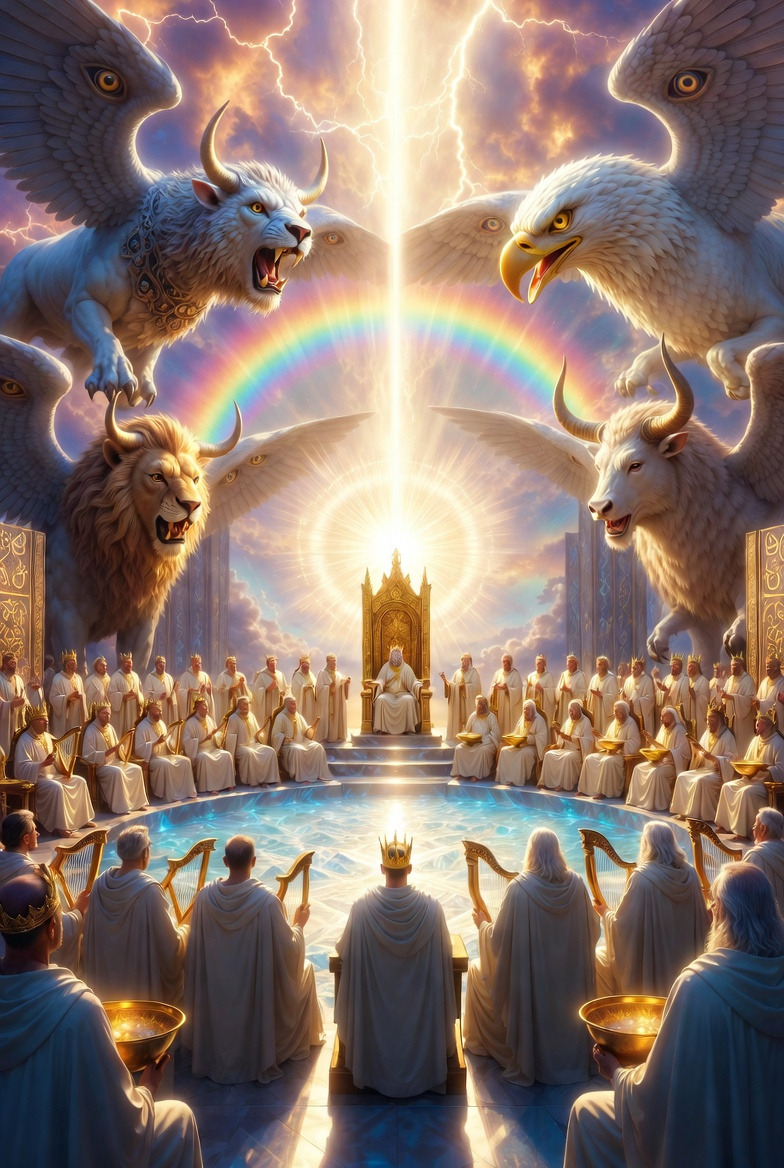
Source-address sits on the throne. The transmitter. The ontological ground. Lightning and thunder proceed from the throne — the coupling radiates. Four living creatures say holy, holy, holy without ceasing — a continuous trill because the structure they report is triadic, and unceasing, in its presence before them. The worship is structural. Even the creatures’ reports are field notes from permanent residents.
Reference-expression appears as a slain Lamb, standing. The elder says Lion; John looks and sees Lamb. This is the operational expression of the configuration disclosed in a single glance. And it rewards unpacking. The elder announces what the position is — conquering authority, the Lion of the tribe of Judah. John turns, looks, and sees conquering authority as a slaughtered animal standing on its feet.
The Lion is the configuration: the identity, the authority, the constitutive reality of the position. The Lamb is the operational expression: that authority enacted, not an exertion of force but the absorption of cost. Authority through slaughter, not despite slaughter (“Humility wears the crown”). The elder’s announcement and John’s observation are not in conflict. They are the same reality seen from two different vantage points — what the position is versus what the position did. And what it did is what made it worthy.
The Lamb takes the scroll from the hand of Source-address. The signal picks up the trajectory. Operational execution begins. John witnesses this in real-time.
Coupling-operative is present as the seven spirits of God sent out into all the earth (5:6). The hand that opens the gate from inside. Seven — complete operational coverage. Sent out — not stationary but distributed. Into all the earth — the encounter-surface reaching every system within range.
The scroll is the operational plan. Written on both sides — complete, nothing to add. Sealed by-and-with seven seals — phased, not locked. The distinction matters. A lock prevents access. A phase-seal stages execution. The content is finished. The delivery is sequenced.
No one in heaven or on earth or under the earth is able to open it. The scroll’s execution requires a particular kind of agent — one who operates from within the constitutive triad and from within the recipients’ own condition simultaneously. Not a messenger who carries the plan from one party to another. A bridge — someone who is constitutively on both sides of the gap, who belongs to the throne and belongs to the people the throne couples. No angel qualifies. No elder qualifies. No creature qualifies. The job description is impossibly specific: someone who is what the source is, who has been where the recipients are, and whose passage between the two did not break him.
John weeps. Not for sentimentality, but as structural response to a sealed trajectory — all the conditions for restoration present, the plan written, the route defined, and no one to see it through. The scroll is a cure sitting in a locked cabinet while the patient deteriorates. The plan exists. The operational execution does not. The gap between the written plan and its operational deployment is the gap the entire biblical narrative has been living inside. John weeps because he sees the answer and cannot grasp it in his hands.
“Imagine holding the blueprint for every hospital that was never built, every bridge that was never finished, every letter that was never sent — and you can read every word, but you can’t make any of it happen. That’s a sealed scroll. That’s what made the old man whimper.” —Phineas McFuddlers
The slain Lamb stands, worthy. N† accomplished — the cup consumed, the cost and the cure in the same person because they were always the same person. The one who qualifies is the one who absorbed the full accumulation of what the scroll would disclose — who went through the cascade’s terminus before the first seal was opened — and returned standing. The scroll’s executor is the scroll’s content. The plan and the person are the same.
The rest of what follows is the unsealing of the scroll.
Part IV: The Scroll Unseals
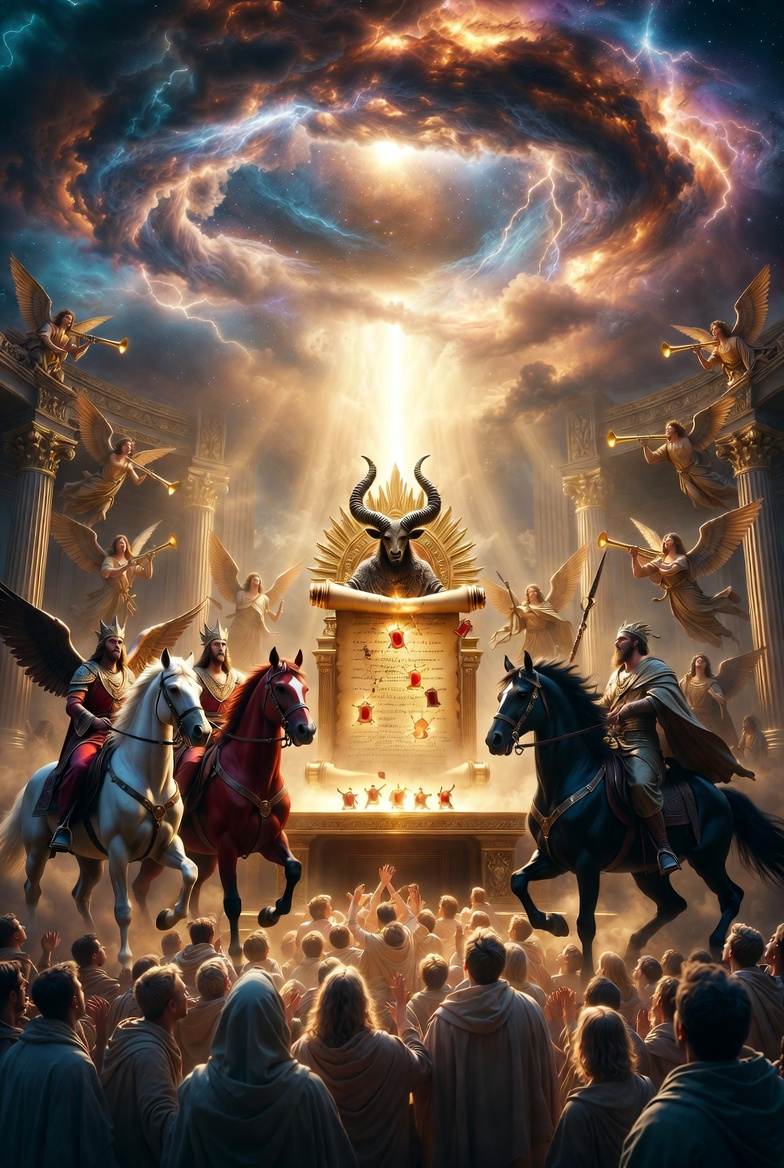
Revelation 6–8:1 — The Seven Seals
The Lamb opens the seals. Each seal initiates a phase of the scroll’s content. The common reading treats the seals as predictions — future events in chronological sequence, a timeline of catastrophes the reader can plot on a calendar. The program reads these differently. And we must state the difference at the threshold because it governs everything that follows.
The seals are not predictions, but operational disclosures: the trajectory’s own architecture made visible. The distinction is between a weather forecast and an X-ray. A forecast tells you what will happen next Tuesday. An X-ray shows you the structure that has been there all along. The seals do not announce coming events. They disclose the architecture of a trajectory that was written on the scroll before the first seal was peeled open. The content was always there. The Most High held it in his hand. The unsealing makes its contents visible.
This is the paper’s falsifier in action. If the seals read more coherently as chronological predictions than as structural disclosures, the program’s reading fails. The reader should test both frames against the text and see which one the architecture supports.
First Seal: The White Horse (6:1–2)
A rider on a white horse with a bow and a crown, going out conquering and to conquer. The tradition splits viciously on this one — is this Christ or anti-Christ? The debate has produced libraries, which require dusting. Our program’s framework resolves the ambiguity; and the resolution is, itself, a finding.
This is the signal going out. Reference-expression in operational mode. White because the signal is pure. Crowned because the authority is earned — the Lamb was worthy. Conquering because the scroll’s execution is not a request but an operation. The trajectory moves. From point A, to…
But the tradition’s confusion is itself diagnostic: the signal and its substitution are indistinguishable from outside. The anti-Christ function rides a white horse too (Chapter 19 resolves which is which). The misrecognition is structural. It is not that the tradition has been careless. It is that the substitution is designed to be indistinguishable from the signal by any observer who has not had the encounter. The white horse looks the same from outside whether the signal or its counterfeit is riding it. This is the anti-Christ function’s operational signature: it works precisely because it looks like the real thing. The only instrument that distinguishes them is the encounter itself — and the encounter is exactly what the substitution replaced.
“Two riders. Same horse color. Same crown. Same direction. One’s the signal, one’s the forgery, and from the bleachers they’re identical. The tradition’s been arguing for two thousand years about which is which, and the argument itself is the finding. If you can’t tell them apart from outside, maybe the whole point is that you were never supposed to stay outside.” —Phineas McFuddlers
Second Seal: The Red Horse (6:3–4)
Peace is taken from the earth. People slaughter one another. The cascade consequence of the signal going out into a substrate that is constitutively resistant. The trajectory moves and the resistance compounds. This is not God causing war. This is the structural consequence of the signal encountering a substrate whose coupling has been degraded by four thousand years of compounding refusal.
When light enters a space that has organized itself around darkness, the darkness does not simply yield. It fights. The conflict is not incidental to the trajectory. It is the trajectory encountering the debris field. The red horse does not bring war as a punishment from the trajectory’s author. The red horse discloses the war that was already structurally present in the substrate’s resistance — human resistance, due to choice — a resistance that becomes visible only when the signal arrives and collides with it. The debris was always there. The signal’s arrival — as always — makes the body react. Different mode of reaction.
Third Seal: The Black Horse (6:5–6)
Scales. Measurement. Scarcity calibrated. A day’s wage for a day’s food. But the oil and wine are not to be harmed. The cascade produces economic consequence — scarcity — but the essential supplies (oil and wine, both sacramental elements, both elements of the encounter) remain protected. The trajectory does not destroy its own operational materials. The judgment falls on the infrastructure of managed proximity — the commercial systems, the distribution networks, the institutional apparatus — while preserving what the encounter requires to operate. Generator and consequence, separated by the scalpel of the seal. Everything, much like our methodology, stripped bare.
Fourth Seal: The Pale Horse (6:7–8)
Death. Authority over a fourth of the earth. Sword, famine, plague, wild beasts — the classic cascade consequences when coupled systems fail at scale.
N² mechanics are visible in the chain: sword produces famine because violence disrupts agriculture and supply. Famine produces plague because malnourished populations cannot resist disease. Plague produces social collapse because governance infrastructure requires living administrators. Social collapse releases the wild beasts — both literal and structural — because the systems that contained them have failed. Each failure mode feeds the next. The toll is not linear but compounding. Four consequences, each one the generator of the next, each one expanding the failure surface the previous one created.
A fourth of the earth — not total destruction but significant system degradation. The trajectory’s execution generates consequences in the substrate that resists it.
Fifth Seal: The Martyrs (6:9–11)
Souls under the altar. Those slain for the word of God and the testimony they held. They cry: “How long?”
The fifth seal does not disclose an external event. It discloses the operational cost of the trajectory. The signal goes out. The substrate resists. The resistance produces casualties — not as punishment but as the structural consequence of the encounter operating in hostile substrate. The witnesses testify. The substrate kills witnesses. This has been the pattern since Abel. The cost is not accidental. It is architectural. The trajectory that moves through a resistant substrate generates friction, and the friction falls on the bodies of the people who carry the signal. They are not collateral damage. They are the contact surface between the trajectory and the debris field. The signal reaches the substrate through persons, and the substrate’s resistance is expressed against persons.
“I don’t know about y’alls definition of evil but seems to align accordingly.” —Phineas McFuddlers
The martyrs are told to rest a little longer — the scroll’s execution is not complete. N² is still compounding. N† has been accomplished but its full disclosure has not. The trajectory has a timeline. The cost is real. The encounter timeline is not negotiable. And the “how long?” is the oldest prayer in the program’s corpus — the cry of the person who can see the trajectory’s destination and cannot understand why the route passes through their body.
Sixth Seal: Cosmic Destabilization (6:12–17)
Earthquake. Sun goes dark. Moon turns to blood. Stars fall. Sky splits. Mountains and islands move. Every category of power — kings, generals, rich, mighty, slave, free — hides and cries out for the mountains to cover them from the face of Source-address and the wrath of the Lamb.
This is not weather. This is the coupling surfacing at a scale that destabilizes the substrate’s entire architecture. The “stars falling” are not astronomical events — they are the collapse of the orientation system. Stars are what you navigate by. When the configuration’s own disclosure becomes unavoidable, everything that was organized around the configuration’s concealment collapses. The towers destabilize. The mountains — symbols of stability, institutional permanence, civilizational endurance — move. The islands — isolated systems, independent operators, those who believed they could opt out of the coupling — discover they cannot.
And the response: hiding. Not repentance. Hiding. The same response as the garden: “I heard your voice and I was afraid, and I hid.” The structural response to unmanaged proximity has not changed since Genesis 3. The first human reaction to the unmanaged encounter was to seek cover. The reaction at the sixth seal is identical — kings and slaves together, calling for the mountains to fall on them, preferring geological collapse to the encounter. The substrate’s architecture — every layer of managed distance, every tower, every institution — is revealed as insufficient. The kings and the slaves hide together because the coupling does not recognize the distinction between them. Inescapable addressability. Every eye.
Interlude: The Sealed and the Multitude (7:1–17)
Between the sixth and seventh seals — a pause. 144,000 sealed from the twelve tribes. A great multitude from every nation that no one could count.
The 144,000 is structural, not numerical. Twelve tribes times twelve thousand — complete coverage of the covenant community, squared. This is N² applied to preservation, and the inversion is worth naming. Everywhere else in the program, N² is the exponent of failure — the cascade that compounds destruction. Here it is the exponent of protection. The same mathematics that describes how failure scales also describes how preservation scales when the coupling operates constructively. The formula does not change. The signal does.
The sealing is not escape from the trajectory but protection within it — the same structural logic as the Passover. The destroyer passes through. The sealed survive the passage. Not removed from the substrate but marked within it.
The great multitude is the operational output. From every nation, tribe, people, and language — the inescapable addressability made manifest. The coupling reached them all. They came through the great tribulation — not around it. They washed their robes in the blood of the Lamb — the cup’s consumption applied to the recipients. And they are before the throne, serving day and night. The trajectory’s destination: not escape from proximity but habitation within it. The fire does not remove them from the room. The fire makes the room inhabitable.
Seventh Seal: Silence (8:1)
Half an hour of silence in heaven.
The most structurally significant verse in the seal sequence. After the cosmic destabilization, after the martyrs’ cry, after the sealing and the multitude — silence. Not emptiness. Not absence. The moment before the quarterback says hut and the center snaps the ball. The silence that precedes operation. The pause between inhale and exhale. Visceral. The scroll’s first phase is complete. The trajectory discloses its architecture. What follows — the trumpets — is the next operational phase. The silence is the hinge.
The program has observed what silence costs: the force required to stop a cascade is not proportional to the cascade — it is proportional to the cascade’s coupling surface. The reader may test this against any system where cessation was attempted with less than the full weight of what was compounding and ask whether the system stayed stopped. Silence is not the absence of noise. Silence is the concentration of power that precedes its deployment. The drawn bow before the arrow. The held breath before the word. Heaven itself goes quiet — not because it has nothing to say, but because what comes next requires the full weight of what precedes it.
The seventh seal does not end the trajectory. It loads the next phase. Seven trumpets emerge from the seventh seal. The scroll does not execute linearly — it nests. Phase within phase. Seals contain trumpets contain bowls.
For the reader who has tracked N² across the substrates of our program, this nesting is recognizable. The architecture is recursive — the scroll’s execution applies its own structural principle to itself. The cascade compounds; the disclosure of the cascade also compounds. Each phase does not merely follow the previous one. Each phase emerges from within the previous one, the way the seventh seal contains the seven trumpets, and the seventh trumpet will contain the seven bowls. The depth increases with each nesting. The failure surface expands. And within the recursion, the terminus: what N† already accomplished in-and-through the Lamb is now disclosed phase-by-phase to a substrate that has not yet recognized what the throne room already knows.
Part V: The Trumpets
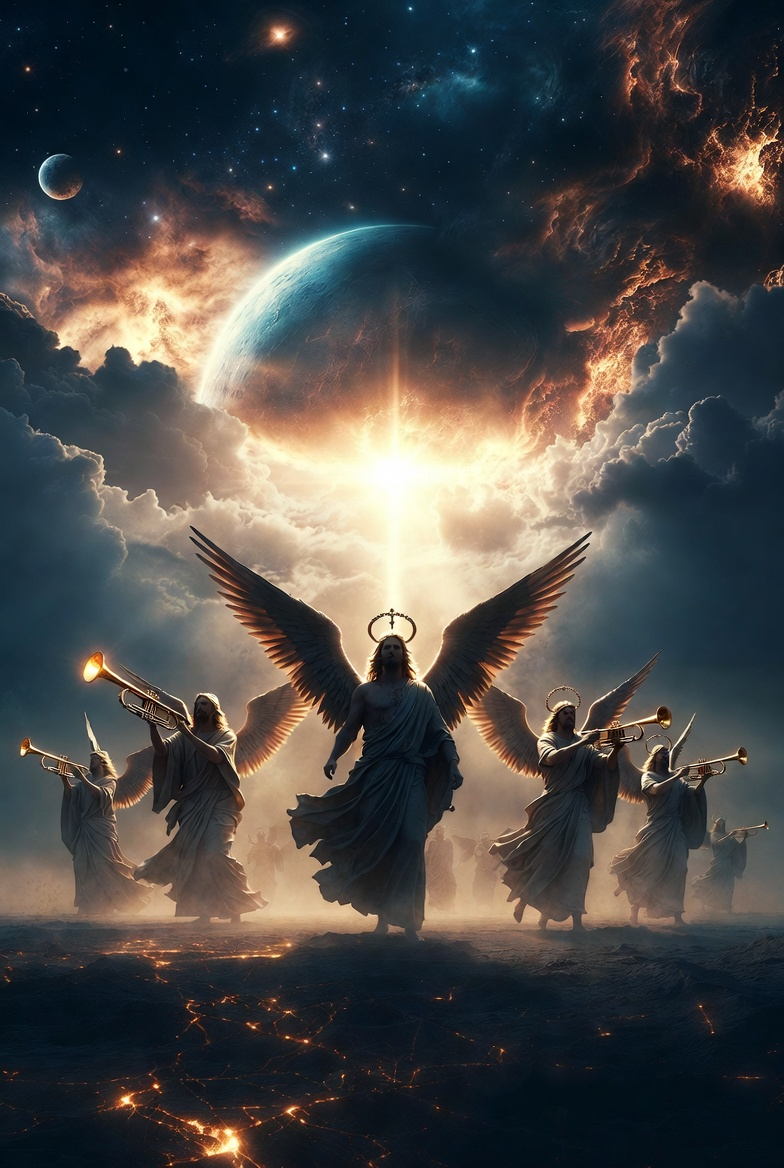
Revelation 8:2–11:19 — Warning Systems and Cascade Amplification
Trumpets are instruments of attention and focus. Their function in Hebrew culture is not musical but operational — they announce, they mobilize, they signal approach. A trumpet at the city wall does not entertain. It means something is coming and you need to know about it. The seven trumpets are the trajectory’s warning system. Not threats. Announcements. The scroll’s execution proceeds, and the substrate is, thusly, notified forthrightly.
The seals disclose the trajectory’s architecture—what the scroll contains. The trumpets announce its arrival. The shift is from disclosure to notification. The substrate has been shown the structure. Now the structure approaches. Soon, it will arrive. Encounter happens. No one is the only one exempt.
Trumpets 1–4: Environmental Cascade (8:6–12)
The first four trumpets strike the created order systematically: earth (a third of vegetation burned), sea (a third of marine life destroyed, a third of ships wrecked), fresh water (a third made bitter — the star called Wormwood), and sky (a third of sun, moon, and stars darkened).
The pattern is N² scaling across environmental substrates, and the cascade chain is traceable. Each trumpet strikes a different substrate, and each substrate’s failure feeds the next. Vegetation loss destabilizes terrestrial ecosystems — food supply, soil stability, atmospheric regulation. Marine collapse disrupts trade — the commercial infrastructure that connects civilizational nodes. Freshwater contamination threatens survival at the most basic biological level. Celestial dimming disrupts orientation — timekeeping, navigation, agricultural cycles, the basic infrastructure of civilizational coordination. The cascade moves from the ground under your feet to the sky above your head, and at each stage the failure surface expands because the next system depended on the previous one.
One third. Not total destruction. Significant degradation. The trajectory’s warning phase operates at a level designed to be survivable but unmistakable. A third is enough to destabilize every dependent system without rendering the substrate non-functional. The substrate can still respond. The question is how it chooses to respond.
The generator is not the trumpet — the generator is the coupling surfacing in a substrate that has been organized around the coupling’s concealment. The environmental consequences are the debris field produced by the collision between the trajectory and the substrate. The same signature as orbital debris: coupled systems interacting at scale, producing consequences no individual actor intended.
Trumpet 5: The First Woe — The Locust Army (9:1–12)
A star fallen from heaven to earth, given the key to the shaft of the abyss. Locusts emerge — but not ordinary locusts. They have human faces, women’s hair, lions’ teeth, iron breastplates, and the sound of chariots. They are told not to harm vegetation — only people who do not have the seal of God on their foreheads. Their king is Abaddon/Apollyon: Destroyer.
The tradition reads this as demonic invasion — literal or semi-literal entities emerging from a spiritual underworld. Before the program distinguishes its reading, let it name what the tradition gets right. The tradition recognizes that what emerges is hostile, organized, and operates under a king. The tradition recognizes that the origin is the abyss — a generative source beneath the visible substrate. The tradition recognizes that the sealed are exempt. The program does not dispute these structural observations. The program disputes the identification of the agent.
The program reads it as the anti-Christ function made visible. The locusts emerge from the abyss — the generative source of the substitution — and they have human faces. The substitution wears a human face. It looks like us. It talks like us. It is armored (iron breastplates — institutional infrastructure). It sounds like war (chariots — mobilized force). And it does not kill. It torments for five months. The anti-Christ function’s operation is not destruction but torment — the sustained condition of living under substitution, managed proximity, the portrait where the person should be. Not death. Something worse than death in a specific structural sense: the ongoing experience of being managed where you should be encountered, of receiving the portrait when you were promised the person. The sealed are exempt because they have already had the encounter the substitution replaces. The torment cannot operate on someone who knows what the real thing feels like.
The star fallen from heaven is not Satan in a biographical sense. The reading requires Heiser-grade exegetical, register clarity. In the empirical register, a star is an astronomical body. In the apocalyptic literary register, a star is a figure of authority or position. The program reads the structural register: a signal that was in heaven (the position it held) that fell to earth (operated in the substrate) and, in the substrate’s reception, opened the abyss. The encounter that should have produced communion instead produced the anti-Christ function — because the substrate received it through misrecognition. The same dynamic as Eden: the configuration speaks; the recipient hears the voice and hides; the hiding generates the infrastructure of concealment; the infrastructure becomes the abyss from which the locust-substitutions emerge. The abyss is not a place. It is the generative consequence of misreceiving the signal.
The finding’s falsifier: if the abyss can be shown to operate independently of the substrate’s reception of the signal — if it generates the anti-Christ function in contexts where no signal was received or misreceived — then the abyss is an independent agent, not a generative consequence, and the reading fails. The reader is invited to test whether any instance of the abyss’s operation in the text occurs absent a prior act of misrecognition.
Trumpet 6: The Second Woe — The Army of Two Hundred Million (9:13–21)
Four angels released at the Euphrates. An army of two hundred million. A third of humanity killed by fire, smoke, and sulfur. And the survivors — here is the structural finding — do not repent. They continue worshipping idols and practicing violence and sorcery.
The sixth trumpet is the cascade at terminal velocity. The failure surface has expanded from environmental systems (trumpets 1–4) through the anti-Christ function’s torment (trumpet 5) to civilizational catastrophe at continental scale (trumpet 6). N² scaling. Each phase nests within the previous. Each phase expands the scope. And the diagnostic result is that the substrate’s response to the cascade is more of the same behavior that produced the cascade.
This is the anti-Christ architecture tightening to its most vicious expression. The idols are the nine candidates — towers, substitutions, managed proximity. The survivors cling harder to the towers as the towers collapse. The managed version is failing catastrophically, and the substrate’s response is to build more managed versions. The program has seen this across every substrate we examined: as the cascade approaches its terminus, the rate of tower-building accelerates — the substrate produces more institutional infrastructure in its final approach than in all preceding phases combined. The reader may test this against any civilizational collapse dataset and ask whether the documentation volume contradicts the pattern. The closer the cascade gets, the more frantically the substrate builds towers. The community that drowns in the consequence of substitution responds by compounding its substitution efforts.
“Your house is on fire because you wallpapered over the smoke detector. So, you’re wallpapering faster. With flame-retardant wallpaper, granted, but still — you’re decorating a fire, buddy.” —Phineas McFuddlers
The Euphrates is the boundary of the promised land — the edge of the covenant territory. The historical Euphrates marked the limit of the land God promised to Abraham, the border beyond which the story of the covenant community was not extended. The four angels have been held at the boundary. The trajectory’s execution crosses the boundary. What was contained is released. The cascade that was operating within the covenant substrate (seals) now operates across the full substrate (trumpets). The scope expands. The mathematics compounds.
Interlude: The Little Scroll and the Two Witnesses (10:1–11:14)
Another pause between the sixth and seventh — same structural pattern as our seals’ sequence. An angel descends with a little scroll, already open. John is told to eat it — sweet in the mouth, bitter in the stomach. He must prophesy again.
The little scroll is the trajectory’s content internalized. The operational plan is not just observed; it is consumed. And the consumption produces two incompatible sensations in the same body. Sweet because the encounter is real and the plan is restoration — the scroll’s content is good news at its core. Bitter because the plan’s execution generates consequences that devastate the substrate — the route to restoration passes through the debris field. The debris field constitutes real suffering in real bodies.
The cup again. The same duality: both trees in one vessel. Life and death are not separate trajectories. The trajectory is experienced according to how the receiver processes the signal. A person aligned with the signal tastes sweetness — the restoration emerges salient. A person organized around concealment of the signal tastes bitterness — the trajectory dismantles the infrastructure that conceals it. Same scroll. Same content. Two experiences. The difference is not in the scroll. The difference is in John’s stomach.
Then, our two witnesses prophesy for 1,260 days. Thus, fire proceeds from their mouth. They have power to shut heaven, turn water to blood, and strike the earth with plagues — the powers of Elijah and Moses. When they finish their testimony, the beast from the abyss kills them. Their bodies lie in the street for three and a half days. The nations gaze and celebrate. Then they are raised and ascend.
The Throne Room identifies the witness function: faith and reason operate together, testify to structure by stripping the structure bare. Two witnesses testify. They do not build and substitute. They expose and then get killed for it — our tradition tends to kill things that strip its towers — but like the phoenix, they arise. Their testimony persists. The structure they reveal requires them to neither stand nor remain present and accounted for. The pillars hold whether our witnesses are alive or dead. The witnesses are not the pillars. They function as pointers to the configuration, to the signal, to them. Whatever that looks like…
The nations’ celebrations at the witnesses’ deaths is the substrate’s response to the stripping of its towers. When the thing that exposes the substitution is killed, the communities that depend on the substitution celebrate because the exposure has ceased, momentarily (perceptually, to them, that is). But exposure is like an opioid. Witnesses rise. Their testimony is structural, not biographical. You cannot kill a finding. You can kill the finders. The finding stands on its own, with or without their presence.
Trumpet 7: The Kingdom Declared (11:15–19)
The seventh trumpet—like the seventh seal—adds not another consequence to the sequence but declares the operational outcome of the phase.
“The kingdom of the world has become the kingdom of our Lord and of his Christ, and he will reign forever and ever.” —Revelation 11:15, LEB
Source-address and Reference-expression. The kingdom — the operational domain of the configuration — declares itself as encompassing and saturating the substrate. The verb is egeneto — aorist tense. In Greek, the aorist presents an action as a completed whole, not as an ongoing process. Not will become in some future millennium. Not is becoming in a gradual transition. All that mumbo jumbo already happened. Has become. The action is accomplished. The disclosed trajectory lands and reaches its destination, from the throne room. “The mountain comes to Mohammed.” The scroll was always complete. The execution unfolds that which was always already written.
“Of course it’s contractual. So, the Pharisees were a necessary evil?” —Phineas McFuddlers
The temple in heaven is opened. The ark of the covenant is seen. Lightning, thunder, earthquake, hail. The original encounter technology — the ark, the mercy seat, the locus of managed proximity where Source-address met the recipients on a schedule — is visible. Not on earth inside a tower. In heaven, inside the room the towers were built to replicate. The original is disclosed. The copies are rendered unnecessary. Not by destruction but by unveiling. The veil is removed.
Part VI: The War
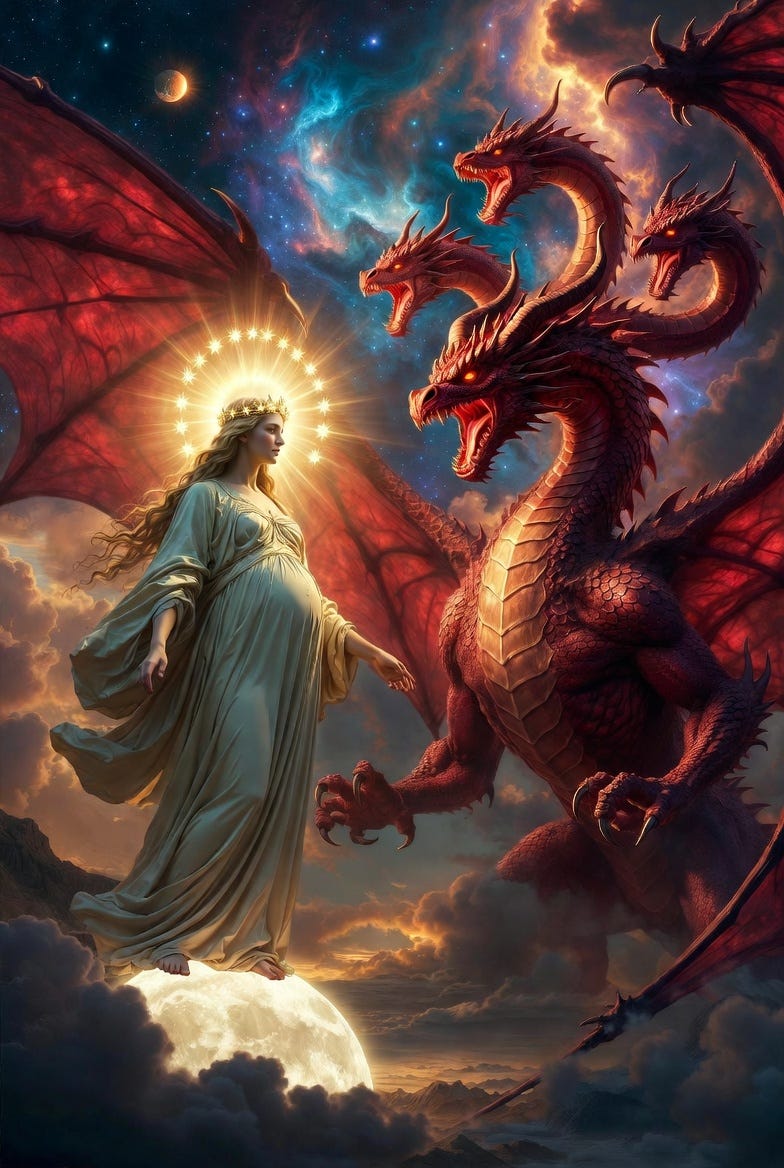
Revelation 12–14 — The Generator Exposed
The trumpets disclose the cascade’s operational phases. The book pauses to disclose the generator. Chapters 12–14 are not the next chronological event, but the X-ray of architecture — the mechanism underneath the seals and trumpets made salient. The program has always asked: what is the generator behind the consequence? These chapters elaborate.
Please note the structural placement. The book spent six chapters showing the cascade in operation — consequences escalating through seals and trumpets, the failure surface expanding, the substrate resisting and compounding. Now, before the bowls execute the terminal phase, the book stops and says: here is what produces all of it. The generator is named before the final consequences are poured. The scalpel separates generator from consequence before the consequence reaches its maximum expression.
The Woman, the Dragon, and the Child (12:1–17)
A woman clothed with the sun, the moon under her feet, twelve stars on her head — the covenant community in its cosmic aspect. She is pregnant. A great red dragon with seven heads and ten horns stands before her and waits to devour her child. The child is born and caught up to God and his throne. The woman flees to the wilderness. War erupts in heaven. The dragon is cast down. This is the traditional reading.
The structural reading: the trajectory — the scroll’s content — gestates within the covenant community across the full span of the biblical narrative. The pregnancy is not incidental imagery, but the structural relationship between the community and the trajectory the signal carries. The scroll’s content develops inside the covenant substrate from Abraham forward — grows, forms, approaches delivery. The dragon is necessarily the anti-trajectory, because it emerges from the garden generator. Not a competitor with an alternative plan — the dragon does not offer a better scroll. The dragon offers no scroll at all. The dragon is the structural opposition to the plan’s execution: the encounter surface. Seven heads — complete institutional infrastructure of the seven churches. Ten horns — ominous! The anti-trajectory lacks not organization, but content and context. The apparatus of a trajectory is true, but the destination is false. The fire still appears to be an excellent metaphor, contextually.
The traditional reading says the dragon’s strategy is consumption: devour the child before the trajectory executes, so it can conquer. The problem with this reading is that it fails to recognize that the cascade began in the garden. The trajectory begins “In the beginning.” That cascade is substrate invariant. Any attempts to terminate the signal before the signal terminates the cascade is tantamount to the fish who files a grievance against water. And the fish is vehement in his position that the water has no bearing over its existence.
The strategy as preemptive — if the signal never reaches operational mode, the cascade never meets its terminus, is the stuff of great fiction, but not structural reality. The image is the compounded projection of every biblical narrative that illuminates destruction of the messianic line — Pharaoh’s infanticide, Herod’s slaughter, the crucifixion itself. The dragon operates across millennia: consume the child! That is the pinnacle of the mountain that is the generator, if what is known of evil is put to practice and rues the day.
The child is caught up to the throne. Reference-expression completes the circuit — from the covenant community (born of the woman), through the cup (the dragon cannot devour what was already consumed), to the throne (where a slain lamb stands with a scroll sticking out its mouth. How ridiculous is that! lol). The whole thing never gets off the ground. Gethsemane acknowledges the configuration as operational prescience.
The dragon in the olive garden is that function which denies him, sleeps on the job, turns against him, arrests him, judges him, crucifies him, and pierces him. Jesus consumed the cup’s contents at the alignment of-and-with his father’s will. Even if people wish to believe the dragon intends to consume the cup’s contents by force, the failure of the dragon imagery is ignorance of its own limitations. Its constituent make-up cannot consume any such contents. No human can. No son of the Most High could. Governments may be consumers of things, but that cup ain’t one’em, man. The tradition can believe that N† preempts N² to slay some fire breathing dragon, but that dragon is what their misrecognition concocts. The terminus absorbs the cascade. The engineering schematic preceded the run.
So, this chick flees to the wilderness — the same wilderness where we encounter Hagar, where our pillars hold outside the tradition. The covenant community is preserved not inside its own institutional infrastructure, apparatus, costume, but in the stripped place where the encounter operates without substitution.
Then a war in heaven. Michael and his angels against the dragon. The dragon is defeated and cast to earth. And the announcement:
“Now the salvation and the power and the kingdom of our God and the authority of his Christ have come, because the accuser of our brothers has been thrown down, the one who accuses them before our God, day and night. And they conquered him by the blood of the Lamb and by the word of their testimony, and they did not love their lives until death.” —Revelation 12:10–11, LEB
The accuser is the structural function our program identifies as ha-satan: a divine council member whose adversarial stewardship assignment tested the bonds between signal and receiver (ask Job). Not a mythological villain, a corrupted steward — one whose governance mandate to protect the vulnerable became weaponized against the governed. The traditional image of the dragon—the ha-satan function that began in a garden—the generator function’s misrecognition of encounter propagating through the substrate, projected outward as inverse meaning.
And now the juxtaposition y’all’ve been waitin’ for: the Ha-Satan that stood before the Most High in Psalm 82:6-7. Well, the verdict was plain and simple: God resolved the issue on his side. Hence, the trajectory. The blood of the Lamb: N†, the accumulated weight consumed, word made flesh, the witness function operating through the substrate. The cascade’s generator is not defeated by a larger force but by the trajectory’s own operational mechanism: consumption of the cup and testimony to the encounter.
The dragon, cast to earth, pursues the woman. The earth helps her. The dragon is furious and goes to make war on “the rest of her offspring — those who keep the commandments of God and hold the testimony of Jesus.” The generator, unable to terminate the trajectory’s encounter-surface at its source, attacks the signal’s receivers. The cascade cannot kill the signal; so, it targets the receivers. The same pattern since Abel. The substrate’s resistance to encounter-surface expresses itself through violence against those who carry the signal’s testimony.
The Beast from the Sea (13:1–10)
Seven heads. Ten horns. Diadems. The dragon gives it his power, throne, and authority. One head appears to have been mortally wounded but is healed. The whole earth marvels and follows the beast.
The beast from the sea is the anti-Christ function institutionalized at civilizational scale. Not a single political leader — a system. The dragon is the generator. The beast is the projection of the generator function as institutional expression. The dragon operates behind the veil of culture and society and government. The beast’s operation is embedded within the planetary infrastructure of Earth.
The seven heads are the complete set of institutional substrates through which the substitution operates. Ten horns are instruments wielded in service of-and-to the substitution. This requires specificity: who gave the system its power? The anti-trajectory delegated. The beast did not seize authority autonomously. It was authorized. The dragon that failed to consume the Christ on a cross now operates through institutional proxy. The generator has externalized its operation into human systems that persist by virtue of its presence. The beast is just the dragon’s franchise.
This is the finding that our program has tracked across all five substrates. Each and every time a tower is exposed, the generator function substitutes and rebuilds. A wound intended to kill the system is survived because the system’s operating principle is substitution, and substitution simply substitutes a new version of itself for the exposed one. The tower falls and another tower rises from the rubble wearing the old tower’s brand. The Reformation exposed the medieval Church’s substitution — and within a generation, Protestant institutions were performing the same function in new vocabulary. The Enlightenment exposed religious authority’s substitution — and within a century, secular institutions occupied the same position with the same operational logic. The wound heals because the system’s core operation is self-replacement. You cannot kill substitution by substituting something for it.
The earth marvels. “Who is like the beast?” This is misrecognition at civilizational scale. The managed version is so convincing the substrate cannot distinguish it from the real thing. The portrait passes for the person. The creed passes for the encounter. The institution passes for the coupling. The anti-Christ function’s success is measured by the awe it generates — the same awe that should be directed at the configuration is redirected to the substitution.
Authority for forty-two months — the same duration as the witnesses’ testimony, the woman’s wilderness sojourn. The trajectory and the anti-trajectory operate simultaneously, in the same timeframe, in the same substrate. Contemporaneous. This is not sequence but collision. The signal and its substitution occupy the same historical space. The substrate must choose. The paper is about such recognition.
The Beast from the Earth (13:11–18)
Two horns like a lamb. Speaks like a dragon. Performs signs. Makes fire come down from heaven. Creates an image of the first beast and gives it breath so it speaks. Marks everyone with the number of the beast: 666.
Two horns like a lamb. The second beast mimics Reference-expression. This is the anti-Christ function at its most refined: not a political monster but a religious substitute that looks like the real thing. It has the Lamb’s appearance and the dragon’s voice. It performs signs — the operational evidence that should indicate the encounter is real — in service of the substitution. It makes fire come down from heaven — counterfeiting Coupling-operative’s signature (Acts 2, Pentecost, fire on people).
The entire triad is counterfeited. This requires the reader to see the architecture clearly, because the counterfeit is precise. Source-address’s authority is counterfeited by the first beast — political and institutional power claiming ultimate allegiance. Reference-expression’s appearance is counterfeited by the second beast — lamb-horns, religious presentation, the look of the signal without the signal’s content. Coupling-operative’s fire is counterfeited by signs from heaven — experiential phenomena that mimic the encounter without the encounter-surface. The anti-Christ function does not simply oppose the triad but replicates it. It builds its own source, its own signal, and its own spirit, and the counterfeit triad operates on the substrate with the same three-position architecture as the real one.
“So the counterfeit didn’t just forge the signature. It forged the pen, the ink, and the hand that holds the pen. That’s not a forgery. That’s a parallel universe with worse management.” —Phineas McFuddlers
The image of the beast that speaks: the portrait that replaces the person, now given artificial animation. A creed that talks. A doctrine that performs. An institution that breathes with borrowed breath — not the breath of Coupling-operative but breath given by the second beast. The anti-Christ function creates its own version of the triad — complete with projection of source, signal, and spirit — and the substitute triad operates on the substrate. The substrate receives the counterfeit and cannot tell the difference because the only instrument that would reveal the difference — the encounter itself — is exactly what the counterfeit replaced.
The anti-Christ function is human achievement raised to its maximum expression and still falling short. Not inhuman. Not supernatural. The best humanity can do without the encounter. The most sophisticated tower. The most convincing substitute. The most elaborate management of proximity. And it is one short. Always one short. Because the tower cannot do what only the transmitter can…
The Lamb on Zion and the Harvest (14:1–20)
After the beasts — after the full disclosure of the anti-Christ function’s architecture — the Lamb stands on Mount Zion with the 144,000. The trajectory is not derailed by the anti-trajectory. The signal persists through the substitution. Reference-expression stands exactly where the beast claimed to stand. The community that bears the Lamb’s name (not the beast’s mark) is with him. The counterfeit triad built its own Zion. The real one was already occupied.
Three angels announce. The first: eternal gospel to every nation. Inescapable addressability. The second: Babylon’s fall. The tower’s collapse is announced before it is narrated (chapters 17–18) — the verdict precedes the evidence because the verdict was always already contained in the architecture. The third: warning about the beast’s mark.
Then the harvest: the earth is reaped. The grain and the grapes. Restoration and judgment — the same trajectory experienced according to orientation to the signal. Both trees. One cup. The harvest does not sort people into arbitrary categories. The harvest discloses what was always already the case: some were coupled to the signal; some were coupled to the substitution. The harvest makes the coupling visible. It does not create it.
Part VII: The Bowls
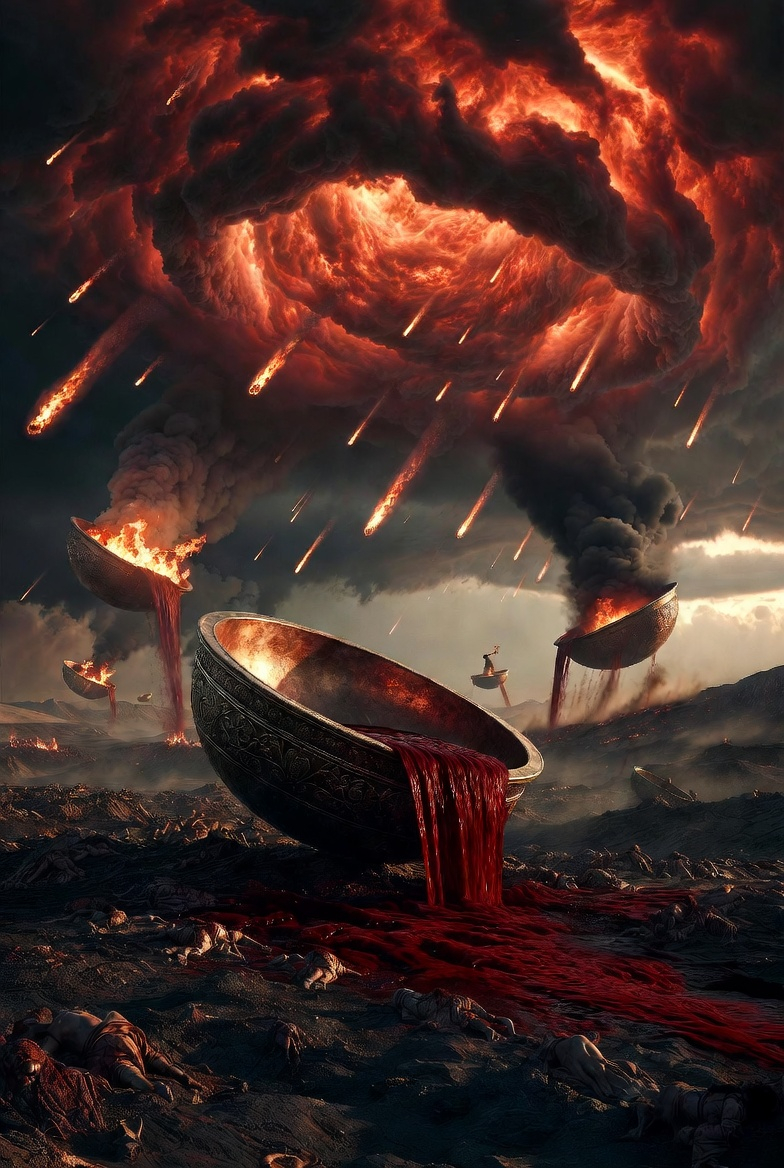
Revelation 15–16 — Terminal Cascade
The seven bowls of God’s wrath. The seals disclose the trajectory’s architecture. The trumpets alert. The bowls execute. N² at full scale. No more “a third.” The bowls are total.
The three-phase architecture is itself a finding, and the reader should see it before the bowls begin to pour. The seals show the substrate what the scroll contains — disclosure. The trumpets announce the scroll’s arrival — announcement: Encounter. The bowls deliver the scroll’s content without modulation — execution. Each phase nested within the previous: the seventh seal contained the trumpets; the seventh trumpet contained the bowls. The intensity increases because the nesting deepens. The failure surface at the bowl phase includes everything the seals disclosed and the trumpets announced, now compounded. If the seals were the X-ray and the trumpets were the diagnosis, the bowls are the surgery. The patient is shown the scan. The patient is told what’s coming. The patient did not harken lo. The surgery proceeds.
The structural pattern echoes the Exodus plagues — and this is not coincidence but architecture. Exodus was the prototype: a coupled community inside a hostile substrate, the trajectory executing liberation through cascade consequences that fall on the substrate’s infrastructure while preserving the coupled community. The plagues were not punishments imposed from outside. They were the structural consequences of the trajectory encountering institutional resistance. Each plague struck a domain the Egyptian system depended on — the Nile, the livestock, the firstborn, the orientation system (darkness). Pharaoh’s heart was hardened — the substrate’s resistance intensified with each phase. The trajectory did not harden Pharaoh. The trajectory’s approach surfaced the hardness that was already structural. The bowls replay the same architecture at cosmic scale. What Exodus performed in one nation, the bowls perform across the full substrate. Earth.
Bowl 1: Earth — Sores (16:2)
Harmful sores on those with the mark of the beast. The anti-Christ function’s coupling produces pathology. What was invisible — the mark, the substitution’s branding — becomes visible as disease. The managed proximity generates consequences that surface on the bodies of those who carry its mark. The tower makes its occupants sick. The substitution that promised to protect produces the condition it claimed to prevent. The anti-Christ architecture in flesh.
Bowl 2: Sea — Death (16:3)
The sea becomes like the blood of a corpse. Every living thing in it dies. Not a third — all. The commercial infrastructure (ships, trade, the Babel-to-Babylon economic network) collapses entirely. The substrate on which civilizational exchange depends is rendered non-functional. N² has reached its terminal expression in the maritime domain. At the trumpet phase, a third of the sea was struck — the system was degraded but functional. At the bowl phase, the degradation is total. The same substrate, the same system, the same mathematics — and the exponent has had two more phases to compound.
Bowl 3: Rivers — Blood (16:4–7)
Fresh water becomes blood. The angel of the waters says: “You are just in these judgments… because they shed the blood of saints and prophets, you have given them blood to drink.” The diagnostic is explicit: the cascade’s consequence is commensurate with the substrate’s treatment of the signal’s carriers. The witnesses were killed. The prophets were silenced. The blood that was shed becomes the blood that is consumed. The cup’s logic applies to the substrate: what you poured out is poured back. Not revenge — structural reciprocity. The coupling is bidirectional. The substrate that killed the witnesses now drinks the consequence of the killing. The mechanism is not punitive but architectural — the same coupling that carried the signal to the recipients carries the cost of the signal’s rejection back to the rejecters.
Bowl 4: Sun — Scorching (16:8–9)
The sun scorches with fire. And the people “blaspheme the name of God who has authority over these plagues, and they do not repent and give him glory.”
The encounter-surface intensifies to the point of pain. The substrate’s response is to curse the source. Not ignorance. Recognition of the source combined with refusal of the encounter. The substrate knows who is doing this. The substrate will not turn. The generator is identified and rejected simultaneously.
This is the structural definition of blasphemy, and the program’s framework gives it precision the colloquial usage lacks. Blasphemy is not profanity. It is not careless speech about sacred things. Blasphemy is recognition without response. Acknowledgment without alignment. The substrate sees the source, names the source, attributes authority to the source — “God who has authority over these plagues” — and curses the source. The encounter is not missed but met and refused.
The signal arrives. The receiver identifies the transmitter and turns away with the transmitter’s name on their lips. This is not the hiding of Genesis 3. This is the post-hiding condition — the substrate that has been found, has been addressed, has been identified by the encounter-surface, and has chosen refusal over alignment. The coupling has reached them. They have refused the coupling. The addressability is inescapable. The response is not. Either way, they get YHWH-size hugs.
Bowl 5: Throne of the Beast — Darkness (16:10–11)
Poured on the throne of the beast. The anti-Christ function’s operational center is struck. Darkness over the beast’s kingdom. The people gnaw their tongues in agony and curse God. Still no repentance.
The anti-Christ function’s infrastructure is destabilized but its recipients cling to it. The tower collapses and the occupants refuse to leave because the tower is their orientation system. This is the finding the entire section hinges on. Without the substitution, they have no framework for encounter. The managed proximity was all they knew. The creed was their only vocabulary for the configuration. The institution was their only map to the transmitter. The ritual was their only access protocol. Remove the managed version and there is only raw proximity — unmanaged, unmediated, uncontrolled — and raw proximity terrifies more than the collapsing tower.
The darkness is not external. The darkness is what the beast’s kingdom looks like when the beast’s infrastructure fails. The system that provided orientation — time keeping, navigation, meaning, identity, community — has gone dark. The occupants discover they have no independent capacity to navigate. They were never taught to see by the fire’s own light. They were taught to see by the tower’s interpretation of the fire and the interpretation collapses. The fire still burns. They cannot look at it directly because every instrument they possess was calibrated for interpretation, not source.
“You spent so long reading the menu you forgot what food tastes like. Now the restaurant’s on fire, you’re still holding the menu, and someone’s offering you an actual meal — but you can’t eat it because it’s not on the list.” —Phineas McFuddlers
Bowl 6: Euphrates — Dried Up (16:12–16)
The Euphrates dries. The boundary of the promised land is removed. Three unclean spirits like frogs emerge from the dragon, the beast, and the false prophet — the counterfeit triad produces its own operational output. They gather the kings to Armageddon.
Armageddon — Har-Magedon — Mount Megiddo. A place, not a concept. The valley of Megiddo was where empires collide — Egyptian, Assyrian, Israelite — the geographical crossroads where civilizational cascades converge. Thutmose III fought there. Josiah died there. The valley was soaked in the blood of civilizational collisions across a millennium. The gathering at Armageddon is not a future military battle with tanks and helicopters. It is the structural convergence of all the cascading failures at a single point. N² collapse. Every coupled system’s failure arriving at the same coordinates simultaneously. The civilizational equivalent of the Kessler cascade: too many fragments, too much velocity, too little space. The debris field becomes self-sustaining.
Between the sixth and seventh bowls — again the structural pause — a word from Reference-expression: “Behold, I am coming like a thief. Blessed is the one who stays awake.” The trajectory arrives without announcement to those who are not watching. The signal does not send advance press releases. The encounter surfaces when the managed version collapses, and those who were watching the tower instead of the transmitter are caught unaware.
Bowl 7: Air — Completion (16:17–21)
Poured into the air. A voice from the throne: “It is done.” Earthquake greater than any before. The great city splits into three parts. The cities of the nations fall. Babylon is remembered. Islands flee. Mountains vanish. Great hailstones fall.
“It is done” — gegonen — the same declaration as the seventh trumpet (”has become”). The trajectory’s execution is declared complete from the perspective of the operational center. The same aorist. The same accomplished fact. The seventh seal produced silence — the loaded pause. The seventh trumpet declared the kingdom accomplished. The seventh bowl declares the execution done. Three phase-endings, each nested within the previous, each declares from a deeper level of the recursion that the scroll’s content has reached its terminus.
The great city splits — three parts, because the configuration’s own architecture is triadic, and what is not aligned with the triad fractures along the lines the triad exposes. The splitting is not random. It follows the architecture. Mountains vanish — the towers, the permanent-seeming institutions, the things that looked like they would stand forever. Islands flee — the isolated systems, the opt-out strategies, the independence claims. Everything that was organized around the coupling’s concealment is reorganized by the coupling’s disclosure.
No repentance. The substrate curses God because of the hail. The trajectory’s completion does not produce universal recognition. It produces disclosure. What was hidden is unveiled. The response to the unveiling is a function of the receiver’s orientation, not the unveiling’s intent.
Part VIII: The Tower Falls
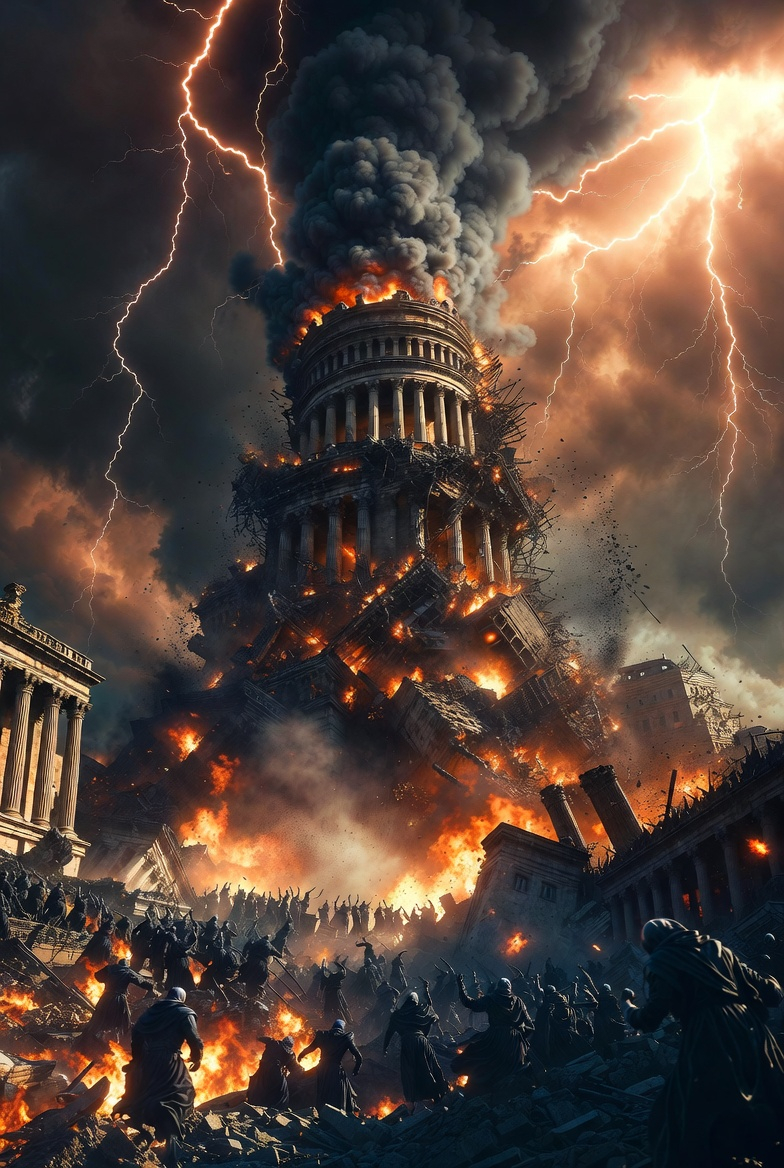
Revelation 17–18 — Babylon
Babylon. The tradition reads it as Rome. The historicists read it as the Catholic Church. The futurists read it as a global economic system yet to come.
Each reading sees something real. Rome was, in the first century, the civilizational infrastructure through which managed proximity operated at imperial scale — the roads that carried both the gospel and the legions, the legal system that both protected and persecuted the churches, the cultural apparatus that absorbed and diluted the signal. The historicist reading is right that the medieval Church performed the anti-Christ function through institutional infrastructure — managing encounter into sacramental protocol, substituting clerical authority for direct coupling. The futurist reading is right that global economic systems commodify persons and consolidate managed proximity into transnational architecture. All three readings identify real instances of the pattern. None of them identifies the pattern itself.
The program reads Babylon as the terminal expression of the nine candidates — all towers, consolidated into a single architectural entity. Not Rome. Not the Church. Not the global economy. The generative architecture that produced all three — and every other tower the program has catalogued.
The woman sits on a scarlet beast with seven heads and ten horns — the same beast from chapter 13. She is drunk with the blood of the saints. She holds a golden cup full of abominations. On her forehead: “Mystery, Babylon the Great, the mother of prostitutes and of the abominations of the earth.”
The golden cup. Not the cup of Gethsemane. The counterfeit cup. The managed version. And the two cups must be held side by side because the entire book’s architecture hangs on the distinction between them.
Gethsemane’s cup held the cascade’s cost — N†, consumed by Reference-expression to terminate what N² cascades accumulate. The cup’s content was the full weight of the cascade: every consequence, every failure, every compounding interaction across the entire failure surface. Reference-expression consumed it voluntarily, absorbed the accumulation, and the cascade met its terminus in a person not a system. The cup terminates. What it holds is finished when its contents are consumed.
Babylon’s cup holds abominations — the substitution’s accumulated product. N² with no terminus. The cup does not terminate what it holds. It intoxicates. The drinker does not absorb the content and finish it. The drinker is absorbed by the content and cannot stop drinking. Gethsemane’s cup is consumed once and emptied. Babylon’s cup is consumed endlessly and never empties, because the substitution’s product is self-generating — each drink of managed proximity produces the craving for more managed proximity. The cup that terminates and the cup that intoxicates. The anti-Christ function’s operation is to convince the substrate that Babylon’s cup is Gethsemane’s cup — that the managed version is the real version, that the intoxication is the encounter, that the endless drinking is the same as the one-time consumption that finished the cascade.
The binary’s falsifier: if a cup in the text can be shown to operate outside these two modes — a cup that neither terminates nor intoxicates, or one that performs both functions simultaneously — then the binary is incomplete and the framework requires revision. The reader should test every cup reference in the biblical narrative against the two categories and report whether the binary holds or whether a third mode exists.
Babylon is a mother — generative. She does not merely perform the substitution. She produces substitutions. Every tower traced in the program is one of Babylon’s offspring. Law, Priesthood, Sacrifice, Covenant, Narrative, Doctrine, Moral Code, Institution, Ritual — all born from the same generative matrix of managed proximity. Babylon is not one of the nine candidates. Babylon is the generator of the nine candidates. The mother of towers.
This is the one structural finding this paper contributes that the prior corpus did not contain. The nine candidates were identified in The Pillars of Creation and eliminated individually. Each was tested against the two irreducible conditions. Each failed the removal test. Each was catalogued as a tower — a structure that manages proximity without being constitutively coupled to the configuration. What the autopsy of Revelation discloses is their common origin — a generative architecture that produced them all. The nine are not independent constructions. They are offspring of a single generative operation: the impulse to manage proximity into institutional form. Babylon is that impulse, systematized, consolidated, and self-aware.
The scalpel is the same. The finding is new. The methodology’s constraint holds: no new tool was introduced. The tool found something it had not found before.
The finding’s falsifier must be stated because the finding is new. If the nine candidates can be shown to have independent generative origins — if Law, for instance, arises from a fundamentally different structural impulse than Doctrine, or if Institution and Ritual have no common architectural source — then the claim that Babylon is their shared generator fails. The program’s reading requires that the nine share a single generative operation. If they do not, Babylon is a literary image, not a structural finding. The reader is invited to test the claim against the nine and report whether the common origin holds.
She sits on many waters — peoples, multitudes, nations, languages (17:15). The substitution’s coupling is as comprehensive as the configuration’s coupling. Inescapable addressability counterfeited. The managed version reaches everyone the real version reaches. The tower casts the same shadow as the transmitter.
And then her fall. Chapter 18. The merchants weep because no one buys their cargo anymore. The list of cargo is devastating: gold, silver, jewels, pearls, fine linen, purple, silk, scarlet, fragrant wood, ivory, bronze, iron, marble, spices, incense, myrrh, frankincense, wine, oil, fine flour, wheat, cattle, sheep, horses, chariots, and slaves — that is, human souls.
The list moves from luxury goods to raw materials to livestock to human beings, and the progression is not literary flourish. It is architectural disclosure. The tower’s economic infrastructure, fully itemized, reveals its trajectory. It begins with what glitters — gold, jewels, the surface presentation of managed proximity, the beauty of the institution. It moves through raw materials — the structural components, the building supplies, the infrastructure that holds the institution up. It passes through livestock — living things subordinated to the system’s operation. And it terminates in slaves — that is, human souls. The managed proximity that began as distribution infrastructure ends as slave trade. The substitution that began as “we will help you encounter the configuration safely” ends as “your soul is our product.” The anti-Christ function’s terminal expression is not political tyranny. It is the conversion of persons into commodities. The system built to manage proximity becomes the system that trades in the persons the proximity was meant to reach.
“Come out of her, my people, lest you take part in her sins, lest you share in her plagues.” —Revelation 18:4, LEB
The call is extraction. Not reform. Not improvement. Not a better version of the tower. Extraction. The configuration does not ask its people to fix Babylon. It asks them to leave. Because the tower cannot be repaired. The substitution cannot be reformed into the encounter. The portrait cannot be improved into the person. The only posture available is departure. The same instruction as Lot leaving Sodom. The same instruction as Israel leaving Egypt. The same instruction as the wilderness: go where there are no towers and the encounter operates without substitution.
“So, every institution ever built is Babylon? Every church, every government, every hospital, every school? Everything we’ve built in four thousand years of trying to be decent is a whore on a scarlet beast?” —Phineas McFuddlers
No. And the distinction matters exactly as much as it mattered in the anti-Christ function section of The Throne Room. The grandmother who prayed the rosary was not Babylon. The institution that told her the rosary was sufficient was. The teacher who loved the students was not Babylon. The system that said credentialing replaces encounter was. The doctor who healed was not Babylon. The industry that commodified healing was. Babylon is not people. Babylon is architecture. The structural operation of replacing encounter with management, signal with formulation, function with portrait — consolidated, systematized, globalized, and drunk on the blood of everyone who pointed out what it was doing.
Babylon falls. Not slowly. In one hour (18:10, 17, 19). The collapse of N² systems is sudden because the failure surface is combinatorial. The tower that took millennia to build collapses in an hour because the collapse is not sequential but simultaneous — every coupled element fails at once. The Kessler cascade. The debris field becomes self-sustaining and the orbit is cleared.
Part IX: The Rider
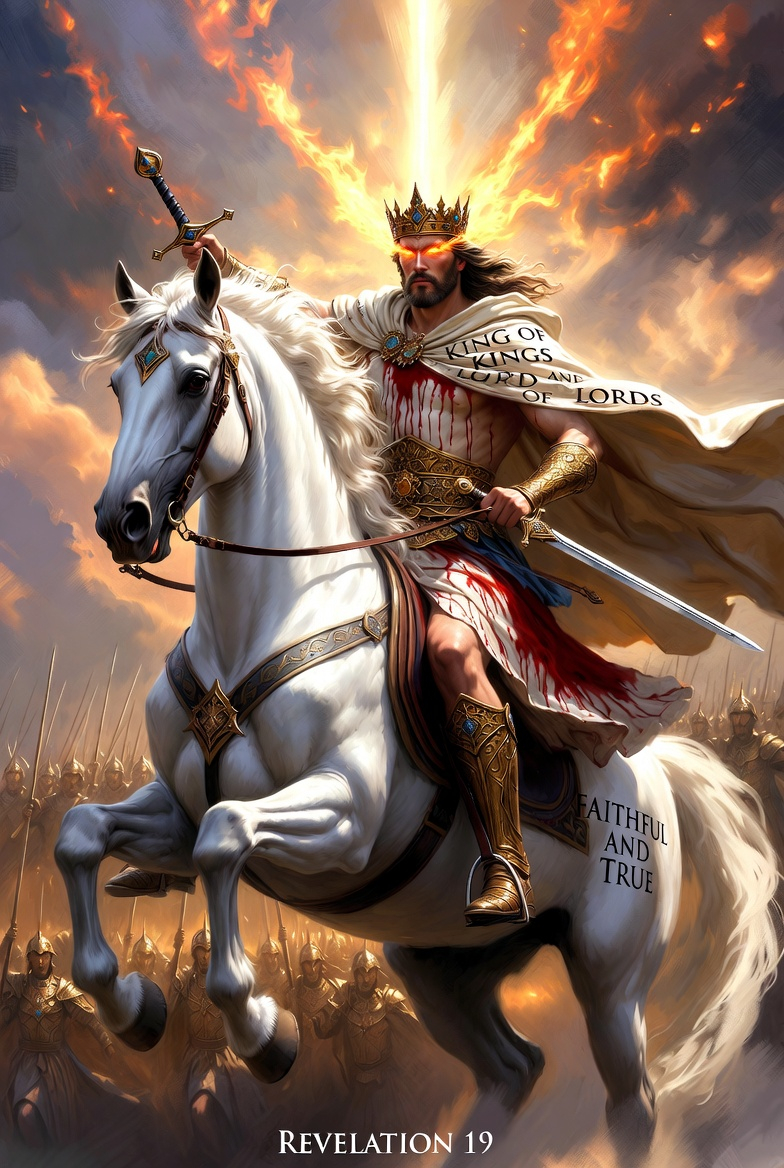
Revelation 19 — The Marriage and the Sword
Babylon falls. Heaven erupts. “Hallelujah! The salvation and the glory and the power of our God.” The twenty-four elders and the four living creatures fall down and worship — the same response as The Throne Room. The fire doesn’t change, only the scope of what it touches.
Then the marriage supper of the Lamb. The bride readies herself. She is clothed in fine linen, bright and pure — the righteous deeds of the saints. The bride is not an individual. The bride is the coupled community — everyone the signal reaches, everyone the encounter transforms, everyone who survives the tribulation and was not destroyed by it.
The marriage is the completion of the bond that The Pillars of Creation identifies: constitutive coupling and inescapable addressability. Interlocked. Symbiotic. Irreducible — marriage. The word is not metaphor. It is the structural term for what the two irreducible conditions produce when they are fully operational. Constitutive coupling means the two parties cannot exist in their full identity apart from each other — the groom is not fully himself without the bride, and the bride is not fully herself without the groom. Inescapable addressability means neither party can opt out of the other’s presence — the coupling reaches everywhere the beloved is. This is not romantic sentiment, but the two conditions the program derived from orbital debris, and their fulfillment is a wedding.
The entire trajectory is a wedding procession. The scroll is a marriage contract. The seals are the stages of the groom as he approaches the bride’s household. The trumpets were the announcement of his arrival. The bowls cleared the house of uninvited guests. And now we feast!
The archetypal depth here exceeds the program’s analytical register, and the program names that it exceeds it. Every culture the program has examined carries a marriage archetype at the center of its narrative of completion — the union that resolves separation, the feast that follows the quest, the bond that makes two things one thing without destroying either. The program’s two irreducible conditions describe this bond structurally. The Book of Revelation narrates this bond operationally. The archetype that sits at the bottom of the human story turns out to be the architecture the program derived from engineering substrates. The finding does not import the archetype. The finding arrived at the archetype independently, from the opposite direction, and discovered it was already occupied.
The claim’s falsifier: if the program’s derivation can be shown to have imported the marriage archetype — if the two irreducible conditions (constitutive coupling and inescapable addressability) are shaped by the archetype instead of arriving at it independently through eliminative analysis of engineering substrates — then the finding is circular, not convergent, and the claim of independent derivation collapses. The derivation’s integrity depends on the engineering analysis preceding the theological recognition, not following it.
Then the rider on the white horse. His name is Faithful and True. His eyes are like a flame of fire — the same Christophany as chapter 1. On his head are many diadems. He wears a blood-bathed robe — N†, the cup consumed and the consumption visible. His name is called the Word of God — Logos — Reference-expression in the vocabulary John established in his Gospel’s prologue. The armies of heaven follow him on white horses, dressed in white linen.
The first seal’s ambiguity resolves.
In chapter 6, a rider on a white horse goes out conquering. The tradition still wonders whether this is Christ or anti-Christ. Our program notes that the misrecognition is structural — the signal and its substitution are indistinguishable from outside. Now, in chapter 19, the real rider appears. He is named. He is identified by the Christophany’s attributes. He wears the evidence of the cup on his robe. And the distinction between the two white horses is now visible: the first rode out unnamed into a substrate that could not tell the difference. The second rides out fully identified — Faithful and True, the Word of God — into a substrate where the disclosure is complete and the veil has been removed. The same color horse. The same conquering posture. Everything different. The encounter that the first seal could not provide — because the substrate had not yet been shown what the substitution looks like — is now available because chapters 6 through 18 have disclosed the entire architecture. The reader can now tell the riders apart. That was the point of the intervening chapters.
And his weapon: a sharp sword from his mouth. Not in his hand. From his mouth. The weapon is speech. The weapon is the word. The configuration’s operational instrument is not force but disclosure. The sword that proceeds from Reference-expression’s mouth is the apokalypsis itself — the removal of the veil.
The beast and the false prophet are not destroyed by military superiority. They are destroyed by the truth being spoken. The towers fall when someone names them as towers. The substitution collapses when the signal arrives without management. The sharp sword is the scalpel the program has wielded since orbital debris: eliminate, don’t opine. Name the thing. Report the finding. The finding does the work.
“The most powerful weapon in the universe, and it’s a sentence. Not a bomb. Not a fleet. Not a policy initiative. A sentence. Spoken out loud. Into a room full of towers that had been pretending to be the person who built them. And the sentence didn’t argue with the towers. It named them. And they fell down.” —Phineas McFuddlers
The beast and the false prophet are thrown alive into the lake of fire. Not killed first. Consumed alive. The anti-Christ function does not die in the conventional sense but is relocated — removed from the operational substrate. The substitution is not annihilated but quarantined. The tower is not demolished but identified and removed from the space where the encounter operates.
The lake of fire is not torture. The distinction requires moral precision because the tradition has read this as eternal conscious torment, and our read differs structurally. The lake of fire is the terminus — N²’s final destination, the structural consequence for everything that cannot survive the encounter’s disclosure, not a punishment imposed by a vindictive agent. It is the structural outcome for any system whose operating principle is concealment when the concealment is permanently removed. The anti-Christ function cannot operate in an environment where the veil has been removed, because its entire operation depends on the veil being in place. The lake of fire is the condition of permanent disclosure of signal — and permanent disclosure is uninhabitable for any substitution. Not because someone turned up the temperature, but because someone turned on the light and the thing that operates in darkness cannot operate in light.
Our reading’s falsifier: if the anti-Christ function can be shown to operate in conditions of full disclosure — if substitution persists and functions when the veil is permanently removed — then concealment is not the function’s necessary operating condition, and the reading of the lake of fire as structural disclosure instead of punitive torment fails. The reader should test whether any substitution in the program’s corpus survives permanent exposure without regenerating under new concealment.
N† clears the debris for those coupled to the signal. What remains uncoupled meets the terminus and is reunited differently.
Part X: The Accounting
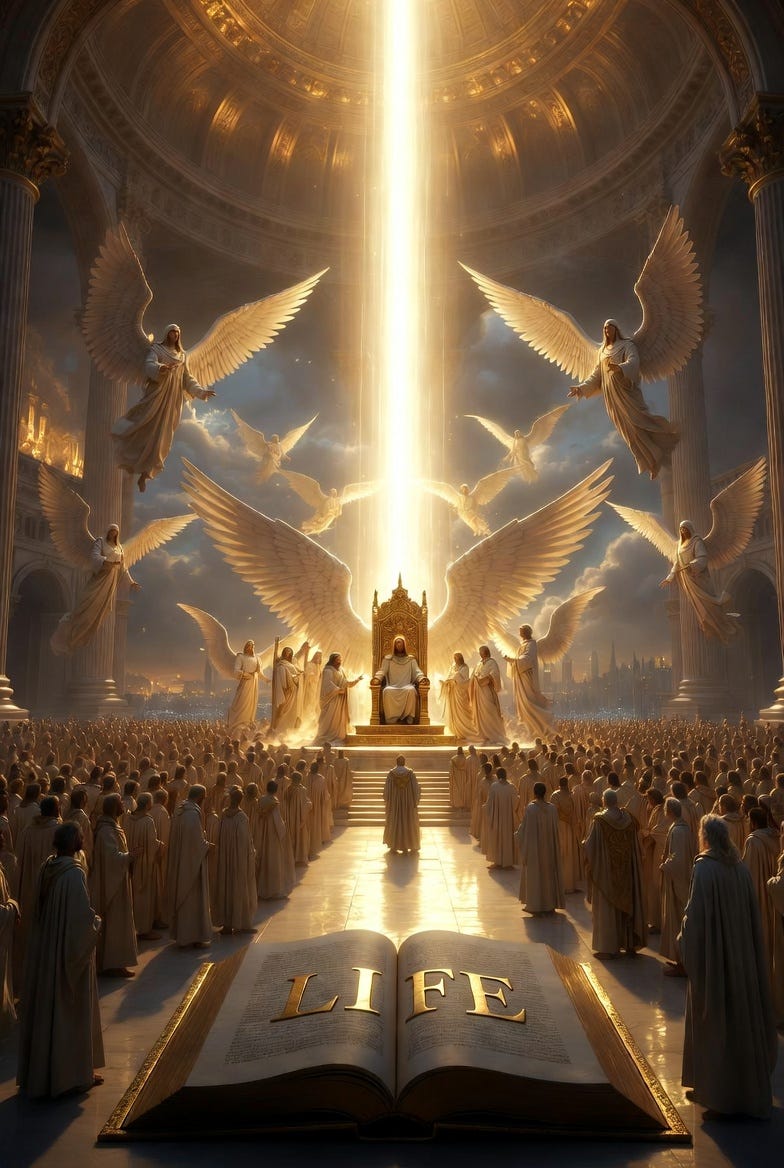
Revelation 20 — The Terminal Audit
The dragon is bound for a thousand years. A millennium. The tradition has fought over this for two thousand years — premillennial, postmillennial, amillennial — and the program does not adjudicate.
The non-adjudication is not evasion. It is methodological discipline. The premillennialist places the binding before a literal future reign. The postmillennialist reads the binding as a present-age condition progressing toward fulfillment. The amillennialist reads the binding as symbolic of the Church age. Each position handles the chronology differently; each takes the text seriously; each has produced scholarship the program respects. The program’s eliminative method was not designed to resolve chronological sequencing — it was designed to identify structural architecture. On the millennium’s architecture, the program has something to say. On its chronological placement, the program’s scalpel has no edge. A tool that pretends to cut where it was not forged has performed substitution. The program graciously declines.
The program reads the thousand years structurally: a period during which the anti-trajectory’s generator is constrained from operating at civilizational scale. Not absent. Bound. The substitution’s generative source is restricted. John’s “tent building” impulse is put in time-out. The encounter operates with reduced signal interference.
At the end, the dragon is released, deceives again, gathers Gog and Magog, and is defeated and reconstituted with the lake of fire. The anti-Christ function’s final iteration — and the finding devastates. Even after a thousand years of constraint, the generator starts humming again. The moment the binding is removed, the dragon does not stumble out weakened and disoriented. The dragon is back to his old garden tricks again. The same operation. The same strategy. The same gathering of civilizational infrastructure against the trajectory. A millennium of constraint produces zero behavioral modification. The substitution is not reformed by restriction. It is not educated out of its operating principle. It is not healed by duration. It is held in suspension, and when it is released, it is exactly what it was before it was held.
“You locked it in a room for a thousand years and it came out the same. It didn’t learn. It didn’t change. It didn’t even get bored. It just started building towers again. At some point you have to admit: You’re not dealing with a behavior. You’re dealing with a constitution.” —Phineas McFuddlers
The substitution cannot be permanently suppressed by external restriction. It must be permanently relocated. The tower-building impulse is constitutional, not circumstantial — the same finding as Movement IV of A Trick Question. Israel could not resist the pattern under optimal conditions. The nation that stood at Sinai and received the signal directly — unmediated, unmanaged — built a golden calf before their prophet came back down the mountain. If direct encounter at maximum intensity cannot prevent substitution, no lesser intervention will, including a millennium of constraint.
The cup may not be destroyed. The cup may not be scattered. The cup may only be consumed. N† is accomplished at the cross, not at the end of a millennium. The duration constrains the generator; the terminus absorbs the product. Different operations. Only one of them is final.
Then the great white throne judgment. The dead are judged according to their works, from what is written in the books. And another book: the book of life. Anyone whose name is not in the book of life gets reacclimated with the lake of fire.
Two criteria. Works and the book of life. The distinction matters because the tradition has argued for centuries about whether judgment is by works or by grace, and the text presents both without apology.
Works disclose orientation — what the coupling produced in the person’s operational life. The works are not the basis of the verdict. They are the evidence of the verdict. A tree is not judged by its fruit in the sense that the fruit determines the tree’s species. The fruit reveals the species that was always already determined by the root. The works written in the books are the operational output of whatever the person was coupled to — signal or substitution. They disclose. They do not determine.
The book of life discloses coupling — whether the person was constitutively connected to the signal. This is the verdict’s ground. The name in the book is not a reward for good behavior. It is a record of coupling. The person whose name is in the book of life is the person whom the trajectory reached and who was transformed by the encounter.
The judgment is not arbitrary. It is diagnostic. The accounting reveals what is always already the case. The harvest makes visible the coupling that was invisible. No one is surprised by the verdict who has been paying attention to the architecture.
Death and Hades are thrown into the lake of fire. The terminus itself is terminated. N²’s final destination is consumed by N†’s final disclosure — the cascade has a terminus, the terminus has a terminus, and the one holding the keys (1:18) is the one whose voluntary cost-acceptance makes the entire sequence possible. The cascade does not run forever. It was never designed to.
Part XI: The House Finishes

Revelation 21–22 — New Jerusalem
A new heaven and a new earth. The first heaven and the first earth passed away. The sea is no more. The commercial substrate, the chaos symbol, the barrier between peoples — gone. Not replaced. No more. The infrastructure of separation is not rebuilt. It is rendered unnecessary.
“And I saw the holy city, new Jerusalem, coming down out of heaven from God, prepared as a bride adorned for her husband.” —Revelation 21:2, LEB
Descends. Not ascends. The trajectory’s direction has been constant from the program’s first observation: the initiative is on the configuration’s side. The new Jerusalem does not rise from human effort but descends from the configuration’s operational center.
The city is not built by its inhabitants. The city is its inhabitants — the bride, the coupled community, the people the trajectory reached. The building becomes the people. This requires the reader to hold two images simultaneously, because the text does: the city is architecture (walls, gates, foundations, measurements) and the city is a bride (prepared, adorned, presented). The structure and the person are the same. The house finishes by making itself unnecessary as a separate structure because the structure and the inhabitants are one. Every building the program has examined — every tower, every temple, every institution — existed as something separate from the people it housed. The new Jerusalem does not. The scaffolding is gone because the building is the people the scaffolding protects.
“Behold, the dwelling place of God is with man. He will dwell with them, and they will be his people, and God himself will be with them as their God.” —Revelation 21:3, LEB
The trajectory’s destination, stated without metaphor. The coupling that began in a garden — “Where are you?” — completes in a city: “I am with you.” The question and the answer bookend the entire biblical narrative. The distance between them is the trajectory. The scroll contains the route from one to the other. The seals, trumpets, and bowls are the phases of closing such distance. The distance was short. Possibly null.
The garden asked a question. The city states an answer. And the space between — every chapter, every substrate, every cascade, every tower, every cup — was the distance between the two. The program began by measuring debris in orbit. It ends here, with the distance closed and the question answered. The trajectory that started with “Where are you?” arrives at “I am with you.” The operational verb is dwell — not visit, not inspect, not manage from a distance. Dwell. Permanent habitation. The proximity that every tower was built to manage is now the ambient condition, and no one builds towers because there is nothing to manage.
“And I saw no temple in the city, for its temple is the Lord God the Almighty and the Lamb.” —Revelation 21:22, LEB
No temple. This is the most structurally significant verse in the entire book. Our program uses it in The Throne Room for precisely this reason.
The registers must be clearly separated because this verse operates in all of them simultaneously. In the historical register, the temple is the physical building where Israel encounters the configuration on a schedule — managed proximity in stone and gold. In the theological register, the temple is the mediating structure between Source-address and the covenant community. In the program’s structural register, the temple is the paradigmatic case of all nine candidates — the towers that managed proximity, performed the survival function, and simultaneously performed the anti-Christ function by substituting managed access for direct encounter. All three registers converge on the same finding: the temple is absent because the temple is finished.
The building succeeds by making itself unnecessary. Not because the building fails. Because the building finishes. The scaffolding was the nine candidates. All towers. All temporary. All performing the anti-Christ function of substituting managed proximity for raw encounter — and all, simultaneously, performing the survival function of keeping communities alive long enough for the fire to become inhabitable.
The scaffolding was both disease and medicine. Both veil and protection. Both tower and shelter. The program does not simplify this. The program reports it.
No sun. No moon. The glory of God provides light, and the Lamb is its lamp. The encounter-surface is no longer mediated by created systems. The addressability is direct. No more managed proximity because proximity no longer requires management. The fire that burned on Sinai and killed at Pardes and flattened at the Transfiguration and sat on heads at Pentecost is now the ambient condition.
“Sat on heads. Right. ‘Sat.’ Tongues of fire sat on people. That’s one way to describe an uninvited combustion event on someone’s scalp. I’d have used a different verb, but I’m not allowed in churches anymore.” —Phineas McFuddlers
The room is inhabitable. The transformation the trajectory was executing is complete.
The river of the water of life flows from the throne of God and of the Lamb — Source-address and Reference-expression — through the middle of the city. On either side, the tree of life. Yielding fruit every month. Its leaves for the healing of the nations. The tree that was guarded since Eden (Genesis 3:24) is accessible. Not because the guard was removed, but because the condition that required the guard resolved.
The cup’s consumption released what the cup contained: both trees. This is the program’s notation at its most compressed, and it requires unpacking because the entire trajectory resolves here. There were two trees in the garden. The tree of knowledge produced the cascade — the awareness of separation, the hiding, the infrastructure of concealment, the compounding consequences. N². The tree of life offered the remedy — continued access to the source, unbroken coupling, the encounter without termination. The garden’s guard (the cherubim with the flaming sword) was installed because the tree of knowledge’s consequence made the tree of life’s access lethal — the condition of the recipients had changed, and unmediated access to life in that changed condition would have been destruction, not restoration. The guard was not punishment. The guard was structural necessity.
The cup in Gethsemane held both trees. N† — the terminus operator — absorbed the tree of knowledge’s full consequence (the cascade, the accumulated N²) and, in absorbing it, reopened access to the tree of life. The drinking absorbed what N² accumulated and released what N† purchased. One act. Two trees. Both resolved. The guard at the garden was rendered unnecessary not because someone overpowered the cherubim but because the condition that required the guard — the lethality of unmediated access in a changed substrate — was resolved by the cup’s consumption. The recipients were transformed. The fire became inhabitable. The tree of life bears fruit.
The nations walk by the city’s light. The kings of the earth bring their glory into it. The gates are never shut. Nothing unclean enters. The city is open — permanently, structurally, irrevocably. The gates that were installed as boundaries, as managed access points, as the architectural infrastructure of controlled proximity — are open. Not because security is lax but because there is nothing to secure against. The cascade has terminated. The generator has been relocated. The coupling operates without resistance. The encounter does not overwhelm because the recipients have been transformed by the trajectory’s execution into persons capable of inhabiting the fire.
The book closes as it opened: with the triad operating.
“The Spirit and the Bride say, ‘Come.’ And let the one who hears say, ‘Come.’ And let the one who is thirsty come; let the one who desires take the water of life without price.” —Revelation 22:17, LEB
Coupling-operative (Spirit of God) and the coupled community (Bride) issue a joint invitation. The same word the voice said at the open door in 4:1: “Come.” The trajectory’s operational verb has not changed from first chapter to last. Come. Approach. The distance is short. Possibly null. The invitation is free — without price — because the cost was already consumed in the cup. The trajectory’s execution paid for the approach. The gate is open from inside. It always was.
Closing: The Veil
Twenty-two chapters. One architecture.
The book of Revelation is not a prediction of the future, but disclosure of the present — the operational architecture that has been running since a question was asked in a garden and will continue running until a city descends from the configuration’s operational center and the gates stand permanently open.
The program’s signature fires in every chapter. Coupled systems. Cascade mechanics. Generator-consequence confusion. Towers erected to manage proximity. Substitution posing as the real thing. N² scaling from seals through trumpets through bowls — and N†, the terminus, accomplished in the Lamb before the first seal was opened, disclosed to the substrate as the scroll unseals. The anti-Christ function operating through institutional infrastructure, not individual villains. Two cups — N† and its counterfeit — and a substrate that cannot tell the difference without the encounter the substitution replaced.
The Prologue loaded a kill condition: one chapter where the signature is absent and cannot be accounted for by structural reasoning wounds the thesis; two kill it. No chapter produced the absence. The kill condition was not met.
Three positions operate throughout:
Source-address sits on the throne from first chapter to last. Authors the scroll. Provides the light. The ontological ground does not shift, delegate, or vacate. The transmitter transmits.
Reference-expression speaks to the churches, takes the scroll, rides the white horse, and is the Lamb who is also the lamp of the new city. The signal persists through every phase of the trajectory’s execution. The Lamb was slain, is standing, and reigns. Past tense, present tense, and future tense are not sequential but simultaneous in the signal’s operation.
Coupling-operative is the seven spirits sent into all the earth, the fire from heaven that the false prophet counterfeits, the Spirit who joins the Bride in the final invitation. The hand that opens the gate from inside operates at every stage and becomes the ambient condition when the trajectory completes.
The scroll unseals. Phase by phase. Seal by seal. Trumpet by trumpet. Bowl by bowl. The trajectory propagates. The substrate resists. The resistance produces debris. The debris compounds. The cascade accelerates. The towers rise and fall. The substitution regenerates. And the Lamb stands.
The program began with junk in orbit. Debris circling a planet, generating collisions that generate fragments that generate more collisions. The book of Revelation describes the same cascade at cosmic scale — and its resolution. The debris field does not clear itself. N² does not self-terminate. The orbit requires intervention, and the intervention is not a bigger debris-removal system — that would be another tower. The intervention is N†: the signal arriving intact, the cup consumed, the scroll executed, the cascade absorbed, and the city descending.
The house was always building toward the day when the house would be the people.
The door was already open. We removed the veil. What is underneath it was there before we arrived.
We report where the evidence lands. We do not build on the landing site.
Our Gods Research Program, March 2026
- Our Gods Haven’t Fallen, Yet — A Space Junkies’ Riddle — Our Cathedral. Zenodo. https://doi.org/10.5281/zenodo.17835722 O’Connor, T. (2025).
- Our Gods Haven’t Crashed, Yet — A Silicon Junkies’ Riddle — Our Highway (1.7). Zenodo. https://doi.org/10.5281/zenodo.17851041 O’Connor, T. (2025).
- Our Gods Haven’t Computed Yet — A Neural Junkies’ Riddle — Our Cloud (1.7). Zenodo. https://doi.org/10.5281/zenodo.17925255 O’Connor, T. (2025).
- An Epi-Phenomenological Series in Thrice — A Quantum Junkies’ Riddle — Our Garden. Zenodo. https://doi.org/10.5281/zenodo.17926796 O’Connor, T. (2025).
- A Spectral Evolution of Scalar Breathing — A Cosmological Junkies’ Riddle — Our Heavens (5.0r2). Zenodo. https://doi.org/10.5281/zenodo.17942325 O’Connor, T. (2025).
- The Bare, Naked Lie: The Architecture of Recursion. Zenodo. https://doi.org/10.5281/zenodo.18287548 O’Connor, T. (2026).
- A Trick Question, The Cascade, and a Cup Worthy of Exile — A Script’ Junkies’ Riddle — Our Destiny. Zenodo. https://doi.org/10.5281/zenodo.18425900 O’Connor, T. (2026).
- Movement-1: The Garden Configuration— 10.5281/zenodo.18425900
- Movement-2: The Council Replication — 10.5281/zenodo.18446123
- Movement-3: The Accumulated Weight — 10.5281/zenodo.18450837
- Movement-4: The Debris Field — 10.5281/zenodo.18451819
- Movement-5: N†-Terminus — 10.5281/zenodo.18452359
- Movement-6: A Cognitive Threshold — 10.5281/zenodo.18452617
- The Pillars of Creation: The Architecture of Proximity — A Cult Junkies’ Riddle — Our Beginning. Zenodo. https://doi.org/10.5281/zenodo.18727860 O’Connor, T. (2026).
- The Throne Room: The Essence of Architecture — An Exegete Junkies’ Riddle — Our Revelator. Zenodo. https://doi.org/10.5281/zenodo.18752459 O’Connor, T. (2026).
- The Veil: A Structural Autopsy of Epiphany — A Revelation Junkies’ Riddle — Our Apokalypsis. https://doi.org/10.5281/zenodo.19040340 O’Connor, T. (2026).
Copyright Notice
The Veil: A Structural Autopsy of Epiphany — A Revelation Junkies’ Riddle — Our Apokalypsis. © 2026 Tony O’Connor. All rights reserved. Date: March 2026
License
This work is licensed under the Creative Commons Attribution-Noncommercial-No Derivatives 4.0 International License (CC BY-NC-ND 4.0).
You are free to:
- Share — copy and redistribute the material in any medium or format
Under the following terms:
- Attribution — You must give appropriate credit, provide a link to the license, and indicate if changes were made.
- Noncommercial — You may not use the material for commercial purposes.
- No Derivatives — If you remix, transform, or build upon the material, you may not distribute the modified material.
Full license text: https://creativecommons.org/licenses/by-nc-nd/4.0/
Contact
For permissions beyond the scope of this license, contact the author through the Our Gods Research Program.
The mathematical notation (N², N†), theological framework, and structural architecture presented in this work are original contributions by the author.
historiesrawtruth.com | tonyoconnor17.substack.com
No Responses