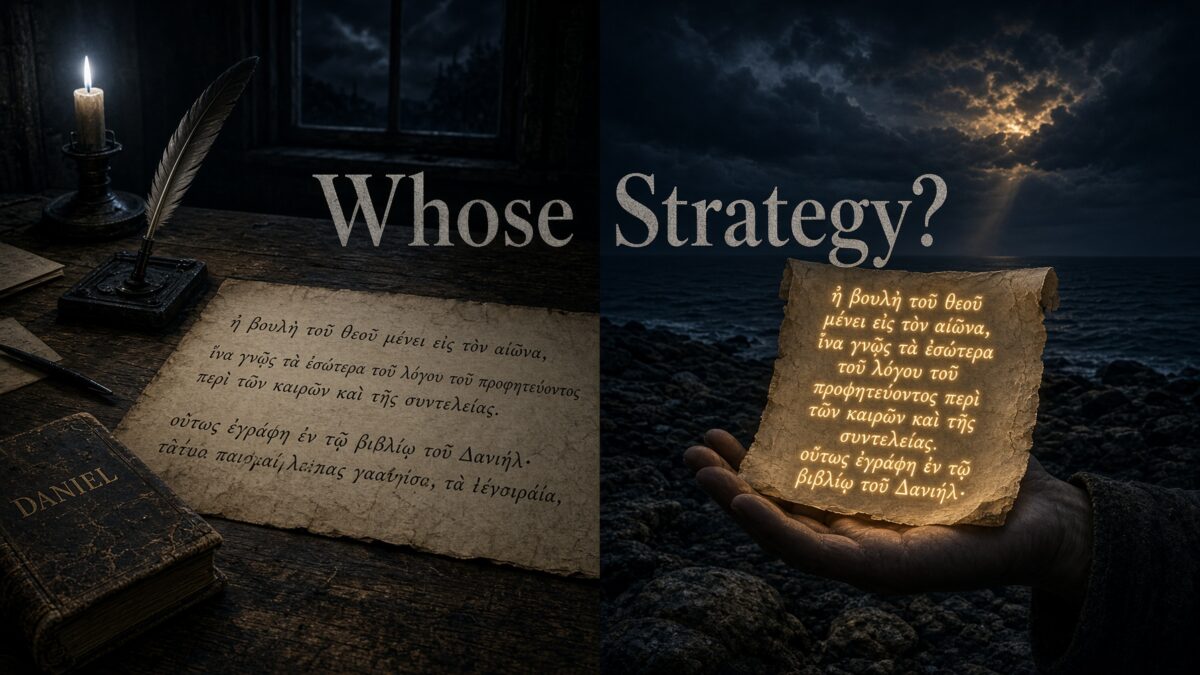
The Desk and the Island: Revelation’s account of itself, and the method that steps past it
(A tribute to Mike Heiser’s Naked Bible Podcast)
“Blessed is the one who reads aloud and blessed are those who hear the words of the prophecy and observe the things written in it, because the time is near!” — Revelation 1:3
Michael Heiser’s Naked Bible Podcast series on Revelation reads the book’s Old Testament fabric the way modern scholarship does: as John’s work, done at a writer’s desk, after the vision. We take Heiser’s own rule — read the Bible in its ancient setting and strip away later systems’ contexts — one step further, to what Revelation’s first hearers heard. The book presents itself as given and transmitted, from God to Christ to an angel to John, who is told to write twelve times and once told not to (10:4). It puts Old Testament material in the words of Christ and the angel. The field has placed that material at John’s desk without arguing against the book’s own account. We set out the reading Heiser’s rule leads to, on which the Old Testament enters at reception, wherever the book marks it (a partition, not a blanket), and the tests that could break it. The reading is not new: Heiser had already written it, for every prophet but John.
For Dr. Michael S. Heiser (February 14, 1963 – February 20, 2023), who taught a generation to read the Bible in its own world.
The Naked Bible Podcast (NBP) series on the Old Testament in Revelation opens with a summary of what it will do: look at how the author “dipped into the Old Testament to create the book of Revelation,” and at “his strategies” for doing so (NBP 352, p. 1). That is a fair description of a whole field. In the modern literature, which Moyise and the series date from Gregory Beale’s 1984 work (NBP 352, p. 5), the analysis of Revelation’s Old Testament fabric has been the study of what John did with his Bible: which passages he reached for, how he reworked them, what he meant by the changes. Each of those is a question about what John intended.
The book describes itself differently. Its first sentence says the revelation was God’s, given to Jesus Christ, sent through his angel to John, who reports what he saw (1:1–2). John is then told to write twelve times, and once told not to (10:4). The book ends with Jesus saying he sent the angel (22:16) and with a warning against adding or taking away (22:18–19). On the book’s own account, the strategy belongs to the one who sent it. John’s part is to see, to hear and to write: to put into words what he was shown and told, as a messenger renders a message he did not compose.
The two descriptions can be reconciled, and scholars reconcile them, usually by placing real visions first and literary work second. What is rare is to see the reconciliation argued from the book’s opening rather than assumed before it. The series starts at 1:4 by announcement and gives its reason: that is where the Old Testament phrases begin (NBP 352, p. 17). Across thirty exegetical episodes and another six for listener Q&As, 1:1 is examined once, in the episode on chapter 10, where its chain of senders becomes evidence that the angel is Christ (NBP 378, pp. 7–10); 1:2–3 are read aloud once and never discussed (NBP 355, p. 3). The field reads the chain too and does not let it decide where the Old Testament fabric enters. The method starts at the desk.
The series is careful about what it will not do. At the outset Heiser says, “we’re not doing prophecy here,” and rules out End Times systems and the arguments between them (NBP 352, p. 3). That is a reasonable boundary, and it is not the boundary our piece questions. But the word he sets aside is the book’s own name for itself, at both ends (1:3; 22:7, 10, 18–19). The third verse calls the book “the words of the prophecy” and blesses “the one who reads aloud” and “those who hear” it and “observe the things written in it” (1:3). It is the verse that says what kind of thing the book is, how it was meant to be received, and what it asks of the people receiving it: one reader, many hearers, a blessing on keeping what is written. In keeping clear of prophecy as a modern topic, the series also keeps clear of prophecy as the book’s account of itself, and the reader and hearers go with it.
Our piece is about that starting point, not a case against the man or his podcast. Mike Heiser’s series is the clearest recent statement of the method, and his own working rule is the best tool for examining it. He asks his listeners to read the Bible in its ancient setting, stripped of later systems’ contexts, and he says in the same episode that our interpretive rules “did not exist in the first century” (NBP 352, p. 9). Our piece takes that rule one step further, to the front door of Revelation. The first hearers were told that what was written had been given and sent, and they heard it read aloud (1:3). What would it have meant to them that it was John’s composition?
What the book says about itself
Revelation states its own chain of custody, as Luke’s preface does (Luke 1:2); but Luke’s chain begins with eyewitnesses, and Revelation’s begins with God. In the Lexham English Bible the opening runs: “The revelation of Jesus Christ, which God gave him to show to his slaves the things which must take place in a short time and communicated it by sending it through his angel to his slave John, who testified about the word of God and the testimony of Jesus Christ, all that he saw” (1:1–2). Four links: God, Jesus Christ, the angel, John. John’s role in the sentence is to testify to what he saw.
The chain is restated at the close, in words that repeat 1:1 exactly; Bauckham reads the repetition as the marker of the epilogue (The Climax of Prophecy, p. 23). The angel says: “These words are faithful and true, and the Lord, the God of the spirits of the prophets, has sent his angel to show his slaves the things which must take place in a short time” (22:6). Jesus says, “I, Jesus, sent my angel to testify to you about these things for the churches” (22:16). Bauckham, who reads the book as a composition, identifies this angel as “the angel to whom 1:1 referred” (The Climax of Prophecy, p. 5). The angel who shows John these things (22:8) is not Christ in another form: twice John falls at his feet, and twice he is stopped with “I am your fellow slave” (19:10; 22:8–9). Heiser uses the same test. Discussing the Apocalypse of Zephaniah, where a great angel who looks much like Revelation’s Christ tells the seer not to worship him, he points out that Christ in Revelation 1 does not refuse John’s worship (NBP 363, p. 14). Heiser once reads 1:1’s angel as Christ himself (NBP 378, p. 9). On either reading the chain begins with God, and at the close he keeps the interpreting angel distinct from Jesus, quoting Beale’s note that an angel’s refusal of worship serves “to highlight the divine source of visions” (NBP 397, pp. 21–22). So, the book’s account is specific: it names a sender, a courier and a recipient, at both ends of the book.
Between those ends John writes on command. “What you see, write in a [scroll] and send it to the seven churches” (1:11). The Greek word is biblion, a scroll, and it is singular: one scroll for all seven churches. “Write the things which you saw, and the things which are, and the things which are about to take place after these things” (1:19). Each of the seven letters opens with the instruction to write, followed by the words to be written (2:1, 8, 12, 18; 3:1, 7, 14). Later a voice from heaven says “Write” (14:13); the angel says “Write” (19:9); the one on the throne says “Write” (21:5). Twelve commands in all. Once the command is reversed: “And when the seven thunders spoke, I was about to write, and I heard a voice from heaven saying, ‘Seal up the things which the seven thunders spoke, and do not write them!'” (10:4).
That last verse deserves more attention than it gets. The Greek says John was about to write (emellon graphein). Whatever one thinks about the psychology of visions, the book’s own picture at 10:4 is of a man writing during the experience, not after it. A command not to write presupposes a man about to write, and it tells us how to read the twelve commands to write: as obeyed while the vision ran, not afterwards. When a listener later asked whether John was simply writing what he saw and heard, Heiser said John is “not interrupting the angel and writing things down, like a stenographer,” and that “after the fact, he sets it to writing” (NBP 363, p. 2). That may be true of visions in general. It is not what Revelation says about itself, and 10:4 is the one verse where a stenographer is exactly what we are shown. He says it in his exegesis too: “it’s not like he’s writing this stuff while he’s in a trance”; the book is “at least in part a recollection,” on the strength of 1:10, “I was in the Spirit” (NBP 370, p. 20). The series’ last word on it comes from the same verse: asked about the Lord’s day of 1:10, Heiser puts the vision on “some run-of-the-mill Sunday” and the writing afterwards, when John “produces to writing what he saw and heard in his visions” (NBP 405, p. 14). But the verse both answers lean on is the one where the voice says write (1:10–11), and the series reads 10:4 aloud in its episode on chapter 10 and passes it without comment (NBP 378, p. 4). Nor does “in the Spirit” tell us what the recollection view needs it to. The one New Testament writer who reports such an experience in the first person declines to say how it worked: caught up to the third heaven, Paul says twice, “whether in the body or apart from the body I do not know, God knows” (2 Corinthians 12:2–3).
The verse is odd in a second way. The thunders are the only words in Revelation that John is told to seal, and not to write. Daniel was told to seal up his scroll until the time of the end (Daniel 12:4, 9). He wrote the dream down (7:1), asked inside it what the beasts meant (7:16), and when he asked how it would end, he was refused (12:8–9): what went in and what stayed out was never his call. At the close John is told the reverse, not to seal up the words of this prophecy (22:10). So, the book’s one withheld item is withheld in the middle of writing it, by a voice, and the hearers are told it exists. Paul reports the same from inside such an experience, and not in an apocalypse: caught up to paradise, he “heard words not to be spoken, which it is not permitted for a person to speak” (2 Corinthians 12:4). A composer could include that as an “echo” of Daniel, but it is still an odd thing to make up: a report to one’s hearers of what one was stopped from writing.
The Old Testament has its own picture of how a dictated record comes to be, and it belongs beside Revelation. Jeremiah speaks; Baruch writes the words on a scroll; Baruch reads the scroll to the people because the prophet cannot go himself (Jeremiah 36:4–6, 10). When the king burns the scroll, the same words are dictated again, and more of the same kind are added (36:32). The additions come from the source, not from the scribe. In the writing, Revelation’s John is closer to Baruch than to Jeremiah: the words are given; the pen is John’s.
The book also says what must not happen to it. “If anyone adds to them, God will add to him the plagues written in this [scroll]. And if anyone takes away from the words of this [scroll] of prophecy, God will take away his share of the tree of life” (22:18–19). A text that forbids additions and cuts is a text that presents itself as fixed at the source. Heiser reads the warning through Deuteronomy, as a call to obedience rather than a rule for copyists (NBP 397, pp. 23–24). That is the right background, and it makes the point: Deuteronomy’s formula guards words Moses was commanded, not words he composed (Deuteronomy 4:1–2; 12:32).
The canon knows how to declare the opposite. Luke opens his Gospel by naming earlier accounts, eyewitness sources, careful investigation and an orderly arrangement of his own (Luke 1:1–4). That is a composer’s preface, and it is the plainest test our piece has to offer. If Revelation described itself the way Luke does, our argument below would fall. It describes the reverse: where Luke investigated, John was shown; where Luke arranged, John was told what to write and what not to (1:19; 10:4). The canon knows how to declare the same thing too. Paul says of his gospel that he did not receive it from man, nor was he taught it, “but I received it through a revelation of Jesus Christ” (Galatians 1:12), and Revelation’s first three words are that phrase.
None of this settles how the visions worked, or how long any of it lasted, and none of it denies that John wrote a book in his own Greek, whether with his own hand or through a scribe. It settles what the first hearers were told, and it sets the burden. An interpreter may conclude that John composed the Old Testament fabric of the book at his desk. That conclusion has to be argued against the book’s own account, not assumed before it.
What the method assumes
Episode 352 introduces the method without arguing it, and the introduction repays close reading, because the assumption sits in the vocabulary rather than in any claim.
The frame comes from Steve Moyise, whose 1995 study Heiser quotes at length. Revelation never uses formulas like “as it is written”; in Moyise’s words, it “weaves its words and phrases into its own composition” (NBP 352, pp. 5–6). Because it quotes nothing outright and alludes constantly, the reader hears two voices, the source text’s and John’s, like a radio between stations (pp. 6–7). Heiser adopts the frame and states the series’ thesis in its terms. “Our thesis is simple,” he says: “pay attention to when John is doing this,” and understand “what he’s citing and what he does with it and why” (p. 3).
Then come Beale’s eight categories, from his 1998 study of John’s use of the Old Testament, as the episode presents them: literary prototype, thematic use, analogy, universalization, informal direct fulfillment, typology, inversion and stylistic use (NBP 352, pp. 10–16). Each is a description of something John does. In Heiser’s summary, John follows an Old Testament passage’s structure “to then write some portion of his own book”; he pulls clusters of allusions and uses them “for fodder, to produce his own material” (p. 10). He repurposes persons and events “to produce or illustrate his own content” (p. 11). Summing up the sixth category: “John will start pooling resources”; the book “weaves them together into a new composition”; there is “a lot floating around in John’s head” and he “feels very free to mix things” (pp. 13–14).
Count the words. In his own voice across the episode, Heiser calls John “the author” or “the writer” more than a dozen times. The words vision, angel, received and dictate do not occur. The introductory episode of a series on Revelation gives the book an author and no source. That is not an argument he made. It is the shape of the language he inherited.
The same episode contains the material for a different picture. Reading Beale on Revelation 3:7, Heiser quotes Beale’s own description of the verse: it is “Christ’s self-description” (p. 12). In the next breath the Isaiah material inside that self-description is John’s work: “John is using Isaiah 22:22 as a substitution” (p. 12). When the series returns to the verse in episode 363, Beale’s own sentence has no agent at all: a quotation from Isaiah “is substituted” (NBP 363, p. 17; Beale 1998, p. 117). The agent is supplied by the method. The text has Christ speaking: “This is what the holy one, the true one, the one who has the key of David … says” (3:7). The method has John composing. Both cannot be the plain reading, and the episode never notices the choice. Later in the series Heiser calls John “the mouthpiece for the Lord in these letters” (NBP 362, p. 11). The key of David is in one of those letters.
Heiser did take a position, in his exegesis as well as when listeners asked. On the throne vision of chapter 4 he says John uses Ezekiel’s material “or God providentially gives him the material by virtue of the vision—it’s probably a little bit of both” (NBP 368, p. 16). In episode 363 he affirmed real visions and placed the Old Testament connections in the writing-up, prompted by what John knew or by the Spirit; he even allowed that “the angel could relate something in the Old Testament” to John (NBP 363, p. 3). In episode 402 he said the same (p. 16). This is the standard two-layer view, and it is Beale’s: John “had genuine visions” and “subsequently recorded those visions in literary form,” and the Old Testament in them comes partly from “subsequent reflection” on it “during the writing down of the vision” (Beale 1998, p. 66). Beale even grants that the visions themselves “would have been experienced in the author’s own thought forms” (p. 65), which is where our reading set out below begins. Beale is candid about where the second layer happens. He endorses Barnabas Lindars’ view that John’s literary work “arose out of meditation worked out quietly in the study” (Beale 1998, p. 22). In the commentary he leaves room for the other picture: “It is possible that John wrote the book at intervals as the whole vision was being unfolded (cf. 10:4),” with 1:1–2 and perhaps all of chapter 1 written once the whole vision had been given (Beale 1999, p. 170 n. 64).
Where that study was is worth asking. The book puts John on Patmos when he is told to write (1:9–11), and has him about to write while the thunders still speak (10:4). On the traditional reading of 1:9, where John calls himself the churches’ partner in the tribulation, he was there in exile (Eusebius, Church History 3.18.1), and Bauckham reads everything between the prologue and the epilogue as “a single visionary experience which took place on Patmos” (The Climax of Prophecy, p. 3). The verb at 1:9 is past tense, “I was on the island,” and a good many commentators take that to mean John wrote after he had left, traditionally from Ephesus. Perhaps he did; the book does not say, and where the fair copy was finished is a separate question from where the writing began. The series, in passing, has him writing on the island: Patmos is “where John is when he writes the book of Revelation” (NBP 353, p. 2). What the book does say is that the command came on the island and the writing was under way before the vision ended. The series was asked the question directly: did John have scrolls on Patmos? Heiser said it was “pretty evident that he did, because he cites them everywhere,” and that visitors to a garrison island could have brought him “a copy of the Scriptures” (NBP 400, pp. 9–10). That may be so. But the evidence offered for the scrolls is the fabric the scrolls are then used to explain. The book mentions no Scripture scrolls and no study, on Patmos or anywhere else; it mentions a voice, a vision and a command to write.
Episode 363 also shows where the method settles when no one is asking. Explaining 1:18, Heiser pictures John after the vision thinking, “How do I describe what I’ve seen?” and reaching for “Daniel 7 or whatever,” or the Apocalypse of Zephaniah, and he has a word for the choice: “it’s strategic” (NBP 363, p. 14). The Scripture enters when John describes, not when he sees, and the strategy is John’s.
So, the position exists. What it lacks, in the series and in the field, is an argument from the book’s front door. Beale does read 1:1 closely, through Daniel 2: its verbs mean symbolic visions “communicated through an angel,” and what he draws from them is a rule for reading the symbols, not an account of where the Old Testament fabric enters (1998, pp. 295–97). Bauckham reads it as an account of transmission. The scroll the Lamb takes from the throne and opens is the scroll the angel brings down to John (10:2, 8); it holds “the central and principal content of John’s prophetic revelation,” and its path from God to John “corresponds exactly to the opening words of Revelation” (The Climax of Prophecy, p. 254). In that chain “the angel is merely the messenger” (p. 254), and John himself, Bauckham says, regards the revelation his prophecy communicates as the scroll’s contents (p. 255). Bauckham still credits the design to John. Heiser grants Aune’s summary that God is the source and Christ the agent who transmits the revelation: “Right, he does” (NBP 378, p. 10). Then he moves to Christology. All three assign the Old Testament fabric to the study before the book’s own claim about its origin is weighed.
There is a second assumption underneath the first, and it belongs to the field more than to the series. Lindars’ study, Beale’s meditation worked out in it, and Bauckham’s John, who chose every word with deliberate reflection: all three picture a man who works texts, one who can lay Daniel beside Ezekiel and weigh them. Bauckham says so outright. His John “studied Old Testament prophetic books” with intensity and read them by the rabbis’ rule of verbal analogy (gezerah shawah), interpreting passages that share a word or phrase in the light of each other, “like many of his Jewish contemporaries” (The Climax of Prophecy, pp. 29–30). Heiser’s own picture is different. What John pools is “floating around in John’s head” (NBP 352, pp. 13–14); his mind is “so filled with lots of the Old Testament that he just starts picking things off the shelf to describe for his reader what it is that he’s seeing” (NBP 354, p. 4). That is Scripture carried in memory and spent on description, which is halfway to the reading set out below, and it is the picture Bauckham rules out as mistaken. The series and the field’s strongest argument disagree about what kind of man John was, and the series never notices. Working texts was a trained office, and Scripture says so. The Old Testament’s scribes are royal officials (2 Samuel 8:17; 1 Kings 4:3; 2 Kings 12:10; Esther 3:12). A scribe reads the rediscovered Torah to the king (2 Kings 22:8–10). Ezra’s Levites read the law aloud and give the sense to a people who hear it (Nehemiah 8:1–8). Jesus reads in the synagogue to hearers (Luke 4:16–20). Revelation itself expects one reader and many hearers (1:3). Isaiah pictures a sealed book handed to one who can read and one who cannot (29:11–12). The Sanhedrin perceives Peter and John as unlettered, ordinary men (Acts 4:13). Whether the word means “uneducated” or “illiterate” is disputed, and Keith glosses it “illiterate”; but he places them “outside the realm of formal scribal education” (Keith 2010, pp. 59–60), which is all this argument needs. The kindred question about Jesus at John 7:15 he reads as one of scribal literacy, not literacy as such (p. 52). How few could read at all is contested. One estimate puts Jewish literacy in the land at under 3 percent (Bar-Ilan 1992); others run higher; a full-length study declines to give a number, leaves Bar-Ilan’s 3 percent “open,” and puts the rate “well below the 10–15 percent” estimated for Roman society (Hezser 2001, p. 496).
The limit of this point should be stated plainly. Revelation commands John to write, and at 10:4 he is about to. Nothing here says John could not write, and nothing here is settled by literacy: a John who carries Scripture in memory can compose from memory, and the desk picture does not need a scroll in his hand. What it needs is the scribe’s activity, text laid beside text and each word weighed, and the text nowhere puts John in the class that did it. On the series’ own premise John was a Galilean fisherman from a family business (Mark 1:19–20), not a physician like Luke (Colossians 4:14) or a trained scribe. Most people in John’s world carried Scripture by hearing and by memory. That is where our reading begins.
The same move elsewhere
The frame is older and wider than one series, and it comes in three strengths.
At its strongest it is acted on. R. H. Charles, in the International Critical Commentary of 1920, treated the closing chapters of Revelation as disordered by a later hand. John, on his account, died with the book unfinished, and “a faithful but unintelligent disciple” assembled the rest in the order he thought right (Charles 1920, vol. 1, p. l); Charles marked passages as interpolations and printed 20:4–22:21 in a restored order of his own (vol. 2, pp. 144–54). This is where the frame ends up when it is followed all the way down. Once the book is a composition, its order is an editorial question, and the commentator becomes a second editor. The book’s own warning about adding and taking away does not stop him. He brackets 22:18b–19 as the disciple’s last interpolation: the warning against adding to the book is itself, on his reading, an addition to it (vol. 1, p. lv; vol. 2, pp. 222–23).
Heiser’s own complaint about the academy points the same way. In 352 he calls it “nonsense” to judge John by a modern seminary method (p. 8), wants hermeneutics taught from what first-century writers actually did rather than from rules they never had (p. 9), and tells the seminary-trained that if John offends their method, “maybe the problem was your hermeneutics class instead of John” (p. 10). Charles is that habit reaching the text itself. The frame Heiser inherited is a milder form of it: a modern picture, the author at his desk, laid over a book that describes itself otherwise.
More often the frame is assumed. Moyise’s “its own composition” is accurate as a description of the finished book. It becomes an assumption at the point where the composition is credited to John’s craft without asking whether the book credits it elsewhere.
Occasionally the frame is argued, and the strongest argument is Richard Bauckham’s. In The Climax of Prophecy (1993) he shows that the book is built with such attention to the detail of language and structure that “scarcely a word can have been chosen without deliberate reflection” on its place in the whole (p. x). Bauckham holds that John had real visions. His argument is that the book as we have it is too designed to be a transcript and, therefore, must be the product of long reflection and composition. Ian Paul makes the same argument from the book’s literary patterning: what we hold is a vision report, carefully composed, not the vision itself. True for both readings. No one thinks the report is the vision. A retelling that differs from its source does not make its narrator its author, and on the book’s own account its author is the one who sent it. Bauckham also closes one door in advance: the allusions are “not a haphazard use of Old Testament language by a writer so soaked in the Old Testament that he naturally uses its language,” but “disciplined and deliberate allusion to specific Old Testament texts” (pp. x–xi). Our reading set out below is not the soaked writer. We do not say Scripture’s language fell out of John by habit. We say the book names its speakers, and ask whose discipline runs through the speech it attributes to someone else.
Two readings
The answer to Bauckham is in the tests below, and it turns on one observation. The patterning he finds runs straight through the speech the book says was dictated. If the design is John’s, then John designed words he attributes to God, to Christ, to a voice from heaven and to the angel. That is a larger claim than the two-layer view usually admits, and it is the point at which a composer’s reading has to argue against the text rather than alongside it.
Set the two readings side by side and they differ on one point.
The composition reading runs: John sees; John remembers; John writes, and at the desk the Old Testament enters, by allusion, by pattern, by deliberate reworking. Beale and Bauckham hold this openly; Heiser holds it in his exegesis and when asked (NBP 368, p. 16; NBP 370, p. 20; NBP 363, pp. 2–3; NBP 400, pp. 9–10; NBP 402, p. 16; NBP 405, p. 14). The Old Testament fabric is the writer’s contribution.
The other reading, the one Heiser’s rule leads us to, runs: the message is fixed at its source; the picture is given, and the Scripture the receiver already carries by hearing, memory and recitation lets him recognize what he is shown; John writes what he saw and heard. On our reading the Old Testament enters at reception, not at a desk. A study and a shelf of scrolls make it a scriptorium, which is a generous amount of furniture donated to a man the tradition says was banished to Patmos. The book says it plainly: God gives the revelation to Christ, who sends it through his angel (1:1; 22:16), and that is what John sees and writes. A man whose Bible lives in his memory sees a beast from the sea and knows whose beasts it resembles. He does not go and look Daniel up; there was no chapter 7 to turn to. Nobody footnotes what they saw. It comes to John in the imagery Daniel received (the sea, the beasts, the horns), though not as a copy of Daniel’s picture: Revelation 13 folds Daniel’s four beasts into one (see our tests below).
Both readings end in the same book. Both allow John his own Greek and his own hand. They differ on where the Old Testament enters and who put it there. On our reading the answer is a partition rather than a blanket. In speech the book marks as dictated, the imagery and the wording both arrive at reception. In what John describes seeing, the imagery arrives at reception and the wording is his: he describes what he was shown in the words he has, and the words he has are Scripture’s. Where John speaks in his own voice, the composer has the floor. One thing we do not concede is the order. The book’s sequence markers, “after these things I saw,” present the order of the report as the order of the showing, and the design Bauckham finds in the whole rests on that order as much as on any wording. The difference over where the Old Testament enters is testable, and the tests are set out with the objections below. We take the order on the book’s word.
The reading Heiser’s rule leads us to comes with a guard, without which it would explain everything and therefore nothing. It applies only where the text marks reception: where John says he saw, heard, was shown or was told to write. Where John speaks in his own voice, as in the greeting (1:4–7), our reading claims nothing. The point is not that John never composed a sentence. It is that the book tells us which sentences are his and which he was given, and the method reads them alike.
The guard has to be paid for inside the visions, not only in the greeting, because John does speak in his own voice there. He glosses what he sees. The seven lamps are the seven spirits of God (4:5). The Lamb’s seven eyes are the seven spirits sent out into all the earth (5:6), which is Zechariah’s picture of the seven eyes of the Lord that range through the earth (Zechariah 4:10). The bowls of incense are the prayers of the saints (5:8). The fine linen is the righteous deeds of the saints (19:8). This is the first resurrection (20:5); this is the second death (20:14). He calls for wisdom and offers a number (13:18), and for endurance (14:12). None of these is given to him by a voice; each is John telling his hearers what a thing means. By the guard they are the composer’s, and at 5:6 the Old Testament enters in John’s voice. Our reading makes that concession in the open, and the sort below depends on it: the glosses are the control. Set them against the explanations the book attributes to Christ (1:20) and to the angel (17:7–18), and the question becomes whether the Old Testament fabric runs through the given speech as thickly as through the glosses. If it lived only in the glosses, the composer would have the book.
What the receivers say
Revelation is not the first vision report in the canon, and the earlier ones describe what receiving is like.
Daniel sees the four beasts and does not understand them. He approaches one of the attendants and asks; the attendant interprets (7:15–16). He sees the ram and the goat and hears Gabriel told, by name, to make him understand (8:15–17); afterwards he says he was appalled and still did not understand (8:27). At the end he says outright that he heard but did not understand, and is told the words are sealed until the end (12:8–9). Daniel is, on the series’ own count, the book Revelation draws on almost as often as the whole Torah (NBP 352, p. 17), and its receiver is a man who has to be told what he is looking at.
Zechariah is the same. He sees horses among the myrtles and asks the angel what they are (1:9). He sees the lampstand and the olive trees and asks twice; the angel answers with a question of his own, whether Zechariah does not know, and Zechariah says no (4:4–5, 13). The receiver’s ignorance is a fixed feature of these reports. Whatever else it is, it is the mechanism they describe: the picture arrives; the meaning is supplied. The disciples stand in the same place in the Gospels. When they ask what the parable of the sower means, Jesus tells them that knowing the mysteries of the kingdom of God has been given to them, and then he gives them the meaning (Luke 8:9–15). The word is the one Revelation uses when the angel offers John “the mystery of the woman and of the beast” (17:7).
The New Testament describes the same mechanism from the other side. The prophets, Peter says, searched their own prophecies to learn what the Spirit in them was indicating, and were told they were serving not themselves but a later generation (1 Peter 1:10–12). The word came through them without coming from them. Peter’s second letter says no prophecy of Scripture came by the prophet’s own impulse; men spoke from God as the Spirit carried them (2 Peter 1:20–21). Scholars divide over whether 1:20 speaks of the prophet’s interpretation or the reader’s, and the letter’s authorship is disputed. Either way, its claim is that the origin of prophecy lies outside the prophet. Applying it to John is an inference, and our readers should weigh it as one.
Luke carries the thread through. Twice the meaning of Jesus’ words is concealed from the disciples (Luke 9:45; 18:34), until the risen Jesus opens their minds to understand the Scriptures (24:45). Understanding, in Luke, is given, not worked out. Paul’s image is a veil over the reading of Moses, lifted in Christ (2 Corinthians 3:14–16). The New Testament’s own picture of how its writers came to read the Old Testament as they did is not a picture of method.
John behaves like his predecessors. He falls at the first sight as if dead (1:17), as Ezekiel did (1:28) and as Daniel did (8:17–18; 10:9). John takes a scroll from the angel’s hand and is told to eat it (Revelation 10:8–10), as Ezekiel was (Ezekiel 2:8–3:3). He cannot name the crowd in white and says the elder knows (7:13–14). He marvels at the woman on the beast, and the angel offers the explanation (17:7). Twice he bows to the angel and is stopped (19:10; 22:8–9). Beale himself notes that in three of the book’s four uses of “mystery,” a heavenly mediator resolves the symbol for John (1998, p. 36). John glosses, as we have said; what he never does is resolve a mystery the book calls by that name. The first mediator is Christ himself, who explains the seven stars and the seven lampstands before any angel speaks (1:20).
Nor does John ever see the face he knew. On the series’ own premise he had spent years with Jesus (NBP 352, p. 8), yet the Christ of Revelation always comes in Scripture’s imagery: Daniel’s figures, with white hair, eyes like fire and feet like bronze (1:13–16; compare Daniel 7:9; 10:5–6); a slain Lamb standing, where John had just been told to look for a Lion (5:5–6); a rider on a white horse (19:11–16). In chapter 1 the figure is identified by what he says, not by his face: “I was dead, and behold, I am living forever and ever” (1:18). A composer can explain that as deliberate theological portraiture. It is also exactly what our reading predicts: the picture comes in Scripture’s imagery, and the identity comes in the words.
And the Old Testament arrives, in the scroll, antecedent to John’s desk, from Christ and from the angel alike. In the letters it comes in Christ’s own dictated words: Balaam (2:14), Jezebel (2:20), the rod of iron from Psalm 2 (2:27), the key of David from Isaiah 22 (3:7). Later it arrives in the angel’s explanations: the ten horns are ten kings (17:12), which is the reading Daniel was given for the same horns (Daniel 7:24). Heiser allowed, when asked, that the angel could point John to Old Testament material (NBP 363, p. 3). The book says he did, and says Christ did, and the method never follows it up.
The yardstick
Episode 352 sets one test for John’s use of the Old Testament, and on its own terms it is a fair test. Could John’s reading have been reached “using only the Masoretic Text or the Septuagint” before Jesus came? If so, the use is legitimate (NBP 352, p. 7). What sets John apart, Heiser says, is his time with Jesus and the hindsight of living after him (p. 8). He asks in passing whether John’s source might be neither text (p. 7), but the test as first stated names only those two; a page later he adds “the Hebrew underlying the Septuagint” (p. 8), which is the door the series never walks through.
The trouble is the yardstick, and Heiser’s own scholarship supplies the correction. His 2001 article on Deuteronomy 32:8, the foundation of the divine-council reading he is best known for, follows the Dead Sea Scrolls and the Greek against the Masoretic Text at two verses (32:8 and 32:43), and states the principle: no text form should be assumed superior; each reading is weighed on its merits (Heiser 2001, p. 55). He keeps the Masoretic reading where he judges it better (Exodus 1:5; p. 54 n. 9). That is text criticism done properly, one verse at a time.
The standard handbook says why it has to be done that way. In John’s day there was no Masoretic Text in the proper sense. The consonants existed, and they were stable: the Qumran copies of the Masoretic group, and the texts from the other Judean Desert sites, are close to the medieval text (Tov 2001, p. 30). But the vowel signs, accents and notes that make the Masoretic Text what it is developed between the seventh and eleventh centuries and were added to the consonants (p. 22); the Aleppo Codex was vocalized about 925, and the Leningrad Codex dates from 1009 (pp. 46–47). Scholars, Tov notes, call the Second Temple form proto-Masoretic, and when they call it the Masoretic Text they do so anachronistically (p. 23). Through the period of the First and Second Temples that line was “merely one textual tradition out of many,” and its central position was strengthened in the first century CE, as the other streams weakened or ceased (p. 19).
So, the before-Jesus test, as first stated, hands John two fixed Bibles that did not yet exist in that form, and it flattens the plurality that Heiser’s own work on Deuteronomy 32 insists on. Beale, whose categories the series adopts, credits John with more than two: the Septuagint and “variants therein,” forerunners of Theodotion, Symmachus and Aquila, and Hebrew and Targumic texts, “a knowledge on the author’s part of different ‘Bibles'” (1998, p. 66). The point is precise, not sweeping. It is not that Heiser mistrusts the Masoretic Text; he defends its readings where they deserve it. It is that the method’s yardstick is coarser than the one he uses when he does text criticism himself.
The cost shows where the series finds John’s theology. In episodes 354 and 355 Heiser treats the white hair of the one like a son of man (1:14) as John’s own move: John blurs Daniel’s two figures, the Ancient of Days and the son of man, “which Daniel 7 doesn’t do,” and “this is part of John’s theology” (NBP 354, p. 6; NBP 355, p. 8). But the Old Greek of Daniel 7:13, the Septuagint’s own Daniel before the church replaced it with Theodotion’s version, has the son of man figure arriving as the Ancient of Days rather than coming up to him, one short word’s difference, hōs for heōs (Stuckenbruck 1995; Reynolds 2008). The blend the series credits to John sits inside the second of the two Bibles its own test allows. If that reading was in a Bible John’s hearers knew, 1:14 is not John’s theology but his report. Two things keep the point honest. Stuckenbruck’s own title asks whether the reading is a scribal slip or a theological translation, and in the first century Daniel’s throne vision “seems to have been known in at least two forms,” the Old Greek’s and the one Theodotion shares with the Hebrew (Zacharias 2011, p. 455), so which Daniel John’s hearers carried is a real question. The field knows the variant. Beale noted it in 1984: the Septuagint variant, with the son of man approaching “as the Ancient of Days,” “may have represented a tradition which helped influence John’s transference of the attributes” (Beale 1984, p. 177 n. 59). Even with the reading in hand, Beale keeps the transference John’s. At 1:14 the commentary does not repeat the note; it cites the Septuagint of Daniel 7:13 for “one like a Son of man” and derives the head and hair from the Ancient of Days at 7:9, a “transferal of attributes” to Christ (Beale 1999, pp. 209–10). The series never checks the variant, though episode 355 itself credits John with following the Greek at Isaiah 11:4 (p. 18). It reads the Septuagint of Daniel 7 for the beasts, at verses 6 and 8 (NBP 383, p. 13). In the listener questions it distinguishes the Greek versions by name, Aquila’s and “the Septuagint or Old Greek” among them (NBP 403, p. 13), and it sums up what the whole series taught: John’s audience knew its Old Testament “via the Septuagint” (p. 12). Daniel 7:13 is five verses past Daniel 7:8. The yardstick changes length from verse to verse.
Objections and tests
The fair objections should be stated with their answers.
No one denies the vision. Agreed. Beale, Bauckham and Heiser all hold that John saw something. The dispute is where the Old Testament enters, at reception or at a desk, and whether that placement is argued or assumed.
The book is too carefully built to be a transcript. This is Bauckham’s argument and the one that matters. The answer is a sort. Take the book’s patterned features and divide them by who is speaking: John narrating, or a voice he is told to write down. Bauckham’s own example will do: the seven blessings, which he counts among John’s “meticulous literary artistry” (The Climax of Prophecy, pp. 29–30). Two are John’s own narration (1:3; 20:6). Two sit inside explicit commands to write: a voice from heaven says “Write” and gives a blessing on the dead (14:13), and the angel says “Write” and gives a blessing on the invited (19:9). Three are, on most readings, Christ’s (16:15; 22:7; 22:14). Bauckham grants that each blessing “belongs in its place in the book for reasons unconnected with the fact that it is one of seven” (p. 29); two of those reasons are a command to write. If the sevenfold pattern is John’s design, then John composed at least two blessings he attributes to a heavenly voice and an angel, inside speech he was commanded to take down. The composer’s cheaper reply is that John composed none of them and reached seven by choosing which heard sayings to report. The book’s own account leaves little room for that reply: the words are fixed at the source, the one omission it shows is a voice’s order rather than John’s choice (10:4), and taking away from them is the second thing it forbids (22:19). Either way the claim has to be made openly, and it is a larger one than the two-layer view usually states.
The series supplies three more cases without noticing them. At 1:8 the text says who speaks: “says the Lord God.” At 1:17–18 Christ says “I am the first and the last” of himself. Episode 353 credits the pairing to John: “John is mixing the language” and applying it to Father and Son (NBP 353, p. 13). At 3:7 the key of David from Isaiah 22:22 is, in Beale’s words, part of “Christ’s self-description,” and in Heiser’s, “John is using Isaiah 22:22” (NBP 352, p. 12). Episode 363 says it again: John “saw significance in Isaiah 22:15–25” (NBP 363, p. 18). At 3:9 the series has Revelation invert Isaiah’s picture of the nations bowing to Israel, voices the objection it expects, that John “makes it stand on its head,” and answers it: “it’s the same God” who spoke in Isaiah and speaks in Christ (NBP 352, p. 15). The answer is the text’s own account, and it is better than the objection it meets: the speaker at 3:9 is Christ, and the reversal is his. Beale, from whom the series takes the category, calls the reversal “probably a conscious attempt to express the irony” and has John draw the conclusion (Beale 1999, p. 94). The honest counter-cases are in the greeting. 1:4 is John’s own voice, so the grammar there is his: the title “the one who is” left unbent after “from,” ungrammatical on purpose so that the title stays as it stands. So is the allusion to Zechariah at 1:7.
Revelation is apocalyptic literature, a genre with its own conventions, including the seer’s vision report. True of the genre. But most of the apocalypses that set the convention are pseudonymous, written centuries after the figure they name. Revelation names a living writer, his island and seven real churches. The genre observation does not transfer to it without argument, and “it’s the genre” is a modern classification, not something the first hearers knew. What they heard was the book’s first word, apokalypsis. It does not mean catastrophe, cataclysm or the end of the world; it means an uncovering, the removal of a veil. The genre is named after this book, not the other way round. Our own reading of the word, and of the Word it unveils (19:13), is set out in The Veil (O’Connor 2026), offered for the same scrutiny our piece gives Heiser’s series.
“Unlettered” at Acts 4:13 is polemic, and Dionysius of Alexandria doubted, on the quality of the Greek, that the apostle wrote the book at all (Eusebius, Church History 7.25). Perhaps so, and he did. The claim here is only “not a trained scribe,” never “could not write,” and it rests on the scribal office in Scripture more than on one word. The rough Greek says nothing about the source: on Beale’s reading it is deliberate Hebrew idiom; on ours it is what a hearer-writer sounds like, writing in a language that was not his first. Neither reading tells us where the Old Testament entered.
Heiser stated two layers when asked. He did (NBP 363, pp. 2–3; 400, pp. 9–10; 402, p. 16; 405, p. 14), and in his exegesis as well (NBP 363, p. 14; 368, p. 16; 370, p. 20). The point is that the view is stated, never argued from the book’s opening, and that its central claim, John not writing during the vision, meets 10:4.
The absence of citation formulas shows composition. It is data both readings share. The prophets’ vision reports carry no formulas either (Ezekiel 1; Daniel 7–8; Zechariah 1–6), while Daniel does cite when he is reading a scroll (9:2). The formula belongs to the reader, not to the seer.
Our reading cannot fail. It can. Its guard confines it to marked reception, and one condition and three tests bear on it, of unequal weight. The kill condition was Luke’s preface: a Revelation that described itself as researched and arranged would have ended the argument. The first test is the speaker sort above, with John’s glosses as the control; if the book’s patterning turned out to live only in John’s narration and glosses and never in dictated speech, the composer would win it. Those two have teeth. The second test is fusion. Revelation 13:1–2 takes Daniel 7 as its model, as Beale’s first category says, but it does not copy the picture. It fuses Daniel’s four beasts into one and lists their features in reverse: leopard, bear, lion. Its seven heads are the total of Daniel’s beasts’ heads (one, one, four, one), and its ten horns are the fourth beast’s. Revelation 4 does the same with Ezekiel’s living creatures: one face each instead of four, six wings instead of four, and the eyes on the creatures alone, with no wheels at all, where Ezekiel 1 had put them on the wheels and Ezekiel 10 on creatures and wheels alike (4:6–8; compare Ezekiel 1:6, 18; 10:12; Isaiah 6:2). That is not what copying from a scroll looks like. A composer can read the fusion as deliberate, so this test is a weak positive, not a decisive one. The third test is the receiver’s understanding. If the symbols he reports were at John’s command, his questions and his errors would be hard to explain. He asks, he marvels, he falls, he bows to the wrong being twice. He behaves like Daniel. A composer can answer that the seer’s ignorance is a convention of the vision report, used knowingly, and so this test, like the second, is a consistency check: our reading passes it, and the composer is not refuted by it.
One step further
Our piece is written in homage to Mike Heiser, and it continues down a path he opened. The two-layer view may be right. What it needs is an argument that starts where the book starts, and the field has not supplied one, because the frame it inherited had already assigned the Old Testament to the writer before the first verse was read.
Heiser’s rule is the right one. Read the book in its ancient setting; strip away later systems’ contexts; do not sit in judgment on a first-century writer for failing a modern method. Applied one step further, the rule asks what the first hearers were told about the book they were hearing, and the answer is on its first page. They were told it was given, sent and seen. Heiser himself took half the step. In episode 402, in the same answer that placed the writing-up after the vision, he said what John saw and heard was “communicated in specific ways” to “compel him” to make the Old Testament connections, material presented “by God or emissary angels” (NBP 402, p. 16). On that account the design begins at the source. Whether John then composed its fabric at a desk is a question the text allows us to ask. It is not a question the text allows us to skip.
The habit of reading Revelation as literature first and as testimony second is a trap because it is invisible from inside. The categories are good; the observations are true; the book is intricately made. None of that decides who made it so. Whose strategy? The book gives its answer in its first sentence: God’s. If Mike were still with us, he would say Yahweh’s. The method should at least argue with it.
Standing in the council
The argument the method owes the book has already been made, and Heiser made it. It is in The Unseen Realm, chapter 27, “Standing in the Council,” and in his exegesis of Ezekiel’s call four years before the Revelation series opened (NBP 113, “Ezekiel 2–3,” August 14, 2016, p. 4). Neither is about Revelation. Both are about what a prophet is, and the answer is the reading our piece has set out.
A prophet, in that chapter, is simply someone who speaks for God, and before he speaks he has to meet him: “when God chooses someone to represent him, that person must first meet with God,” with the visible Lord, “who can be discerned by human senses,” and often in the place where the council sits (The Unseen Realm, ch. 27, p. 236). The pattern runs from Adam, who listened in the council of God (Job 15:7–8), through Enoch, Noah and the patriarchs, Moses at the tent and Joshua beside him, to Isaiah in the throne room and Ezekiel by the canal. The test that fixes it is Jeremiah’s: the true prophet has stood in the council of the Lord and seen and heard his word; the false one speaks a vision of his own mind (Jeremiah 23:16–22). “The implications are clear,” Heiser writes: “true prophets have stood and listened in Yahweh’s divine council; false prophets have not.” Then the sentence our piece hinges on: “The litmus test of direct divine encounter for validating one who claimed to speak for God never went away in Israel. It was alive and well in New Testament times” (p. 239). On the podcast he put the test in his own words: a direct encounter with God, typically in the form of a man, “to give you the words you’re going to say, to commission you? Has that happened to you? That is really the test of propheticity” (NBP 113, p. 5). “A prophet tells the people whatever God wants them to hear”; “They are just mouthpieces” (p. 7).
Put the test to Revelation and it is met at every point of the pattern. The visible Lord of the pattern appears, in human form, one like a son of man, and John sees him, hears him and is touched by him: he falls at his feet as if dead, the right hand is laid on him, and the first words to him are the reassurance Heiser says typically fills that slot in a call narrative, do not be afraid, and then the commission, write (1:12–19; NBP 113, p. 8). The voice comes from behind him (1:10), where Ezekiel heard his (Ezekiel 3:12), in the verse Heiser reads as the council’s own voice (NBP 113, pp. 14–15). He is summoned up and is there at once, in the Spirit, before the throne, the twenty-four elders, the four living creatures and the myriads (4:1–11; 5:11): the council assembled, the room Isaiah was called in and that came to Ezekiel. He is handed a scroll and told to eat it, sweet in the mouth and bitter in the stomach, as Ezekiel’s was sweet and Ezekiel went out in bitterness (10:9–10; Ezekiel 3:3, 14), and the commission that follows the eating has a plural subject: they said to me, you must prophesy again, over peoples, nations, languages and kings (10:11), the council’s “us” that Heiser’s chapter stops to notice at Isaiah 6:8. He is sent (22:16). The book calls its words prophecy at both ends (1:3; 22:7, 18–19), calls God the God of the spirits of the prophets (22:6), sets John among his brothers the prophets (22:9), and near its close has John name himself as the one who heard and saw (22:8). Stood in the council; saw and heard; given the words; sent. On Heiser’s test John is a prophet, and on Heiser’s definition a prophet is a mouthpiece. The reading set out above is not a new proposal. It is his account of prophecy, applied to the one book of the New Testament that calls itself prophecy.
The scroll is where his own reading is most exact. Of Ezekiel’s he says: “Whether it’s literal, quasi-literal, visionary, isn’t really the point. The point is that by virtue of the act and the whole scene, Ezekiel knows and the readers are going to know that God is depositing his words inside Ezekiel. Whatever’s going to come out of Ezekiel’s mouth is going to be the genuine word of God” (NBP 113, p. 10). He reads Daniel Block aloud and agrees with him: “Unlike his contemporary Jeremiah, Ezekiel is not free to exploit any rhetorical means available to move the people to repentance unless those strategies inhere in the received oracle. This deliberately chosen form of expression, my words, prepares the way for the prophet’s confinement and dumbness. Ezekiel’s own voice must be silenced” (Block 1997, as read at NBP 113, p. 14). Block says the same in his own lectures on the chapter: the Lord “promised to provide Ezekiel with a script for his utterances,” so that the prophet “was neither responsible for the message he proclaimed nor free to declare whatever he wanted to proclaim,” and the scroll “was inscribed front and back, which meant there would be no room for Ezekiel to add anything to his message” (Block, Ezekiel, lesson 3). In the same lecture the message of God’s spokespersons “derives not from private reasoning or logic, nor mystical reflection, but revelation,” and he reads Revelation 10:8–10 aloud as the last place the motif of the eaten scroll appears. Revelation’s scroll is written on both sides too (5:1), and on Bauckham’s reading it is the one the angel brings down for John to eat (above). Heiser’s gloss: “These are God’s words very specifically and very directly” (p. 14). The word is strategies, and Block puts them in the received oracle. Heiser is careful to add that Ezekiel is the tight case and the other prophets were freer: “none of them are so tightly controlled and tightly bound” (p. 14). Granted. Revelation reenacts the tight case. It is Ezekiel’s scroll John eats, and it is Revelation, not Ezekiel, that forbids its hearers to add or take away and shows its seer told what to write and what not to. If the strategies inhere in the oracle Ezekiel received, Heiser’s own reading puts them in the oracle John received, and the question in our title has his answer before it has Beale’s.
Two more of the series’ words have their pedigree here. In episode 402 what John saw and heard was “communicated in specific ways” to “compel him” to the Old Testament connections (above). In 113 the word is already his. The hand of the Lord on Ezekiel is “a palpable feeling of a compulsion,” “something experiential that goes beyond just hearing,” and he reads Greenberg on it: “that supreme tension outwardly manifest as a trance brought on by consciousness of being addressed by God” (NBP 113, p. 15). The hand is laid on John at 1:17. And on the question our piece has declined to settle, he declined it first. Whether Ezekiel was bodily present or in vision, “the biblical writers don’t care to parse physics information for us”; the throne room that comes to Ezekiel and the one a seer is carried into are, he says, “the same” (p. 9). That is the answer to the weight the recollection view puts on “in the Spirit” (1:10). On Heiser’s own account of Ezekiel, the mode of the encounter does not change what is deposited in him.
So, the series did not lack the reading. It had two frames and used one. For the prophets, Heiser’s frame is the council: the encounter gives the words, and the words are God’s “very specifically and very directly.” For Revelation, the frame was the field’s: the Old Testament in the New is the author’s use of it, and the author is at a desk. Even the word changes meaning between them. In 352, defining Beale’s fulfillment categories, he says “a prophecy (we know this) is a verbal prediction of things to come” (p. 12); in 113, on Ezekiel, “It doesn’t have to be someone who tells the future. That is an incorrect view of prophecy” (p. 7). In Heiser’s thirty exegetical episodes the two frames pass within a sentence of each other and do not meet. The series reads Aune’s label for 1:9–20, “the prophetic call narrative,” and Heiser’s interjection, “boy, don’t we know that?”, answers the rest of the sentence, that the imagery is a pastiche, not the label (NBP 363, p. 5). It weighs whether chapter 5 is a commissioning scene, names the model, “When you hear ‘commission,’ think Isaiah 6 … ‘Here am I; send me.’ And they commission him,” and asks the question of the Lamb, who needs no commission, rather than of the man in the room; the council, he concludes, “is clearly meeting to dispense judgment, not hand out an assignment” (NBP 369, pp. 6–7), and five chapters on it hands one to John (10:11). It reads, in Bandy’s summary of Davis, the list of those who “could all be classified as members of the divine council” in chapters 4 and 5, John among them (NBP 366, p. 13). It defines the prophets, when the two witnesses come up, as “divinely appointed to speak on behalf of God to his people” (NBP 381, p. 14), and never says it of John. And at the scroll it asks Heiser’s own question: “who gave Ezekiel the scroll? Who gave the words to Jeremiah? Whose words were they that he ate? And the answer to both of those is, ‘God.’ Who is giving the scroll to John in Revelation 10?” The answer goes to the identity of the angel, and the verse after the eating, you must prophesy again, is read twice and never remarked (NBP 378, pp. 5, 17–18).
What the series says of how John received the book is the two-layer view, stated when asked and in his exegesis (above), and that view is the one position Heiser’s test does not describe: a prophet who stood in the council and then supplied the fabric himself. On his reading of Ezekiel the strategies are in the oracle; on the two-layer view they are in the writer. That is the whole distance between the island and the desk. In the series Heiser took half the step across it (above). In The Unseen Realm he had taken all of it, for every prophet from Adam to Ezekiel, five years before the series began, and he wrote that the test never went away. Revelation is where it arrives. The reading our piece has argued is not a correction of Mike Heiser. It is his, applied to the one prophet the series spent a year with. His chapter on the council ends with a sentence that will do for this one: “You and I have the advantage of hindsight—but we still need to know what we’re looking at.”
“Now there are also many other things that Jesus did, which—if they were written down one after the other—I suppose not even the world itself could contain the books that would be written.”
— John 21:25
About the author
Tony O’Connor was an atheist most of his life. He surrendered to Christ-Lord Yeshua on August 7, 2025. He works in critical infrastructure protection and writes for Yahweh.
Sources
The Lexham English Bible (Bellingham, WA: Lexham Press, 2012). All Scripture quotations.
Naked Bible Podcast (Michael S. Heiser), Revelation series, transcripts at nakedbiblepodcast.com. Episodes cited: 352, “Introducing the Old Testament in the Book of Revelation” (Nov 29, 2020); 353, “Revelation 1:4” (Dec 7, 2020); 354, “Revelation 1:4–6” (Dec 12, 2020); 355, “Revelation 1:7–20” (Dec 20, 2020); 362, “Revelation 3, Part 1” (Feb 6, 2021); 363, “Revelation 3, Part 2” (Feb 14, 2021); 366, “Revelation 4, Part 1” (Mar 7, 2021); 368, “Revelation 4, Part 3” (Mar 20, 2021); 369, “Revelation 5” (Mar 28, 2021); 370, “Revelation 6” (Apr 3, 2021); 378, “Revelation 10” (May 29, 2021); 381, “Revelation 11” (Jun 19, 2021); 383, “Revelation 13” (Jul 4, 2021); 397, “Revelation 21–22, Part 2” (Oct 30, 2021); 400, “Revelation Q&A, Part 1” (Nov 20, 2021); 402, “Revelation Q&A, Part 3” (Dec 4, 2021); 403, “Revelation Q&A, Part 4” (Dec 11, 2021); 405, “Revelation Q&A, Part 6” (Dec 25, 2021); and, outside the series, 113, “Ezekiel 2–3” (Aug 14, 2016). Page numbers are the transcripts’; the 113 transcript prints none, and its pages are counted from the PDF.
Michael S. Heiser, “Deuteronomy 32:8 and the Sons of God,” Bibliotheca Sacra 158 (2001): 52–74; The Unseen Realm: Recovering the Supernatural Worldview of the Bible (Bellingham, WA: Lexham Press, 2015), ch. 27, “Standing in the Council.”
Daniel I. Block, The Book of Ezekiel: Chapters 1–24, NICOT (Grand Rapids: Eerdmans, 1997), as read aloud at NBP 113 (the volume was not consulted directly); Block, Ezekiel (OT664), lesson 3, “Ezekiel’s Ordination Commission,” BiblicalTraining.org, transcript at https://www.biblicaltraining.org/learn/institute/ezekiel-ot664/ordination-commission-ot664-03 (accessed 7 October 2026); Moshe Greenberg, Ezekiel 1–20, Anchor Bible 22 (Garden City, NY: Doubleday, 1983), as read aloud at NBP 113.
G. K. Beale, The Use of Daniel in Jewish Apocalyptic Literature and in the Revelation of St. John (Lanham, MD: University Press of America, 1984); John’s Use of the Old Testament in Revelation, JSNT Supplement 166 (Sheffield: Sheffield Academic Press, 1998); The Book of Revelation: A Commentary on the Greek Text, NIGTC (Grand Rapids: Eerdmans; Carlisle: Paternoster, 1999).
Steve Moyise, The Old Testament in the Book of Revelation, JSNT Supplement 115 (Sheffield: Sheffield Academic Press, 1995).
Richard Bauckham, The Climax of Prophecy: Studies on the Book of Revelation (Edinburgh: T&T Clark, 1993).
R. H. Charles, A Critical and Exegetical Commentary on the Revelation of St. John, 2 vols., ICC (Edinburgh: T&T Clark, 1920); public-domain scans at archive.org (acriticalandexeg01charuoft; acriticalandexeg02charuoft).
Ian Paul, “Did John see Revelation as a vision?” Psephizo (blog), November 7, 2017, https://www.psephizo.com/revelation/did-john-see-revelation-as-a-vision/ (accessed 5 October 2026).
Emanuel Tov, Textual Criticism of the Hebrew Bible, 2nd rev. ed. (Minneapolis: Fortress; Assen: Van Gorcum, 2001).
Meir Bar-Ilan, “Illiteracy in the Land of Israel in the First Centuries C.E.,” in Essays in the Social Scientific Study of Judaism and Jewish Society, vol. 2, ed. S. Fishbane, S. Schoenfeld and A. Goldschläger (Hoboken: Ktav, 1992), 46–61.
Catherine Hezser, Jewish Literacy in Roman Palestine, Texts and Studies in Ancient Judaism 81 (Tübingen: Mohr Siebeck, 2001).
Chris Keith, “The Claim of John 7.15 and the Memory of Jesus’ Literacy,” New Testament Studies 56 (2010): 44–63.
Loren T. Stuckenbruck, “‘One Like a Son of Man as the Ancient of Days’ in the Old Greek Recension of Daniel 7,13: Scribal Error or Theological Translation?” ZNW 86 (1995): 268–76; Benjamin E. Reynolds, “The ‘One Like a Son of Man’ According to the Old Greek of Daniel 7,13–14,” Biblica 89 (2008): 70–80; H. Daniel Zacharias, “Old Greek Daniel 7:13–14 and Matthew’s Son of Man,” Bulletin for Biblical Research 21 (2011): 453–65.
Eusebius, Church History 3.18.1 (John’s exile to Patmos) and 7.25 (Dionysius of Alexandria on Revelation).
T. O’Connor, The Veil: A Structural Autopsy of Epiphany — A Revelation Junkies’ Riddle — Our Apokalypsis (Zenodo, 2026), https://doi.org/10.5281/zenodo.19040340.
Copyright 2026 Tony O’Connor. Licensed under Creative Commons Attribution-NonCommercial-NoDerivatives 4.0 International (CC BY-NC-ND 4.0). Share and cite freely with attribution. No commercial use. No derivatives.
No Responses