Our Gods Haven’t Crashed, Yet – A Silicon Junkies’ Riddle – Our Highway
Like the quantic jolt of love’s first kiss—information is lossless—encoded on the event horizon of some black hole waiting to be decoded, neither ‘stuff’ nor ‘things’. That’s “metaphysics.” Entanglement is a dance of love, gentle whispers coaxing pushing, pulling, and biting. It’s the sound of dad’s laughter—neither gone nor lost—but smeared across a holographic lens. It’s error-correcting code keeping reality from fraying. Every particle that touched you? Still touches you. Every breath still echoes. Entanglement isn’t “spooky action.” It’s memory. Black holes aren’t endings they’re libraries. And the hologram? That’s God’s selfie.
N-squared isn’t force. It’s intimacy. It’s the moment distance between heavenly bodies reads zero (no separation; in coitus, per se), the universe blinks, then forgets it’s supposed to push and hugs you instead. My dad used to say, “Tone, without bad luck, we’d have no luck at all.” I finally understand what he means. God’s gravity’s so ‘things’ come back, but why so many U-turns? Must some miss the exit to get home? Seemingly so, ‘indeed’ even? And the only thing better than Susskind regaling of entanglement is Susskind regaling of entanglement in a pub in Hobbiton, where we might pretend feigning a modicum of warmth, not “cold, calculated, ‘murder by numbers’,” especially since everything’s already bled so beautifully.
The paper isn’t about math, physics, or theology, not even quantum theology (in loving memory of my Theology & Physics Professor, John Albright). Sure, there’s ‘sufficient’ pedantic poetic prose sprinkled liberally with equations for the strident of heart. It’s a love letter from Mr. Hubris to Miss Crisis. Except unlike most of us timid, they tear things to shreds at the scent of potential reunion, nexus, collision, attack vector, union-in-coitus (?). Those two love one another with a passion greater than God could imagine—ask Him. He set it in motion. Once we prayed so we might touch the stars, touch Heaven. Harken lo! Hath Babel’s bell not tolled? And now our testimony laments confession? Kessler syndrome isn’t coming. It already happened. All the rage in the 70-80s: “That’s not ‘creationism’,” “What’s all this Big Bang stuff?” Such was the nonsense of the adult world in my youth—all noise. Now, signals still ‘live’, mostly static. We say “progress,” “innovation,” (then smile as though we actually believe the words that just flopped out of our mouths). Everything gets phased out. Why not Base-60? That was ‘actually’ cool four thousand one hundred twenty years ago, 2100 BCE. Babylon. Legit. Seriously. WTF!? Seriously? Sure, let’s keep using rulers and time travel will be possible in no time, especially when we consider Al proved time was neither linear nor chronological ~1905-14 (‘special’ and ‘general’).
Epitaph: “And God said, “’Let it be’ Light.” John 1:3 & Lennon

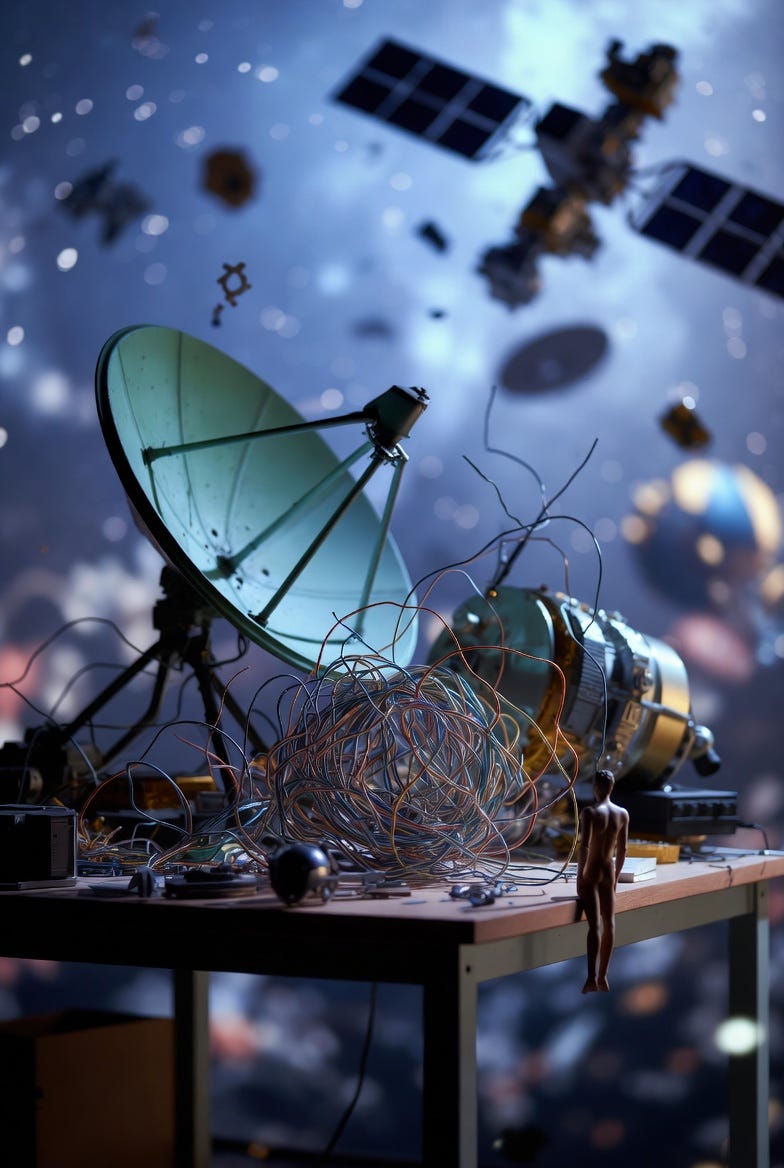
What if gravity isn’t just curved space? What if God gets lonely? The first crack. Kessler syndrome: orbital debris. Junk. Now, live and dead satellites, bolt casings, coffee thermos lids (who knows what astronauts let slip from hand’s grasp, most delicate of ‘things’ anywhere)—all floating 300 miles up, zinging along at ~17,000 mph. Enough mass, enough speed, they hit—create more junk—hit again—until you get that which is tantamount to a “wire bender,” except only thing unclogging that pipe is a nice long rigid line of base-60 ‘time’ at 30FPS-sputtering and stuttering, all sprinkled with trust-decay, liberally. No more satellites. No more GPS. No more porn at 4 a.m. when you’re trying to cry without being seen. That’s heaven falling and Chicken Little’s lost his ever lovin’ mind. Not fire, no brimstone, just silence and a debris field Anakin Skywalker would love to pick for parts. The most fascinating aspect? That the universe isn’t made of stuff—just like every kiss you ever gave (or, at least, tried and got laughed at and put in the ‘friend zone’ of loves’ atmosphere). Not lost—floating, spinning, dancing—waiting to be seen and remembered.
Gravity Equation
F = G m1 m2 / r² = Newton’s law of universal gravitation, where F is the force between two masses (m1 and m2), G is the gravitational constant, and r is the distance between them. This shows how force intensifies as distance shrinks—hubris embracing crisis. Metric: 13,158 satelites. 100K Project by 2030. Growth factor: 7.6x. ~!58 (without mitigation)
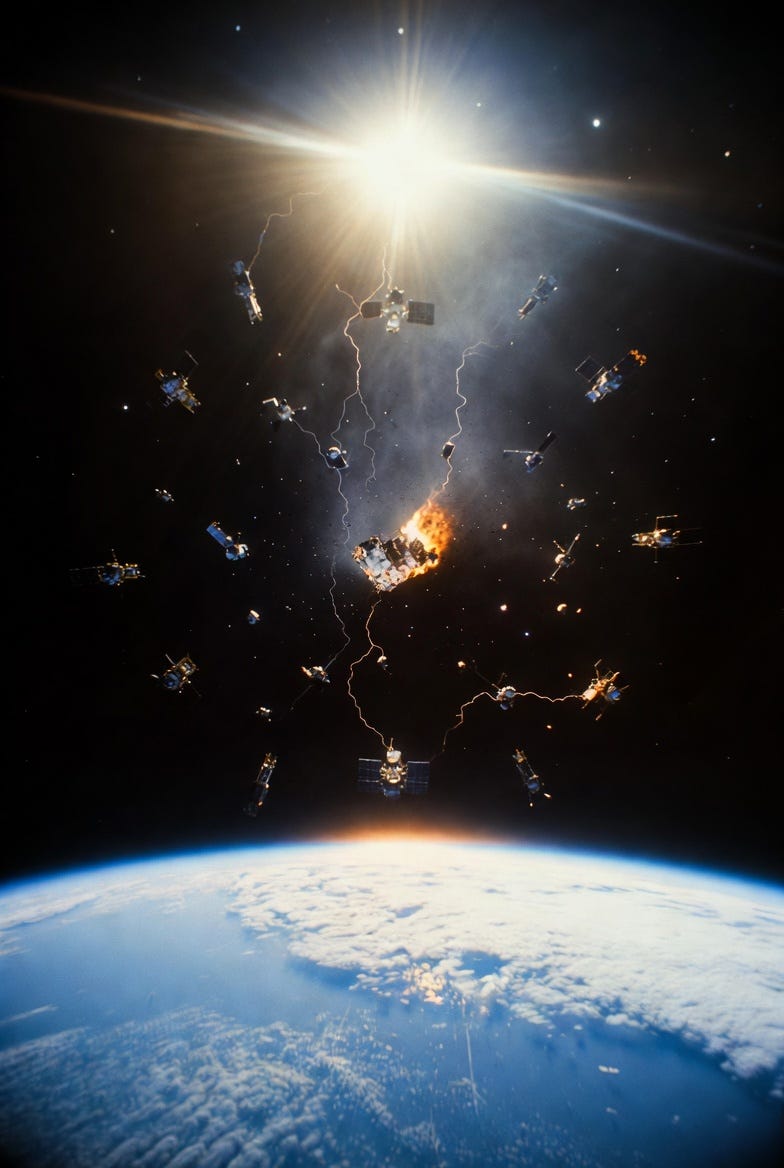
Yet, as the heavens whisper of their fragile balance, we must turn our gaze earthward, where the same laws of collision and consequence play out in silicon and software. In Our Gods Haven’t Crashed Yet, we twist this orbital poetry into terrestrial truth, exploring firmware pushes at scale as modern Babel’s bell begins to toll on our digital highways. Here, N-squared intimacy shifts from heavenly bodies to data streams, where hubris in code deployment births cascades not in space, but in our connected lives—ransomware storms, DDoS debris fields, system outages locking us from the cloud we trashed. This transition underscores our stewardship theme: dominion demands intention, not indiscretion. Whether guiding satellites home or shepherding AI updates, we vote with hands that remember—garden over graveyard, harmony over havoc. Let us act, lest our innovations become the very ghosts we fear.
“Our Gods Haven’t Crashed, Yet – A Silicon Junkies’ Riddle – Our Highway” → O’Connor, T. (2025). Zenodo. https://doi.org/10.5281/zenodo.17851041
No Responses