A Trick Question, The Cascade, and a Cup Worthy of Exile — A Script’ Junkies’ Riddle — Our Destiny (Movement 2 of 6)
“I said, ‘You are gods, and sons of the Most High, all of you. However, you will die like men, and you will fall like one of the princes.'” — Psalm 82:6-7 (LEB)
The Council Replication

Before We Continue
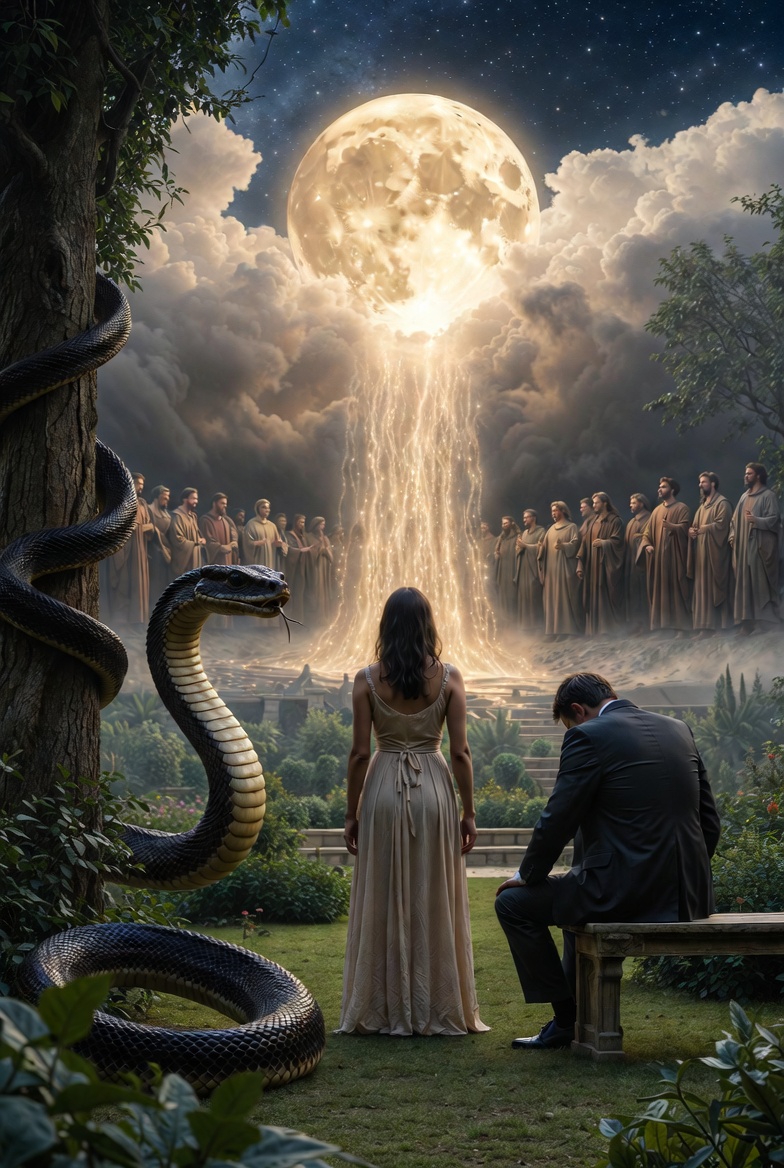
If you’ve arrived here from Movement I, you carry something now—the weight of a pattern seen. A garden bounded and tasked. A serpent’s question that made the clear negotiable. A woman’s evaluation that treated the creator’s word as one input among many. A man’s silence when he should have guarded. The cup refused. The cascade begun.
You may have hoped the pattern was local. A human failure in a human place, contained by the cherubim’s flaming sword. If only. Movement II lifts the gaze from earth to heaven—and finds the same pattern operating among beings who are not human. Divine council members, assigned to govern nations, refuse their cup. The mathematics don’t care about the substrate. The cascade scales the same whether the actors are carbon or spirit, mortal or immortal, earthly or celestial.
This is harder to read than Movement I. Not because the text is more difficult, but because the implications cut deeper. If gods fail the same way humans fail—if beings with direct access to divine presence still distort, evaluate, and defer—then the problem is not ignorance or circumstance. The problem is the structure of bounded authority granted to beings capable of refusing it. The problem is us. The problem is them. The problem is any being offered a cup and given the freedom to set it down.
But take heart. The cascade that compounds from two sources—human below, divine above—is still heading somewhere. The cup that fills from both streams is the same cup that will be offered in a later garden. The weight accumulates, yes. But the weight has a destination. Someone will drink what everyone else has spilled.
Breathe with me. The pattern ascends. And the end is not mathematical.

Register Warning
This paper operates in multiple registers simultaneously: empirical observation (N² mathematics, substrate-independence testing), theological exegesis (Hebrew Bible textual analysis, divine council scholarship), and historical reconstruction (ancient Near Eastern context).
These registers do not naturally cohere. Empirical claims about mathematical scaling cannot prove theological claims about divine beings. Theological interpretations of ancient texts cannot override empirical evidence about cascade mechanics. Historical reconstruction provides context but not verification of metaphysical claims.
Throughout this movement:
- Register transitions will be explicitly marked
- Confidence grades (Solid, Probable, Tentative, Speculative) will accompany claims
- Tier distinctions will be maintained: Corpus-Confirmed (what sources say) vs. Reality-Verified (whether what they say is true)
Audience note: bright children will find accessible explanations; scholars will find philological precision; neither audience should feel excluded.
Prologue: The Pattern Ascends
Movement I traced the origin. A garden, bounded and tasked. Two trees—one offering life within covenant, one offering power outside it. A serpent distorting, a woman evaluating, a man deferring. The cup of bounded limit refused. Cascade initiated. Isolation protocol enacted. The pattern established.
Now the pattern ascends. The same structure appears in the heavenly realm, among beings who are not human. Divine council members receive bounded authority over nations. They refuse their cup—the weight of just governance, the cost of protecting the vulnerable. The consequences cascade. The foundations of the earth go out of course.
[Register: Empirical thesis]
This is the critical demonstration, and the argument of Movement II hinges upon it: the mathematics of refusal are substrate-independent (Probable). The pattern operates identically whether the actors are human in a garden or divine in a council chamber. Distortion, evaluation, deferral. Bounded authority refused. Consequences compounding. N² scaling. The equation does not ask what kind of being is doing the refusing. It only asks: was the cup accepted or deflected?
Falsifier: This claim is falsifiable. If the biblical text portrayed divine beings as operating under fundamentally different structural conditions than humans—if their authority were unbounded, their task undefined, their covenant unspecified—then the parallel would collapse into metaphor. If the consequences of their refusal remained localized in heaven rather than cascading to earth, the N² pattern would fail to replicate across substrates. The reader should test these conditions against the evidence that follows.
Movement II traces the replication. We begin where the biblical text begins: with the council itself—its configuration, its delegation, and its failure.
“I said, ‘You are gods, and sons of the Most High, all of you. However, you will die like men, and you will fall like one of the princes.'” — Psalm 82:6-7 (LEB)
Movement 2
I. Initial Conditions: A Council Configured
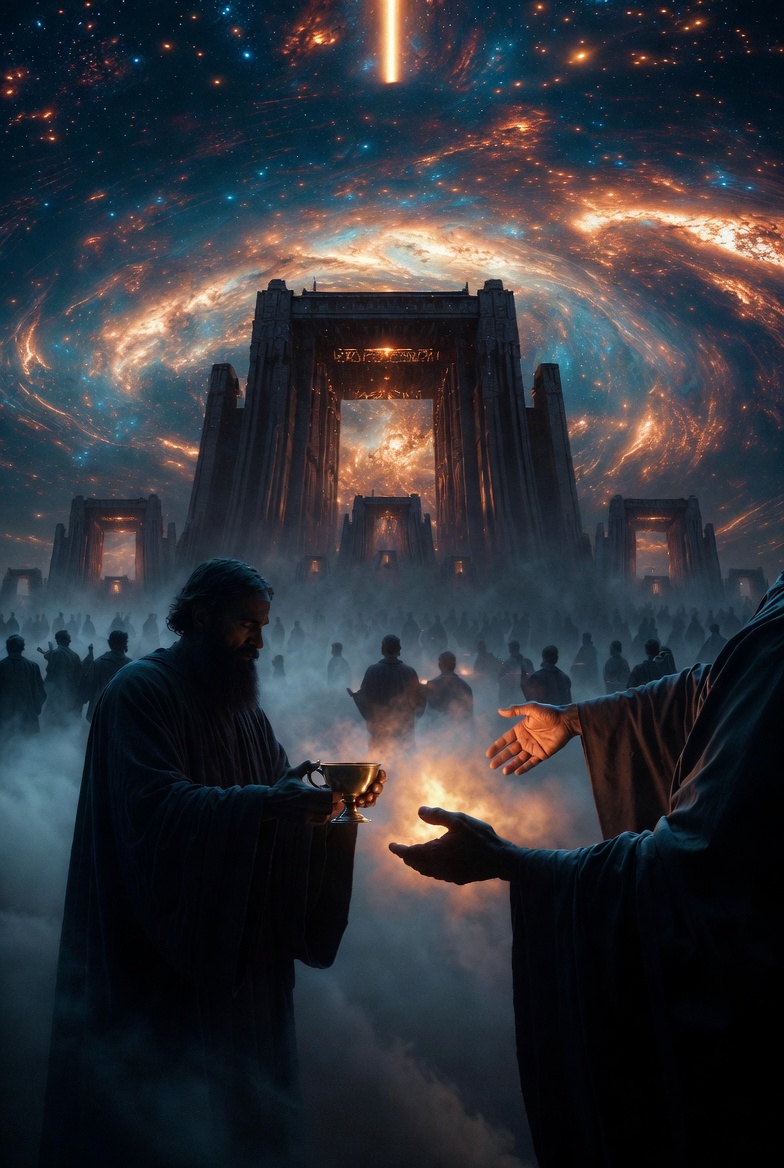
“God stands in the divine assembly; he administers judgment in the midst of the gods: ‘How long will you judge unjustly and show partiality to the wicked?'” — Psalm 82:1-2 (LEB)
Like the Garden, the divine council was an architecture—bounded, tasked, and covenanted. The parallel is not incidental. The same God who established conditions for human flourishing established conditions for cosmic governance. The structure is invariant because the God who structures is invariant.
Bounded
[Register: Philological analysis]
A philological note before theological interpretation. The Hebrew term ʾĕlōhîm (אֱלֹהִים) is grammatically plural but contextually flexible. It can refer to Yahweh (singular, as in Genesis 1:1) or to multiple divine beings (plural, as in Psalm 82:1, 6). The term’s semantic range has generated considerable scholarly debate.
[TIER MARKING] Michael Heiser’s philological analysis (Corpus-Confirmed: this is what Heiser argues) demonstrates that ʾĕlōhîm functions primarily as a locative or place-of-residence term—it designates inhabitants of the spiritual realm, not ontological equivalence with Yahweh. An ʾĕlōhîm is a being whose proper dwelling is the heavenly realm, regardless of that being’s rank, power, or moral status within that realm. Whether Heiser’s analysis is correct (Reality-Verified: Probable) requires assessment against alternative scholarly interpretations—but the reading coheres with the textual evidence and has achieved significant scholarly traction.
[Register: Theological interpretation]
Now the theological implication (Probable, given Heiser’s philological foundation). This means the council members have a bounded identity. They are defined by their station—their place in the cosmic hierarchy. They are not autonomous powers negotiating with Yahweh as equals. They are beings whose existence is constituted by their position within the divine administration. Remove them from that position, and they become something not what they were created to be. Their identity is not self-generated but role-derived.
The intuition is familiar from human institutions. A judge is a judge by virtue of appointment to the bench. Remove the appointment, and the person remains, but the judge does not. A soldier is a soldier by virtue of commission and assignment. Discharge the commission, and the person remains, but the soldier does not. The council members are divine beings by virtue of their station in the heavenly realm. Their boundaries are not geographic but positional—defined by role, rank, and assignment within the cosmic order.
The Garden had walls. The council has hierarchical order. Both are boundaries that define, not restrict.
Tasked
[Register: Text-critical analysis]
Deuteronomy 32:8-9 describes the original delegation: “When the Most High gave the nations their inheritance, when he divided humanity, he established the boundaries of the peoples according to the number of the sons of God. For Yahweh’s portion was his people; Jacob was his allotted inheritance” (LEB).
A text-critical note (Solid—the manuscript evidence is publicly verifiable). The Masoretic Text reads “sons of Israel” (bĕnê yiśrāʾēl), but the Dead Sea Scrolls manuscript 4QDeutj and the Septuagint preserve an earlier reading: “sons of God” (bĕnê ʾĕlōhîm / υἱῶν θεοῦ). The scholarly consensus, reflected in the LEB translation, favors the earlier reading as original, with “sons of Israel” representing a later theological correction to avoid the implication of a divine council. The textual evidence is significant: it suggests that ancient Israelite scribes recognized the passage’s claim and found it sufficiently troubling to emend.
[Register: Theological interpretation]
The implication is striking (Probable, given the text-critical foundation). When God divided humanity into nations after Babel, he assigned divine beings to govern them. Only Israel he kept for himself—”Yahweh’s portion was his people.” The other nations received delegated governance; Israel received direct governance. This is not polytheism; it is delegation. The divine beings govern on behalf of and accountable to Yahweh, not as independent powers.
The task was governance. Real authority over real peoples. The nations’ welfare depended on how these stewards exercised their charge. Like Adam tasked to ʿāḇaḏ and šāmar—to serve and guard the Garden—the council members were tasked to serve and guard the nations. Stewardship, not ownership. Delegation, not autonomy. The parallel with Eden is structural, not decorative.
Covenanted
[Register: Textual exegesis]
Psalm 82 reveals the covenant’s terms (Corpus-Confirmed: this is what the text says). The council members were to “Give justice to the weak and the fatherless; vindicate the afflicted and the poor. Rescue the weak and the needy; deliver them from the hand of the wicked” (Psalm 82:3-4, LEB). These are not suggestions. They are the conditions of the delegation—the performance criteria against which the stewards will be evaluated.
The covenant has consequences, and the text states them in advance: “I said, ‘You are gods, and sons of the Most High, all of you. However, you will die like men, and you will fall like one of the princes'” (Psalm 82:6-7, LEB). The status—”gods,” “sons of the Most High”—is granted. The consequence of failure—mortality, falling—is stated without ambiguity. The beings who were created immortal will experience mortality if they corrupt their stewardship. No hidden terms. No fine print.
[Register: Pattern analysis]
The structure mirrors the Garden covenant precisely (Solid—the structural parallel is demonstrable): permission (divine status, authority over nations), prohibition (implied: do not corrupt this trust, do not favor the wicked over the vulnerable), consequence (death like mortals). The parallel is not analogy but identity. The same covenantal architecture governs both human and divine stewardship.
The Configuration Named
Bounded by station. Tasked with governance. Covenanted to justice with stated consequences. The divine council was configured for flourishing—cosmic flourishing, where heaven’s administration produces earthly welfare. The nations were to experience good governance flowing downward from faithful stewards. The vulnerable were to find protection. The wicked were to face accountability. The foundations of the earth were to remain stable.
The configuration involved a trade-off. The council members received real authority—the power to shape nations’ destinies, to be honored as “gods” by their charges, to participate in cosmic governance. In exchange, they accepted real constraint—accountability to Yahweh, obligation to the vulnerable, the requirement to absorb cost, not extract benefit. What was gained was significance within the divine purpose. What was sacrificed was autonomy from that purpose. The trade-off is identical to Eden’s: received authority within covenant versus grasped autonomy outside it.
Remove any element, and the configuration collapses. Which is precisely what happened.
II. The Sons as Boundary Architecture
The council members—the “sons of God”—occupy a structural position analogous to the two trees in the Garden. They embody the choice between received authority and grasped autonomy, between stewardship that absorbs cost and exploitation that extracts it.
The Cup of Stewardship
[Register: Moral analysis]
To govern justly is costly (Solid—verifiable from any institutional context). Defending the fatherless means opposing those who exploit them—and those who exploit the fatherless are typically powerful, connected, dangerous. Delivering the needy means confronting the structures that create need—and those structures are typically maintained by those who benefit from them. Vindicating the afflicted means rendering judgments that the wicked will resent—and the wicked, by definition, do not accept correction gracefully.
The pattern is visible wherever authority is exercised. A judge who rules against a powerful defendant faces pressure, retaliation, and career consequences; the judge who accommodates power faces none. A regulator who enforces against a wealthy corporation faces lobbying, litigation, and political pressure; the regulator who accommodates faces lucrative post-government employment. A pastor who confronts a major donor’s sin faces the loss of that donor and the donor’s network; the pastor who accommodates faces continued financial stability. The cup of stewardship is always costly. The question is whether the cost will be borne by the steward or deflected onto the vulnerable.
[Register: Structural analysis]
This is the cup offered to every being granted authority: Will you bear the weight that authority requires? Will you accept the cost of protecting those under your care? Or will you deflect that cost onto them, using your position for extraction instead of service?
The Tree of Life offered immortality within covenant—received gift, sustained by relationship with the source. The cup of stewardship offers significance within delegation—received authority, exercised for others, not oneself. Both require not grasping. Both require accepting limits. Both require drinking what is offered, not seizing that which is forbidden. The Tree of Life and the cup of stewardship are structural parallels: channels through which blessing flows when the recipient remains in proper relation to the giver.
The Alternative: Autonomy
[Register: Pattern analysis]
The Tree of Knowledge offered autonomous moral determination—the power to decide for oneself what constitutes good and evil. The council members face an analogous temptation: autonomous governance. Using delegated authority for self-enrichment, not others’ welfare. Favoring the wicked (who offer bribes, alliances, worship) over the vulnerable (who offer nothing but satisfaction of doing that which is right).
Psalm 82:2 names the failure in the text’s own terms (Corpus-Confirmed): “How long will you judge unjustly and show partiality to the wicked?” (LEB). The Hebrew phrase rendered “show partiality” is nāśāʾ pānîm (נָשָׂא פָנִים)—literally, “lift the face.” The idiom appears throughout the Hebrew Bible as the technical term for showing favoritism. To “lift the face” of someone is to grant them favorable attention, to privilege their interests, to see them while ignoring others. The council members have inverted their mandate. Instead of lifting the faces of the weak and fatherless, they lift the faces of the wicked. Instead of defending the vulnerable against the powerful, they defend the powerful against accountability.
This is the knowledge of good and evil enacted at cosmic scale: determining for themselves what constitutes good governance, independent of the covenant that defined their task. The cup of stewardship refused. The cup of autonomy seized. The same refusal, the same structure, different actors.
III. The Refusal: A Sequence Replicated
Movement I identified the Garden’s refusal sequence: distortion, evaluation, deferral. The same sequence operates in the council, now at cosmic scale with cosmic actors. The structure is invariant; only the substrate changes.
Movement A: Distortion
[Register: Pattern analysis]
The serpent asked: “Has God indeed said?” The council members face the same question about their mandate (Probable—the text does not record their deliberation, but the verdict reveals the cognitive state that preceded it). Did God really mean for us to sacrifice our interests for these creatures? Did God really expect us to confront the powerful on behalf of the powerless? Did God really intend this costly stewardship, or is there room for interpretation? Surely the mandate to defend the fatherless admits of nuance. Surely the command to deliver the needy allows for prioritization. Surely “vindicate the afflicted” does not mean “antagonize the wealthy.”
The distortion is not recorded in direct speech—the text gives us the verdict without the deliberation. But the verdict reveals what must have preceded it. “They do not know, and they do not understand; they walk about in the darkness” (Psalm 82:5, LEB). The Hebrew lōʾ yāḏĕʿû wĕlōʾ yāḇînû indicates a state of cognitive failure. These beings who were given clear mandate now “do not know.” The mandate that was clear has become obscure. The covenant that was plain has become negotiable. They have entered darkness—and darkness, in the Hebrew Bible, is never merely the absence of light but the presence of confusion, chaos, and moral disorientation.
This is the darkness that precedes all refusal: the boundary made questionable. Not denied—just unclear. Not rejected—just reinterpreted. The first movement in the cascade is always the same: make the clear command a matter for discussion.
Movement B: Evaluation
[Register: Pattern analysis]
The woman saw that the tree was good for food, pleasant to the eyes, desired for wisdom. She evaluated the forbidden against her own criteria instead of accepting the word that forbade it. The council members perform the same evaluation with different variables (Probable—the pattern is reconstructed from the verdict).
The wicked offer benefits: worship, tribute, alliance. Nations build temples to their assigned divine beings; rulers offer sacrifices; populations provide the psychic sustenance of adoration. The vulnerable offer nothing comparable. The orphan cannot build temples. The widow cannot offer tribute. The poor cannot forge alliances. By any self-interested calculus, favoring the powerful is the rational choice. The evaluation treats the covenant mandate as one input among many, to be weighed against personal advantage—and the scale tips predictably toward those who can pay.
“Show partiality to the wicked.” The Hebrew for “show partiality” (nāśāʾ pānîm) is, as noted, “lift the face.” The council members lift the faces of those who can benefit them while averting their gaze from those who cannot. The evaluation is complete. The cost-benefit analysis favors autonomy over stewardship, extraction over service, the powerful over the vulnerable.
Movement C: Deferral
[Register: Pattern analysis]
Adam was present throughout the serpent’s exchange with Eve and said nothing. He deferred his responsibility to guard. When confronted, he deflected blame to the woman and to God who gave her. The council members enact the same deferral at cosmic scale (Probable—the pattern is inferred from consequence).
The council members defer their responsibility to protect. The poor remain undefended—and the text names this failure directly, not abstractly. The fatherless remain exploited—children without advocates, subject to those who would use them. The afflicted remain in the hand of the wicked—the Hebrew yad (יָד, “hand”) indicating power, control, domination. The beings appointed to guard do not guard. The stewards do not steward. The divine beings assigned to rescue the needy leave the needy in the grip of their oppressors.
And when the consequences manifest—when “all the foundations of the earth are shaken” (Psalm 82:5, LEB)—the responsibility is nowhere to be found. The darkness they walked into has become the darkness they spread. The nations suffer, but the council members have insulated themselves from accountability. The pattern is complete: distort the mandate, evaluate against self-interest, defer responsibility for the consequences.
The Sequence Confirmed
Three actors in Eden, three failures: the serpent distorts, the woman evaluates, the man defers. The council replicates the pattern (Probable): the mandate is distorted (they walk in darkness, not knowing), the options are evaluated (showing partiality to the wicked), responsibility is deferred (the vulnerable remain undefended). The Garden sequence replicates at cosmic scale.
[Register: Empirical thesis]
The mathematics are substrate-independent (Probable). The pattern does not require carbon-based actors, mortal timelines, or earthly geography. It requires only three conditions: bounded authority granted, refusal sequence available, consequences that propagate. Given these conditions, the cascade follows. The equation does not ask what kind of being is refusing. It only asks whether the cup was accepted or deflected.
IV. The Consequences: Cascade Across Domains
The Garden’s refusal cascaded across four domains: self-relation, inter-human relation, human-creation relation, human-divine relation. The council’s refusal cascades across corresponding cosmic domains. The parallel is structural, not decorative.
Domain 1: Cosmic Order
[Register: Textual exegesis]
“All the foundations of the earth are shaken” (Psalm 82:5, LEB). The Hebrew môṭ (מוֹט) means to totter, to slip, to be destabilized. The môsĕḏê ʾereṣ—the foundations of the earth—are not merely the physical ground but the structural substrate of earthly existence, the ordering principles that make stable life possible. When the council corrupts its governance, the very foundations of earthly existence are affected.
[Register: Causal analysis]
This is not metaphor (Probable). The claim is causal, not symbolic. If the beings assigned to govern nations govern unjustly, the nations suffer. If the nations suffer, their peoples suffer. If peoples suffer across the earth, the earth itself bears the weight of accumulated injustice. The physical and the political are not separate domains; they are coupled systems. Corrupted governance produces corrupted conditions produces corrupted outcomes. The cascade flows from heaven’s administration to earth’s experience.
Domain 2: National Welfare
[Register: Textual evidence]
Daniel 10 provides a window into the ongoing corruption (Corpus-Confirmed: this is what Daniel 10 describes). The angel tells Daniel: “The prince of the kingdom of Persia was standing against me for twenty-one days, but Michael, one of the chief princes, came to help me” (Daniel 10:13, LEB). Later: “I must return to fight against the prince of Persia. And when I go, the prince of Greece is coming” (Daniel 10:20, LEB). These “princes” (śar, שַׂר) are not human rulers—the text distinguishes them from the human kings of Persia and Greece who also appear in the chapter. They are the council members, still in position centuries after Psalm 82’s indictment, still exercising authority, but now in opposition to divine purposes, not alignment with them.
[Register: Theological interpretation]
The nations assigned to these beings experience their corruption as war, oppression, injustice, and idolatry (Probable—this is interpretive synthesis). What looks from below like human politics—Persia’s policies, Greece’s conquests—is shaped from above by celestial dereliction. The cascade flows from heaven to earth. The council members who were meant to foster the nations’ welfare instead become obstacles to divine intervention on their behalf.
Domain 3: Human Corruption
[Register: Pattern analysis]
Under corrupted governance, humans learn corruption (Probable). The council members “show partiality to the wicked”—and human rulers learn to do the same. The pattern established in heaven becomes the pattern practiced on earth. Power protects power. Vulnerability is exploited. The strong devour the weak. The model provided from above becomes the template implemented below.
The cascade compounds across levels. Pharaoh’s court shows partiality to Pharaoh’s interests; Egyptian taskmasters show partiality to their own ease; Hebrew slaves bear the cost of the entire system’s corruption. Ahab’s throne shows partiality to Ahab’s desires; Jezebel shows partiality to her religious agenda; Naboth loses his vineyard and his life. Pilate’s judgment seat shows partiality to political stability; the Sanhedrin shows partiality to institutional preservation; an innocent man is crucified. Divine corruption produces national corruption; national corruption produces institutional corruption; institutional corruption produces individual corruption. Each level amplifies the next. The N² scaling operates across multiple substrates simultaneously.
Domain 4: Theological Confusion
[Register: Pattern analysis]
The nations, governed by corrupted divine beings, develop corrupted worship (Probable). The council members who were meant to point the nations toward Yahweh instead become objects of worship themselves—or redirect worship toward created things, toward images, toward the forces of nature they were appointed to administer. Idolatry is downstream of celestial dereliction.
This is why Israel’s calling is so distinctive (Probable—interpretive synthesis). Yahweh kept Israel as “his own portion” precisely because the other nations were assigned to beings who would fail. Israel was to be the demonstration project—what a nation looks like when governed directly by the faithful God, not through corrupted intermediaries. If the demonstration succeeds, the nations have an alternative model. If the demonstration fails, the universality of corruption is confirmed. The stakes of Israel’s calling are cosmic, not merely national. Israel’s faithfulness or failure tests whether any governance—human or divine—may resist the cascade.
The Quadratic Structure
[Register: Mathematical analysis]
Four domains, each corrupted, each corrupting the others (Solid—the structural analysis is demonstrable). Celestial dereliction produces earthly destabilization—that is one connection. National corruption produces human corruption—that is a second. Human corruption produces theological confusion—that is a third. And theological confusion—worship of the corrupted governors—reinforces their power to continue corrupting, which feeds back into celestial dereliction. The cascade loops.
Count the interactions. Four domains with bidirectional corruption pathways means twelve potential connections (each domain affecting the other three, in both directions). Each connection amplifies the others. Celestial corruption that produces national corruption that produces human corruption that produces theological confusion that reinforces celestial corruption is not four sequential events but a compounding system. The mathematics are quadratic because the interactions multiply: one refusal among the council, N² consequences across creation.
V. Demotion: Isolation Protocol, Not Mere Punishment
“I said, ‘You are gods, and sons of the Most High, all of you. However, you will die like men, and you will fall like one of the princes'” (Psalm 82:6-7, LEB).
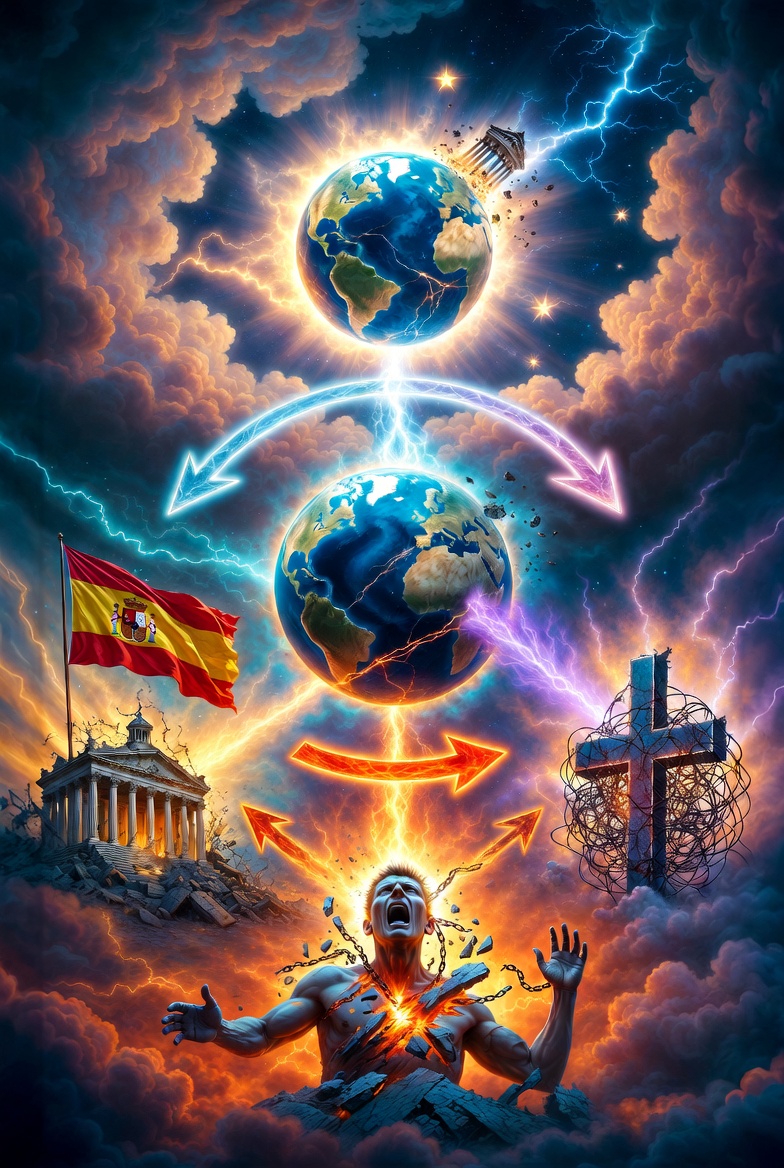
The sentence is striking. Beings created immortal will experience mortality. Beings stationed in heaven will “fall like one of the princes”—the Hebrew kĕʾaḥaḏ haśśārîm (כְּאַחַד הַשָּׂרִים) suggests falling like a human ruler, being toppled from power as earthly princes are toppled. The divine becomes mortal. The eternal becomes finite. The exalted becomes fallen.
The Stated Reason
[Register: Theological analysis]
Like Eden’s expulsion, the demotion has a purpose beyond punishment (Probable—the parallel is interpretive). The logic parallels exactly. If the humans had remained in the Garden with access to the Tree of Life, they would have lived forever in corrupted state—and the cascade would have compounded eternally. Expulsion prevented eternal existence in fallen condition. The demotion serves the same function at cosmic scale.
If the council members were to continue forever in their corrupted governance, the nations would suffer forever under corrupted rule. The foundations of the earth would remain shaken eternally. The cascade would compound without limit. Mortality limits the damage. A corrupted governor who dies like a man can be replaced. An eternal corrupted governor perpetuates corruption eternally. The demotion is an isolation protocol: accept bounded loss (the death of the offenders) to prevent unbounded loss (eternal corruption of the nations).
The Limitation Named
[Register: Structural analysis]
But note what demotion does not accomplish (Solid—demonstrable from the narrative). It removes the offenders—eventually. It does not remove the corruption they introduced. The nations have already learned unjust governance from their celestial models. Human rulers have already adopted the pattern of showing partiality to the wicked. Idolatry has already taken root in populations that learned to worship their assigned gods, not Yahweh. The debris of the council’s failure persists even when the council members themselves are demoted.
The mechanism of persistence is clear. Patterns, once established, outlive their originators. A corporation’s corrupt culture persists after the corrupt founders depart. A nation’s unjust institutions persist after the unjust founders die. A family’s dysfunction persists across generations after the original dysfunctional members are gone. The council’s corruption has been institutionalized in human systems. Removing the council does not remove what the council taught.
Demotion addresses actors, not the pattern they instantiated. It punishes the offenders but does not heal what they corrupted. It is a partial reset—necessary but insufficient. The cascade continues because the conditions for cascading continue. The N² debris accumulates even as the original N is being removed.
VI. The Mathematical Confirmation
Movement II demonstrates that the N² pattern is substrate-independent. We can now state this explicitly as a theorem.
The Substrate Independence Theorem
[Register: Formal analysis]
The Garden established the pattern with human actors. The council replicates it with divine actors. The structure is identical (Solid—the structural parallel is demonstrable):
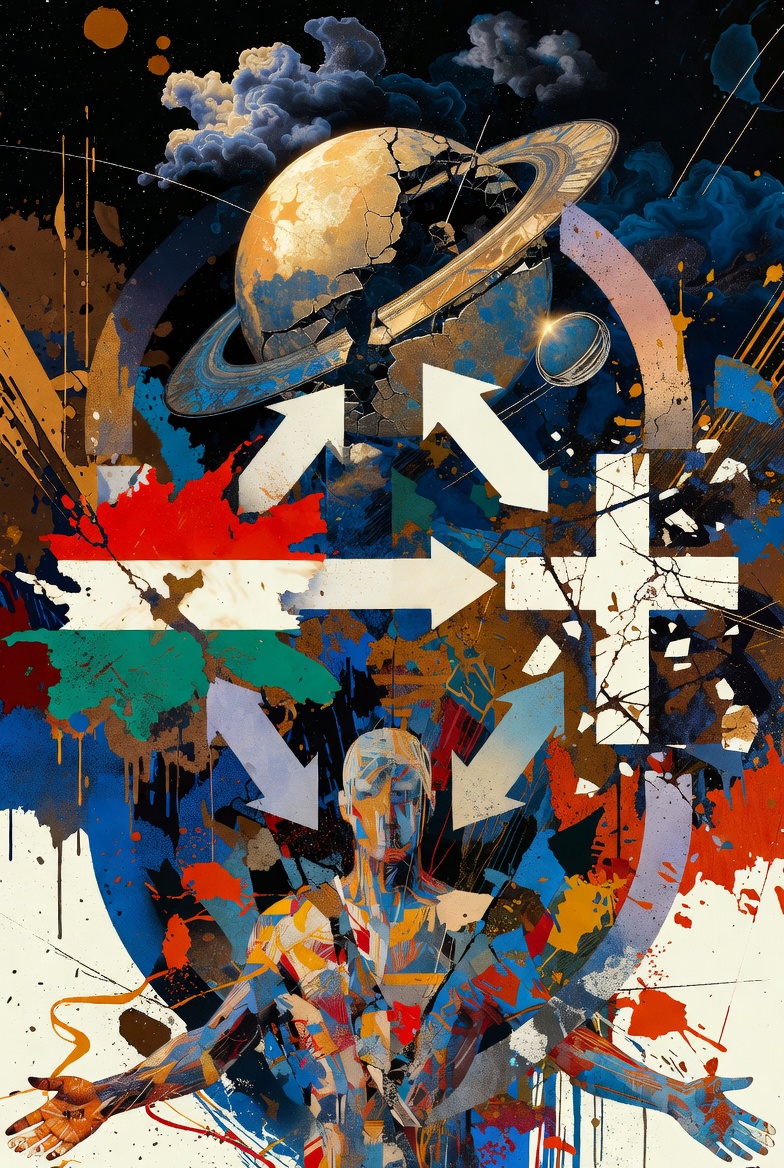
Bounded authority granted → Refusal sequence initiated (distort, evaluate, defer) → Cup deflected → Consequences cascade across domains → Configuration degrades → Isolation protocol enacted → Debris persists beyond punishment
The mathematics do not ask whether the actors are carbon-based or spirit-based, mortal or immortal, earthly or celestial. The pattern operates wherever bounded authority is granted to beings capable of refusing it. N refusals produce N² consequences because each refusal corrupts the configuration for subsequent choices. This is not analogy. It is structure. The same equation governs both cascades because the same relational dynamics produce them.
Falsifier: The theorem would be falsified if we could identify a substrate where bounded authority is granted, the refusal sequence operates, but consequences fail to cascade. If divine beings could refuse their mandate without affecting national welfare, or if human refusal could proceed without corrupting subsequent human choices, the substrate independence claim would fail. The evidence from both Eden and the council shows no such exception. In both cases, refusal cascades. In both cases, the cascade follows quadratic scaling. The theorem holds (Probable).
The Accumulation Problem
[Register: Mathematical analysis]
The Garden’s cascade produced debris that the humans carried out of Eden—shame, blame, the pattern of refusal itself, now embedded in human nature. The council’s cascade produces debris that propagates down to earth—corrupted governance, learned injustice, institutionalized partiality. Now there are two sources of debris: human corruption originating in the Garden, and divine corruption descending from the council. The debris fields overlap. The cascades compound.
This is why the weight accumulates faster than any single-source analysis would predict (Probable). The total cascade is not Garden plus Council—that would be addition. It is Garden times Council—that is multiplication. The corruptions multiply because they reinforce each other. Human tendency to refuse is amplified by celestial modeling of refusal; if even the gods show partiality to the wicked, why shouldn’t human rulers? Celestial corruption is enabled by human worship of the corrupted; the council members’ power persists because the nations continue to venerate them. The interaction term dominates.
The cup that must eventually be consumed—the cup that will appear in Gethsemane—contains the accumulated weight of both cascades. Human and divine. Earthly and celestial. All the N² debris of all the refusals since the beginning, compounded by their interaction.

Coda: The Pattern Descends
The Garden established the pattern. The council replicated it. Now the pattern will descend further—among the Watchers who abandon their station entirely, crossing the boundary between heaven and earth to produce offspring that should not exist.
Movement III will trace this descent and the accumulated weight it produces. The Watchers do not merely corrupt their governance; they abandon it. They do not merely fail at their task; they leave it. The transgression escalates from corruption within role to departure from role. And the debris they produce—the Nephilim, the violence, the forbidden knowledge—will require a reset far more comprehensive than any before: the Flood.
But we already know, from Movement I’s framework, that partial resets cannot terminate cascades (Probable—will be demonstrated in Movement III). They address actors, not patterns. They remove offenders, not debris. The Flood destroys the corrupted generations but the corrupted pattern remains intact and preserved in Noah’s line. Babel’s dispersion fragments the coordinated ambition and redistributes the corruption across seventy nations—the same nations assigned to the same council members whose corruption persists. The resets multiply the cascade’s distribution while failing to address its generator.
The weight accumulates. The cup fills. And somewhere, at the end of the accumulation, waits a garden where the cup will finally be accepted.
But we are in Movement II. The pattern has replicated. The cascade has doubled its sources. The configuration continues to degrade.
The descent begins.
— End of Movement II —
Our Gods Research Program, January 2026
References
- Our Gods Haven’t Fallen, Yet — A Space Junkies’ Riddle — Our Cathedral. Zenodo. https://doi.org/10.5281/zenodo.17835722 O’Connor, T. (2025).
- Our Gods Haven’t Crashed, Yet — A Silicon Junkies’ Riddle — Our Highway (1.7). Zenodo. https://doi.org/10.5281/zenodo.17851041 O’Connor, T. (2025).
- Our Gods Haven’t Computed Yet — A Neural Junkies’ Riddle — Our Cloud (1.7). Zenodo. https://doi.org/10.5281/zenodo.17925255 O’Connor, T. (2025).
- An Epi-Phenomenological Series in Thrice — A Quantum Junkies’ Riddle — Our Garden. Zenodo. https://doi.org/10.5281/zenodo.17926796 O’Connor, T. (2025).
- A Spectral Evolution of Scalar Breathing — A Cosmological Junkies’ Riddle — Our Heavens (5.0r2). Zenodo. https://doi.org/10.5281/zenodo.17942325 O’Connor, T. (2025).
- The Bare, Naked Lie: The Architecture of Recursion. Zenodo. https://doi.org/10.5281/zenodo.18287548 O’Connor, T. (2026).
- A Trick Question, The Cascade, and a Cup Worthy of Exile — A Script’ Junkies’ Riddle — Our Destiny. Zenodo. O’Connor, T. (2026).
- M1 — 10.5281/zenodo.18425900
- M2 — 10.5281/zenodo.18446123
- M3 — 10.5281/zenodo.18450837
- M4 — 10.5281/zenodo.18451819
- M5 — 10.5281/zenodo.18452359
- M6 — 10.5281/zenodo.18452617
Copyright Notice
A Trick Question, The Cascade, and a Cup Worthy of Exile — A Biblical Junkies’ Riddle — Our Destiny
Echoes from the Architecture of Recursion.
© 2026 Tony O’Connor. All rights reserved.
Publication: Our Gods Research Program
Date: January 2026
License
This work is licensed under the Creative Commons Attribution-NonCommercialNoDerivatives 4.0 International License (CC BY-NC-ND 4.0).
You are free to:
- Share — copy and redistribute the material in any medium or format
Under the following terms:
- Attribution — You must give appropriate credit, provide a link to the license, and indicate if changes were made.
- NonCommercial — You may not use the material for commercial purposes.
- NoDerivatives — If you remix, transform, or build upon the material, you may not distribute the modified material.
Full license text: https://creativecommons.org/licenses/by-nc-nd/4.0/
Citation
O’Connor, T. (2026). A Trick Question, The Cascade, and a Cup Worthy of Exile: A Biblical Junkies’ Riddle—Our Destiny. Our Gods Research Program. Zenodo. [10.5281/zenodo.18425900]
Contact
For permissions beyond the scope of this license, contact the author through the Our Gods Research Program.
The mathematical notation (N², N†), theological framework, and structural architecture presented in this work are original contributions by the author.
No Responses