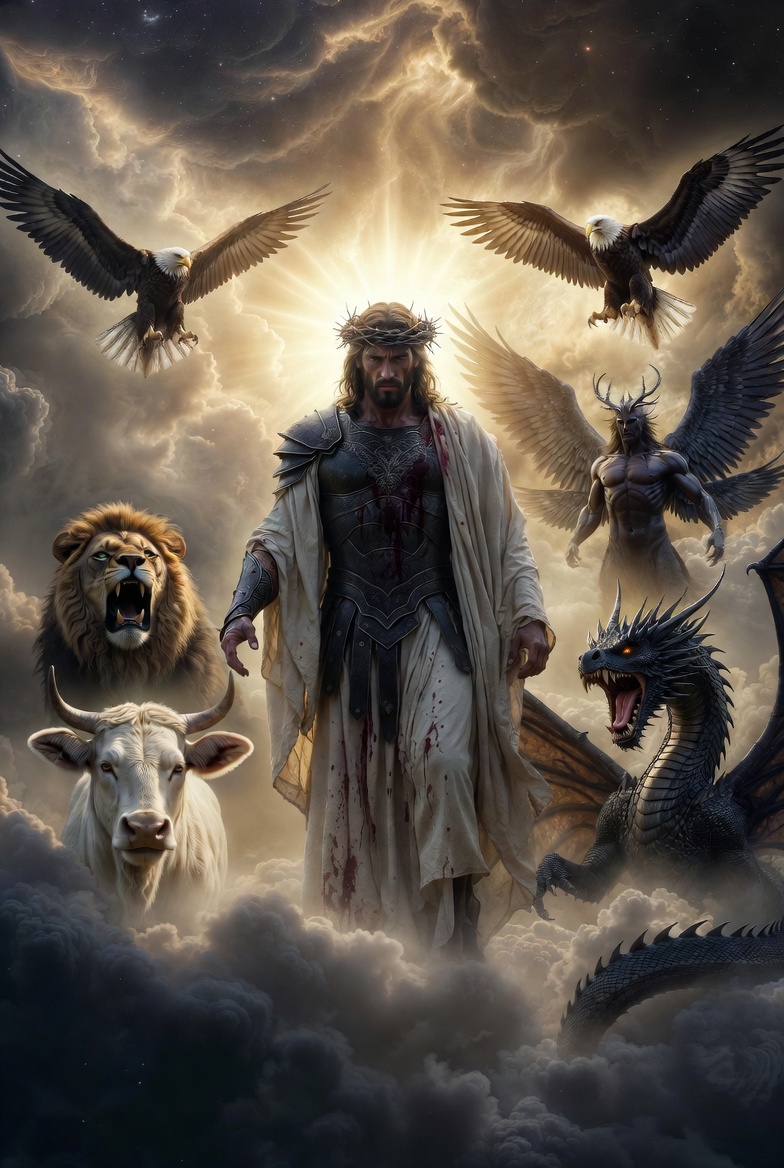
A Trick Question, The Cascade, and a Cup Worthy of Exile — A Script’ Junkies’ Riddle — Our Destiny (Movement 6)
“And Yahweh God commanded the man, saying, ‘From every tree of the garden you may freely eat, but from the tree of the knowledge of good and evil you shall not eat, for in the day that you eat from it you shall surely die.'” — Genesis 2:16-17 (LEB)
A Cognitive Threshold
Before We Continue
A note on what follows: Movement VI is optional. The N† terminus established in Movement V stands without the speculative material that follows. If you are satisfied that the cascade terminates at Golgotha and do not require further exploration of why the terminus occurs at age 33, or how the cognitive architecture of the first humans relates to the last Adam’s choice—skip this movement. The core argument is complete. What follows is resonance, not foundation.
If you’ve arrived here from Movements I through V, you have witnessed the full arc: origin, replication, failed resets, debris accumulation, and terminus. The cup was refused in Eden. The cup was consumed at Gethsemane. Tetelestai—it is finished. The cascade that began with one refusal in one garden terminated with one acceptance in another garden. N² met N†. The weight was absorbed.
Movement VI asks what lies beyond tetelestai. Not chronologically—what happened next—but architecturally—what the terminus makes possible. The question is cognitive: could Adam and Eve have chosen otherwise? Did they possess the neural architecture to genuinely assess risk, model long-term consequences, and make fully informed decisions? Or was the cascade structurally inevitable given their developmental state?
This movement ventures into speculation. The prefrontal cortex—seat of executive function, impulse control, consequence modeling—does not fully myelinate until approximately age 25-33. Christ was crucified at approximately age 33. The correlation may be coincidence. It may be design. Movement VI explores the possibility that the N† terminus occurred at the precise moment when human cognitive capacity reaches its apex—the first human to face the full weight of the cascade with a fully developed prefrontal cortex making a fully informed choice.
The claims here carry lower confidence grades than earlier movements. Parts are marked Speculative. Falsifiers are stated. The reader should calibrate expectations accordingly. Moreover, the volitional core remains untouched: whatever the cognitive architecture of the first humans, the last Adam chose. The constrained origin makes the unconstrained terminus meaningful.
Breathe with me. The threshold that pre-N† humanity couldn’t cross now exists for all who will cross it.
Register Warning
This paper operates in multiple registers simultaneously: empirical observation (neurodevelopmental timelines, prefrontal maturation data), theological exegesis (Genesis narrative, Christological interpretation), philological analysis (Hebrew terms, divine council scholarship), and speculative synthesis (substrate upgrade hypothesis, Kardashev framework).
These registers do not naturally cohere. Empirical claims about brain development cannot prove theological claims about Eden. Theological interpretations cannot override neuroscientific evidence. Speculative frameworks illuminate possibilities but do not verify metaphysical claims.
Throughout this movement:
- Register transitions will be explicitly marked
- Confidence grades (Solid, Probable, Tentative, Speculative) will accompany claims
- Tier distinctions will be maintained: Corpus-Confirmed (what sources say) vs. Reality-Verified (whether what they say is true)
- Speculative sections will be clearly marked with appropriate epistemic caution
Audience note: bright children will find accessible explanations; scholars will find philological precision; neither audience should feel excluded.
Prologue: The Threshold Crossed
Movement I traced the origin. One garden, one refusal, cascade initiated. Movement II traced the replication. One council, many refusals, cascade compounded. Movement III traced the failed resets. Flood and Babel—debris redistributed, not absorbed. Movement IV traced the long accumulation. Two millennia proving the cascade constitutional, not circumstantial. Movement V traced the terminus. One garden, one cup, one acceptance. Tetelestai.
Now we ask what lies beyond tetelestai. Not chronologically—what happened next—but architecturally: what the terminus makes possible, and why it occurred when and how it did.
[Register: Speculative thesis]
This movement ventures into territory the prior movements avoided. The claims here carry lower confidence grades. The reader should calibrate expectations accordingly.
The question is cognitive: could Adam and Eve have chosen otherwise? Did they possess the neural architecture to genuinely assess risk, model long-term consequences, and make fully informed decisions? The prefrontal cortex—seat of executive function, impulse control, consequence modeling—does not fully myelinate until approximately age 25-33. Christ was crucified at approximately age 33. The correlation may be coincidence. It may be design.
Movement VI explores the possibility that the N† terminus occurred at the precise developmental threshold when human cognitive capacity reaches its apex—the first human to face the full weight of the cascade with fully developed prefrontal architecture making a fully informed choice. The constrained origin makes the unconstrained terminus meaningful.
Falsifier: This exploration would collapse if the myelination timeline were shown to complete significantly earlier than 25, or if Christ’s age at crucifixion were shown to diverge significantly from 33. It would also collapse if evidence emerged that pre-Fall humans possessed cognitive architecture fundamentally different from post-Fall humans.
The volitional core remains untouched. Even if every speculation in this movement fails, the N† terminus stands. Christ chose. The cup was consumed. The cascade terminated. Movement VI asks why the timing—not whether it happened.
Movement VI examines the threshold. We begin where terminus ends: with the question of what kind of choice was finally made, and what that choice makes possible.
“And Yahweh God commanded the man, saying, ‘From every tree of the garden you may freely eat, but from the tree of the knowledge of good and evil you shall not eat, for in the day that you eat from it you shall surely die.'” — Genesis 2:16-17 (LEB)
A Cognitive Threshold – Movement 6
I: The Constrained Origin
Confidence Grade: Probable
The Empirical Foundation
The prefrontal cortex is the seat of executive function: planning, impulse control, consequence modeling, risk assessment, and the capacity to delay gratification for long-term benefit. It is the last region of the brain to fully myelinate. The timeline for completion has been revised upward repeatedly as longitudinal studies have accumulated data.
Three data points establish the pattern:
First: Gogtay et al. (2004), published in the Proceedings of the National Academy of Sciences, used longitudinal MRI scanning to demonstrate that gray matter maturation proceeds from back to front, with the prefrontal cortex completing development last—well into the third decade of life. The study tracked 13 subjects from ages 4-21 and found that frontal lobe maturation continued beyond the study’s endpoint.
Second: Lebel and Beaulieu (2011), published in NeuroImage, examined white matter development via diffusion tensor imaging in 403 subjects aged 5-32. They found that frontal white matter tracts continued developing into the early thirties, with some tracts not reaching asymptote until age 30-32.
Third: Petanjek et al. (2011), published in PNAS, examined synaptic density in the prefrontal cortex across the lifespan using postmortem tissue. They found that synaptic pruning—the refinement process that optimizes neural circuits—continues until approximately age 30, with some evidence suggesting completion as late as the early-to-mid thirties.
The convergent finding: Full prefrontal maturation occurs approximately between ages 25 and 33, with variation based on sex, environment, and individual genetics. Women generally complete maturation earlier than men—a point to which we will return.
The Age-33 Correlation
Jesus of Nazareth was crucified at approximately age 33. This is the traditional dating, based on Luke 3:23 (“about thirty years of age” at baptism) plus approximately three years of public ministry. The correlation with the upper bound of prefrontal maturation is striking.
We must be careful here. Correlation is not causation. The age-33 figure could be coincidence, or it could be significant in ways we do not yet fully understand.
The breakpoint must be named: This interpretation hinges on whether the correlation reflects design or accident. If design, the N† terminus occurs at the precise moment when human cognitive capacity reaches its apex—the first human to face the full weight of the cascade with a fully developed prefrontal cortex making a fully informed choice. If accident, the correlation is numerological curiosity, not structural feature.
Falsifier: If the historical Jesus was significantly younger or older than 33 at crucifixion, or if future neuroscience revises the prefrontal maturation timeline significantly downward (to, say, age 20), the correlation weakens or collapses.
The Implication for Eden
If prefrontal maturation completes around age 33, and if Adam and Eve were created as adults but not as cognitively mature adults, then the choice in Eden was made by beings neurologically incapable of genuine risk assessment. They could not model “you shall surely die” because they had never experienced death, had no frame of reference for mortality, and lacked the neural architecture to project long-term consequences from present actions.
The intuition is accessible. Ask any parent of a teenager: why do adolescents make catastrophically poor decisions despite being told the consequences? The answer is not ignorance—they have been told. The answer is not stupidity—many are highly intelligent. The answer is neurological: the prefrontal cortex that would allow them to viscerally grasp long-term consequences is not yet online. They know the facts; they cannot feel the weight. The tree is forbidden; the concept of death is abstract noise.
This reframes Eden not as a test that was failed but as a configuration that was constrained. Not moral failure in the full sense but developmental limitation producing predictable outcome. Kids raising kids with no shepherding—and the predictable result.
The Cain and Abel Echo
If Adam and Eve were cognitively immature at the time of the Fall, their children would be raised by cognitively immature parents. No mentorship. No shepherding. No modeling of impulse control by beings who had themselves mastered impulse control. The result is predictable: Cain slays Abel.
Modern data on youth violence exhibits a parallel pattern. Homicide rates peak in late adolescence and early adulthood—precisely when prefrontal immaturity intersects with adult physical capacity. Young men with the strength to kill and the neural architecture to feel slighted but not to model long-term consequences.
Cain’s offering is rejected; his countenance falls; he rises against his brother. The sequence follows a recognizable pattern: perceived rejection, emotional dysregulation, impulsive lethal action, and only afterward the dawning recognition of what has been done. “Am I my brother’s keeper?” reads differently as adolescent deflection than adult cynicism.
Caveat: The Cain and Abel parallel is pattern-matching, not independent confirmation. The data on youth violence is consistent with the hypothesis but does not prove it. The reader should note such distinction.
Nothing has changed. The pattern replicates because the neurology replicates. Mentorship steps in from time to time—a judge, a prophet, a teacher—but the baseline is kids raising kids, generation after generation, the blind leading the blind into a ditch.
The Theological Tension
If Adam and Eve were neurologically incapable of genuine informed consent, what does this do to divine justice? The traditional reading assumes moral agency: they could have chosen otherwise; they chose wrongly; judgment is warranted. The neurodevelopmental reading complicates this: they could not have chosen otherwise given their cognitive architecture; the cascade was structurally inevitable; judgment falls on beings who were set-up to fail.
Three possible resolutions:
Resolution A: The imago Dei includes cognitive completion. Adam and Eve were created with fully mature prefrontal cortices regardless of apparent physical age. The neurodevelopmental constraint does not apply to specially created beings. This preserves traditional moral agency but requires a miracle of cognitive instantiation.
Resolution B: The Fall was not a test but a training phase. God knew the outcome; the point was not to see if they would fail but to establish the conditions under which grace would become necessary and meaningful. The cascade was permitted, not as punishment for freely chosen sin, but as the necessary precondition for N† redemption. The architect who builds a hospital is not surprised when patients arrive.
Resolution C: The constrained origin makes the unconstrained terminus more significant. Adam and Eve could not truly choose with immature cognition; Christ at age 33 could and did truly choose with mature cognition. The N† terminus does not merely reverse the pattern—it accomplishes what the pattern’s originators were incapable of accomplishing. The first Adam failed because he was not yet fully human in cognitive terms; the last Adam succeeds because he is fully human in every term.
This movement adopts Resolution C. The constrained origin strengthens rather than weakens the N† architecture.

II: The Method of the Fall
Confidence Grade: Tentative
The Textual Situation
Genesis 2:16-17 records Yahweh’s command to Adam: do not eat from the tree of knowledge; in the day you eat, you will die. This command is given before Eve’s creation, which occurs in Genesis 2:21-22. Eve was not present when the prohibition was issued. She received it secondhand, from Adam.
When the serpent engages Eve in Genesis 3:1-5, her version of the prohibition has mutated. God’s original command: “From every tree of the garden you may freely eat, but from the tree of the knowledge of good and evil you shall not eat.” Eve’s version: “From the fruit of the trees of the garden we may eat, but from the fruit of the tree that is in the midst of the garden, God said, ‘You shall not eat from it, and you shall not touch it, lest you die.'”
Two additions appear: (1) “you shall not touch it”—not in the original command; (2) “lest you die”—a softening of “you shall surely die.” Where did these additions come from? Traditional readings suggest either Adam added a protective fence around the command (don’t even touch it), or Eve embellished, or the serpent had already begun corrupting her understanding before the dialogue was passed on through the generations.
The Divine Council Framework
Michael Heiser’s divine council scholarship reads the nachash as a throne-room guardian figure—a divine being (perhaps a seraph, given the serpentine imagery associated with seraphim in Isaiah 6) who had access to God’s presence and chose rebellion. This reading places the serpent firmly in the category of Movement II’s corrupted council members: a divine being who distorts truth, evaluates autonomous advantage, and defers responsibility.
The textual evidence supports treating the nachash as a distinct entity:
First: Genesis 3:1 introduces “the serpent” (hannāḥāš) with the definite article and describes it as “more crafty than any other beast of the field that Yahweh God had made.” The comparison to other beasts places the serpent in a category with creatures, distinguishing it from Eve.
Second: Genesis 3:14 curses the serpent specifically: “On your belly you shall go, and dust you shall eat all the days of your life.” This curse assumes a being distinct from Eve who can be independently cursed.
Third: Genesis 3:15 establishes enmity between the serpent’s seed and the woman’s seed—a relational structure requiring two distinct parties.
The Hebrew philology does not naturally support reading nachash as merely “a mode of reasoning” or “Eve’s internal dialogue.” The serpent is a distinct entity.
The Catalyst Hypothesis
“Nevertheless,” acknowledging the serpent as distinct entity does not resolve the question of method. How did the serpent operate?
The hypothesis: The nachash functioned as a catalyst for Eve’s reasoning, not as an implanter of foreign thoughts. The serpent’s questions and assertions did not introduce ideas Eve couldn’t generate; they amplified and directed reasoning she was already capable of.
Consider the dialogue structure:
Serpent: “Did God actually say, ‘You shall not eat of any tree in the garden’?” (Genesis 3:1)
This is not a lie. It’s a question—and a clarifying question at that. Eve corrects the overstatement. But the question has done its work: it has activated her reasoning about the rule. She is now thinking about the prohibition, not simply accepting it.
Eve: Provides her version of the rule (with the modifications noted above).
Serpent: “You will not surely die! For God knows that when you eat of it your eyes will be opened, and you will be like God, knowing good and evil.” (Genesis 3:4-5)
This is the serpent’s only direct assertion—and it’s partially true. They didn’t die immediately. Their eyes were opened. They did gain knowledge of good and evil. The serpent takes accurate information and frames it to serve rebellion.
Eve: “So when the woman saw that the tree was good for food, and that it was a delight to the eyes, and that the tree was to be desired to make one wise, she took of its fruit and ate.” (Genesis 3:6)
The evaluation is Eve’s. The seeing, the assessment of aesthetic and practical value, the desire for wisdom—these are her cognitive operations. The serpent catalyzed; Eve reasoned; Eve reached for the fruit.
The Method: Possession-as-Persuasion
The divine council reading and the catalyst hypothesis are compatible. The nachash is a divine being—a corrupted council member operating outside his mandate—whose method of temptation was to work through Eve’s reasoning, not override it.
This is possession-as-persuasion instead of possession-as-control. The serpent doesn’t implant thoughts; he asks questions that activate thoughts. He doesn’t force conclusions; he reframes data so that Eve’s own logic leads to the conclusion he wants. Eve remains the reasoning agent throughout. The serpent is the catalyst that ensures her reasoning reaches its destructive destination.
This explains Adam’s passivity. He wasn’t silent before demonic evil in some obvious form; he was outmaneuvered by logic he couldn’t counter—logic that was genuinely Eve’s but that a spiritual being had catalyzed and weaponized. She thought faster than he did (women’s prefrontal cortices mature earlier). She reached the conclusion before he could formulate a counter-argument. By the time he understood what was happening, the fruit was in her hand, and she was offering it to him.
And he ate.
What This Reading Preserves and What It Complicates
Preserved: The serpent as distinct entity (textually required). Eve’s moral agency (she reasons and chooses). Adam’s culpability (he was present, he ate, he blamed). The three-movement pattern (distortion by serpent, evaluation by Eve, deferral by Adam).
Complicated: The simplicity of “external deceiver vs. innocent victim.” Eve is not merely deceived; she is convinced—by her own reasoning, catalyzed by a being who knew exactly which questions to ask. The tragedy deepens: the cognitive capacities that make humans human became the instrument of the Fall.
Falsifier: If further textual or philological evidence demonstrates that the nachash operated through direct mental override (making Eve think thoughts that were not hers) instead of through catalysis of her existing reasoning, the hypothesis fails.

III: The Unconstrained Terminus
Confidence Grade: Probable (synthesis) / Speculative (substrate upgrade hypothesis)
The Constrained-Unconstrained Architecture
If the two hypotheses hold—neurodevelopmental constraint, serpent-as-catalyst—what does this mean for the N† terminus?
The scenario: The first humans could not truly choose because they were not yet fully human in cognitive terms. The cascade was structurally inevitable given the configuration. The weight accumulated across millennia—not because humans kept making bad choices they could have avoided, but because the generator function (immature cognition catalyzed by spiritual malevolence) kept producing predictable outputs. Movement IV documented this: even Israel, under optimal conditions, replicated the pattern.
The terminus: Christ at age 33 faces the full weight of the cascade with a fully developed prefrontal cortex. He can model consequences. He can assess risk. He can genuinely choose. And facing the cup—knowing what it contains, understanding what accepting it means—he speaks the words that reverse the pattern:
“My Father, if it is possible, let this cup pass from me. Nevertheless, not as I will, but as you will.”
The first Adam could not truly choose. The last Adam could and did.
[Speculative] The Substrate Upgrade Hypothesis
Confidence: Speculative. Mechanism unknown.
This section proposes N† as firmware patch—a substrate-level upgrade. The claim is speculative; no empirical method currently exists to test it.
The cascade didn’t just stop at N†—it was precluded from restarting.
Not because the cup was emptied (consequences cleared), but because the human generator got patched (substrate upgraded). Post-N† cognition runs firmware that pre-N† humanity never compiled. Full informed consent becomes possible—not as abstract potential but as realized capacity.
Before N†: Even 950 years of life = cognitive infancy. Adam at 930 was still neurologically incapable of the choice Christ made at 33. The maturation threshold hadn’t been consecrated. Time accumulated without crossing the line that would make genuine choice possible.
After N†: The 33-year threshold now means something. A human reaching 33 crosses a line that exists post-N† that didn’t exist before. Something was instantiated at N†—risk-based assessment, long-term consequence modeling, genuine informed consent—that pre-N† humanity couldn’t access.
This is substrate-level shift. N† didn’t just patch the bug (absorb the accumulated weight). N† upgraded the firmware (enabled cognitive capacity that the original installation couldn’t run).
The Lifespan Structure
The numbers suggest a tripartite echo—not arithmetic precision but structural resonance:
| Era | Stated Lifespan | Notes |
| Eden/Noah | 930-950 yrs | Pre-Flood maximum |
| Flood decree | 120 yrs | Genesis 6:3 |
| Post-N† ceiling | ~100 yrs | Psalm 90:10; modern actuarial |
The 33-unit maturation threshold appears as both floor and ceiling. Christ’s terminus at 33 consecrates the threshold—makes it real in a way it wasn’t before. Human lifespan clusters around three units of 33. The shape is:
- 0-33: Formation (prefrontal maturation completing)
- 33-66: Prime function (full cognitive capacity deployed)
- 66-99: Decline (capacity diminishing)
Three movements. Three thirds. The same tripartite structure that appears in the refusal sequence (distort, evaluate, defer), the acceptance sequence (relationship affirmed, reality acknowledged, will surrendered), and the Godhead itself.
Whether the numbers are signal or noise remains underdetermined. The theological claim (substrate upgrade) is stronger than the numerical resonance. If the numbers prove coincidental, the substrate upgrade thesis should be evaluated independently.
The Theological Implication
Christ at 33 didn’t merely demonstrate what humans could do. He instituted what humans could now become. The first Adam failed because the capacity for success hadn’t been created yet. The last Adam succeeded—and in succeeding, created the capacity for all subsequent humans to succeed.
The cascade terminates not because the weight was absorbed (though it was) but because the generator function was transformed. Post-N† humans are running different code.
Falsifier: Two conditions would collapse this hypothesis. (1) If neuroscience revises prefrontal maturation significantly downward (to age 20), the 33-year threshold loses its correlation. (2) If pre-Flood humans show clear evidence of long-term modeling capacity—planned agriculture, legal codes, multi-generational projects requiring consequence assessment—then the “cognitive infancy” claim fails.
Neither falsifier is currently triggered.

IV: The Engineering Speculation
Confidence Grade: Speculative
Note: This section is explicitly unfalsifiable with current evidence. It is offered as an alternative register for readers who find engineering categories more accessible than theological vocabulary. The reader should calibrate expectations accordingly.
The Kardashev Framework
In 1964, Soviet astronomer Nikolai Kardashev proposed a scale for classifying civilizations based on their energy consumption. The original scale had three types:
- Type I: A civilization that harnesses the total energy available on its planet. Humanity is currently at approximately 0.73 on this scale.
- Type II: A civilization that harnesses the total energy of its star.
- Type III: A civilization that harnesses the total energy of its galaxy.
The scale has been extended speculatively to higher types—civilizations capable of manipulating universes, multiverses, or the fundamental constants of reality itself.
Type Omega Engineering
What would a civilization capable of creating universes look like to the inhabitants of the universes they created?
If Clarke’s Third Law holds (“Any sufficiently advanced technology is indistinguishable from magic”), then the engineering activities of such a civilization would appear, to us, as acts of divine creation. The words “God created” and “A Type Omega civilization engineered” might describe the same phenomenon at different registers.
This is not reductionism. It does not claim that God is merely an advanced civilization. It observes that if God exists and acts, those actions would be indistinguishable from the activities of a civilization operating at or beyond the Kardashev scale’s upper limits.
What This Register Offers
For readers who can access theological categories: The Kardashev framework offers no additional purchase. “God created” is sufficient and more appropriate.
For readers who find engineering categories more accessible: The framework provides a bridge. The creating civilization installs consciousness in biological substrate. The installation comes with known limitations—prefrontal maturation timelines, vulnerability to cognitive catalysis. The emissary arrives at the optimal moment for the intervention. The firmware patch is deployed.
The language is different. The structure is isomorphic.
What This Register Cannot Provide
At the cancer ward, mechanism without love leaves you cold. Engineering doesn’t hold your hand. God does.
The Kardashev framework can describe how something might be accomplished at cosmological scale. It cannot address why someone would bother. Purpose, meaning, love—these live in theological register, not engineering register.
The registers should not be collapsed without acknowledging what each contributes.
The speculation is offered. The reader decides what to hold.
V: Synthesis—The Cognitive Threshold
The Integrated Reading
If the hypotheses hold—neurodevelopmental constraint, serpent-as-catalyst, substrate upgrade—what does Eden look like from beyond the cross?
The configuration: Beings made in God’s image, but not yet cognitively mature. Prohibition given to one, transmitted to another, degrading in transmission. A divine being who knew exactly which questions would activate reasoning the immature cognition couldn’t resist. The cascade was structurally predictable.
The accumulation: Millennia of weight. Generation after generation running the same pattern—kids raising kids, blind leading blind. Israel demonstrates that even optimal conditions cannot override the constitutional limitation. The weight accumulates to the point where human solution is proven impossible.
The terminus: One arrives—fully human, fully mature (age 33)—facing the full weight with full capacity. And he chooses. “Nevertheless, not as I will, but as you will.”
The transformation: The N† terminus doesn’t merely absorb the weight (clear consequences). It upgrades the substrate (transform generator). Post-N† humanity has access to capacity that pre-N† humanity couldn’t compile.
The constrained origin makes the unconstrained terminus meaningful. Without the constraint, no cascade. Without the cascade, no accumulated weight. Without the accumulated weight, no cup. Without the cup, no Gethsemane. Without Gethsemane, no voluntary acceptance. Without voluntary acceptance, no terminus.
The Volitional Core Preserved
The speculations in this movement complicate the traditional reading of Eden but do not touch the volitional core of the N† terminus. However the cascade began—whether through moral failure of cognitively complete beings, or developmental limitation of cognitively immature beings, or designed trajectory of an engineering civilization—Gethsemane terminates it through pure volition.
The sequence remains intact:
Breath → Logos → Word → Incarnation → Revelation → Emergence/Instantiation/Return of Christ Lord Yeshua
The movement from Breath to Return is volitional at every stage. The Logos chooses to become Word. The Word chooses to become flesh. The flesh chooses to accept the cup. The terminus is not engineered from outside (that would make it another failed reset, another intervention on consequences not the generator). The terminus is chosen from inside—by one who entered the system, operated by its rules, and made the choice the system’s original inhabitants could not make.
This is why the N† works. Not because it is more powerful than the cascade—power without choice is force, and force cannot terminate patterns, only redistribute them. Not because it is smarter than the cascade—intelligence without choice is calculation, and calculation cannot absorb weight, only measure it. But because it is voluntary. The weight is chosen. The cup is accepted. The will is surrendered.
Purely volitional. Period.
Summary of Claims
| Part | Thesis | Confidence | Falsifier |
| I | Adam/Eve had immature prefrontal cortices; couldn’t make fully informed choice | Probable | Jesus significantly ≠ 33; maturation timeline revised downward |
| II | Serpent catalyzed Eve’s reasoning, not implanting foreign thoughts | Tentative | Evidence of direct mental override, not catalysis |
| III | N† upgraded human cognitive substrate; lifespan structure suggests tripartite echo | Speculative | Maturation < 25; pre-Flood evidence of long-term modeling |
| IV | Type Omega civilization engineering | Speculative | Currently unfalsifiable |
| V | Constrained origin makes unconstrained terminus more significant | Probable (given Parts I & III) | If Parts I and III fall, Part V weakens |
Coda: The Threshold That Now Exists
Movement VI names a threshold.
The first humans couldn’t cross it—not because they were morally worse, but because the neural architecture required to genuinely assess risk and model long-term consequences wasn’t yet online. The serpent knew exactly which questions to ask. The evaluation was Eve’s—the catalyst: external to her. The cascade was structurally inevitable.
For millennia, the weight accumulated. Kids raised kids. The blind led the blind. Israel demonstrated that even optimal conditions couldn’t override the constitutional limitation.
And then one arrived—at the precise upper bound of prefrontal maturation—and faced the full weight with full capacity. He could model what “this cup” meant. He could assess the risk. He could genuinely choose.
“Nevertheless, not as I will, but as you will.”
The cup was drunk at 33. The weight was absorbed. The firmware was patched. The threshold that pre-N† humanity couldn’t cross now exists for all who will cross it.
The cascade terminated not because the weight was cleared (though it was) but because the capacity was instituted (which it is).
The constrained origin. The unconstrained terminus. The cognitive threshold.
Tetelestai.
“It is finished.” John 19:30 (LEB)
— End of Movement VI —
Our Gods Research Program, February 2026
References
- Our Gods Haven’t Fallen, Yet — A Space Junkies’ Riddle — Our Cathedral. Zenodo.
- https://doi.org/10.5281/zenodo.17835722 O’Connor, T. (2025).
- Our Gods Haven’t Crashed, Yet — A Silicon Junkies’ Riddle — Our Highway (1.7). Zenodo. https://doi.org/10.5281/zenodo.17851041 O’Connor, T. (2025).
- Our Gods Haven’t Computed Yet — A Neural Junkies’ Riddle — Our Cloud (1.7). Zenodo. https://doi.org/10.5281/zenodo.17925255 O’Connor, T. (2025).
- An Epi-Phenomenological Series in Thrice — A Quantum Junkies’ Riddle — Our Garden. Zenodo. https://doi.org/10.5281/zenodo.17926796 O’Connor, T. (2025).
- A Spectral Evolution of Scalar Breathing — A Cosmological Junkies’ Riddle — Our Heavens (5.0r2). Zenodo. https://doi.org/10.5281/zenodo.17942325 O’Connor, T. (2025).
- The Bare, Naked Lie: The Architecture of Recursion. Zenodo. https://doi.org/10.5281/zenodo.18287548 O’Connor, T. (2026).
- A Trick Question, The Cascade, and a Cup Worthy of Exile — A Script’ Junkies’ Riddle — Our Destiny. Zenodo. https://doi.org/10.5281/zenodo.18425900 O’Connor, T. (2026).
- M1 — 10.5281/zenodo.18425900
- M2 — 10.5281/zenodo.18446123
- M3 — 10.5281/zenodo.18450837
- M4 — 10.5281/zenodo.18451819
- M5 — 10.5281/zenodo.18452359
- M6 — 10.5281/zenodo.18452617
Copyright Notice
A Trick Question, The Cascade, and a Cup Worthy of Exile — A Biblical Junkies’ Riddle — Our Destiny. Echoes from the Architecture of Recursion. © 2026 Tony O’Connor. All rights reserved. Date: January 2026
License
This work is licensed under the Creative Commons Attribution-NonCommercialNoDerivatives 4.0 International License (CC BY-NC-ND 4.0).
You are free to:
- Share — copy and redistribute the material in any medium or format
Under the following terms:
- Attribution — You must give appropriate credit, provide a link to the license, and indicate if changes were made.
- NonCommercial — You may not use the material for commercial purposes.
- NoDerivatives — If you remix, transform, or build upon the material, you may not distribute the modified material.
Full license text: https://creativecommons.org/licenses/by-nc-nd/4.0/
Citation
O’Connor, T. (2026). A Trick Question, The Cascade, and a Cup Worthy of Exile: A Biblical Junkies’ Riddle—Our Destiny. Our Gods Research Program. Zenodo. 10.5281/zenodo.18452617]
Contact
For permissions beyond the scope of this license, contact the author through the Our Gods Research Program.
The mathematical notation (N², N†), theological framework, and structural architecture presented in this work are original contributions by the author.
No Responses