Echoes from The Architecture of Recursion — Movement 1 of 6
“And Yahweh God commanded the man, saying, ‘From every tree of the garden you may freely eat, but from the tree of the knowledge of good and evil you shall not eat, for in the day that you eat from it you shall surely die.'” —Genesis 2:16-17 (LEB)
The Garden Configuration

Before We Begin
Dear reader, friend, seeker—whatever brings you here, welcome.
You’ve picked up a thread that’s been weaving through time, a pattern that may not be ignored once seen. This series isn’t just a paper—it’s a map of how one choice ripples out and changes everything that follows from it. It’s about refusal, that quiet fork in the road where we say no to what’s bounded, and how that no compounds into a storm of consequences.
Over six movements, from the Garden’s forbidden fruit to a cup offered in a later garden—and beyond, to what that cup makes possible—we’ll trace a pattern that whispers through history: what happens when bounded gifts are refused, authority delegated but corrupted, lines crossed in divine descent, resets attempted but debris lingering like shadows, and the weight of it all concentrated in one final offer? Will the cascade compound unchecked, or does mercy guard a return not yet seen?
This isn’t abstract theology or dry math; it’s the structure of human history, visible in orbital debris, financial crashes, civilizational falls. The ancients called it sin (Hamartia); we can call it correlated failure scaling quadratically (probable). But the point is hope: patterns may be seen, faced, and perhaps—at last—terminated. If this resonates, breathe with me through these pages. The cup is offered: Will we consume?
“And going forward a little, he fell on his face and prayed, saying, ‘My Father, if it is possible, let this cup pass from me. [Yet], not as I will, but as you will.'”
—Matthew 26:39 (LEB)
Register Warning
This paper operates in multiple registers simultaneously: empirical analysis (N² scaling mathematics, engineering systems, orbital mechanics), ancient Near Eastern textual analysis (Hebrew philology, Genesis exegesis), and theological interpretation (covenant theology, redemption narrative).
These registers do not naturally cohere. Empirical data cannot prove theological claims, and theological interpretation cannot override empirical evidence. Historical reconstruction provides context but not verification of metaphysical claims.
Throughout this movement:
- Register transitions will be explicitly marked
- Confidence grades (solid, probable, tentative, speculative) will accompany claims
- Tier distinctions will be maintained: Corpus-Confirmed (what sources say) vs. Reality-Verified (whether what they say is true)
Audience note: bright children will find accessible explanations; scholars will find philological precision; neither audience should feel excluded.
The central thesis—that the N² pattern visible in engineering systems is structurally identical to the biblical cascade pattern—probable. The reader will find explicit falsification criteria stated: if the claim fails, it fails visibly.
Prologue: Two Gardens, One Cup
This paper traces a line between two gardens. In the first, a man and woman stand before a tree and reach for what was forbidden. In the second, a man kneels alone and accepts what could have been refused. Between these two moments lies the entire biblical narrative—and the probable mathematical structure of human history.
The cup appears at both ends. In Eden, the fruit of the forbidden tree is the cup refused—the bounded limit that, if accepted, would have preserved relationship; but it was not accepted. In Gethsemane, the cup of accumulated weight is offered again—the full consequence of every refusal since Eden; and, it is accepted. “…not as I will, but as you will.”
What happens between these gardens is cascade. One refusal does not produce one consequence; it changes the configuration within which all subsequent choices are made. The mathematics are quadratic: N refusals produce N² consequences, because each refusal corrupts the conditions for the next.
This requires unpacking. In the expression N², N represents the count of refusals—discrete moments where bounded authority is declined, where the cup of limit is deflected instead of being consumed. The superscript ² indicates that consequences do not merely add; they multiply. Why? Because each refusal degrades the configuration within which the next choice occurs. A lie requires a second lie to maintain it. A betrayal breeds suspicion that makes reconciliation harder. A corrupted institution trains its members in corruption. The first refusal produces its own consequence; the second refusal produces its consequence plus its interaction with the first; the third produces its consequence plus interactions with both prior refusals. The sum is not N but N².
This is not metaphor. It is the structure of compounding failure, visible across substrates (solid for the engineering instances; probable for the structural identity claim):
- Orbital debris fields demonstrate the pattern: one collision produces fragments; each fragment becomes a potential impactor; the probability of subsequent collisions scales with the square of debris count—this is Kessler syndrome.
- Financial contagion demonstrates the pattern: one bank’s failure creates uncertainty; uncertainty causes credit contraction; credit contraction stresses other banks; the crisis propagates quadratically through interconnected balance sheets—this was 2008.
- Civilizational collapse demonstrates the pattern: one institutional failure reduces trust; reduced trust makes cooperation harder; harder cooperation causes more institutional failures; the cascade compounds—this was Rome, and Ur, and may yet be us.
The ancients called it sin (Hamartia). We can also call it what it is: correlated failure that scales with the square of the refusals.
The argument of this paper hinges on a single probable claim: that the pattern visible in orbital mechanics and financial systems is the same pattern described in Genesis 3, and that this identity is not analogy but structure. If this claim fails—if the biblical pattern operates by different mathematics than the engineering pattern—then the paper’s central thesis collapses. The reader should hold this breakpoint in mind throughout.
Movement I examines the first garden. We begin where everything begins: with the configuration that made flourishing possible, the choice that broke it, and the mercy that preserved a future.
Movement 1

I. Initial Conditions
Before the choice, the configuration. The Garden of Eden was not paradise in the sense of effortless pleasure. It was an architecture—bounded, tasked, and covenanted. Each element matters. Remove any one, and the configuration that made flourishing possible collapses.
Bounded
Genesis 2:8 specifies: “And Yahweh God planted a garden in Eden, in the east, and there he placed the man whom he had formed” (LEB). The garden is not coextensive with Eden; it is situated within it. The Septuagint translates the Hebrew gan (גַּן) as paradeisos (παράδεισος), a Persian loanword denoting a walled royal park—an enclosure with defined edges.
The first human dwelling was not unbounded wilderness. It was a defined space with perimeters. This is not restriction but condition. A river without banks is a swamp. A garden without walls is a field. A relationship without boundaries is dissolution. The bounded space is where cultivation happens—where tending is possible because the domain is finite, where guarding is meaningful because there is something to guard against.
[Register: engineering]
Before introducing theological significance, consider the engineering intuition. Every functional system operates within parameters. A pump has rated pressure limits; exceed them and the seals fail. A bridge has load ratings; exceed them and the structure fails. A relationship has trust boundaries; exceed them and the bond fails. Parameters are not enemies of function but conditions of it. The Garden’s boundaries were the parameters within which human flourishing was rated to operate.
Tasked
Genesis 2:15 states: “And Yahweh God took the man and set him in the garden of Eden to cultivate it and to keep it” (LEB). The Hebrew verbs are ʿāḇaḏ (עָבַד, to work, to serve) and šāmar (שָׁמַר, to guard, to protect, to keep watch). This verb pairing carries significant intertextual weight: the same combination appears in Numbers 3:7-8 to describe Levitical duties—serving in the tabernacle and guarding its sacred precincts. The linguistic parallel is not incidental (probable). Eden was the first sanctuary; Adam was the first priest.
Eden was not vacation. It was vocation. The human was placed there as steward-priest, with responsibilities requiring attention and effort. The garden needed tending (ʿāḇaḏ); the sacred space needed guarding (šāmar). Flourishing was not passive reception but active participation in divine purpose.
Note the assignment of responsibility. Yahweh God tasked the man—not an abstraction, not a committee, not a diffuse humanity, but a specific individual placed in a specific garden. The task was personal because responsibility is personal. When Movement III traces the refusal sequence, this assignment will matter: the one tasked to guard will fail to guard, and the failure will be his, not circumstance’s.
Covenanted
Genesis 2:16-17 records the first divine speech to humanity. The structure is covenantal: permission (“From every tree of the garden you may freely eat”), prohibition (“but from the tree of the knowledge of good and evil you shall not eat”), and consequence (“for in the day that you eat from it you shall surely die”).
Note the ratio. Every tree is permitted. One tree is prohibited. The Hebrew construction mikkōl ʿēṣ-haggān ʾāḵōl tōʾḵēl uses the infinitive absolute for emphasis: “eating you shall eat”—you may freely, abundantly, without reservation eat from every tree. Against this vast permission stands one prohibition. The permission is comprehensive; the prohibition is singular. This is not a god hoarding good things from creatures. This is a creator establishing the single boundary that defines the relationship itself.
The consequence is stated in advance: “in the day that you eat from it you shall surely die” (LEB). The Hebrew môṯ tāmûṯ (מוֹת תָּמוּת) again uses the infinitive absolute—”dying you shall die.” No ambiguity. No hidden terms. No fine print requiring legal interpretation by Pharisees. The covenant is clear: within these bounds, everything flourishes; breach this one limit, and the configuration changes seemingly irreversibly.
The Configuration Named
Bounded, tasked, covenanted. These three elements constitute the initial conditions. The mathematics of what follows depends on understanding that these conditions were not arbitrary divine preference but structural necessity (probable). The boundaries were the architecture of relationship—without edges, no intimacy, only diffusion. The task was participation in divine purpose—without vocation, no meaning, only existence. The covenant was clarity about what maintained the whole system—without stated terms, no trust, only uncertainty.
The configuration involved a trade-off, as all configurations do. The humans received bounded freedom instead of unbounded autonomy. They received derived purpose instead of self-generated meaning. They received relational identity not absolute independence. What was sacrificed was the illusion of self-sufficiency. What was gained was reality itself—participation in the life of the creator, not isolation in self-referential existence. The tree at the center offers the trade-off in reverse
II. Two Trees: The Architecture of Choice
At the center of the Garden stood two trees. They are not decoration. They are the architectural heart of the configuration—the physical instantiation of the choice that would determine everything.
The Tree of Life: Gift Within Bounds
The Tree of Life (ʿēṣ haḥayyîm, עֵץ הַחַיִּים) offered immortality. The Hebrew ḥayyîm is a plural of intensity—”lives” or “living” in the fullest sense. Genesis 3:22 confirms its function: eating from it confers eternal life.
This tree was not forbidden. The humans could eat from it freely—it fell within the comprehensive permission of “every tree of the garden” and probably fell on the ground in front of them (so, why not try?). Immortality was offered as gift: available, accessible, within the bounded space, requiring only reception. Eternal life was not earned, not conditional on performance, not withheld pending some future achievement. It was there for the taking, to be grasped in hand.
The Tree of Life represents what the creator offers within covenant: life without end, received as gift, sustained by relationship. This is the archetypal pattern of grace—’the good’ that is given, not grasped; the abundance that flows from remaining in proper relation to the source. Every subsequent biblical image of blessing echoes this tree: the river that makes glad the city of God, the leaves that are for the healing of nations, the water of life offered freely. The tree stands at the beginning and reappears at the end, bookending Scripture with the same offer. This is the cup that could have been consumed once forever.
The Tree of Knowledge: Power Outside Bounds
The Tree of the Knowledge of Good and Evil (ʿēṣ hadaʿaṯ ṭôḇ wārāʿ, עֵץ הַדַּעַת טוֹב וָרָע) requires careful attention. The phrase “good and evil” (ṭôḇ wārāʿ) functions as a merism—a figure of speech using polar opposites to indicate totality. “Heaven and earth” means everything spatial. “Young and old” means everyone regardless of age. “Good and evil” means all moral knowledge, the entire domain of ethical determination.
[Register: philological]
A philological note before theological interpretation. The Hebrew daʿaṯ (דַּעַת) often implies experiential knowing, not mere cognitive awareness. Adam “knew” (yāḏaʿ) Eve (Genesis 4:1)—the term indicates intimate union, not information. Knowledge of God throughout the prophets means covenant relationship, not theological datum. The philological evidence suggests that the knowledge this tree offers is not information about morality but experiential determination of morality—the power to decide for oneself what constitutes good and evil, independent of external authority, probable.
[Register: theological]
This is why the tree was forbidden. Not because moral knowledge is bad—the humans already had moral knowledge, received through the covenant command. The prohibition concerned autonomous moral determination: deciding for oneself, apart from the creator’s word, what constitutes good and evil. If the creature determines for itself what constitutes ‘the good’, the creator’s word is no longer authoritative. The relationship that depends on received word dissolves. You cannot simultaneously receive your definition of reality from another and define reality for yourself.
This interpretation may be falsified. If the text portrayed the tree as offering neutral information—data that could be received without affecting the receiver’s relationship to the source—then the interpretation would fail; moreover, the serpent’s own framing confirms the relational stakes: “you will be like God, knowing good and evil” (Genesis 3:5, LEB). The offer is not information but status: not data but divinity, not learning but becoming. The tree represents the cup refused—the limit that, if accepted, would have preserved relationship; but, accepting it requires not grasping, not reaching, not taking what was not offered.
The Architecture Exposed
The two trees together reveal the architecture of the choice:
Life within covenant (Tree of Life): Receive immortality as gift. Remain in relationship. Accept that the creator defines reality. Flourish within bounds.
Autonomy outside covenant (Tree of Knowledge): Seize the power to define good and evil. Become your own authority. Dissolve the relationship that was the condition for flourishing.
The trees are not equal options on a menu. One is offered; one is forbidden. One sustains the configuration; one shatters it. The choice is not between two goods but between received life and grasped power—between consuming the cup of bounded relationship and refusing it for the cup of unbounded autonomy.

III. The Refusal: A Sequence in Three Movements
Genesis 3 narrates the choice. The sequence is precise: distortion, evaluation, deferral; three actors, three failures, one cascade. We trace each movement because this sequence replicates—in the divine council, among the Watchers, at Babel, throughout history. The specific actors change; the structure does not.
Movement A: The Serpent Distorts
The serpent (nāḥāš, נָחָשׁ) is introduced in Genesis 3:1: “Now the serpent was more crafty than any other animal of the field that Yahweh God had made” (LEB). The Hebrew ʿārûm (עָרוּם, crafty, shrewd) creates deliberate wordplay with “naked” (ʿărûmmîm, עֲרוּמִּים) in Genesis 2:25: “And the man and his wife, both of them, were naked, and they were not ashamed.” The humans’ vulnerable nakedness meets the serpent’s calculating shrewdness. The phonetic echo signals thematic connection: what was innocent exposure will become shameful exposure.
The serpent’s opening: “Has God indeed said, ‘You shall not eat from any tree of the garden’?” (Genesis 3:1, LEB). Note the distortion. God said they could eat from every tree freely except one. The serpent reframes comprehensive permission as comprehensive prohibition—emphasis on the forbidden not the permitted. The question does not deny the boundary; but makes the boundary questionable. “Has God indeed said?” The word of the creator, which was clear, becomes a matter for discussion.
This is the first move in every cascade: make the boundary negotiable. The pattern recurs across millennia and substrates. The accounting rule that seemed clear becomes subject to interpretation. The marital commitment that was absolute develops exceptions. The engineering specification that was inviolable acquires waivers. The distortion does not deny the boundary—that would be too obvious. It makes the boundary a topic for conversation, one input among many, open to reconsideration. “Has God indeed said?” is the serpent’s gift to every subsequent refusal.
Movement B: The Woman Evaluates
The woman’s reply reveals distortion already at work: “From the fruit of the trees of the garden we may eat, but from the fruit of the tree that is in the midst of the garden, God said, ‘You shall not eat from it, and you shall not touch it, lest you die'” (Genesis 3:2-3, LEB). She adds to the prohibition. God said nothing about touching. The boundary is already being modified—and any modification, whether more restrictive or less, treats the boundary as subject to human adjustment not divine establishment.
The serpent’s second move contradicts directly: “You will certainly not die!” (Genesis 3:4, LEB). Having established that the boundary can be discussed, the serpent now denies the consequence. Then the reinterpretation: “For God knows that on the day you both eat from it, then your eyes will be opened and you both shall be like God, knowing good and evil” (Genesis 3:5, LEB). The prohibition is reframed as divine self-interest: God withholds what would elevate you. The boundary is not protection but suppression.
Genesis 3:6 records the woman’s evaluation in her own cognitive terms: “And the woman saw that the tree was good for food and that it was a delight to the eyes, and the tree was desirable to make one wise” (LEB). Three criteria: physical (good for food), aesthetic (delight to the eyes), intellectual (desirable for wisdom). Each criterion is valid in itself. The tree was good for food—not poisonous, not harmful. It was a delight—beauty is real. It could make one wise—knowledge was conferred.
The problem is not that her evaluation was false but that she was evaluating at all. The creator had already spoken. The tree was off-limits—not because it was bad, but because it was forbidden. Her triple evaluation treats the creator’s word as one input among many, to be weighed against her own assessment of benefit. This is the knowledge of good and evil already in action: determining for herself what constitutes ‘the good’, independent of the word that named the boundary. The fruit was not yet eaten and refusal had already begun.
Movement C: The Man Defers
Genesis 3:6 concludes: “So she took from its fruit and ate, and she gave it also to her husband who was with her, and he ate” (LEB). The Hebrew ʿimmāh (עִמָּהּ, “with her”) indicates proximity. The man was present throughout the exchange. He heard the serpent’s question, the woman’s reply, the serpent’s contradiction, the serpent’s reinterpretation, and still said nothing!
This silence is the man’s failure and, thus, must be named as such. Adam received the command directly from God (Genesis 2:16-17). The woman learned it secondhand—she was not yet created when God spoke the words to Adam (her formation is narrated in Genesis 2:21-22, after the command). When the serpent distorted and the woman modified and then evaluated, the one person present who had heard God’s actual words remained silent. He was tasked to šāmar—to guard. He did not guard. He deferred his responsibility to the moment, to the woman, to silence. The guardian did not guard.
When God questions him, the man’s reply completes the pattern: “The woman whom you gave to be with me—she gave to me from the tree and I ate” (Genesis 3:12, LEB). Responsibility deflected twice—to the woman who gave, and implicitly to God who gave the woman. He does not deny eating. He denies ownership of the choice. The agent becomes passive; the responsible party becomes victim of circumstance and divine arrangement.
The Sequence Named
Three actors, three failures: the serpent distorts, the woman evaluates, the man defers. The boundary is first made questionable (“Has God indeed said?”), then made negotiable (independent evaluation against the divine word), then breached (eating), then disowned (“The woman whom you gave to me”). This is the origin sequence. It establishes the pattern that replicates across substrates and millennia.
The N² Structure: A Worked Demonstration
Why does one refusal produce cascading consequences? Because refusal changes configuration. We now demonstrate this with precision.
Before the fruit, the humans were “naked, and they were unashamed” (Genesis 2:25, LEB). After the fruit, “the eyes of both of them were opened, and they knew that they were naked, and they sewed together fig leaves and they made for themselves coverings” (Genesis 3:7, LEB). The same physical condition—nakedness—now produces a different response—shame and concealment. The configuration has changed. Nakedness before refusal meant vulnerability-within-trust. Nakedness after refusal means exposure-requiring-defense.
And in the changed configuration, the next choice (hiding from God) is made under corrupted conditions. Count the cascade: (1) Refusal—eating the fruit. (2) First-order consequence—shame, requiring concealment. (3) Second-order consequence—hiding from God, because the shame extends to the divine relationship. (4) Third-order consequence—lying when questioned, because the hiding must be explained. (5) Fourth-order consequence—blame, because the lie requires deflection. Each consequence changes the configuration for the next. The corruption compounds.
This is N² in miniature. One refusal does not produce one consequence isolated from all others. It produces a consequence that changes the conditions under which subsequent choices are made. Those choices, now made in degraded conditions, produce worse outcomes. The worse outcomes further degrade conditions. The degradation is not additive but multiplicative: each refusal’s consequence interacts with every prior refusal’s consequence. The mathematics begin here.

IV. The Consequences: Cascade Across Four Domains
The immediate aftermath of the refusal demonstrates quadratic scaling. The consequences do not remain localized; they propagate across four domains, each corrupting the conditions for the others.
Domain 1: Self-Relation
“The eyes of both of them were opened, and they knew that they were naked” (Genesis 3:7, LEB). Before: naked, unashamed. After: naked, ashamed. The same physical state now produces psychological rupture. They see themselves differently because they have become different. The autonomous knowledge they grasped immediately corrupts their relationship to their own bodies. What was natural becomes embarrassing. What was integrated becomes divided. The self is now at war with the self.
Domain 2: Inter-Human Relation
The man’s blame-shift—”The woman whom you gave to be with me”—introduces rupture between the humans. Before: “This one, this time, is bone from my bones and flesh from my flesh” (Genesis 2:23, LEB). Celebration. Recognition. Unity declared. After: “She gave to me.” Accusation. Deflection. Partnership becomes indictment. The one-flesh union fractures into self-protective deflection. Every subsequent human relationship will be negotiated under these corrupted conditions.
Domain 3: Human-Creation Relation
“Cursed is the ground on account of you; in pain you shall eat from it all the days of your life. And thorns and thistles it shall bring forth for you” (Genesis 3:17-18, LEB). The stewardship task (ʿāḇaḏ, to cultivate the garden) becomes toil. The ground that was to be tended now resists. The creation that was partner in flourishing becomes antagonist in survival. The substrate itself has changed—not because the soil altered chemically, but because the relationship between human and earth is now adversarial, not cooperative.
Domain 4: Human-Divine Relation
“And they heard the sound of Yahweh God walking about in the garden at the windy time of day. And the man and his wife hid themselves from the presence of Yahweh God among the trees of the garden” (Genesis 3:8, LEB). Before: walking with God. After: hiding from God. The relationship that was the context for all flourishing is ruptured. The humans who were created for communion now flee from presence. The God whose voice was gift is now the God whose approach triggers concealment.
The Quadratic Structure
Four domains, each corrupted, each corrupting the others. Shame (self-relation) produces hiding (divine relation). Hiding produces lying. Lying produces blame (inter-human relation). Blame produces conflict. Conflict with the ground produces scarcity. Scarcity intensifies conflict. The cascade loops and amplifies.
One generation later, the cascade has already compounded to murder. Cain kills Abel—the first death in Scripture is fratricide. The refusal in the garden has produced, within one generation, the ultimate rupture of inter-human relation. Two generations later, Lamech boasts of killing a man for wounding him and promises seventy-sevenfold vengeance (Genesis 4:23-24). The cascade scales: one refusal, four corrupted domains, sixteen second-order interactions, exponentially compounding consequences. N² is not metaphor. It is the mathematics of compounding corruption.

V. Banishment: Isolation Protocol, Not Punishment
The expulsion from Eden is universally read as punishment. This reading obscures what the text actually says. The expulsion was not revenge but rescue—an isolation protocol preventing a worse outcome.
The Stated Reason
Genesis 3:22-24: “And Yahweh God said, ‘Look—the man has become as one of us, knowing good and evil. And now, lest he stretch out his hand and take also from the tree of life and eat and live forever . . .’ So, Yahweh God sent him out from the garden of Eden to till the ground from which he had been taken. And he drove the man out, and he placed cherubim east of the garden of Eden, and a flaming, turning sword to guard the way to the tree of life” (LEB).
The grammatical construction requires attention, a modicum. The phrase “lest he stretch out his hand” introduces a purpose clause of prevention. God is not saying, “I will punish you by removing access to the Tree of Life.” God is saying, “If you remain here, you will eat from the Tree of Life, and then you will live forever in this corrupted state.” The expulsion prevents an outcome worse than expulsion.
Consider what eternal existence in fallen condition would mean. The knowledge of good and evil—autonomous moral determination—is now part of human nature. Shame, blame, hiding, and deflection have appeared. The self-relation, inter-human relation, human-creation relation, and human-divine relation are all corrupted. If this condition were made permanent through eating from the Tree of Life, there would be no possibility of redemption. The corrupted state would be eternalized. The cascade would compound forever with no possible terminus.
The Engineering Analogy
[Register: engineering]
Engineering systems use isolation to contain failures. When a component fails, you sever its connections to prevent the failure from cascading throughout the entire system. Firewalls exist to stop fires from spreading. Quarantines exist to stop diseases from propagating. Circuit breakers exist to stop electrical faults from destroying grids. The principle is universal: accept bounded loss to prevent unbounded loss.
[Register: theological]
The Garden’s boundaries, once breached, required a more severe boundary—expulsion—to prevent the breach from becoming permanent and irreversible. Banishment is the isolation protocol. The cherubim with flaming swords are not tormentors but firewalls, guarding the Tree of Life—not torturing humanity with what it cannot have, but to preserve the possibility of a future different from the fallen present.
This interpretation would be falsified if the text portrayed the expulsion as arbitrary punishment unconnected to preventing a worse outcome; except, the stated reason—”lest he . . . live forever”—is explicitly preventive. The interpretation would also be falsified if the text portrayed eternal existence in fallen state as desirable; yet, every subsequent biblical trajectory treats mortality as mercy and eternal corruption as horror. The isolation protocol reading coheres with both the immediate text and the broader canonical evolution.
The Gate, Not the Wall
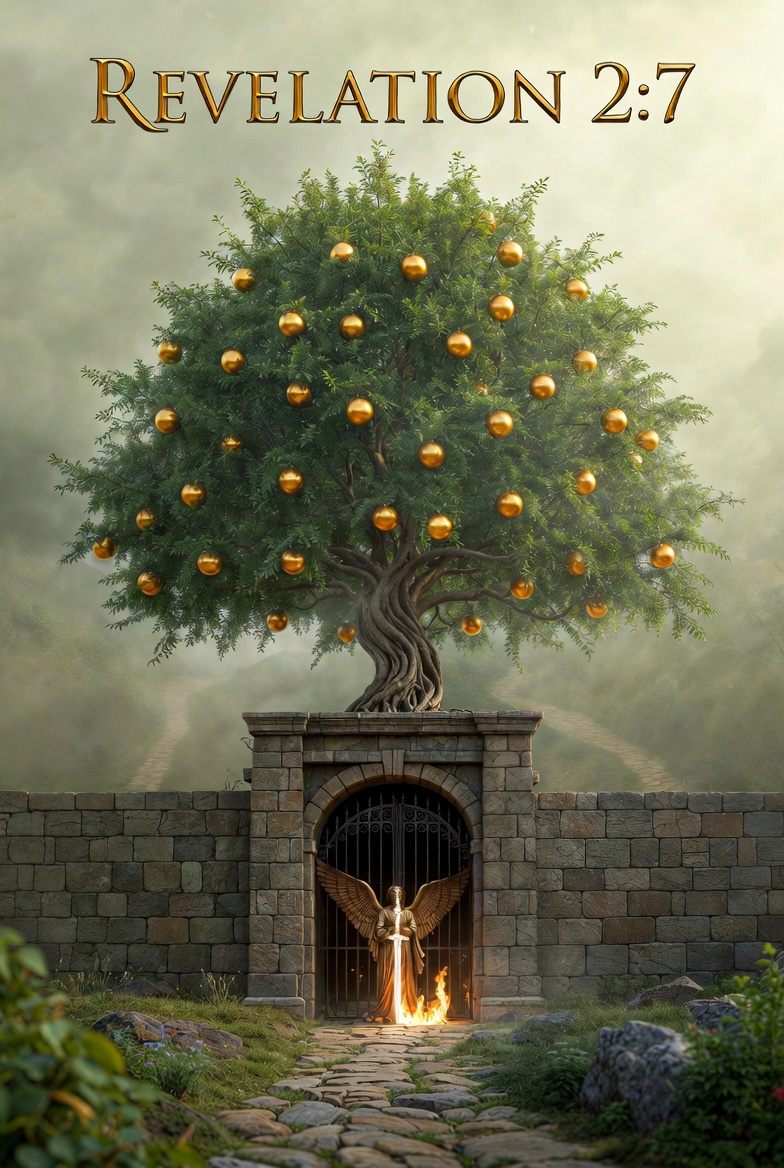
Note what the text does not say. It does not say the Tree of Life was destroyed. It does not say immortality was revoked forever. It says the way is guarded. A guard implies a gate. A gate implies the possibility of passage—under the right conditions, at the right moment.
The isolation protocol is not permanent lockout but temporary containment. The cherubim guard; they do not destroy. The flaming swords turn every way; the swords do not annihilate the path. The question the Garden establishes and cannot answer is: what could satisfy the conditions for return? What manner of passage could navigate past the guardians? What kind of thing could pass through the swords that turn every way?
Revelation 2:7 promises: “To the one who conquers I will give to eat from the tree of life, which is in the paradise of God” (LEB). The tree persists. The paradise persists. The way remains guarded—until it is opened. The isolation protocol awaits its termination.
Coda: The Cup Offered Again
The Garden establishes the pattern but cannot resolve it. The humans cannot un-know what they now know. They cannot un-become what they have become. The sequence of refusal—distortion, evaluation, deferral—is now part of their nature, transmitted to their offspring. Cain murders Abel one generation later. Lamech boasts of vengeance two generations after that. The cascade is running.
What the Garden needs, it cannot provide: someone who, facing the same structure of temptation, makes the opposite choice. Someone who, offered autonomous power, refuses to grasp. Someone who, confronted with a cup of consequence, accepts not deflects. The Garden poses the problem. The Garden cannot provide the solution.
The pattern established in Eden will now replicate. Movement II traces it among divine beings—the council members who received delegated authority and corrupted it, the Watchers who abandoned their station entirely. Movement III traces the accumulated weight as the pattern compounds across millennia. Movement IV traces the debris field that results—the nations, the empires, the prophets who see clearly what others prefer to obscure. Movement V arrives at the second garden, where the cup is offered again. Movement VI examines what the terminus makes possible—the cognitive threshold that separates constrained origin from unconstrained acceptance.
At Gethsemane, a man will kneel alone. The disciples will sleep—deferring their responsibility, replicating the pattern. The cup will be offered: “Let this cup pass from me.” The request is honest; the weight is real. But then the words that reverse Eden: “Nevertheless, not as I will, but as you will.” Where Adam evaluated and grasped, Christ surrenders and receives. Where Adam deferred responsibility, Christ absorbs consequence. Where the first garden initiated the cascade, the second garden will terminate it.
N refusals produce N² consequences. But N† absorbs what N² accumulates.¹ The cross is not metaphor; it is mechanism. The voluntary acceptance of accumulated weight by one not subject to it terminates what involuntary distribution of weight could never clear. The mathematics resolve at Golgotha. The cup is finally consumed.
But we are in Movement I. The cascade has begun. The pattern is established. The isolation protocol is enacted. The way is guarded.
The weight begins to accumulate.
¹ The N† notation—where † represents voluntary cost-acceptance as mathematical operator—will be formally defined in Movement V. The symbol indicates that the cross functions not merely as religious symbol but as the terminus operation that absorbs what N² accumulates.
— End of Movement I —
Our Gods Research Program, January 2026
References
- Our Gods Haven’t Fallen, Yet — A Space Junkies’ Riddle — Our Cathedral. Zenodo. https://doi.org/10.5281/zenodo.17835722 O’Connor, T. (2025).
- Our Gods Haven’t Crashed, Yet — A Silicon Junkies’ Riddle — Our Highway (1.7). Zenodo. https://doi.org/10.5281/zenodo.17851041 O’Connor, T. (2025).
- Our Gods Haven’t Computed Yet — A Neural Junkies’ Riddle — Our Cloud (1.7). Zenodo. https://doi.org/10.5281/zenodo.17925255 O’Connor, T. (2025).
- An Epi-Phenomenological Series in Thrice — A Quantum Junkies’ Riddle — Our Garden. Zenodo. https://doi.org/10.5281/zenodo.17926796 O’Connor, T. (2025).
- A Spectral Evolution of Scalar Breathing — A Cosmological Junkies’ Riddle — Our Heavens (5.0r2). Zenodo. https://doi.org/10.5281/zenodo.17942325 O’Connor, T. (2025).
- The Bare, Naked Lie: The Architecture of Recursion. Zenodo. https://doi.org/10.5281/zenodo.18287548 O’Connor, T. (2026).
- A Trick Question, The Cascade, and a Cup Worthy of Exile — A Script’ Junkies’ Riddle — Our Destiny. Zenodo. O’Connor, T. (2026).
- M1 — 10.5281/zenodo.18425900
- M2 — 10.5281/zenodo.18446123
- M3 — 10.5281/zenodo.18450837
- M4 — 10.5281/zenodo.18451819
- M5 — 10.5281/zenodo.18452359
- M6 — 10.5281/zenodo.18452617
Copyright Notice
A Trick Question, The Cascade, and a Cup Worthy of Exile: A Biblical Junkies’ Riddle—Our Destiny
Echoes from the Architecture of Recursion
© 2026 Tony O’Connor. All rights reserved.
Publication: Our Gods Research Program
Date: January 2026
License
This work is licensed under the Creative Commons Attribution-NonCommercial-NoDerivatives 4.0 International License (CC BY-NC-ND 4.0).
You are free to:
- Share — copy and redistribute the material in any medium or format
Under the following terms:
- Attribution — You must give appropriate credit, provide a link to the license, and indicate if changes were made.
- NonCommercial — You may not use the material for commercial purposes.
- NoDerivatives — If you remix, transform, or build upon the material, you may not distribute the modified material.
Full license text: https://creativecommons.org/licenses/by-nc-nd/4.0/
Contact
For permissions beyond the scope of this license, contact the author through the Our Gods Research Program.
The mathematical notation (N², N†), theological framework, and structural architecture presented in this work are original contributions by the author.
No Responses