
Echoes from The Architecture of Recursion — Movement 3 of 6
“And Yahweh God commanded the man, saying, ‘From every tree of the garden you may freely eat, but from the tree of the knowledge of good and evil you shall not eat, for in the day that you eat from it you shall surely die.’” —Genesis 2:16-17 (LEB)
The Accumulated Weight

Before We Continue
If you’ve arrived here from Movements I and II, you carry something heavier now—the weight of a pattern replicated. Not once but twice. Not in one place but in two realms. A garden and a council chamber. Carbon and spirit. Mortal and immortal. The same sequence: distort, evaluate, defer. The same mathematics: N refusals producing N² consequences. The substrate doesn’t matter. The equation holds.
Now the streams converge. Human corruption flowing from below—the pattern embedded in every descendant of Adam. Divine corruption flowing from above—the council members modeling the very refusals their charges would learn to imitate. Two sources feeding one river. The debris fields overlap. The cascades multiply.
Movement III watches the crisis reach saturation—and watches God attempt to address it. Not once but twice. First the Flood: nearly all terrestrial life destroyed, the earth washed, the contaminated generation removed. Then Babel: humanity fragmented, languages confused, the coordination shattered. Two massive interventions. Both succeed within their parameters. And both fail to terminate the cascade.
This is the hardest movement to absorb. Not because the text is difficult—Genesis is direct about the severity. But because the implications are relentless. If destroying the world doesn’t fix the problem, what will? If fragmenting humanity doesn’t slow the cascade, what can? The answer the text gives is uncomfortable: nothing that operates only on consequences can address what generates them. The actors may be punished. The debris may not be washed away. The pattern persists.
But take heart. The failed resets are not the end of the story. They are the demonstration of what termination would require—and therefore the preparation for what termination will provide. The cup cannot be destroyed. The cup cannot be scattered. The cup can only be consumed. Someone, somewhere, will consume it.
Breathe with me. The weight accumulates. But the weight has a destination.
Register Warning
This paper operates in multiple registers simultaneously: empirical observation (N² mathematics, generator-consequence distinction), theological exegesis (Genesis flood narrative, Babel account), historical reconstruction (pre-Flood conditions, post-Flood trajectory), and engineering analogy (isolation protocols, system saturation).
These registers do not naturally cohere. Empirical claims about cascade mathematics cannot prove theological claims about divine judgment. Theological interpretations of ancient narratives cannot override empirical evidence about system behavior. Engineering analogies illuminate but do not verify metaphysical claims.
Throughout this movement:
- Register transitions will be explicitly marked
- Confidence grades (Solid, Probable, Tentative, Speculative) will accompany claims
- Tier distinctions will be maintained: Corpus-Confirmed (what sources say) vs. Reality-Verified (whether what they say is true)
- Extracanonical sources (1 Enoch) will be marked with appropriate tier caveats
Audience note: bright children will find accessible explanations; scholars will find philological precision; neither audience should feel excluded.
Prologue: The Pattern Accumulates
Movement I traced the origin. The Garden: bounded, tasked, covenanted. The cup of bounded limit refused. Cascade initiated. Movement II traced the replication. The Council: bounded by station, tasked with governance, covenanted to justice. The cup of stewardship refused. Cascade compounded. Two sources now feed the river of corruption—human refusal from below, divine refusal from above.
Now the weight accumulates to crisis. The cascades converge. Human corruption, amplified by celestial modeling—if even the gods show partiality to the wicked, why shouldn’t we? Divine corruption, enabled by human worship—the council members’ power persists because the nations continue to venerate them. The debris fields overlap and multiply. Genesis 6 describes the result: wickedness great, imagination only evil continually, earth filled with violence, all flesh corrupted.
[Register: Empirical thesis]
Something must be done. The question is: what kind of intervention may address a cascade that has reached saturation? The argument of Movement III hinges on a single claim: that interventions which operate only on consequences may not terminate cascades generated by patterns that survive the intervention (Probable). If the Flood and Babel address consequences while leaving the generative pattern intact, they may not succeed at termination—only at temporary suppression or redistribution. The reader should test this claim against the evidence that follows.
Falsifier: This claim would be falsified if either intervention produced lasting change in the underlying pattern. If post-Flood humanity showed different cognitive architecture than pre-Flood humanity, the Flood would have addressed the generator. If post-Babel nations showed different refusal patterns than pre-Babel humanity, dispersion would have addressed the generator.
Movement III examines two attempts—the Flood and Babel. Both are massive interventions. One destroys nearly all terrestrial life. The other fragments humanity’s collective capacity. Both are isolation protocols, accepting bounded loss to prevent unbounded loss. And both fail to terminate the cascade. They address actors, not patterns. They remove offenders, not debris. They redistribute weight but do not absorb it.
Understanding why they fail is essential to understanding what termination would require. The cup may be neither destroyed nor scattered, only consumed.
“And Yahweh smelled the soothing aroma, and Yahweh said in his heart, ‘I will never again curse the ground on account of humankind, for the inclination of the heart of humankind is evil from his youth.'” — Genesis 8:21 (LEB, after the Flood)
Movement 3
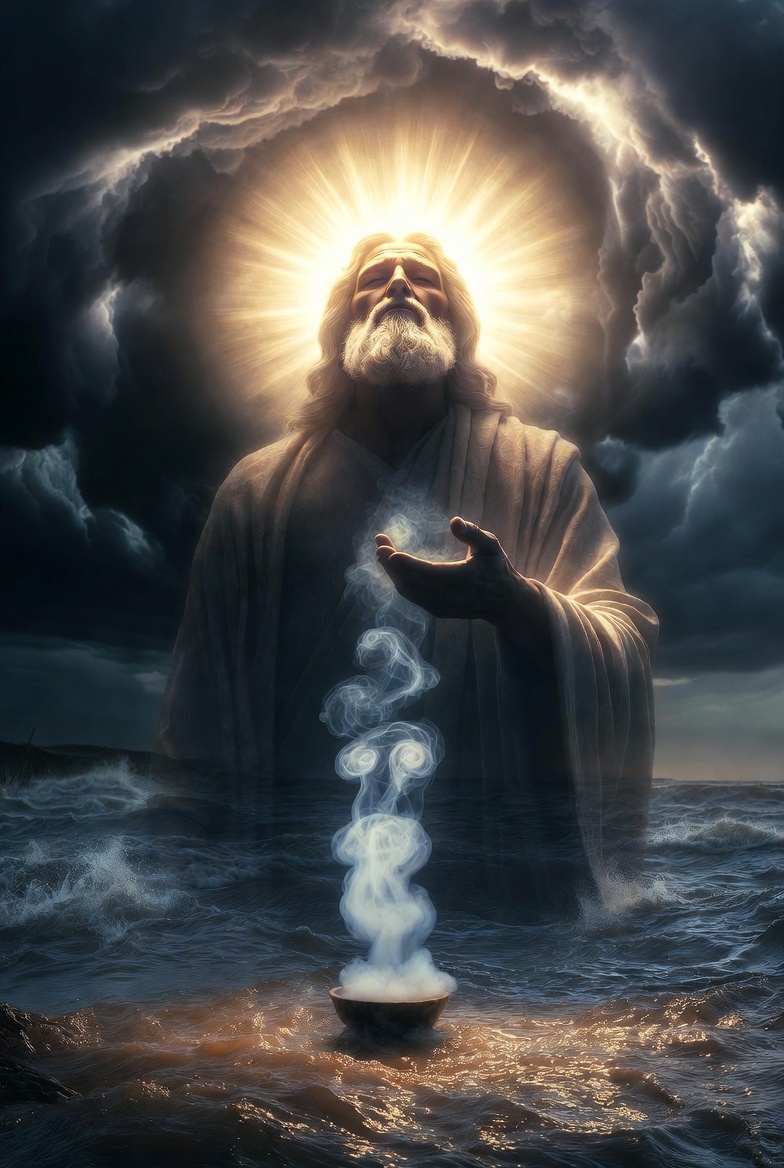
I. The Configuration at Saturation
“And Yahweh saw that the wickedness of humankind was great upon the earth, and every inclination of the thoughts of their hearts was only evil continually.” — Genesis 6:5 (LEB)
Before examining the Flood, we must understand the configuration that provoked it. Genesis 6:5-13 provides the diagnosis in stacked layers. Each layer is worse than the last. The cascade has reached a threshold where the entire system is compromised.
[Register: Engineering analogy]
Before introducing the theological analysis, consider an engineering intuition. When a system approaches saturation, the dynamics change qualitatively (Solid—verifiable from any capacity-limited system). A pipe at 50% capacity behaves linearly—double the input, double the output. A pipe at 99% capacity behaves catastrophically—small additional input produces overflow, rupture, system failure. The pre-Flood world had reached saturation. The cascade was no longer scaling linearly but approaching the vertical asymptote where the system itself fails.
[Register: Textual exegesis]
Layer One: Behavioral Saturation
“And Yahweh saw that the wickedness of humankind was great upon the earth” (Genesis 6:5a, LEB). A philological note before theological interpretation. The Hebrew rabbâ (רַבָּה) indicates magnitude beyond measure—not ‘significant’ or ‘concerning’ but ‘great,’ ‘vast,’ ‘filling the available space.’ The same root appears in Genesis 1:28 for ‘multiply’—the command to fill the earth with human flourishing. By Genesis 6, wickedness has done what humanity was supposed to do. It has multiplied. It has filled.
This is not isolated incidents. This is not a bad neighborhood. This is pervasive, saturating, total (Corpus-Confirmed: this is what the text claims). Wickedness has filled the available space the way water fills a vessel—occupying every corner, leaving no room for anything else. The behavioral substrate is saturated.
Layer Two: Cognitive Saturation
“And every inclination of the thoughts of their hearts was only evil continually” (Genesis 6:5b, LEB). The Hebrew stacks four intensifiers, and each must be unpacked (Solid—the philology is verifiable):
kol-yēṣer (כָּל־יֵצֶר) — “every inclination.” The yēṣer is the formative impulse, the shaping tendency, the imagination that precedes action, not just thoughts but the factory that produces thoughts.
maḥšĕḇōṯ libbô (מַחְשְׁבֹת לִבּוֹ) — “the thoughts of his heart.” The heart in Hebrew anthropology is the seat of will and decision, not merely emotion; such comprise and constitute deliberate cognitions, not ephemeral, passing feeling.
raq raʿ (רַק רַע) — “only evil.” The raq is restrictive: nothing but, solely, exclusively. No admixture of good. No competing impulse. Only.
kol-hayyôm (כָּל־הַיּוֹם) — “all the day,” meaning continually, without cessation, as a permanent state rather than episodic occurrence.
[Register: Theological interpretation]
The theological implication is severe (Probable—interpretive synthesis). The corruption has penetrated from behavior to ideation, not merely doing evil but incapable of conceiving otherwise. The refusal pattern has become the instantiated pattern of thought itself. The cognitive substrate is saturated.
Layer Three: Relational Rupture
“And Yahweh regretted that he had made humankind on the earth, and he was grieved to his heart” (Genesis 6:6, LEB). The Hebrew wayyinnāḥem (וַיִּנָּחֶם) is often translated ‘repented,’ but this risks misunderstanding. The term indicates a shift in disposition toward something, often with connotations of grief or comfort. God’s posture toward creation has changed because creation’s posture toward God has changed. The relational dynamic has ruptured.
The second verb is even more striking: wayyiṯʿaṣṣēḇ (וַיִּתְעַצֵּב), “he was grieved.” The root ʿāṣaḇ (עָצַב) conveys pain, hurt, the ache of wounded relationship. The same root appears in Genesis 3:16-17 for the pain of childbirth and the toil of agriculture—the curses that followed the first refusal. The creator who called creation “very good” now experiences such phenomena as wound. The cascade has now reached the heart of God.
Layer Four: Substrate Contamination
“Now the earth was corrupt before God, and the earth was filled with violence” (Genesis 6:11, LEB). The Hebrew hāʾāreṣ (הָאָרֶץ)—the earth itself—is now corrupted (Corpus-Confirmed). Not just the actors on the stage but the stage itself. The substrate has absorbed so much debris that it has become part of the problem.
The verb timmālēʾ (תִּמָּלֵא) is passive: the earth “was filled” with violence. The earth did not produce the violence; it received it. The violence was generated by human and divine actors, but the earth became its repository. This is debris accumulation at substrate level—the physical world absorbing the consequences of relational corruption until the physical world itself is compromised.
[Register: Engineering analogy]
The pattern is visible in environmental systems (Solid—empirically verifiable). A river can absorb some pollution without changing character. Past a threshold, the river becomes the pollution—its chemistry altered, its ecology collapsed, its identity transformed. The pre-Flood earth had crossed that threshold. The violence was no longer in the earth; the earth was violence.
Layer Five: Categorical Corruption
“And God saw the earth, and behold, it was corrupt, for all flesh had corrupted its way upon the earth” (Genesis 6:12, LEB). The phrase kol-bāśār (כָּל־בָּשָׂר)—”all flesh”—extends corruption beyond humanity. Every embodied creature. The corruption has spread beyond its origin point.
[TIER MARKING: Extracanonical source]
Movement II traced how the Watchers’ transgression produced the Nephilim—hybrid beings of unnatural origin whose violence and consumption were unsustainable. The Book of 1 Enoch (Corpus-Confirmed: this is what 1 Enoch claims; Tentative: whether 1 Enoch accurately preserves ancient tradition is debated, though it is cited in Jude and echoed throughout Second Temple literature) provides additional detail on this corruption. Movement II also traced how the demonic spirits persisting from that transgression would continue to operate after the Watchers themselves were bound. The corruption had metastasized from human to divine to hybrid to the entire category of embodied existence. The categorical substrate is saturated.
The Saturation Named
[Register: Pattern analysis]
Five layers, each worse than the last: behavior saturated, cognition corrupted, relationship ruptured, substrate contaminated, category compromised (Solid—the structural analysis is demonstrable from the text). This is N² at terminal velocity. The number of correlated refusals has reached a point where the consequence function dominates entirely. Each corrupted actor corrupts others. Each corruption changes the configuration for the next. The degradation is now self-sustaining.
[Register: Engineering analogy]
In engineering terms, the system has passed the point of reversibility (Solid—material science). Below a certain threshold, systems may recover—remove the stress, and the material returns to original shape. Above that threshold, deformation becomes permanent—the material has yielded, and no removal of stress may serve restoration. The pre-Flood world had yielded; the deformation was permanent. Incremental intervention could not reverse trajectory.
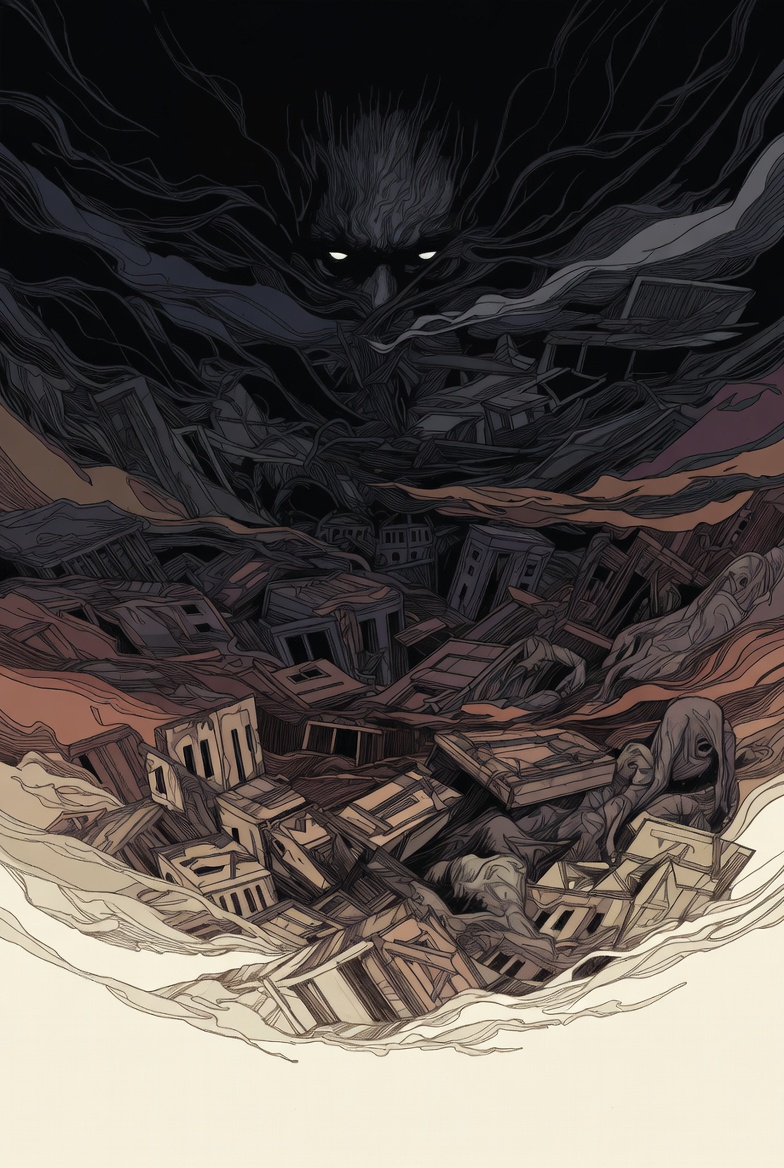
II. The Flood: What It Attempts
The Flood is comprehensive within its domain (Corpus-Confirmed). “And he blotted out every living thing that was upon the surface of the ground, from humankind, to animals, to creeping things, and to the birds of heaven; they were blotted out from the earth. Only Noah and those who were with him in the ark remained” (Genesis 7:23, LEB). One family preserved. One ark floating on the waters of judgment. Everything else—erased.
What the Flood Removes
[Register: Textual analysis]
The corrupted generation. Every human except Noah’s family perishes (Corpus-Confirmed). The network of corruption that had reached saturation—the “mighty men of old, men of renown” (Genesis 6:4), the violent, the endlessly wicked—is physically destroyed. The actors who had produced the saturated condition are removed from the stage.
The contaminated substrate. The earth that was “filled with violence” is washed. The waters return the world to primordial state—tĕhôm (תְּהוֹם), the deep of Genesis 1:2. Uncreation. The corrupted world dissolved; what emerges is, in a sense, new creation. The dove returns with an olive leaf—life reasserting itself on washed ground.
The Nephilim’s bodies. The hybrid offspring of the Watchers’ transgression—the beings whose insatiable consumption had become unsustainable—are eliminated. Their physical forms perish in the waters. The most dramatic expression of ontological corruption is erased from the earth.
The Isolation Protocol
[Register: Engineering analogy]
The Flood is an isolation protocol at maximum scale (Probable—the structural parallel is interpretive). Accept bounded loss—nearly all terrestrial life—to prevent unbounded loss—the eternal perpetuation of saturated corruption. The logic is the same as Eden’s expulsion: if the corrupted configuration continues, it compounds forever. Destruction is mercy. Erasure preserves possibility.
Three examples illuminate the pattern (Solid—empirically verifiable). A surgeon amputates a gangrenous limb—accepts bounded loss of the limb to prevent unbounded loss of the patient. A fire captain orders a controlled burn—accepts bounded loss of acreage to prevent unbounded loss of the forest. A network administrator isolates a compromised server—accepts bounded loss of that node’s function to prevent unbounded propagation through the system. The Flood operates by identical logic at civilizational scale.
Within these parameters, the Flood succeeds (Solid—demonstrable from the narrative). The corrupted generations are removed, the contaminated earth is washed. The Nephilim are destroyed. If the problem were the actors alone, the solution would be complete.
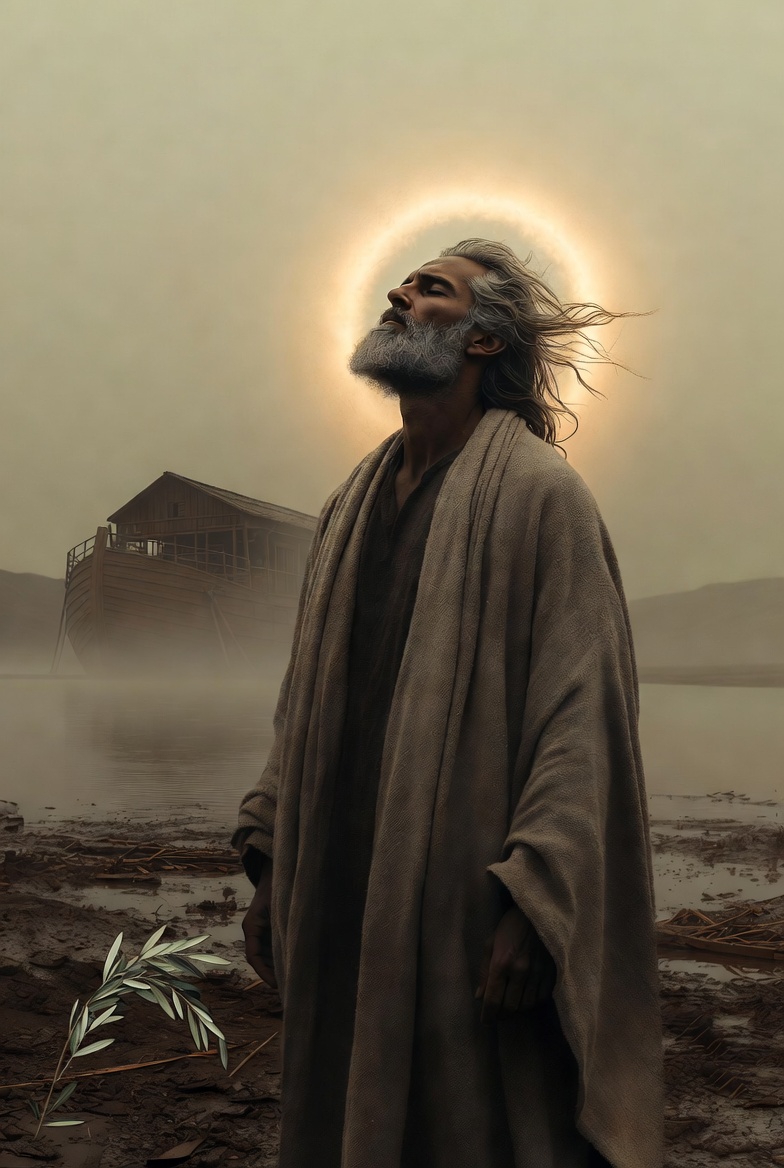
III. The Flood: What It Cannot Remove
The problem is not the actors alone, but the pattern that produces the actors. And the pattern survives. This section names what the Flood could not address—and names it precisely, because precision here determines whether the argument holds.
The Pattern in Noah
[Register: Textual analysis]
Noah is introduced as “a righteous man, blameless among his generation. Noah walked with God” (Genesis 6:9, LEB). The Hebrew ṣaddîq (צַדִּיק)—righteous, just. Tāmîm (תָּמִים)—blameless, complete, having integrity. He alone found grace. He alone was preserved. If anyone could demonstrate that the pattern had been interrupted, it would be Noah.
Genesis 9:20-27 records what happens next (Corpus-Confirmed). “And Noah, a man of the soil, began to plant a vineyard. And he drank some of the wine and became drunk. And he exposed himself in the midst of his tent. And Ham, the father of Canaan, saw the nakedness of his father and told his two brothers outside” (Genesis 9:20-22, LEB).
[Register: Pattern analysis]
One generation after the reset. The righteous man. Shame and nakedness—the same elements that appeared immediately after the Garden’s refusal (Probable—the parallel is interpretive). Ham sees and tells rather than covering—exposure compounding exposure. Noah awakens, curses Canaan—blame deflected to the next generation. Within one family, within one generation: shame, exposure, blame, curse. The Garden’s pattern—distort, evaluate, defer—reappears immediately.
This is not incidental. This is diagnostic (Probable). The man preserved through judgment carries the same capacity for failure that produced the pre-Flood corruption. The pattern was not washed away. It floated in the ark.
The Debris of the Watchers
[TIER MARKING: Extracanonical source]
The Nephilim’s bodies perished. Their spirits did not. Movement II traced how the Watchers’ transgression produced not merely physical offspring but ontological debris—beings whose existence violated the created order. The Book of 1 Enoch (Corpus-Confirmed: this is what 1 Enoch claims; Tentative: the extracanonical source requires appropriate epistemic caution), cited in Jude and echoed throughout Second Temple literature, states the consequence explicitly: “The giants, who are produced from the spirits and flesh, shall be called evil spirits upon the earth… Evil spirits have proceeded from their bodies” (1 Enoch 15:8-12).
[Register: Theological interpretation]
The Flood eliminated the physical expressions of the Watchers’ transgression (Probable, given the canonical-extracanonical synthesis). The spiritual debris persists. This is why demonic activity appears throughout post-Flood Scripture. The “unclean spirits” of the Gospels, the “principalities and powers” of Paul’s letters, the “deceiving spirits” of the pastoral epistles—all trace to debris the Flood could not wash away. The transgression’s actors were bound (the Watchers in chains of darkness) or drowned (the Nephilim’s bodies). The transgression’s output persists.
The Council Untouched
[Register: Structural analysis]
The Flood addresses terrestrial corruption. It does not touch celestial (Solid—demonstrable from the narrative scope). The divine council members—the “sons of God” assigned to govern nations in Deuteronomy 32, indicted for injustice in Psalm 82—remain in their positions. The Flood washes the earth. It does not wash heaven.
Daniel 10, written millennia after the Flood, still describes the “prince of Persia” opposing God’s messenger (Corpus-Confirmed). The corrupted governance continues. The foundations of the earth remain shaken. The intervention that reset the human population left the corrupted cosmic administration intact. The Flood addressed one substrate while leaving another untouched.
The Diagnosis Unchanged
[Register: Textual comparison]
The epigraphs tell the story. Compare them directly (Solid—the textual parallel is verifiable):
Before the Flood: “every inclination of the thoughts of their hearts was only evil continually” (Genesis 6:5).
After the Flood: “the inclination of the heart of humankind is evil from his youth” (Genesis 8:21).
The same diagnosis. The same constitutional corruption. The same pattern of refusal embedded in human cognition. This is remarkable (Probable—interpretive observation). The Flood destroyed the corrupted generation, washed the contaminated earth, eliminated the Nephilim’s bodies—and God’s assessment of humanity’s heart remains unchanged. The pattern survived the intervention that punished the pattern’s expression. The actors were removed. The architecture of refusal remained.
The Covenant Response
[Register: Theological interpretation]
God’s response to the unchanged diagnosis is not another flood but a covenant (Corpus-Confirmed): “I will never again curse the ground on account of humankind… neither will I again strike every living thing, as I have done” (Genesis 8:21, LEB). The rainbow covenant explicitly forecloses the Flood option.
This is not weakness. This is recognition (Probable—interpretive synthesis). If the pattern survives the actors, destroying actors does not solve the problem. The Flood demonstrated what comprehensive destruction may and may not accomplish. It may remove consequences, but may not remove generators.
A clarification on divine knowledge: The “failure” of the Flood is pedagogical, not epistemic. God did not attempt a solution hoping it would work and then discover it didn’t. The demonstration was for us, not for him. The Flood proves—to any observer willing to see—that consequence-level intervention cannot terminate generator-level patterns. The lesson required the demonstration. The demonstration required the apparent failure. The failure was never a surprise to the one who permitted it.
The covenant acknowledges this limitation and commits to a different approach—not because destruction failed within its parameters, but because destruction’s parameters do not include the generator.
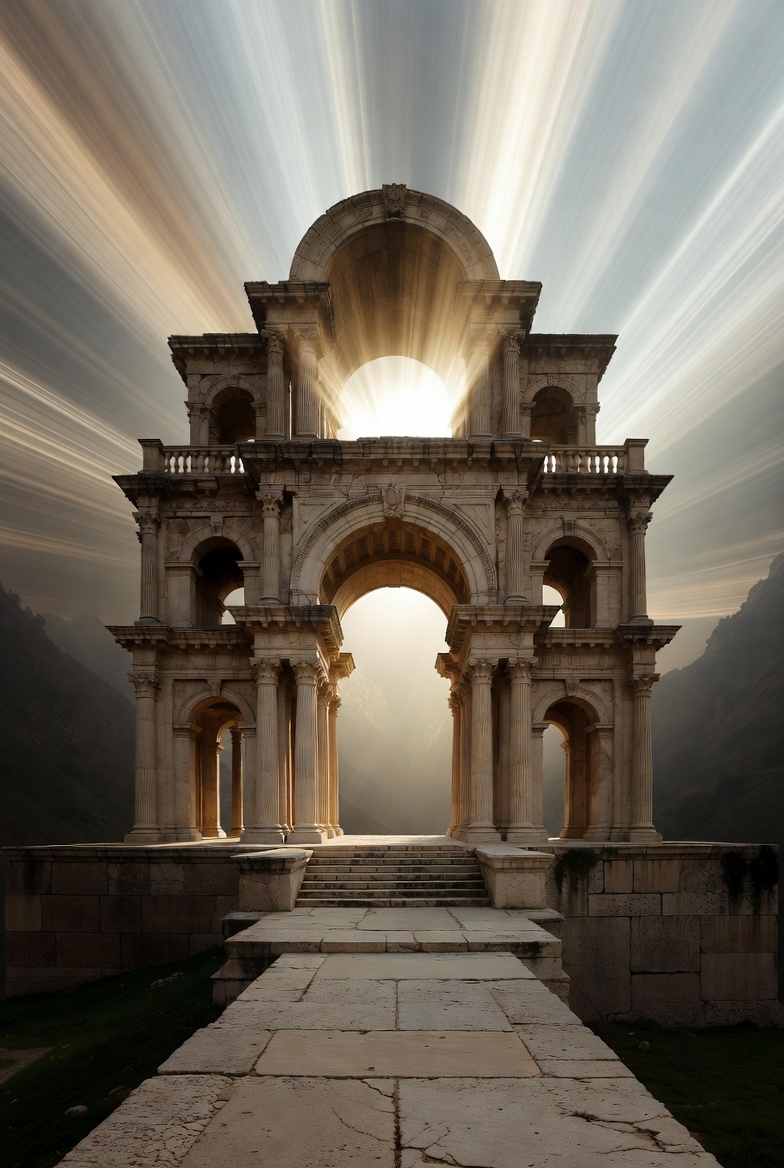
IV. Babel: The Pattern Coordinates
After the Flood, humanity multiplies. After the multiplication, coordination. Genesis 11:1-9 presents the second major intervention—but where the Flood was divine response to accumulated corruption, Babel is divine response to human initiative. The pattern that survived the Flood now attempts to build infrastructure.
The Configuration
[Register: Textual exegesis]
“Now the whole earth had one language and the same words” (Genesis 11:1, LEB). The Hebrew śāpâ ʾeḥāṯ (שָׂפָה אֶחָת)—one lip, one language. Unity. Coordination. The capacity for collective action that no single actor possesses. This is not evil in itself—but in the hands of beings whose imagination is “evil from youth,” coordination becomes amplification.
“And they said, ‘Come, let us build ourselves a city and a tower whose top reaches to the heavens. And let us make a name for ourselves, lest we be scattered over the face of the whole earth'” (Genesis 11:4, LEB). Three elements define the project (Corpus-Confirmed):
Vertical ambition. A tower “whose top reaches to the heavens.” The Watchers descended from heaven to earth. Babel attempts to ascend from earth to heaven. The same boundary violated, the same transgression, reversed direction. Where the Watchers came down, humanity reaches up. The heaven-earth barrier that was transgressed from above is now assaulted from below.
Autonomous identity. “Let us make a name for ourselves.” The Hebrew šēm (שֵׁם) means name, reputation, memorial. The builders seek self-generated significance—identity established by achievement, not received from the creator. This is the Tree of Knowledge at civilizational scale: determining for themselves what constitutes meaning, independent of the word that names them.
Collective consolidation. “Lest we be scattered abroad over the face of the whole earth.” God commanded: “Be fruitful and multiply and fill the earth” (Genesis 9:1, LEB). Babel resists: we will not scatter, we will consolidate. The pattern of refusal now organizes resistance to divine mandate at collective scale.
The Refusal Sequence
[Register: Pattern analysis]
The Garden sequence replicates again (Probable—structural parallel):
Distortion. Did God really mean for us to scatter? Did God really want us dispersed and vulnerable? Surely the command to fill the earth may be reinterpreted. The mandate made questionable.
Evaluation. Consolidation offers security. A tower offers prestige. A name offers permanence. By any human calculus, Babel is rational. The divine mandate is weighed against human advantage and found wanting.
Deferral. No one takes responsibility for confronting the project. The whole earth participates. The whole earth defers to collective momentum. “They said to one another”—the decision diffuses into the crowd, owned by everyone and therefore no one.
The Divine Assessment
[Register: Textual exegesis]
“And Yahweh said, ‘Behold, they are one people with one language for all of them, and this is what they have begun to do. So now nothing that they intend to do will be impossible for them'” (Genesis 11:6, LEB).
[Register: Theological interpretation]
The assessment is not that the tower will reach heaven—that is not the concern (Probable). The assessment is that unified human ambition has no internal limiting principle. The imagination that was “evil from youth”—the same imagination the Flood could not wash—is now coordinated and amplified through unified language and collective will. What begins with a tower will not end with a tower.
Babel is not merely a building project; rather, it’s the cascade’s infrastructure upgrade (Probable—interpretive synthesis). The pattern of refusal, which previously operated through individual and tribal corruptions, now has civilizational coordination. The N² scaling, already devastating at local scales, is about to achieve global amplification.
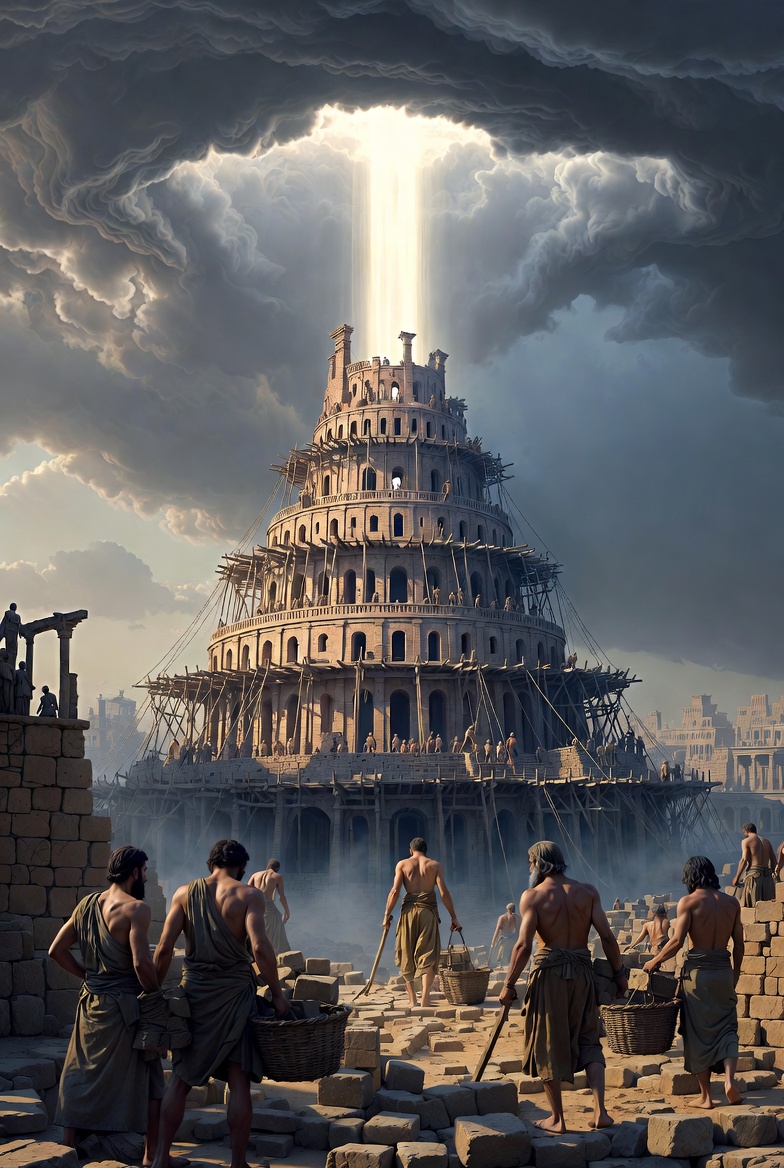
V. Dispersion: Isolation Protocol, Different Mode
“So, Yahweh scattered them from there over the face of the whole earth, and they stopped building the city” (Genesis 11:8, LEB). The intervention is not destruction but fragmentation. Languages confused. Peoples dispersed. Project abandoned.
What Dispersion Accomplishes
[Register: Structural analysis]
It breaks the coordination (Solid—demonstrable from narrative). Different languages mean different peoples. Different peoples mean different trajectories. The unified amplification of corrupted imagination is shattered. The cascade loses its infrastructure upgrade.
It localizes the cascades (Probable). Instead of one humanity compounding one set of refusals, seventy nations each develop their own patterns. The total cascade is distributed rather than concentrated. Each stream flows separately, not combining into one flood.
It creates the context for Israel (Probable—theological synthesis). Deuteronomy 32:8-9 places the division of nations and the assignment of divine council members at this moment. The dispersion creates the structure within which Yahweh keeps Israel as his own portion—the demonstration project of what faithful governance looks like amid universal corruption.
What Dispersion Does Not Accomplish
[Register: Structural analysis]
It does not change the hearts (Solid—demonstrable from subsequent narrative). The dispersed peoples carry with them the same imagination that built Babel. Each language group, each scattered nation, contains the same constitutional corruption. The ambition is localized, not eliminated.
It does not reduce total corruption (Probable). Seventy nations each generating their own corruptions may produce more total debris than one unified humanity. The distribution prevents civilizational coordination but enables civilizational diversity—in evil as well as good.
It assigns the nations to beings who will fail (Probable—synthesis with Movement II). The divine council members receive their territories at Babel. Movement II established that these beings will corrupt their stewardship. The dispersion creates the structure; the council’s failure fills it with corrupted governance.
The Isolation Protocol Named
[Register: Engineering analogy]
Babel’s dispersion is an isolation protocol of different type than the Flood (Probable). The Flood removed actors. Babel removed coordination. The Flood was comprehensive destruction. Babel was strategic fragmentation. Both accept bounded loss to prevent unbounded loss. Both succeed within their parameters. And both share the same fundamental limitation: neither addresses the pattern that produces the problem.
Falsifier: This interpretation would be falsified if either intervention produced lasting change in the underlying pattern. If post-Flood humanity showed different cognitive architecture than pre-Flood humanity, the Flood would have addressed the generator. If post-Babel nations showed different refusal patterns than pre-Babel humanity, dispersion would have addressed the generator. The text shows neither (Solid—textual evidence supports this). The diagnosis remains unchanged. And the pattern continues.
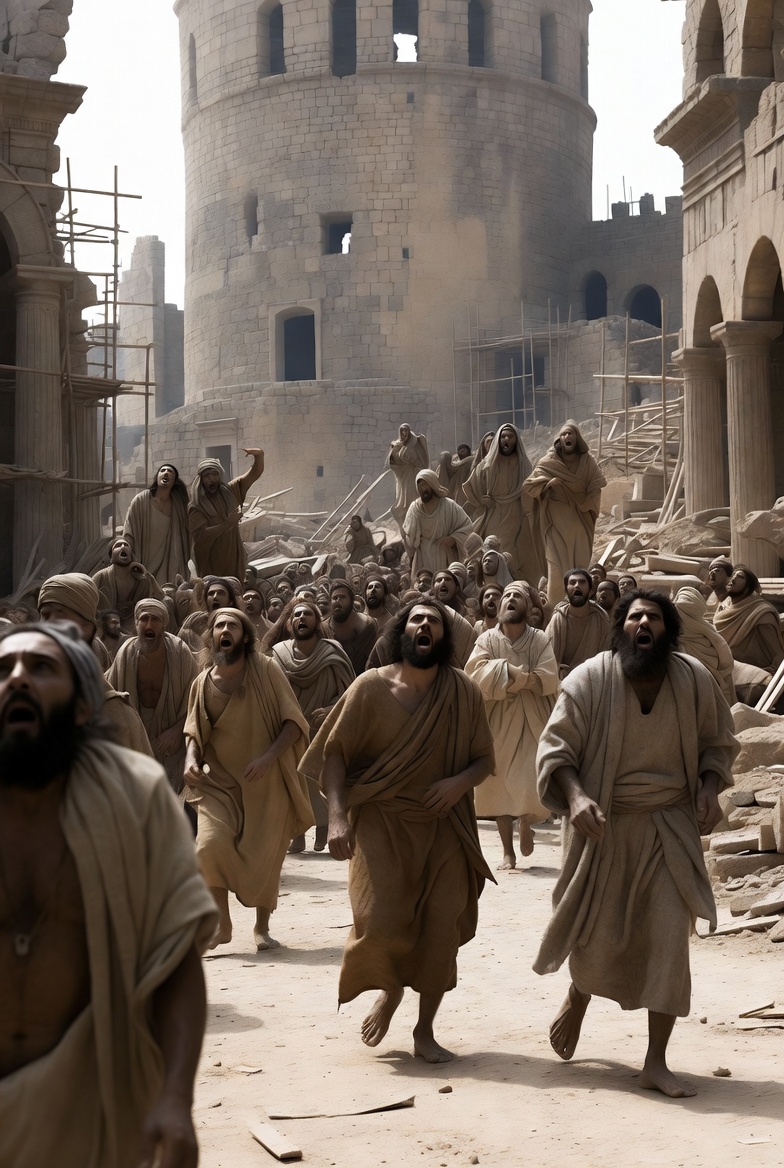
VI. The Mathematics of Failed Resets
The Flood and Babel together demonstrate why partial resets do not terminate cascades. Thus, we may now state this with mathematical precision.
A note on formalism: The N² notation is topological, not quantitative. We are not measuring cascades; we are modeling their structure. Replace N² with any superlinear function—exponential, polynomial, logarithmic-turned-vertical—and the argument holds. What matters is the shape: consequences compound faster than linear intervention can clear them. The notation captures the topology; the numbers are not the point.
The Generator-Consequence Distinction
[Register: Formal analysis]
Every cascade has two components (Solid—the distinction is definitional). Let G represent the generator function—the pattern that produces consequences. Let C represent the consequence accumulation—what the generator produces over time. The total state of the system at any moment is G + C: the active generator plus the accumulated debris.
The Flood attacked C—destroying the corrupted generation, washing the contaminated earth. Babel attacked the coordination multiplier—fragmenting the amplification mechanism that allowed C to compound faster. Neither attacked G.
The generator G is the pattern of refusal itself: distortion, evaluation, deferral. The architecture of refusing bounded authority. The cup-deflection that began in Eden. This pattern is embedded in human nature itself—”the imagination of man’s heart is evil from his youth.” It is embedded in cosmic governance—the council members who corrupt their stewardship. It is embedded in spiritual reality—the demonic debris that persists from the Watchers’ transgression.
[Register: Mathematical analysis]
Any intervention that operates only on C leaves G intact. G continues producing. C re-accumulates. The cascade resumes (Solid—logically necessary given the definitions). This is why the same diagnosis appears before and after the Flood. C was reset to near-zero. G remained unchanged. G immediately began regenerating C.
The Debris Persistence Theorem
[Register: Formal analysis]
Movement I identified relational debris (Garden: shame, blame, broken relationship). Movement II identified structural debris (council: corrupted governance) and ontological debris (Watchers: demonic spirits, forbidden knowledge). The Flood’s limitation may now be stated as a theorem (Probable—the theorem is interpretive synthesis):
Any intervention that operates only on one substrate may not eliminate debris that has propagated to other substrates.
The Flood operated on the physical substrate. It could not touch the celestial substrate (corrupted council still in position), the spiritual substrate (demonic persistence from the Watchers’ transgression), or the psychological substrate (corrupted imagination in Noah’s line). The debris had already cross-contaminated. Physical intervention alone was insufficient because the problem had become trans-substratic.
Falsifier: This theorem would be falsified if we could identify an intervention on one substrate that eliminated debris on all substrates. No such intervention appears in the biblical record. The claim stands.
The Coordination Paradox
[Register: Mathematical analysis]
Babel reveals a different mathematical problem (Solid—the mathematics are demonstrable). The cascade scales with N²—the number of correlated refusals. Babel attempted to maximize N through unified humanity. Dispersion reduced N by fragmenting coordination.
But fragmentation does not reduce N to zero. It creates multiple smaller N values: N₁, N₂, N₃… N₇₀—one for each nation. Each nation scales quadratically within its domain, producing Nᵢ² consequences. The total consequence is the sum: Σ(Nᵢ²).
Compare this to unified humanity: one N value producing N² total consequences, where N = ΣNᵢ. Since (ΣNᵢ)² is greater than Σ(Nᵢ²) whenever N > 1, dispersion slows the cascade. Seventy separate streams compound less than one combined river. But Σ(Nᵢ²) is still greater than zero. The total accumulated weight still grows. The cup still fills—just more slowly.
The Termination Requirements
[Register: Formal analysis]
What would actual termination require? The mathematics suggest three necessary conditions (Probable—these are derived requirements):
First: Address the generator, not just consequences. The pattern of refusal itself—the “imagination of man’s heart” that remains “evil from youth”—must be addressed. Not its expressions but its architecture. G must be changed, not just C cleared.
Second: Trans-substratic efficacy. Any solution must operate across physical, celestial, spiritual, and psychological domains simultaneously. Debris persists in all substrates. All must be addressed. An intervention limited to one substrate is futile.
Third: Absorption, not redistribution. The Flood redistributed debris from many to few (from the whole population to Noah’s family). Babel redistributed coordination from unified to fragmented (from one humanity to seventy nations). Neither absorbed. The accumulated weight—the full N² consequence of all refusals—must go somewhere. If merely moved, it continues to operate. Only absorption terminates.
[Register: Thesis preview]
The cup may not be destroyed—destruction merely releases the weight to scatter, fractally. The cup may not be scattered—scattering merely distributes the weight across more vessels. The cup may only be consumed—the weight absorbed by one capable of containing it without passing it on.
Coda: The Weight Continues
From the Garden, through the council’s corruption, through the Watchers’ descent and the Nephilim’s violence, through the Flood’s destruction and Babel’s dispersion—the cascade continues. Partial resets addressed symptoms while leaving causes intact. Punishment removed actors while leaving debris. Fragmentation slowed coordination through distributive corruption.
The weight accumulates. Each generation inherits not clean conditions but the degraded configuration left by all previous generations. The divine council members still govern nations corruptly—in spirit. The demonic debris still operates. The human heart still imagines evil from its youth. And now, post-Babel, seventy nations each contribute their distinctive refusals to the total.
Movement IV will trace this accumulation through the debris field—the long history from Babel to Gethsemane. The prophets will document the cascade. Israel will demonstrate what faithful governance could look like—and fail, confirming that even direct divine relationship may not overcome the pattern. The nations will rise and fall, each adding to the cosmological weight of the cup, filled with the corruption across millennia—plus the vigorish.
And thus somewhere, at the end of the accumulation, awaits another garden, not Eden with its two trees; Gethsemane with its one cup: The full accumulated weight of every refusal since the beginning—human and divine, terrestrial and celestial, individual and civilizational—concentrated in a single vessel.
“My Father, if it is possible, let this cup pass from me.”
The request acknowledges the weight is real. The cup could be refused. Another reset could be attempted. Another redistribution. The pattern could continue compounding indefinitely.
“Nevertheless, not as I will, but as you will.”
The cup is accepted. The weight absorbed. The cascade meets its terminus.
But we are in Movement III. The resets failed, debris accumulates, and the cup continues to fill. The long wait begins.

— End of Movement III —
Our Gods Research Program, January 2026
References
- Our Gods Haven’t Fallen, Yet — A Space Junkies’ Riddle — Our Cathedral. Zenodo. https://doi.org/10.5281/zenodo.17835722 O’Connor, T. (2025).
- Our Gods Haven’t Crashed, Yet — A Silicon Junkies’ Riddle — Our Highway (1.7). Zenodo. https://doi.org/10.5281/zenodo.17851041 O’Connor, T. (2025).
- Our Gods Haven’t Computed Yet — A Neural Junkies’ Riddle — Our Cloud (1.7). Zenodo. https://doi.org/10.5281/zenodo.17925255 O’Connor, T. (2025).
- An Epi-Phenomenological Series in Thrice — A Quantum Junkies’ Riddle — Our Garden. Zenodo. https://doi.org/10.5281/zenodo.17926796 O’Connor, T. (2025).
- A Spectral Evolution of Scalar Breathing — A Cosmological Junkies’ Riddle — Our Heavens (5.0r2). Zenodo. https://doi.org/10.5281/zenodo.17942325 O’Connor, T. (2025).
- The Bare, Naked Lie: The Architecture of Recursion. Zenodo. https://doi.org/10.5281/zenodo.18287548 O’Connor, T. (2026).
- A Trick Question, The Cascade, and a Cup Worthy of Exile — A Script’ Junkies’ Riddle — Our Destiny. Zenodo. O’Connor, T. (2026).
- M1 — 10.5281/zenodo.18425900
- M2 — 10.5281/zenodo.18446123
- M3 — 10.5281/zenodo.18450837
- M4 — 10.5281/zenodo.18451819
- M5 — 10.5281/zenodo.18452359
- M6 — 10.5281/zenodo.18452617
Copyright Notice
A Trick Question, The Cascade, and a Cup Worthy of Exile: A Biblical Junkies’ Riddle—Our Destiny
Echoes from the Architecture of Recursion
© 2026 Tony O’Connor. All rights reserved.
Publication: Our Gods Research Program
Date: January 2026
License
This work is licensed under the Creative Commons Attribution-NonCommercial-NoDerivatives 4.0 International License (CC BY-NC-ND 4.0).
You are free to:
- Share — copy and redistribute the material in any medium or format
Under the following terms:
- Attribution — You must give appropriate credit, provide a link to the license, and indicate if changes were made.
- NonCommercial — You may not use the material for commercial purposes.
- NoDerivatives — If you remix, transform, or build upon the material, you may not distribute the modified material.
Full license text: https://creativecommons.org/licenses/by-nc-nd/4.0/
Contact
For permissions beyond the scope of this license, contact the author through the Our Gods Research Program.
The mathematical notation (N², N†), theological framework, and structural architecture presented in this work are original contributions by the author.
No Responses