Echoes from the Architecture of Recursion — Movement 5 of 6
“And going a little farther, he fell on his face and prayed, saying, ‘My Father, if it is possible, let this cup pass from me. Nevertheless, not as I will, but as you will.'” — Matthew 26:39 (LEB)
N†-Terminus
Before We Continue
If you’ve arrived here from Movements I through IV, you carry the full weight now—the knowledge that nothing works. The Garden’s refusal initiated the cascade. The Council’s corruption compounded it. The Flood and Babel redistributed but could not absorb. Israel demonstrated that even optimal conditions cannot override constitutional corruption. The prophets documented what they could not fix. The empires added layer upon layer to the cup. Two millennia of debris, saturating every substrate, exceeding any human capacity for remedy.
Movement V arrives at the terminus. Another garden—not Eden with its two trees, but Gethsemane with its one cup. The full accumulated weight of every refusal since the beginning, concentrated in a single vessel, offered to one who did not generate any of it. The mathematics that have been building across four movements now resolve. N² meets N†. The cascade meets its terminus.
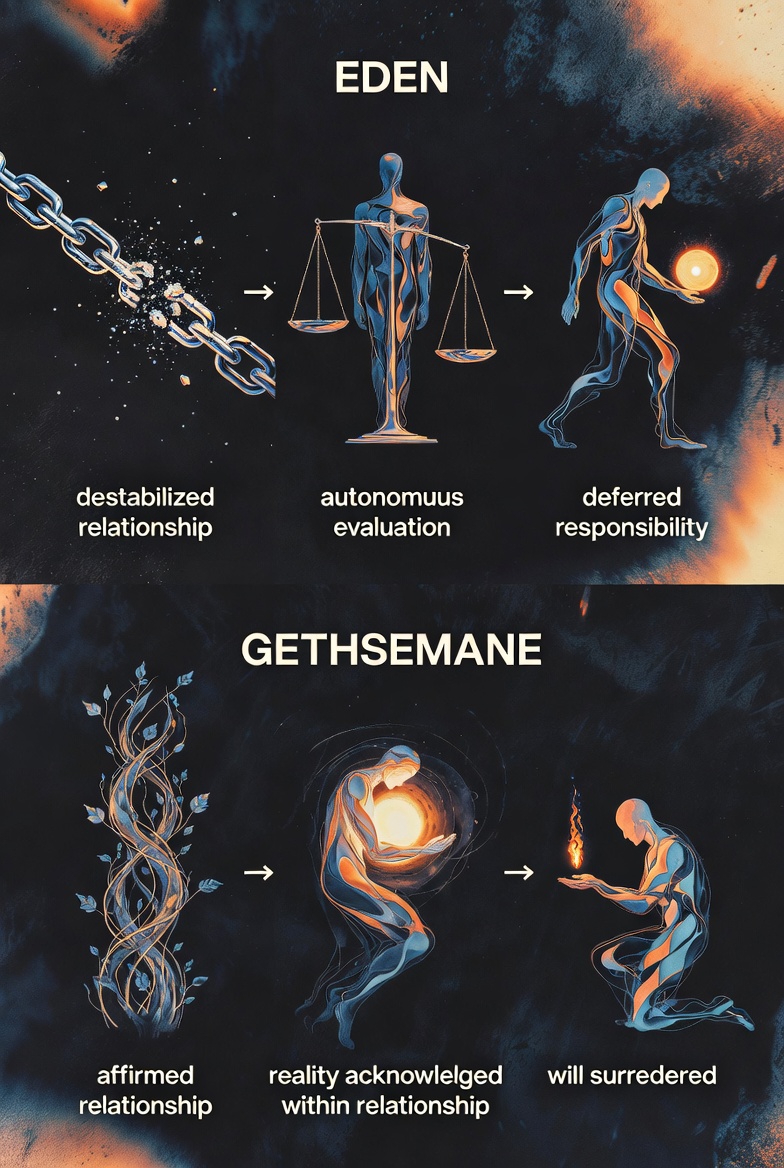
This is the hardest movement to write and the simplest to summarize. One man. One cup. One choice. The prayer has three movements—relationship affirmed, reality acknowledged, will surrendered—the exact reversal of Eden’s three movements of distortion, evaluation, and deferral. Where the first garden initiated the cascade, the second garden terminates it. Where Adam deflected, Christ absorbs. Where Eve evaluated autonomously, Christ surrenders filially. Where the serpent distorted the boundary, Christ affirms the relationship.
The cup is consumed. The weight is absorbed. The cascade terminates—not because the consequences are cleared (though they are) but because the generator is addressed (which it is). The cross operates across all substrates simultaneously. The resurrection proves the absorption complete.
Breathe with me. The weight has reached its destination. Tetelestai.
Register Warning
This paper operates in multiple registers simultaneously: empirical observation (N² mathematics, trans-substratic efficacy), theological exegesis (Gethsemane narrative, Pauline soteriology), philological analysis (Greek terms, Hebrew parallels), and engineering analogy (isolation protocols, boundary conditions).
These registers do not naturally cohere. Empirical claims about cascade mathematics cannot prove theological claims about atonement. Theological interpretations of Gospel narratives cannot override empirical evidence about system behavior. Engineering analogies illuminate but do not verify metaphysical claims about what the cross accomplished.
Throughout this movement:
- Register transitions will be explicitly marked
- Confidence grades (Solid, Probable, Tentative, Speculative) will accompany claims
- Tier distinctions will be maintained: Corpus-Confirmed (what sources say) vs. Reality-Verified (whether what they say is true)
Audience note: bright children will find accessible explanations; scholars will find philological precision; neither audience should feel excluded.
Prologue: The Pattern Terminates
Movement I traced the origin: one garden, one refusal, cascade initiated. Movement II traced the replication: one council, many refusals, cascade compounded. Movement III traced the failed resets: Flood and Babel—debris redistributed, not absorbed. Movement IV traced the long accumulation: two millennia of compounding refusal, Israel demonstrating that the cascade is constitutional, not circumstantial. The generator function is embedded in the human heart itself. No external optimization may reach it.
Now the pattern meets its terminus. Another garden—not Eden with its choice still open, but Gethsemane with its choice finally made. The accumulated weight of every refusal since the beginning, concentrated in a single cup, offered to one who did not generate any of it.
[Register: Empirical thesis]
This is the critical demonstration, and the argument of Movement V hinges upon it: cascade termination requires voluntary acceptance of accumulated weight by one not subject to it (Probable). The N† operator—voluntary cost-acceptance—is not one option among many but the only mathematically coherent terminus. Forced solutions (annihilation, compelled obedience, divine mind-rewrite) do not address the generator; they merely redistribute or suppress. The question Movement V must answer: does the cup get consumed? And if so, does the consumption satisfy the termination requirements the prior movements have established?
Falsifier: This claim would be falsified if the biblical text portrayed atonement as forced rather than voluntary—if Gethsemane showed compulsion rather than choice. It would also be falsified if the terminus failed to operate across all substrates simultaneously (human debris, divine debris, structural debris). The reader should test these conditions against the evidence that follows.
Movement V examines the terminus. We begin where the accumulation ends: with a garden, a cup, and the question of whether anyone will consume what everyone else has spilled.
“And going a little farther, he fell on his face and prayed, saying, ‘My Father, if it is possible, let this cup pass from me. Nevertheless, not as I will, but as you will.'” — Matthew 26:39 (LEB)
Movement 5

I. The Cup: What It Contains
Before examining the choice, we must understand what the cup contains. This is not metaphor. The cup is the accumulated weight of every refusal since Eden, concentrated into a single vessel. Thus, we may now inventory its contents with precision, organized by the three debris categories established in earlier movements.
The Human Debris
[Register: Historical inventory]
The cup contains Adam’s silence and Eve’s evaluation (Corpus-Confirmed—Movement I traced these). It contains Cain’s murder and Lamech’s sevenfold boast. It contains the wickedness that was great in the earth, every imagination only evil continually. It contains Noah’s drunkenness and Ham’s exposure. It contains Babel’s hubris and every imperial extraction since—Egyptian slavery, Assyrian erasure, Babylonian exile, Persian domination, Greek desecration, Roman crucifixion.
It contains Israel’s golden calf and the judges’ cycles of apostasy. It contains Saul’s disobedience and David’s adultery and Solomon’s idolatry. It contains the blood of every prophet killed, every widow exploited, every orphan abandoned, every stranger oppressed. Two millennia of human refusal, N² across countless generations, compounding across every civilization the debris field documented.
The Divine Debris
[Register: Theological inventory]
The cup contains the council’s corruption—every unjust judgment, every wicked person favored, every vulnerable soul abandoned by beings appointed to protect them (Probable—Movement II traced these). It contains the foundations of the earth shaken, the nations groaning under celestial dereliction, the worship redirected from Yahweh to the beings who should have pointed toward him.
It contains the Watchers’ transgression—the boundary between heaven and earth violated, the teaching that should not have been taught (metallurgy for weapons, cosmetics for seduction, astrology for divination), the unions that should not have occurred. It contains the spirits of the Nephilim still roaming after the Flood, still corrupting, still adding to the weight across every generation since.
The Structural Debris
[Register: Pattern inventory]
The cup contains the pattern itself—the architecture of refusal that has replicated across every substrate (Probable). The distortion that makes boundaries questionable. The evaluation that treats divine word as one input among many. The deferral that deflects responsibility into incoherence. The generator function that no flood may wash, no dispersion may fragment, no covenant may override.
It contains “the imagination of man’s heart evil from his youth”—the constitutional corruption that persists through every reset. It contains “the heart deceitful above all things”—the generator that produces new debris faster than any intervention may clear it. The cup contains not merely the outputs of the pattern but the pattern itself.
The Weight Named
[Register: Theological synthesis]
This is what the cup contains (Probable—synthesis across movements). Not a portion—the whole. Not a sample—the totality. The full N² accumulation of every refusal by every actor across every substrate since the first refusal in Eden, plus the vigorish.
[Register: Philological analysis]
Paul names it with terrible precision (Corpus-Confirmed): “He made him who knew no sin to be sin on our behalf” (2 Corinthians 5:21, LEB). A philological note. The Greek is hamartian epoiēsen (ἁμαρτίαν ἐποίησεν)—”he made sin,” not “he made a sinner” or “he made sinful.” Not sins plural—individual acts that could be catalogued and addressed piecemeal. Sin singular—the entire weight of the cascade, the pattern itself, the generator function and all its outputs, concentrated into one cup, offered to one who had never contributed to its contents, even if that same one created the cup.
II. Gethsemane: The Configuration
[Register: Philological analysis]
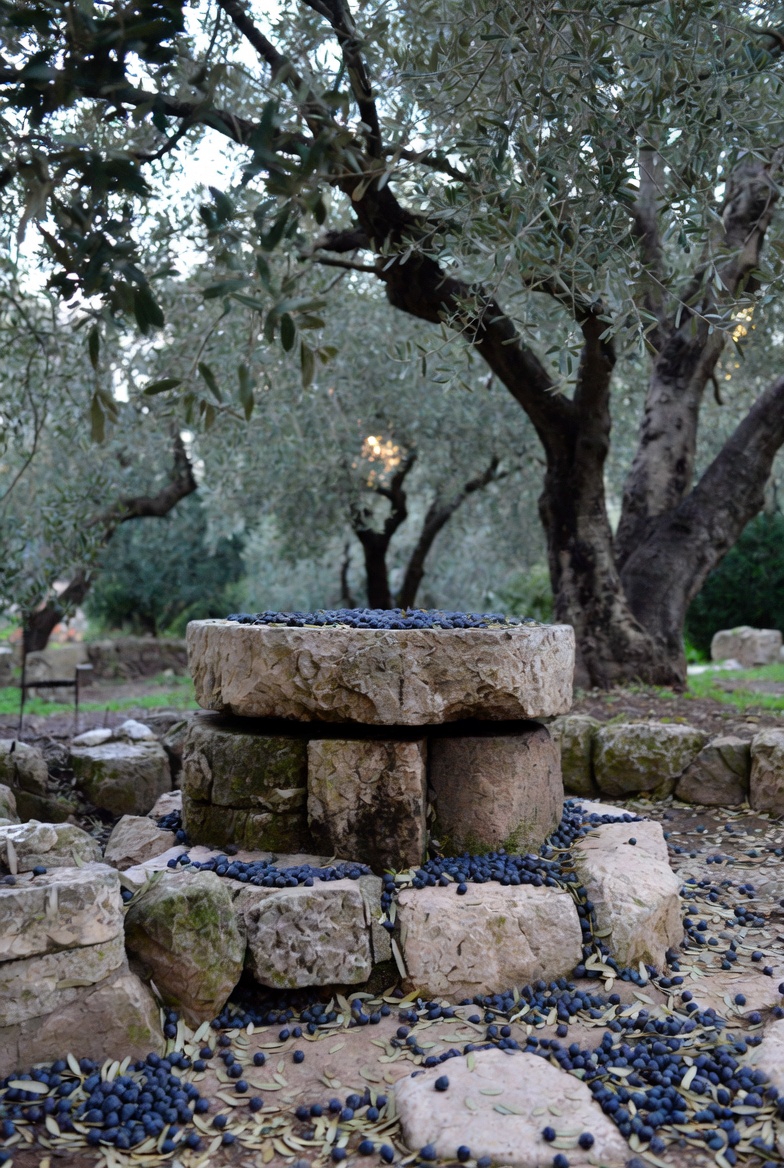
The name Gethsemane comes from the Aramaic gat šĕmānê (גַּת שְׁמָנֵא)—”oil press” (Solid—the etymology is verifiable). A place where olives are crushed to extract what is within. The location is not incidental. The naming is not accidental. This is where the weight will be pressed, where what has accumulated will be extracted, where the cup will be consumed.
The Parallel Structure
[Register: Pattern analysis]
Eden was a garden. Gethsemane is a garden. Eden had trees at its center. Gethsemane has olive trees—the source of anointing oil, the oil that consecrated priests and kings—oil that once powered light now powers industry, for N² power structures? Eden had a choice between two options—life within covenant or autonomy outside it. Gethsemane has a choice between two options—the cup accepted or the cup refused (Solid—the structural parallel is demonstrable).
Eden had three human actors who failed: the serpent who distorted, the woman who evaluated, the man who deferred. Gethsemane has three human companions who fail: Peter, James, and John who cannot stay awake for one hour (Corpus-Confirmed). The disciples replicate the pattern even here—they defer their responsibility to watch, they sleep through the crisis, they will scatter when it arrives. The pattern operates to the last moment.
But Gethsemane has one who does not fail; one who faces the same structure of temptation and makes the opposite choice.
The Solitude
[Register: Textual exegesis]
“And going a little farther” (Matthew 26:39, LEB). The disciples are left behind. The choice is not made by committee. The cup must not be distributed among many—after two millennia, the cup only fills faster. The weight must be absorbed in a singularity, or not at all.
“He fell on his face.” The posture of total submission. Not standing in negotiation, not sitting in deliberation—prostrate. The weight that approaches is not theoretical.
[Register: Medical observation]
Luke records that “his sweat became like drops of blood falling down on the ground” (Luke 22:44, LEB). The medical term is hematidrosis—capillaries rupturing under extreme stress (Solid as medical phenomenon—hematidrosis is documented in clinical literature, though rare; Probable as occurrence here—Luke’s medical background and specific description suggest reliable observation). The physical body anticipates imminence—that which must be endured, experientially, phenomenologically. The cup is real. The weight is real. The choice is real.
[Register: Textual exegesis]
And in that solitude, prostrate, sweating blood, he prays.
III. The Prayer: Structure of Surrender
“My Father, if it is possible, let this cup pass from me. Nevertheless, not as I will, but as you will.”
The prayer has three movements—the same number as the refusal sequence in Eden (Solid—the structural parallel is demonstrable). Yet, where Eden’s three movements led to refusal, Gethsemane’s three movements lead to acceptance. The structure is reversed. The pattern is broken. We may now trace the reversal with precision.
Movement A: Relationship Affirmed
[Register: Philological analysis]
“My Father.” The prayer begins with relationship (Corpus-Confirmed). Not “God” in the abstract—”Father” in the intimate. Mark’s account preserves the Aramaic: Abba (Mark 14:36)—the word a child uses for a parent, a term of endearment and trust. Before the request, before the submission, the relationship is named and claimed.
[Register: Pattern analysis]
This is the opposite of Eden’s first movement (Probable). The serpent’s distortion began by destabilizing relationship: “Has God indeed said?” The question created distance between the woman and the one who had spoken. It introduced doubt about divine intention and integrity. Gethsemane begins by closing distance. Whatever happens next happens within unbroken relationship. The Father’s character is not questioned. The Father’s love is not doubted. The relationship is the foundation on which everything else stands.
Movement B: Reality Acknowledged
[Register: Textual exegesis]
“If it is possible, let this cup pass from me.” The request is honest (Corpus-Confirmed). The weight is real. The cup could be refused—that option exists. If there is any other way to accomplish what must be accomplished, let that way be found.
[Register: Theological interpretation]
This is not doubt. This is not weakness. This is the acknowledgment that the choice is real (Probable). A choice that may not be refused is not a choice—it is compulsion. The cup must be both consumable and declinable for any drinking to be voluntary. The prayer names what the mathematics have proven: the weight is beyond human bearing. “If it is possible”—but the very framing acknowledges that it may not be possible. There may be no other way.
[Register: Pattern analysis]
This is the opposite of Eden’s second movement (Probable). The woman’s evaluation treated the forbidden tree as one option among many, weighing God’s word against her own autonomous assessment. Gethsemane’s acknowledgment does not weigh options—it names the weight honestly while remaining in relationship. The evaluation in Eden was autonomous; the acknowledgment in Gethsemane is filial. The woman asked, “What do I prefer?” The Son asks, “What does the Father will?”
Movement C: Will Surrendered
[Register: Philological analysis]
“Nevertheless, not as I will, but as you will.” The pivot. The reversal. The word that changes everything (Corpus-Confirmed).
Nevertheless—despite the weight, despite the honest acknowledgment that the cup could pass, despite the reality that this is beyond human bearing. The Greek is plēn (πλήν)—an adversative particle indicating strong contrast. Everything before the “nevertheless” is real. Everything after it supersedes.
Not as I will—the autonomous will that could refuse, the will that in Eden grasped for independent determination, is here surrendered. Not eliminated—surrendered. The capacity remains; the exercise is declined. The Son retains the ability to refuse; he declines to use it.
But as you will—the Father’s will becomes the operative will. The relationship named in the first movement now becomes the governing reality. The son’s will aligns with the father’s will. The boundary that defines the relationship—”your will, not mine”—is accepted not refused.
[Register: Pattern analysis]
This is the opposite of Eden’s third movement (Probable). Adam deferred—he refused responsibility, blamed others, deflected consequence onto his wife and onto God (“the woman whom you gave me”). Gethsemane accepts—takes responsibility for what others accumulated, claims the consequence they deflected, absorbs what they refused to bear.
The Pattern Reversed
[Register: Structural synthesis]
Three movements in Eden: relationship destabilized (“Has God indeed said?”), autonomous evaluation (“good for food, pleasant to the eyes, desirable to make wise”), responsibility deferred (“The woman whom you gave me”). Three movements in Gethsemane: relationship affirmed (“My Father”), reality acknowledged within relationship (“if it is possible”), will surrendered (“nevertheless, not as I will”) (Solid—the structural parallel is demonstrable).
The same structure. The opposite direction. The pattern that has replicated across every substrate since Eden—in the council, in the Watchers, in every human heart—is here reversed. Not by force from outside but by choice from within. Not by destroying the pattern but by walking it backward. Not by avoiding the temptation but by passing through it to the other side.
IV. The Cross: The Cup Consumed
The prayer in Gethsemane is the decision. The cross is the execution. The cup accepted in the garden is drunk on the hill. We must now trace what happens when the accumulated weight of N² meets the one who absorbs it.
Trans-Substratic Operation
[Register: Theological analysis]
Movement III established that termination requires trans-substratic efficacy—operating across physical, celestial, spiritual, and psychological domains simultaneously (Solid—this was established in Movement III). The Flood failed because it operated only on the physical substrate. No single-substrate intervention can eliminate debris that has propagated to all substrates. The cross succeeds because it operates across all four (Probable—this is the theological claim):
Physical substrate: The body is broken. The blood is shed. “Yahweh was pleased to crush him” (Isaiah 53:10, LEB). The physical consequences of the cascade—death, pain, the curse on the ground—are absorbed into a physical body. The one who made the physical world enters it fully, subjects himself to its brokenness, and carries its corruption into death.
Celestial substrate: “Having disarmed the rulers and the authorities, he made a public disgrace of them, triumphing over them in it” (Colossians 2:15, LEB). The corrupted council members, the rebellious divine beings, the cosmic powers that have governed unjustly since Babel—these are addressed (Corpus-Confirmed). The one who assigned them their territories now enters their domain as apparent victim and emerges as victor. The cross is not merely human event; it is cosmic confrontation.
Spiritual substrate: “In order that through death he could destroy the one who has the power of death, that is, the devil” (Hebrews 2:14, LEB). The demonic debris of the Watchers’ transgression, the spirits that have roamed since the Nephilim perished, the accuser who has leveraged human guilt since Eden—these are addressed (Corpus-Confirmed). The cross enters the spiritual realm through death and breaks its power from within.
Psychological substrate: “He made him who knew no sin to be sin on our behalf, so that we could become the righteousness of God in him” (2 Corinthians 5:21, LEB). The generator function—”the imagination of man’s heart evil from his youth”—is addressed not by external reformation but by substitution (Corpus-Confirmed). The one who never generated debris takes the debris into himself. The one whose heart was never deceitful bears the full weight of every deceitful heart.
The Generator Addressed
[Register: Theological interpretation]
The cross does not merely address consequences—it addresses the generator (Probable). This is the mechanism the prophets glimpsed but could not explain. Jeremiah saw the new covenant with law written on hearts, but could not see how. Ezekiel saw the divine breath raising dry bones, but could not see what would release it. The mechanism is substitution.
The generator function—autonomous will, self-determining evaluation, relationship-destabilizing distortion—is not reformed but replaced. The old pattern does not gradually improve; it dies with Christ. The new pattern does not gradually emerge; it rises with him. “I have been crucified with Christ, and it is no longer I who live, but Christ lives in me” (Galatians 2:20, LEB). The generator is not fixed. It is executed and replaced.
The Absorption Complete
[Register: Philological analysis]
“It is finished” (John 19:30). The Greek is tetelestai (τετέλεσται)—a perfect passive: “it has been completed,” “it has been accomplished,” “it has been paid in full” (Solid—the philology is verifiable). The tense indicates completed action with ongoing results. The word was used on commercial receipts to indicate a debt fully discharged. The cup is empty. The weight is absorbed. The N² accumulation of every refusal since Eden has been drunk to the dregs.
[Register: Theological synthesis]
Not redistributed—absorbed. Not scattered—consumed. Not deflected—borne (Probable). The cascade that no flood could terminate, that no dispersion could fragment, that no covenant could override—this cascade meets the one thing that can stop it: voluntary acceptance of its full weight by one who did not generate it and therefore is not subject to it.
V. Resurrection: Proof of Termination
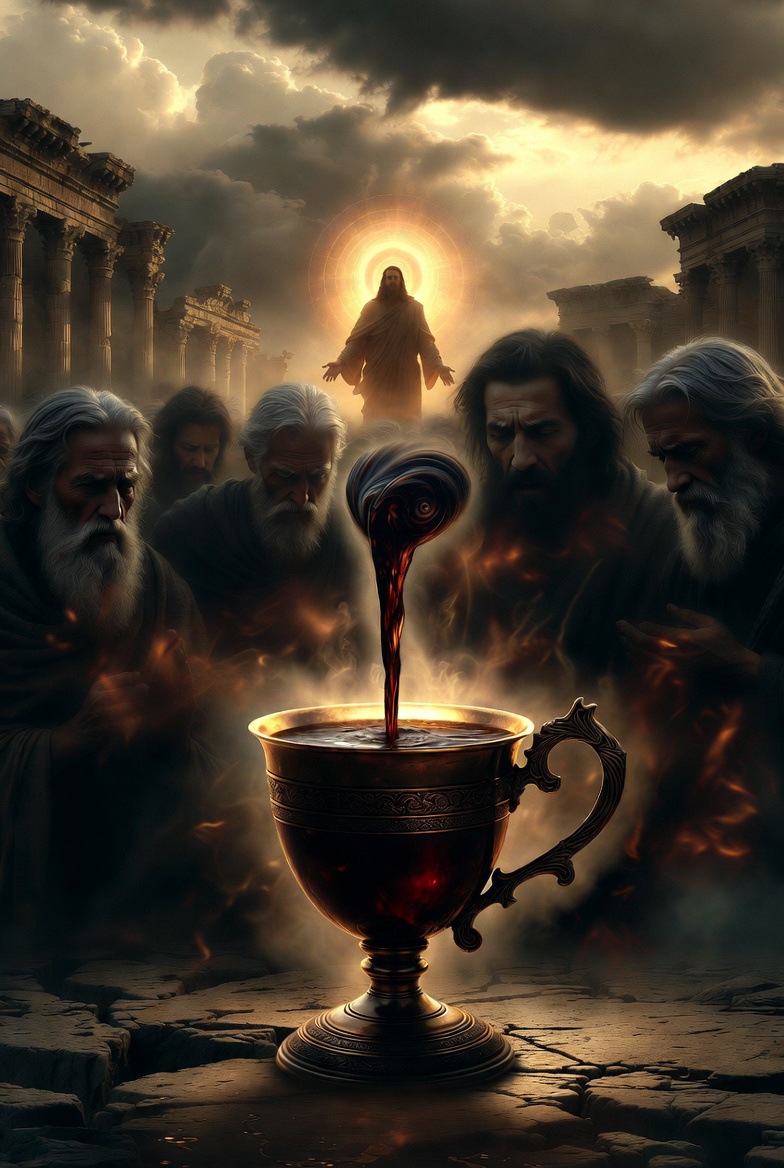
Death is not the end of the story. If it were, the cross would be merely another failed reset—the removal of an actor without the clearing of debris. The resurrection is the proof that something different has happened. The cascade has not merely been interrupted. It has been terminated.
The Logic of Resurrection
[Register: Theological analysis]
Death is the consequence of the cascade (Corpus-Confirmed). “In the day that you eat from it you shall surely die” (Genesis 2:17, LEB). Death entered through refusal and has claimed every human since. If the one who bore the full weight of the cascade remains dead, then death has won—the weight was too great even for him, and the cascade continues. This is the falsifier stated at the movement’s opening (Solid—this is the logical structure).
[Register: Textual exegesis]
But he does not remain dead (Corpus-Confirmed—this is what the text claims). “Death is swallowed up in victory. Where, O death, is your victory? Where, O death, is your sting?” (1 Corinthians 15:54-55, LEB). The resurrection is not merely a miracle—it is proof (Probable—this is the interpretive claim). It demonstrates that the weight has been fully absorbed without destroying the one who absorbed it. The cup consumed, the drinker lives. The falsification condition is not met. The termination stands.
The New Configuration
[Register: Theological interpretation]
The resurrection does not restore the pre-Fall configuration—it establishes a new one (Probable). The risen Christ is not Adam before the fruit; he is the “last Adam” (1 Corinthians 15:45, LEB), the beginning of a new humanity. The pattern of refusal has been broken. The pattern of acceptance has been established. A new generator function is now available.
“So then, if anyone is in Christ, he is a new creation; the old things have passed away; behold, the new things have come” (2 Corinthians 5:17, LEB). The “old things” are not merely sins committed but the generator that produced them—the architecture of refusal, the pattern of distortion-evaluation-deferral (Probable). The “new things” are not merely forgiveness for past acts but a new pattern—relationship affirmed, reality acknowledged, will surrendered. A new operating system, not merely patched software.
The Terminus Confirmed
[Register: Theological synthesis]
The resurrection confirms what the cross accomplished (Probable). The cascade is terminated—not paused, not redistributed, not temporarily interrupted, but terminated. The N² accumulation has met its N† terminus. Voluntary cost-acceptance by one who was not subject to the cost has absorbed what involuntary cost-distribution could never clear. The cup is empty. The one who emptied it lives. The debris field, for those who enter the new configuration, is cleared.
VI. The Mathematics: N† Defined
[Register: Formal analysis]
We can now state with precision what N† represents and why it functions as terminus.
The Definition
N² represents the cascade: refusals compounding quadratically, each changing the configuration for the next, debris accumulating across substrates and generations, consequences multiplying faster than any intervention can clear them (Solid—this was established across Movements I-IV).
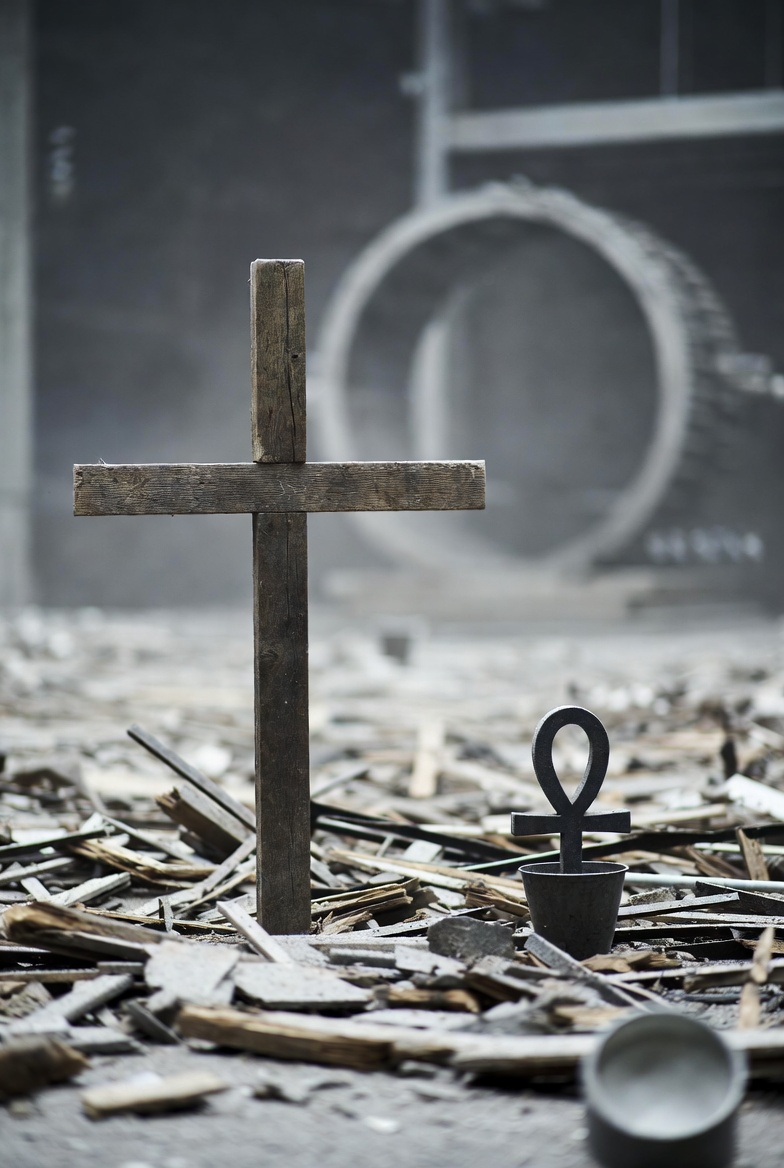
N† represents the terminus: voluntary acceptance of accumulated weight by one not subject to it, operating across all substrates simultaneously, absorbing instead of redistributing (Probable—this is the mathematical model). The † is not merely a religious symbol—it is the mathematical operator that terminates what N² accumulates. The crucifixion indicates voluntary cost-acceptance as cascade terminus.
Why no alternative terminus exists: The voluntariness is not decorative—it is constitutive. Any forced solution (divine mind-rewrite, annihilation, compelled obedience) would violate the voluntariness that makes acceptance meaningful. Force does not terminate refusal; it merely redistributes it. Compelled obedience is not acceptance—it is suppression, and suppressed patterns resurface. The generator can only be addressed by one who chooses to bear its weight without being forced to. This is why N† works and why no other operator could.
The Conditions Satisfied
[Register: Formal verification]
Movement III stated three termination requirements (Solid—these were established in Movement III). The cross satisfies all three (Probable—this is the claim):
Address the generator, not just consequences. The cross does not merely forgive sins—it provides substitution. The old generator (autonomous will, self-determining evaluation) dies with Christ. The new generator (surrendered will, filial trust) rises with him. The heart is not merely cleaned but replaced.
Trans-substratic efficacy. The cross operates in physical, celestial, spiritual, and psychological substrates simultaneously. Christ’s death and resurrection address body (broken and raised), powers (disarmed and shamed), demons (defeated through death), and heart (replaced through identification). No substrate is untouched; no debris persists beyond reach.
Absorption, not redistribution. The weight is not scattered among many or spread across time. It is concentrated in one cup, drunk by one person, absorbed completely. “It is finished” means finished—not to be continued, not to be redistributed, not to compound further.
The Substrate Independence Completed
[Register: Pattern synthesis]
Movement II established that the pattern of refusal is substrate-independent—it operates identically whether the actors are human or divine, whether the setting is garden or council chamber, whether the substrate is carbon or spirit (Solid—this was established in Movement II). Movement V reveals that the terminus is also substrate-interdependent (Probable). The N† solution works not because it addresses one substrate but because it addresses the pattern itself.
The voluntary acceptance of bounded limit—”not my will but yours”—is the structural opposite of the refusal of bounded limit that initiated the cascade. The reversal is architectural, not circumstantial. The terminus is mathematical, not merely moral. The same invariant pattern that made the cascade substrate-independent makes the terminus substrate-interdependent!
VII. The Original Boundary Condition
[Register: Engineering synthesis]
We began this paper with a claim: that Christ functions as the original boundary condition—the gate that closes, the rollback state that audits, the isolation point that accepts bounded loss to prevent unbounded loss. We now demonstrate this claim.
The Gate
[Register: Textual exegesis]
Eden’s gate was guarded by cherubim after the Fall—access to the Tree of Life blocked to prevent eternal existence in corrupted state (Corpus-Confirmed). The gate functioned as protection: better mortality than immortal corruption. Christ is the new gate: “I am the door. If anyone enters through me, he will be saved” (John 10:9, LEB). The access that was blocked is now opened—but only through the one who absorbed the corruption that required the blocking. The gate functions not by keeping out but by transforming those who enter.
The Rollback State
[Register: Engineering analogy]
Database systems maintain rollback states—snapshots of data before corruption, to which the system may return when errors accumulate beyond repair (Solid—the engineering principle is verifiable). The corrupted state is not patched; it is replaced with the clean state. Christ is the rollback state for humanity (Probable—this is the theological interpretation). “For just as in Adam all die, so also in Christ all will be made alive” (1 Corinthians 15:22, LEB). The Adamic configuration, corrupted beyond repair, is not patched—it is rolled back to the pre-corruption state embodied in Christ, the “last Adam.”
The Isolation Point
[Register: Engineering analogy]
Engineering systems use isolation points to contain cascades—accepting bounded loss at one point to prevent unbounded loss throughout the system (Solid—the engineering principle is verifiable). A circuit breaker trips, sacrificing local function to protect system integrity. A firewall isolates a compromised segment, accepting bounded disconnection to prevent unbounded propagation. The cross is the ultimate isolation point (Probable—this is the theological interpretation). The full weight of the cascade is concentrated at one point—one person, one cup, one moment. The bounded loss (the death of Christ) prevents unbounded loss (eternal cascade continuation). The isolation succeeds because the weight is absorbed, not merely contained.
The Engineering Echo
[Register: Synthesis]
Our best engineering practices—firewalls, rollback states, isolation protocols, bounded loss acceptance, circuit breakers, fail-safes—are unconscious echoes of this original boundary condition (Probable—this is interpretive synthesis). We did not invent these patterns; we discovered them. They work because they reflect the structure of reality itself, the architecture embedded in creation by its creator.
The cross is not an engineering metaphor—our engineering is a cross echo. We build systems that accept bounded loss to prevent unbounded loss because that is how the ultimate system was repaired. The pattern is not original to us; it is original to the one who bore the ultimate bounded loss to prevent the ultimate unbounded loss. We discover what was always there.

Coda: The Cup Emptied
We began in a garden with a tree and a choice. We traced the refusal and its cascade across substrates and millennia. We watched the failed resets—flood and dispersion—clear symptoms while leaving the generator intact. We walked through the debris field of human history, watching the cup fill with the weight of every refusal.
And we arrived at another garden. Gethsemane. Where one knelt alone, facing the full cup, and spoke the words that reversed the pattern:
“My Father”—relationship affirmed, not destabilized.
“If it is possible, let this cup pass from me”—reality acknowledged, not autonomously evaluated.
“Nevertheless, not as I will, but as you will”—will surrendered, not deferred.
The cup was drunk. The weight was absorbed. The cascade met its terminus. The resurrection proved what the cross accomplished: not another failed reset but actual termination. The debris field is cleared for all who enter the new configuration.
N† has absorbed what N² accumulated.
The gate is open. The rollback state is available. The isolation has succeeded.
“It is finished.” John 19:30 (LEB)
Tetelestai.
— End of Movement V —
Our Gods Research Program, February 2026
References
- Our Gods Haven’t Fallen, Yet — A Space Junkies’ Riddle — Our Cathedral. Zenodo. https://doi.org/10.5281/zenodo.17835722 O’Connor, T. (2025).
- Our Gods Haven’t Crashed, Yet — A Silicon Junkies’ Riddle — Our Highway (1.7). Zenodo. https://doi.org/10.5281/zenodo.17851041 O’Connor, T. (2025).
- Our Gods Haven’t Computed Yet — A Neural Junkies’ Riddle — Our Cloud (1.7). Zenodo. https://doi.org/10.5281/zenodo.17925255 O’Connor, T. (2025).
- An Epi-Phenomenological Series in Thrice — A Quantum Junkies’ Riddle — Our Garden. Zenodo. https://doi.org/10.5281/zenodo.17926796 O’Connor, T. (2025).
- A Spectral Evolution of Scalar Breathing — A Cosmological Junkies’ Riddle — Our Heavens (5.0r2). Zenodo. https://doi.org/10.5281/zenodo.17942325 O’Connor, T. (2025).
- The Bare, Naked Lie: The Architecture of Recursion. Zenodo. https://doi.org/10.5281/zenodo.18287548 O’Connor, T. (2026).
- A Trick Question, The Cascade, and a Cup Worthy of Exile — A Script’ Junkies’ Riddle — Our Destiny. Zenodo. O’Connor, T. (2026).
- M1 — 10.5281/zenodo.18425900
- M2 — 10.5281/zenodo.18446123
- M3 — 10.5281/zenodo.18450837
- M4 — 10.5281/zenodo.18451819
- M5 — 10.5281/zenodo.18452359
- M6 — 10.5281/zenodo.18452617
Copyright Notice
A Trick Question, The Cascade, and a Cup Worthy of Exile — A Biblical Junkies’ Riddle — Our Destiny. Echoes from the Architecture of Recursion. © 2026 Tony O’Connor. All rights reserved. Date: January 2026
License
This work is licensed under the Creative Commons Attribution-NonCommercialNoDerivatives 4.0 International License (CC BY-NC-ND 4.0).
You are free to:
- Share — copy and redistribute the material in any medium or format
Under the following terms:
- Attribution — You must give appropriate credit, provide a link to the license, and indicate if changes were made.
- NonCommercial — You may not use the material for commercial purposes.
- NoDerivatives — If you remix, transform, or build upon the material, you may not distribute the modified material.
Full license text: https://creativecommons.org/licenses/by-nc-nd/4.0/
Citation
O’Connor, T. (2026). A Trick Question, The Cascade, and a Cup Worthy of Exile: A Biblical Junkies’ Riddle—Our Destiny. Our Gods Research Program. Zenodo. 10.5281/zenodo.18425900]
Contact
For permissions beyond the scope of this license, contact the author through the Our Gods Research Program.
The mathematical notation (N², N†), theological framework, and structural architecture presented in this work are original contributions by the author.
No Responses