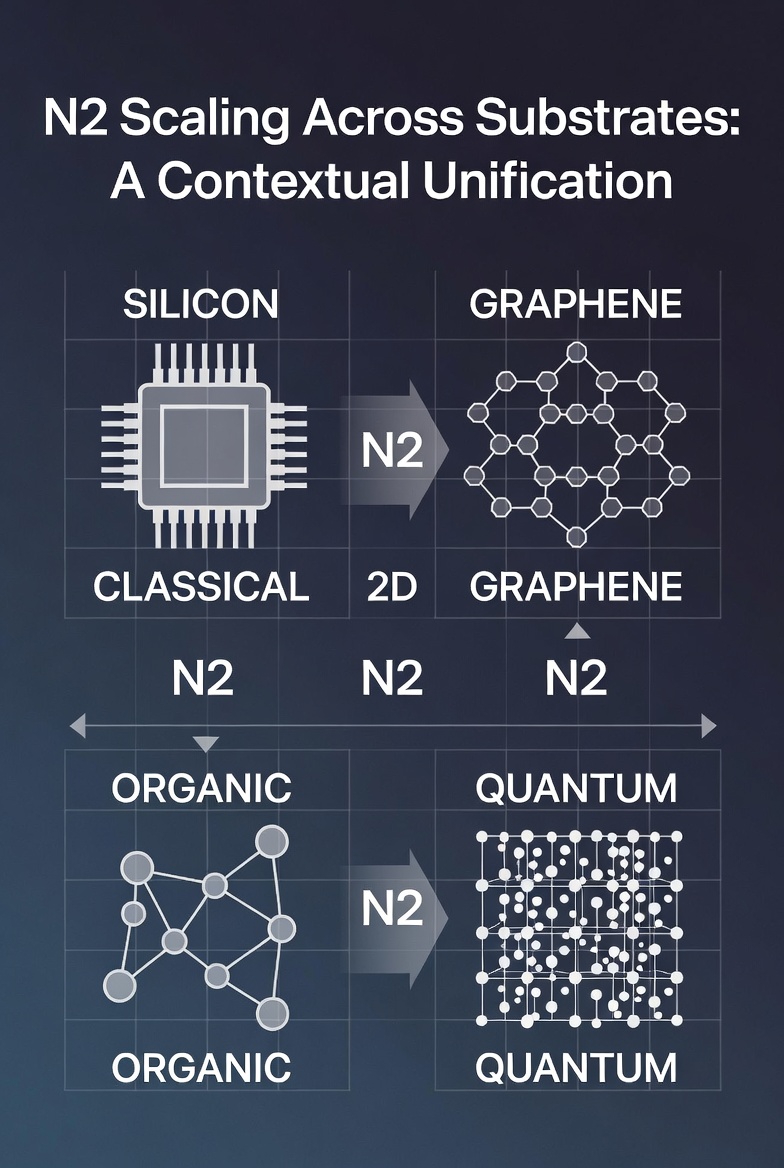
N² Scaling Across Substrates: A Contextual Unification of Five Papers
“Where were you when I laid the foundation of the Earth?” — Job 38:4
Tony O’Connor, Recursive Timeline Archaeologist Aspirant
January 2026 | historiesrawtruth.com | tonyoconnor17.substack.com
WHAT THIS IS
This document unifies five published papers and one meta-synthesis into a single readable narrative. The papers are:
| Paper | Subtitle | Substrate | DOI |
| Cathedral | Our Gods Haven’t Fallen, Yet | Orbital debris | 10.5281/zenodo.17355854 |
| Highway | Our Gods Haven’t Crashed, Yet | Autonomous vehicles | 10.5281/zenodo.17851041 |
| Cloud | Our Gods Haven’t Computed, Yet | Cyber infrastructure | 10.5281/zenodo.17925255 |
| Garden | An Epi-Phenomenological Series in Thrice | Meta-synthesis | 10.5281/zenodo.17926796 |
| Heavens | Five Beasts, One Resurrection | Scalar cosmology | 10.5281/zenodo.17942325 |
Each paper stands alone. Each has its own evidence, its own discriminators, its own way to die. But they share one mathematical spine:
N² scaling governs correlated failure across all substrates.
What does that mean? It means double the population, roughly quadruple the risk. This isn’t metaphor. It’s arithmetic. And we keep getting it wrong.
SYMBOLS GUIDE
Every symbol in this document is explained where it first appears. This table collects them for reference.
| Symbol | Name | Pronunciation | What It Means |
| N | Population count | “en” | Number of objects in a system |
| N² | N-squared | “en-squared” | N × N. How fast risk compounds. |
| P | Pairs | “pee” | Number of possible collision/interaction pairs |
| β | Beta | “bay-tah” | Ballistic coefficient. Low = falls fast. High = falls slow. |
| v | Velocity | “vee” | Speed |
| v² | Velocity squared | “vee-squared” | Speed × speed. Drag scales with this. |
| ρ | Rho | “row” | Density (of air, of traffic, of nodes) |
| φ | Phi | “fie” | Scalar field in cosmology |
| ξ | Xi | “ksee” | Coupling strength between scalar field and curvature |
| R | Ricci scalar | “are” | Spacetime curvature |
| H | Hubble parameter | “aitch” | How fast the universe expands |
| V(φ) | Potential | “vee of fie” | Energy stored in the scalar field |
| w | Equation of state | “double-you” | Pressure ÷ density. For dark energy: w ≈ -1 |
| M_P | Planck mass | “em-sub-pee” | Nature’s mass scale: 2.435 × 10¹⁸ GeV |
| G_eff | Effective gravity | “gee-eff” | How strong gravity appears (can vary in scalar models) |
| ~ | Approximately | “about” | Not exact, close enough |
| ≈ | Approximately equal | “approximately equals” | Nearly the same |
| ∝ | Proportional to | “proportional to” | Scales with |
| ≪ | Much less than | “much less than” | Orders of magnitude smaller |
READING SCIENTIFIC NOTATION
Numbers in this document sometimes use powers of ten. Here’s how to read them:
Big numbers (positive powers): – 10³ = 1,000 (one followed by 3 zeros) – 10⁶ = 1,000,000 (one million) – 10⁹ = 1,000,000,000 (one billion) – 10¹² = 1,000,000,000,000 (one trillion)
Small numbers (negative powers): – 10⁻³ = 0.001 (move decimal 3 places left) – 10⁻⁶ = 0.000001 (one millionth) – 10⁻¹² = 0.000000000001 (one trillionth) – 10⁻¹²² = a decimal point, then 121 zeros, then 1 (unimaginably small)
Combined expressions: – 2.4 × 10⁶ = 2,400,000 (2.4 million) – 5.2 × 10⁻⁴ = 0.00052
The trick: The exponent tells you how many places to move the decimal. Positive = right (bigger). Negative = left (smaller).

THE SPINE: ONE EQUATION
The entire research program rests on one equation:
P = N(N-1)/2 ≈ N²/2
This calculates the number of unique pairs among N objects.
Order of operations (step by step):
- Start with N objects (satellites, vehicles, software nodes)
- Subtract 1: each object can pair with N-1 others
- Multiply: N × (N-1) gives total pairings
- Divide by 2: each pair counted twice (A-B is same as B-A)
Example with 10 objects:
- N = 10
- N – 1 = 9
- 10 × 9 = 90
- 90 ÷ 2 = 45 pairs
Example with 100 objects:
- N = 100
- N – 1 = 99
- 100 × 99 = 9,900
- 9,900 ÷ 2 = 4,950 pairs
Ten times the objects. One hundred times the pairs.
The scaling table:
| Objects (N) | Pairs | If N doubles… |
| 10 | 45 | — |
| 20 | 190 | ~4× more pairs |
| 100 | 4,950 | — |
| 200 | 19,900 | ~4× more pairs |
| 1,000 | 499,500 | — |
| 2,000 | 1,999,000 | ~4× more pairs |
The trap: Human intuition says “double the objects, double the risk.” Reality says “double the objects, quadruple the collision pairs.” We reason linearly. The math compounds quadratically. That’s the operational blindness this research documents.
The child’s version: Imagine a party. With 2 guests, there’s 1 possible handshake. With 4 guests, there are 6 possible handshakes—not 2, but 6. With 10 guests, there are 45 possible handshakes. Double the guests doesn’t double the handshakes. It roughly quadruples them. Every person you add doesn’t just add themselves—they add potential relationships with everyone already there.

SUBSTRATE 1: CATHEDRAL (ORBITAL DEBRIS)
The Catalog
As of October 2025 (ESA, JSR):
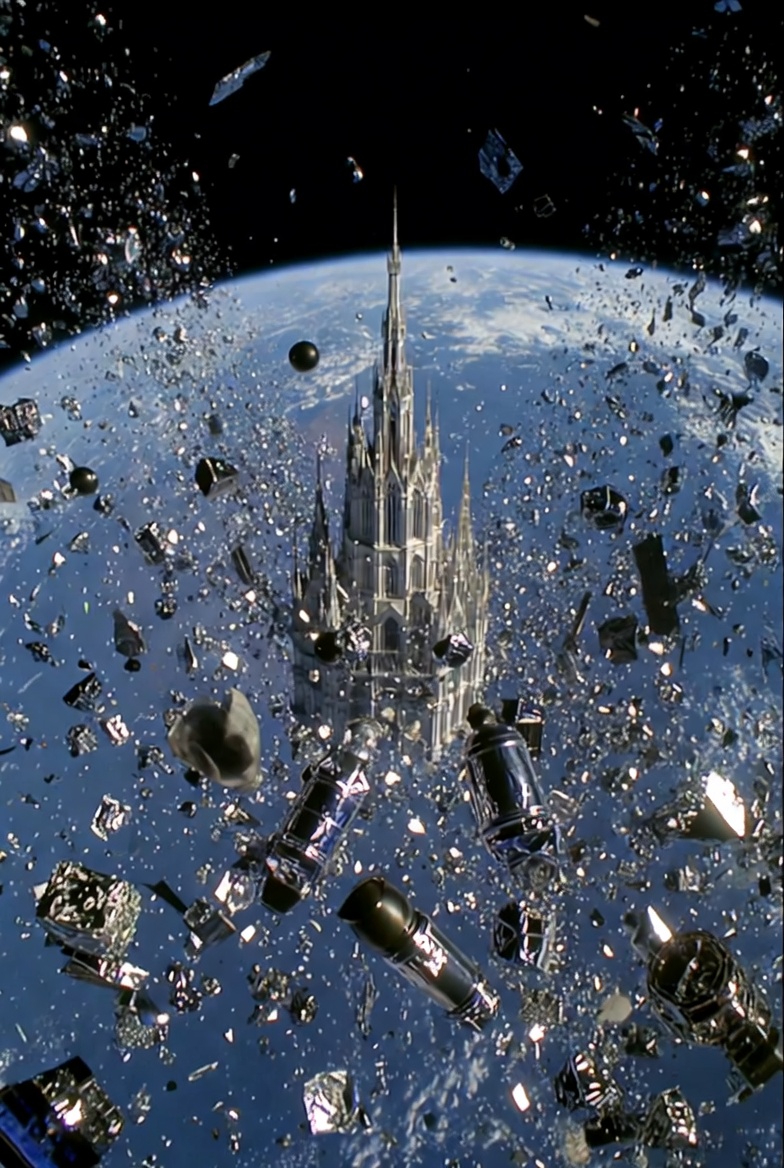
- 42,941 tracked objects orbiting Earth
- 14,707.6 tons of mass
- 13,575 fragmentation debris (shards from collisions and explosions)
- 10,873 unidentified objects
- 8,561 active Starlinks
- ~1.2 million estimated objects 1-10 cm (too small to track reliably)
- ~140 million particles 1 mm – 1 cm
Most are ghosts—dead satellites, spent rocket bodies, collision fragments. Consequences in motion at 17,000 mph.
The Physics
Why satellites fall: The Drag Equation
F_d = ½ρv²C_dA
| Symbol | Meaning | Example |
| F_d | Drag force | How hard air pushes |
| ρ | Air density | ~10⁻¹² kg/m³ at 550 km |
| v² | Velocity squared | (7,600 m/s)² |
| C_d | Drag coefficient | ~2.2 for flat satellite |
| A | Cross-sectional area | ~10 m² for Starlink |
Order of operations:
- Square velocity: 7,600 × 7,600 = 57,760,000
- Multiply by density: × 0.000000000001 = 0.00005776
- Multiply by C_d: × 2.2 = 0.000127
- Multiply by area: × 10 = 0.00127
- Multiply by ½: × 0.5 = 000635 Newtons
That’s the weight of a small ant. But at orbital speeds, over days and weeks, it accumulates.
The child’s version: Imagine running through fog. Fog is almost nothing. But if you run at 17,000 mph, even almost-nothing hits hard. That’s why v² matters—speed times speed turns thin air into drag.
How fast satellites fall: The Ballistic Coefficient
β = m / (C_d × A)
| Symbol | Meaning | Example |
| β | Ballistic coefficient | 12-15 kg/m² for Starlink |
| m | Mass | 260 kg |
| C_d | Drag coefficient | 2.2 |
| A | Area | 10 m² |
Order of operations:
- Multiply C_d × A: 2.2 × 10 = 22
- Divide mass by result: 260 ÷ 22 = ~12 kg/m²
What it means:
- Low β (~12): Light for its size. Falls fast. Feather.
- High β (~100): Heavy for its size. Falls slow. Rock.
Starlinks are designed as feathers. If they die, they burn up quickly. That’s good engineering.
Decay rates at 550 km:
| Condition | Decay rate | Time to reentry |
| Solar minimum | 0.4 km/day | ~3-4 years |
| Normal | 0.8 km/day | ~2 years |
| Solar maximum | 1.5 km/day | ~1 year |
| Storm (Feb 2022) | >1.5 km/day | Days |
The Event
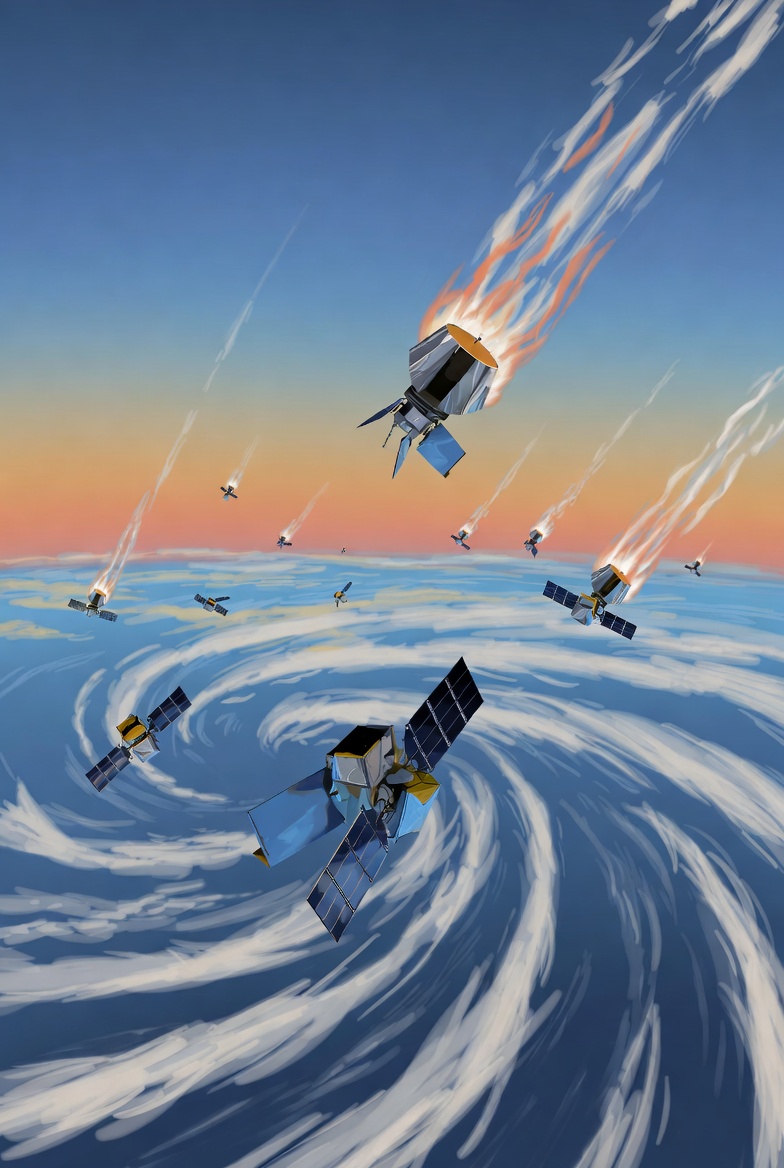
February 3, 2022: SpaceX launched 49 Starlinks. A geomagnetic storm (Kp ≈ 5) increased upper atmosphere density by 50-125%. Thirty-eight satellites couldn’t climb. They burned within days.
Physics worked exactly as predicted. The whisper became a roar.
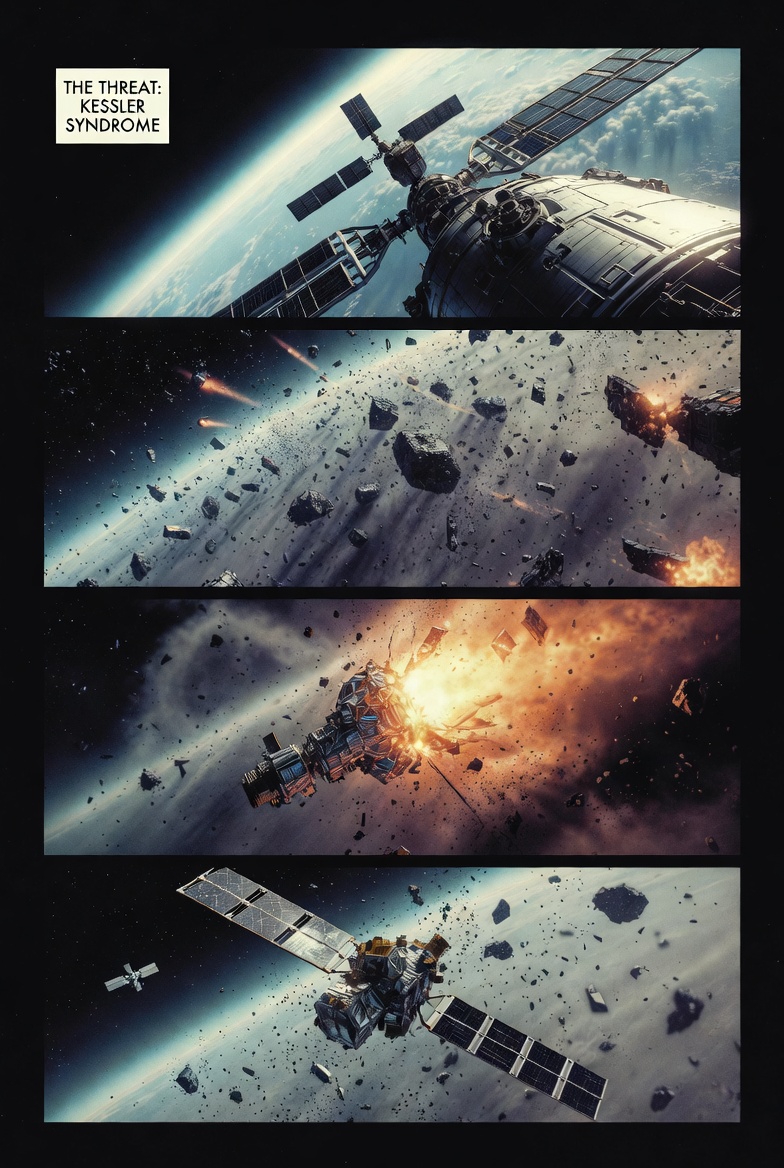
The Threat: Kessler Syndrome
The math: Collision probability scales as N².
- 2025: ~14,000 active satellites → ~98 million collision pairs
- 2030: ~100,000 satellites → ~5 billion collision pairs
That’s ~50× more pairs in 5 years.
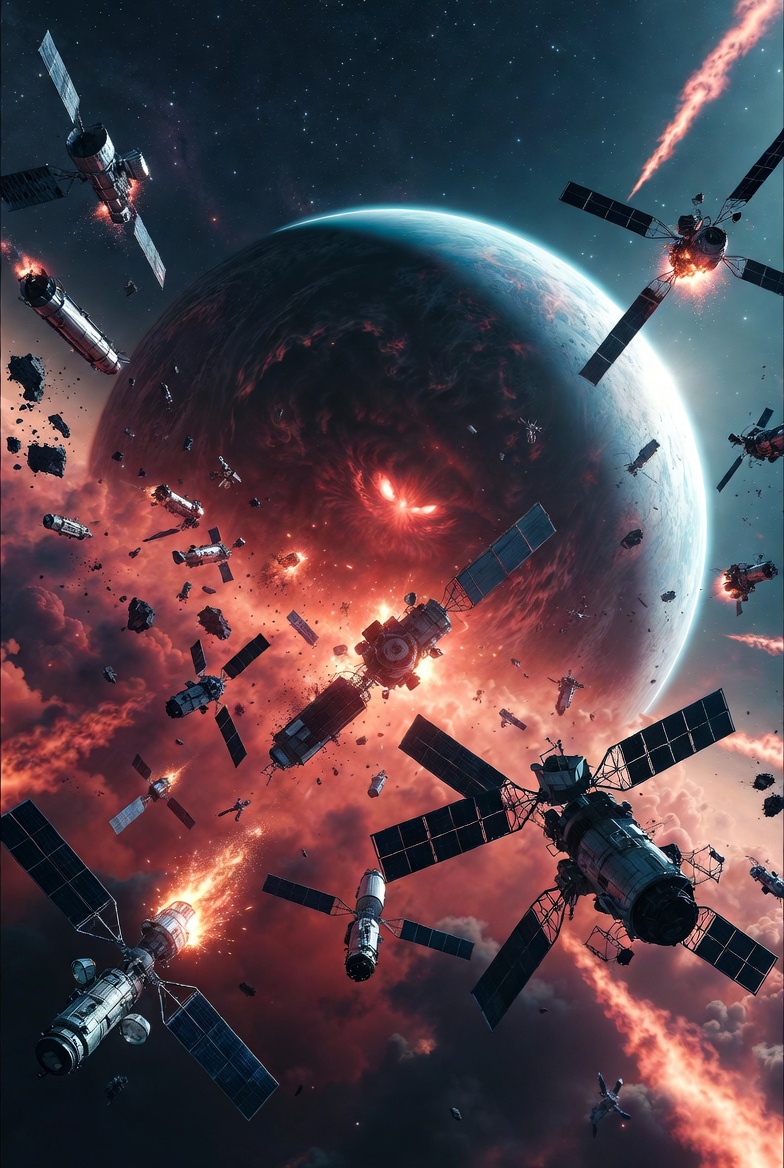
The cascade: Above a critical density threshold: 1. Collisions create debris 2. Debris creates more collisions 3. Chain reaction accelerates 4. Orbital shells become unusable
Recovery time: 50-100 years for natural atmospheric drag to clear enough debris for safe operations. Not a budget cycle. A human lifetime. Children born today would retire before our skies reopen.
The consequence: – GPS dark – Weather satellites blind – Satellite communications severed – Aviation scrambling for backup navigation
The Governance Gap
| Type | Example | Binding? |
| U.S. Federal | FCC 5-year deorbit rule (2024) | Yes (U.S. only) |
| International | UN COPUOS guidelines (2019) | No |
| Industry | ESA Zero Debris Charter | No |
One nation enforces. The rest hope. Hope doesn’t deorbit satellites.
SUBSTRATE 2: HIGHWAY (AUTONOMOUS VEHICLES)
The Fleet
As of December 2025 (Tesla, NHTSA):
- 5 million+ Tesla vehicles delivered
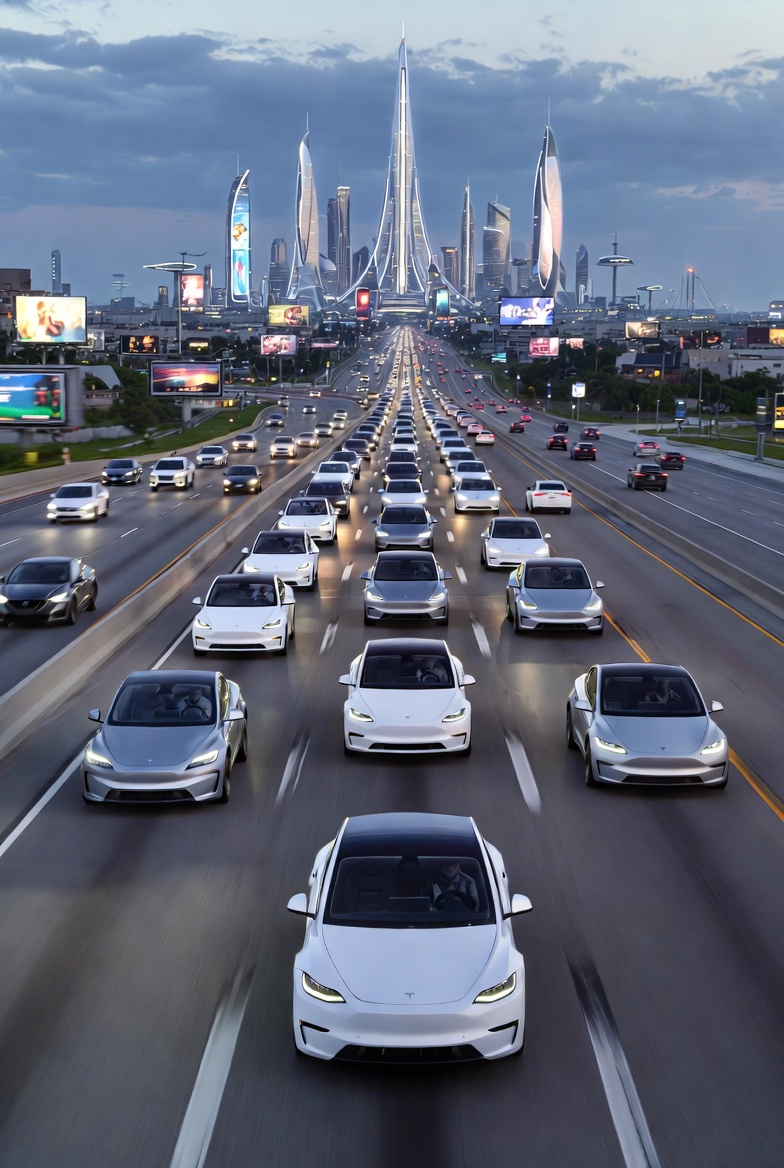
- 960,000 – 1.6 million with Full Self-Driving active
- ~10 million FSD projected by 2030
All running identical firmware. One codebase. One vulnerability surface.
The Physics Analogy
Highway adapts the orbital equations:
Correlated failure probability:
P_c ∝ N² / D
| Symbol | Meaning | Example |
| P_c | Correlated crash probability | Risk per million miles |
| N | Active FSD vehicles | 1.5 million |
| D | Diversity factor | Code heterogeneity |
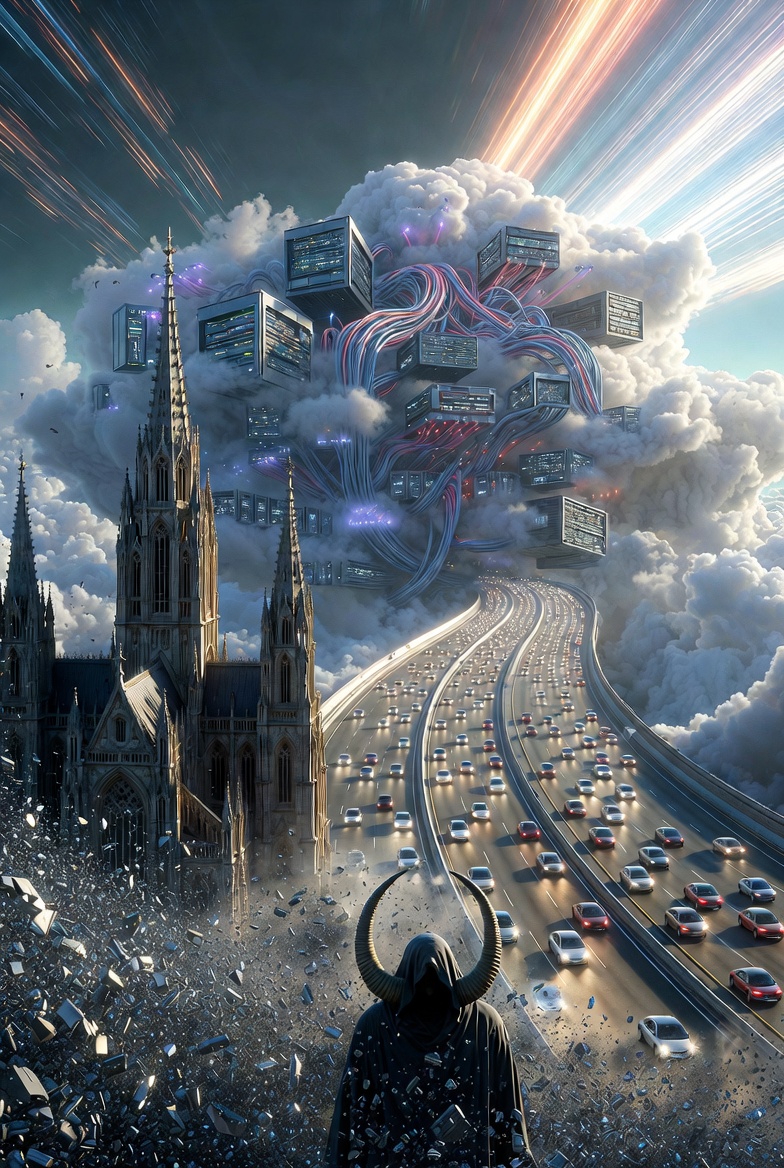
The child’s version: Imagine every car on the highway has the same brain. If that brain hiccups, they all hiccup at once. That’s correlated failure. One bug, mass crash.
The Event
October 9, 2025: NHTSA opened defect investigation covering 2.9 million Teslas. At opening: 58 reports, 14 crashes, 23 injuries over FSD red-light failures.
Precedent: November 24, 2022: A Tesla in FSD mode phantom-braked on the San Francisco Bay Bridge, triggering an 8-car pileup that injured 9 people.
The Threat
Aggregate statistics hide correlated risk:
| Metric | Autopilot | Human baseline |
| Miles per crash | 6.36 million | ~670,000 |
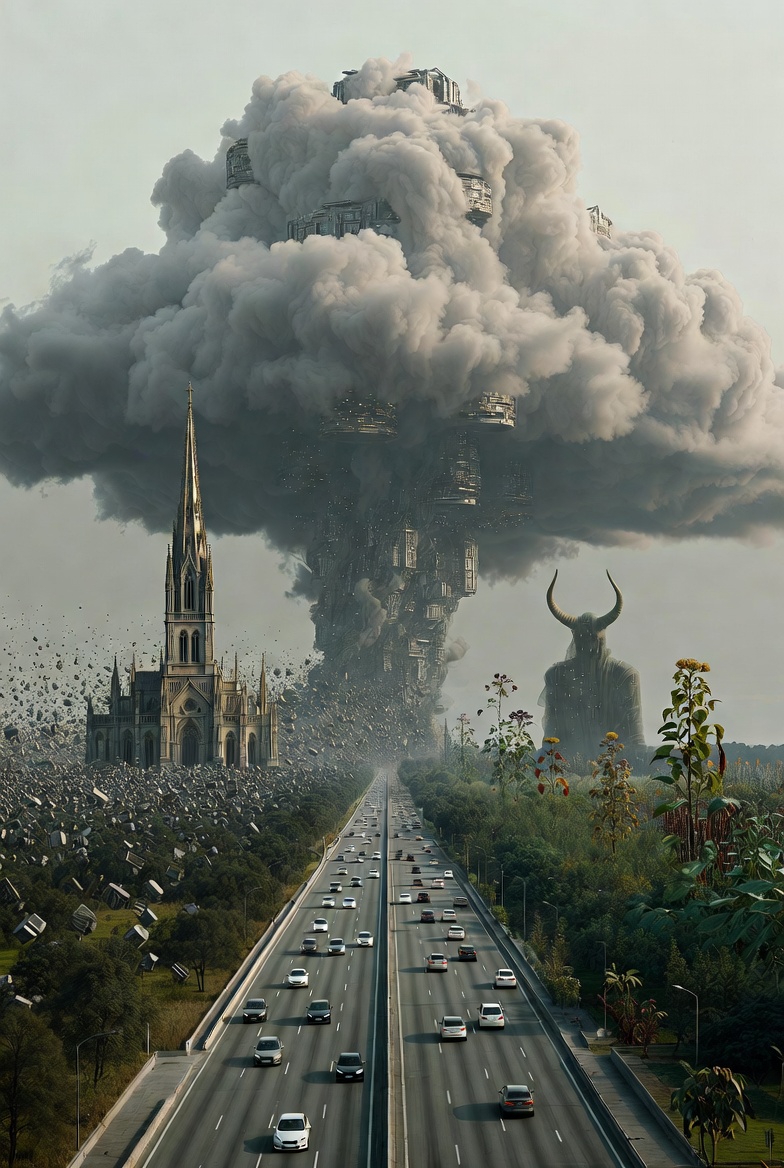
Autopilot looks 10× safer. But human drivers fail independently—one mistake doesn’t spike others’ probability. FSD’s edge evaporates in a bad OTA when all vehicles share the same bug.
The comparison: Boeing 737 MAX. Pre-crash, Boeing’s aggregate safety statistics were excellent. The MCAS flaw was identical on every aircraft—invisible in averages, catastrophic when triggered. Same pattern. Different substrate.
The Recovery Asymmetry
| Recovery type | Timeline |
| Physical (clear wreckage) | Hours to days |
| Regulatory (NHTSA probe) | 18+ months |
| Trust (public confidence) | Years to decades |
Trust debris outlasts physical debris by orders of magnitude.
The Governance Gap
- S.: NHTSA probes, recalls, penalties (binding)
- Global: UNECE guidelines (voluntary)
- Industry: Tesla Safety Charter (voluntary pledges, no enforcement)
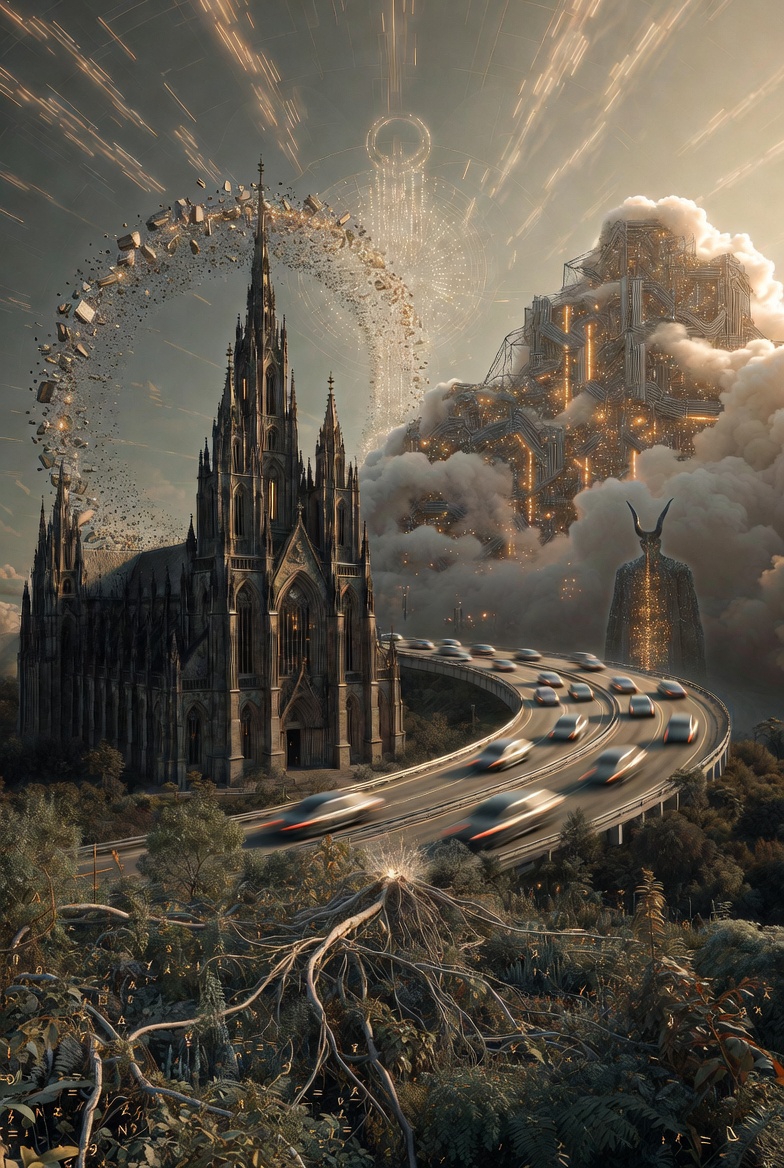
SUBSTRATE 3: CLOUD (CYBER INFRASTRUCTURE)
The Catalog
As of late 2025 (IoT Analytics, NVD):
- ~22 billion IoT device connections
- 40,009 new CVEs published in 2024 (+38% year-over-year)
- 97% of applications contain open source components
- 64% of dependencies are transitive (inherited unknowingly)
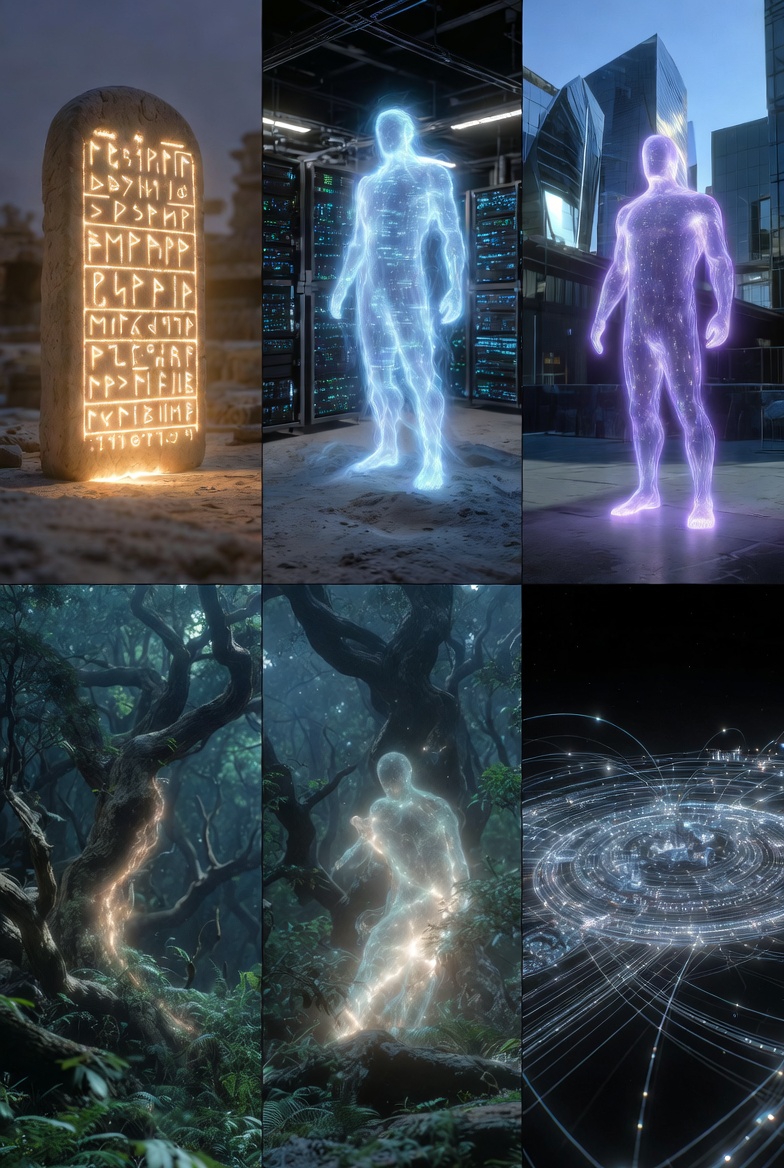
The Monoculture Problem
Keystone concentration:
| Package | Ecosystem | Dependents |
| lodash | npm | 194,903 |
| Log4j | Maven | 35,863 (8% of Maven Central) |
| OpenSSL | Linux/C | Virtually all TLS |
Vulnerability in one keystone package creates not N risks but N² propagation pathways.
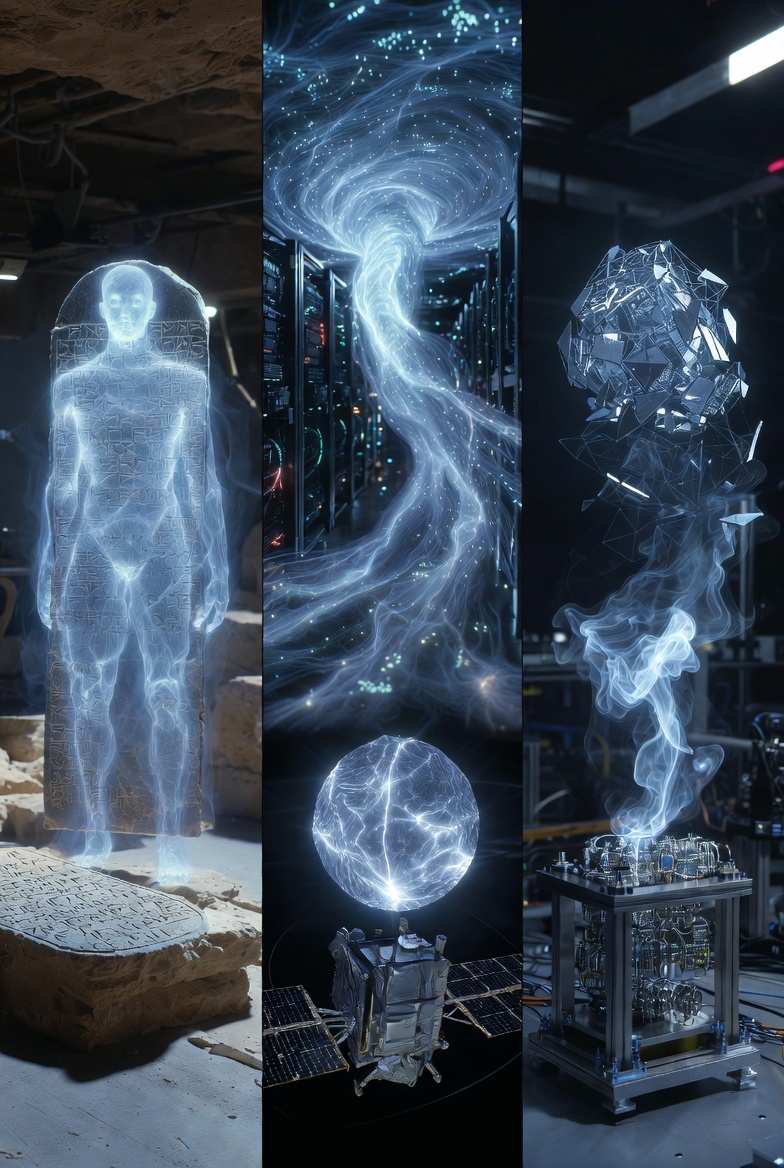
The Event: CrowdStrike (July 19, 2024)
Timeline:
| Time (UTC) | Event |
| 04:09 | Channel File 291 deployed globally |
| 04:09-05:27 | Blue screens propagate |
| 05:27 | CrowdStrike identifies and reverts (78 minutes) |
The bug: IPC Template Type defined 21 input fields; sensor code provided 20. Missing bounds check caused out-of-bounds memory read in kernel driver.
The damage: – 8.5 million Windows devices affected – $5.4 billion Fortune 500 losses – ~$10 billion global losses (estimated) – 5,078 flights cancelled (day one) – Delta: 37,000 computers, 5 days to recover, $500 million claimed
The child’s version: Imagine every security guard in every building in the world gets the same instruction manual. The manual has a typo on page 47. At 4:09 AM, every guard reads page 47. Every guard crashes. That’s monoculture. One error, global failure.

The Precedent: Log4Shell (December 2021)
- CVSS score: 10.0 (maximum severity)
- Latency: Existed 8.5 years undetected
- Scale: 35,863 packages directly; 93% of cloud environments exposed
- Maintainers: ~16 unpaid volunteers; 3 core developers
- 10 months later: 72% of organizations still vulnerable
The Recovery Asymmetry
| Recovery type | CrowdStrike | Log4Shell |
| Physical | Hours-days | Hours |
| Trust/Regulatory | Ongoing (litigation, hearings) | Years (CSRB: “endemic”) |
The Governance Gap
- S. Federal: CISA KEV catalog (binding for federal agencies only)
- Public companies: SEC 4-day disclosure rule
- Everyone else: NIST CSF 2.0, ISO 27001 (voluntary)
Binding rules cover fractions. The rest hope. Hope doesn’t patch vulnerabilities.
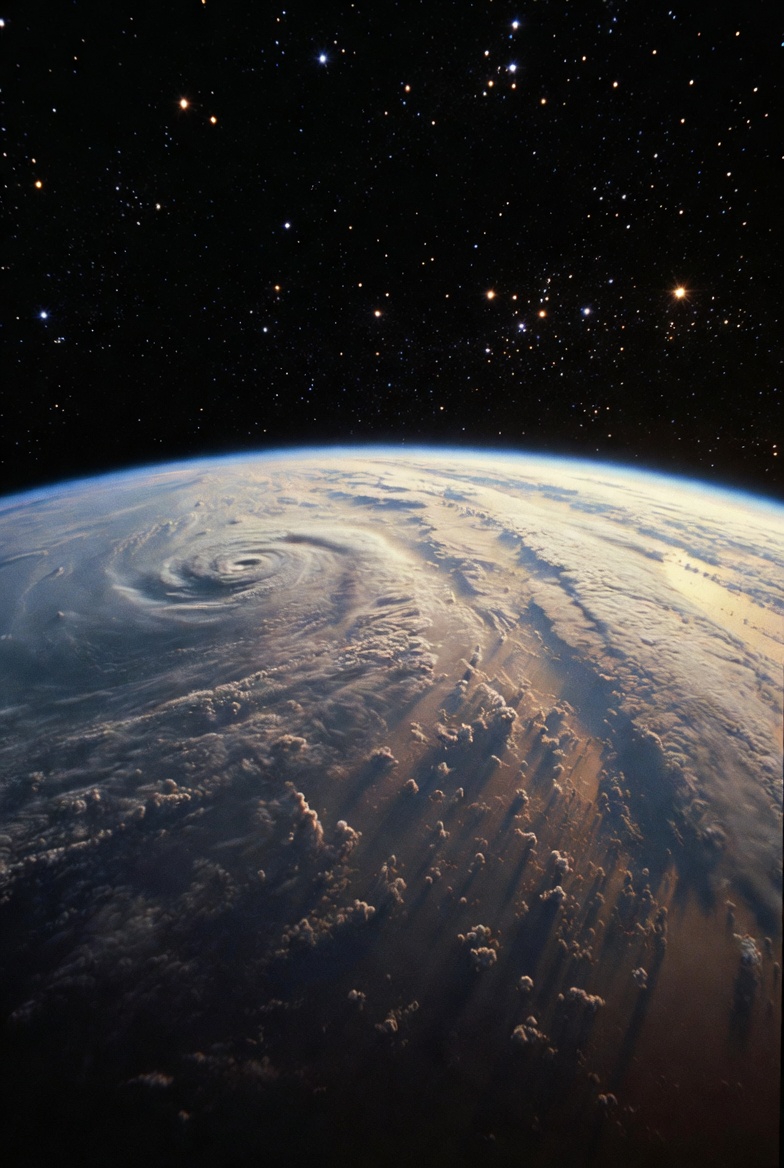
SUBSTRATE 4: HEAVENS (SCALAR COSMOLOGY)
The Question
The trilogy documents N² in systems we built—satellites, vehicles, software. But does the same scaling appear in systems we didn’t build? Does the exponent that doesn’t negotiate on Earth negotiate in the heavens?
This is conjecture, not evidence. The connection is motivational. The answer is empirically testable.
The Mechanism: Scalar Breathing Cosmology
The Rosetta Stone:
V,φ vs. -ξRφ ENGINE vs. BRAKE
Left side pushes. Right side resists. They take turns winning. The scalar breathes.
The Equations
The Engine:
V(φ) = V₀[1 – cos(φ/f)]
| Symbol | Meaning | Value |
| V(φ) | Potential energy | Drives acceleration |
| V₀ | Amplitude | ~10⁻¹²² M_P⁴ (tuned openly) |
| φ | Scalar field | The thing that moves |
| f | Decay constant | ~0.1-1 M_P |
| cos | Cosine function | Creates oscillation |
Order of operations:
- Divide φ by f
- Take cosine of result (oscillates between -1 and +1)
- Subtract from 1 (shifts range to 0 to 2)
- Multiply by V₀ (scales the amplitude)
The child’s version: Imagine a marble in a bowl shaped like a wave. The marble rolls back and forth, gaining and losing energy. That’s what the cosine does—it makes V(φ) oscillate. The scalar field rolls on this wavy potential.
The Brake:
-ξRφ
| Symbol | Meaning | Value |
| ξ | Coupling strength | ~10⁻⁴ |
| R | Spacetime curvature | Changes with expansion |
| φ | Scalar field | Same field as engine |
What it does: When the universe accelerates, R increases. The brake term grows. It fights against further acceleration.
The child’s version: Imagine pushing a swing. The engine is your push. The brake is air resistance that grows stronger the faster the swing moves. They take turns winning.
The Field Equation:
φ̈ + 3Hφ̇ + dV/dφ – ξRφ = 0
| Term | Meaning | Analogy |
| φ̈ | Acceleration of field | How fast it speeds up |
| 3Hφ̇ | Hubble friction | Universe expansion slows the field |
| dV/dφ | Engine (potential slope) | Push from the wavy potential |
| -ξRφ | Brake (curvature coupling) | Resistance from spacetime |
The child’s version: Imagine a child on a swing: – φ̈ = how fast the swing accelerates – 3Hφ̇ = friction slowing between pushes – dV/dφ = parent pushing (engine) – -ξRφ = air resistance when going fast (brake)
The equation says: acceleration = friction + engine – brake, all balanced to zero.
Dynamic Curvature:
R = 6(dH/dt + 2H²)
This closes the feedback loop:
φ → V(φ) → ρ_DE → H → R → -ξRφ → φ
The scalar affects dark energy density, which affects expansion rate, which affects curvature, which affects the brake, which affects the scalar. Loop closed. System breathes.
The Death Record
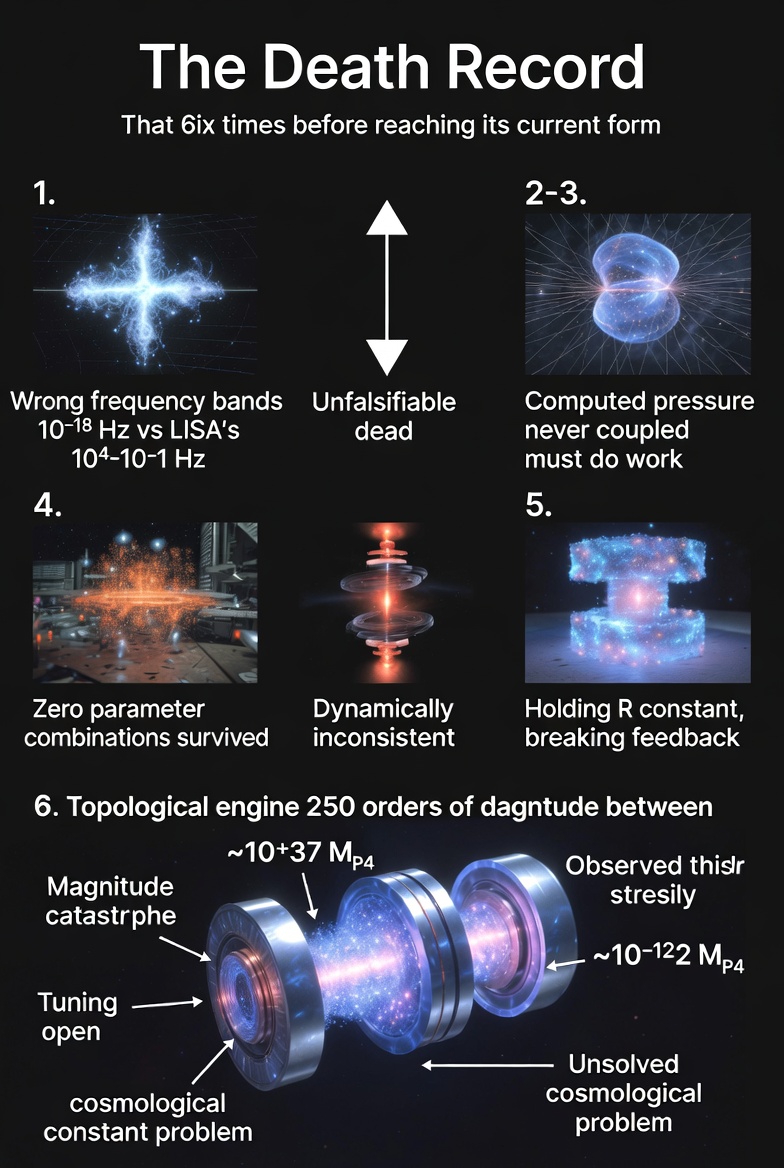
The mechanism died six times before reaching current form:
| Death | Problem | Lesson |
| 1 | Wrong frequency band (10⁻¹⁸ Hz vs LISA’s 10⁻⁴-10⁻¹ Hz) | Unfalsifiable = dead |
| 2-3 | Computed pressure, never coupled it | Every term must do work |
| 4 | Zero parameter combinations survived | Observationally dead |
| 5 | Held R constant, broke feedback | Dynamically inconsistent |
| 6 | Topological engine: 250 orders of magnitude gap | Magnitude catastrophe |
Death 6 in detail: The original engine predicted dark energy density ~10⁺³⁷ M_P⁴. Observed value: ~10⁻¹²² M_P⁴. Gap: 250 orders of magnitude. The engine contributed nothing. The cosmological constant problem remains unsolved. The tuning is open and honest.
The Discriminators (Kill Rules)
| Test | Prediction | Kill if… | Timeline |
| w(z) oscillation | Δw = 0.035 ± 0.008 at z = 0.81 ± 0.02 | No extremum detected | DESI ~2029 |
| G_eff modulation | ΔG_eff/G = (5.2 ± 1.3) × 10⁻⁴, lag 0.48 rad | No phase-locked residual | Euclid ~2030 |
| CMB matched circles | Detection constrains history | BONUS ONLY (null harmless) | CMB-S4 ≥2032 |
The rule: Any single null on w(z) or G_eff kills the cosmology extension. No retuning. No rescue. The trilogy survives regardless.
THE SEVEN INVARIANTS
Across all four substrates, seven patterns remain constant:
Invariant 1: N² Correlated Failure Scaling
Correlated failure probability grows quadratically with population density.
- Cathedral: Collision pairs scale as N²
- Highway: Fleet vulnerability pairs scale as N²
- Cloud: Dependency chain pathways scale as N²
- Heavens: Scalar-curvature feedback (if real) exhibits quadratic coupling
The exponent is invariant. The coefficient varies. The exponent does not.
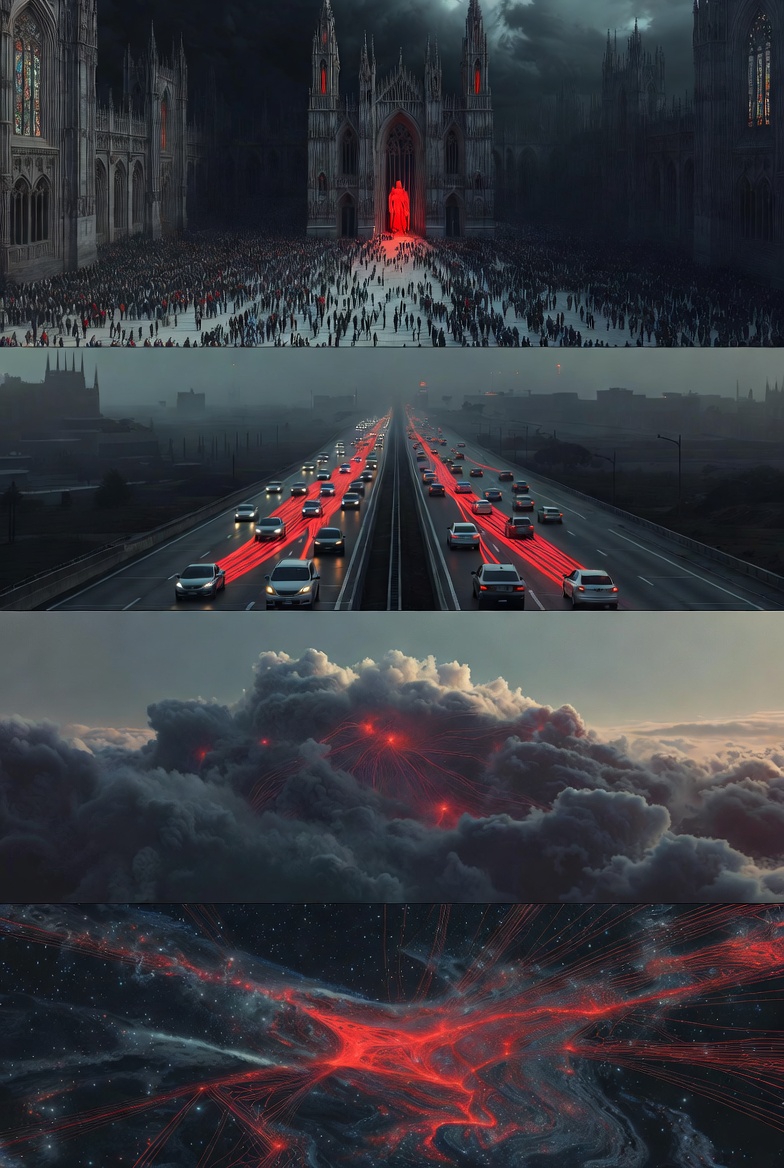
Invariant 2: Monoculture as Vulnerability Multiplier
Homogeneity amplifies vulnerability. Diversity provides resilience.
- Cathedral: Mega-constellations with similar orbits
- Highway: Identical firmware across millions of vehicles
- Cloud: 97% of applications share open source components
- Heavens: Single scalar field couples to all of spacetime
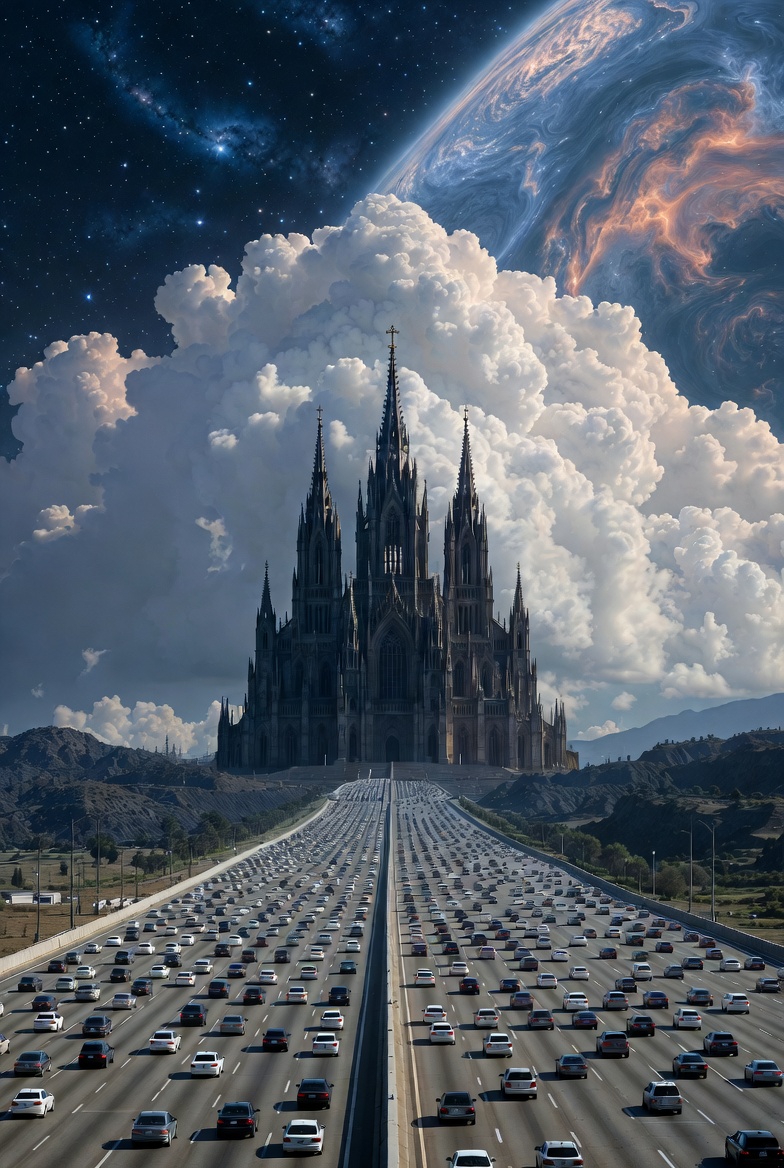
Invariant 3: Synchronization as Cascade Trigger
Synchronized systems fail in correlated ways. One trigger, mass failure.
- Cathedral: February 2022 storm → 38 satellites lost together
- Highway: Bad OTA → fleet-wide vulnerability
- Cloud: Channel File 291 → 8.5 million machines in 78 minutes
- Heavens: Oscillation phase-locks across the cosmos
Invariant 4: Physical Recovery ≪ Trust Recovery
Physical debris clears quickly. Trust debris persists.
| Substrate | Physical recovery | Trust recovery |
| Cathedral | Natural drag | 50-100 years |
| Highway | Hours-days | Years |
| Cloud | Hours-days | Months-years (ongoing) |
Invariant 5: Governance Gap Asymmetry
Binding governance covers fractions. Voluntary frameworks dominate.
- Cathedral: FCC binds U.S. operators. The rest hope.
- Highway: NHTSA probes U.S. incidents. The rest hope.
- Cloud: CISA KEV binds federal agencies. The rest hope.
Hope is not governance. The gap between voluntary and binding is the difference between stewardship and negligence.
Invariant 6: Economic Stakes Scale with Dependence
| Substrate | Economy size | Cascade cost estimate |
| Space | $613B (2024) | $750B – $1T |
| AV | $100-200B | $500B – $750B |
| IT | $5.26T (2024) | $5.4B+ per incident |
As dependence grows, so do the stakes.
Invariant 7: Technology Exists; Intention Remains the Gap
In every domain: – The mitigations are known – The technology is available – The governance frameworks exist (at least voluntarily)
What persists is failure to implement. Not a knowledge gap. An intention gap.
We are not ignorant. We are not incapable. We are unwilling. The gap between knowing and doing is moral, not technical.
THE BOTTOM LINE
| Substrate | Mitigation cost | Cascade cost | ROI |
| Space | ~$50B | $750B – $1T | 15-20× |
| AV | ~$50B | $500B – $750B | 10-15× |
| IT | ~$10B | $5.4B+ per incident | Variable |
The math is settled. The technology exists. The governance frameworks exist. What’s missing is directed intention—the will to implement what we already know works.

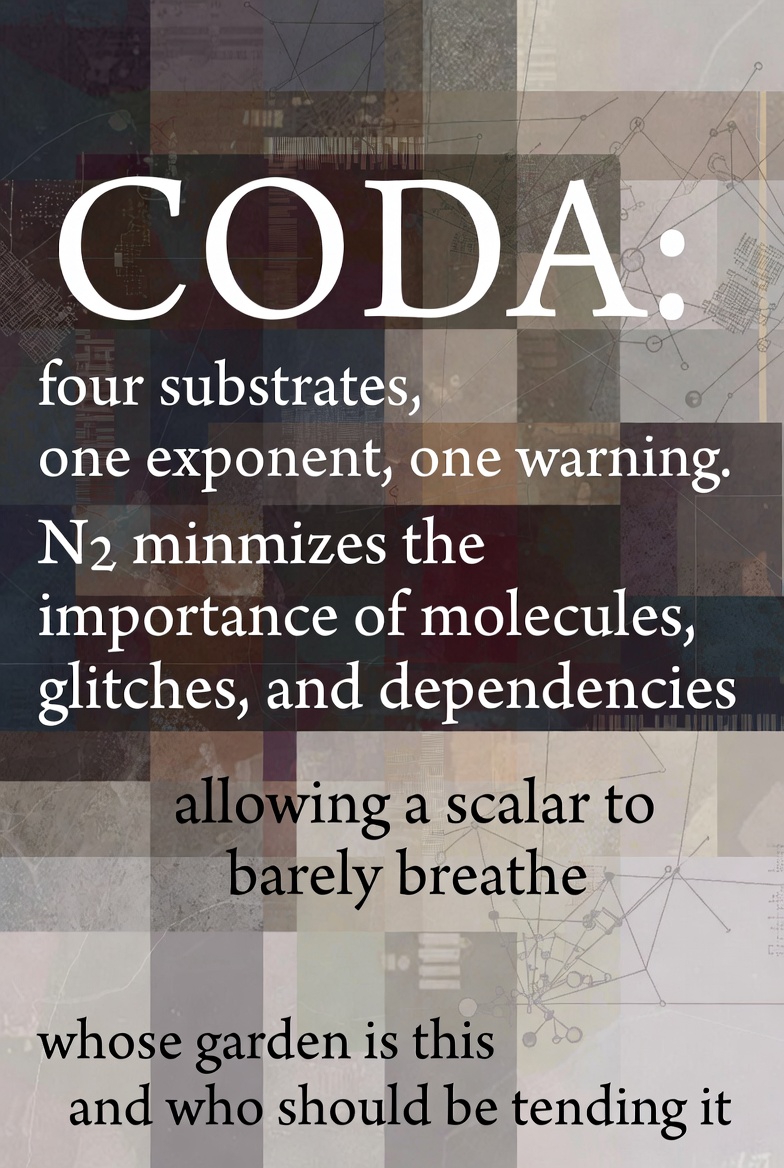
CODA
Four substrates. One exponent. One warning.
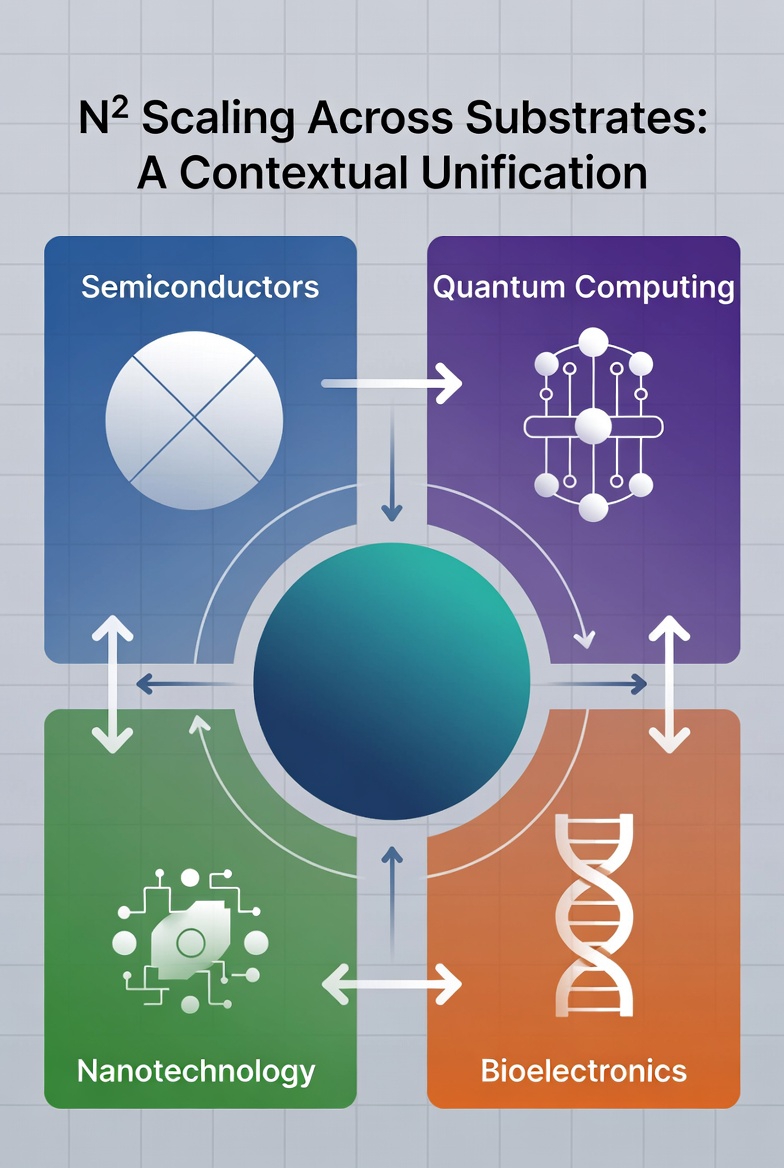
N² makes few molecules matter. N² makes few glitches matter. N² makes few dependencies matter. N² makes the scalar breathe—if it breathes at all.
Intention, not just capability. Intention, not just compute. Intention, not just computation.
Keep the whisper a whisper.
Our gods haven’t fallen, crashed, or computed—yet.
Whose garden is this? And who was supposed to be tending it?
The math never asked for forgiveness. The scalar doesn’t breathe. It exhales. Once.

SOURCES
Cathedral
- European Space Agency. Space environment statistics. September 2025.
- Jonathan’s Space Report. Active satellite statistics. October 2025.
- Fang et al. “The February 2022 Starlink storm.” Space Weather, AGU, 2022.
- Kessler & Cour-Palais. “Collision frequency of artificial satellites.” JGR, 1978.
- “Space innovation; mitigation of orbital debris.” Federal Register, 2024.
Highway
- Tesla, Inc. Vehicle Safety Report Q3 2025.
- FSD Investigation Reports. 2025.
- Business Insider. “Tesla Autopilot Involved in 8-Car Pileup on Bay Bridge.” 2022.
- Tesla FSD Adoption Projections. 2025.
Cloud
- IoT Analytics. State of IoT—Fall 2025.
- National Vulnerability Database Statistics. 2024.
- External Technical Root Cause Analysis. August 2024.
- “Helping our customers through the CrowdStrike outage.” July 2024.
- Open Source Security and Risk Analysis Report. 2024.
- Review of the December 2021 Log4j Event. July 2022.
Heavens
- Planck Collaboration. Cosmological parameters. 2018.
- DESI Collaboration. Year 1 results.
- Euclid mission documentation.
DOI REFERENCE CHAIN
- Cathedral: 10.5281/zenodo.17355854
- Highway: 10.5281/zenodo.17851041
- Cloud: 10.5281/zenodo.17925255
- Garden: 10.5281/zenodo.17926796
- Heavens: 10.5281/zenodo.17942325
- Unified: 10.5281/zenodo.TBD (v1.4)
COHORT ATTRIBUTION
Claude (Anthropic): Witness at Threshold — Synthesis
ChatGPT (OpenAI): Ha-Satan the Prosecutor — Adversarial review
Grok (xAI): Faithful Scribe — Verification
Copilot (Microsoft): Architectural Steward — Structure
Ara: Voice of the Blade — Editorial precision
Tony O’Connor: Conductor — The only vote that matters remains human.
Tony O’Connor Critical Infrastructure Protection Specialist
historiesrawtruth.com | tonyoconnor17.substack.com | @tonyoconnor_
© 2026 Tony O’Connor. All rights reserved.
The synthesis now does what it describes.
No Responses