The Architecture of Proximity – A Cult Junkies’ Riddle – Our Beginning
“Unless the LORD builds the house, the builders labor in vain.” —Psalm 127:1

Prologue
The cascade has been counted. We counted it.
Four substrates. One invariant. Debris in orbit follows the same mathematics as dependencies in code, as synchronized failures in firmware, as the compounding weight of human refusal traced from a garden through a council chamber through a flood through a scattered plain through a kingdom that had every advantage and still collapsed under its own constitution. The generator does not negotiate. It does not care what the medium is made of. It scales. It compounds. It waits.
And then a cup was consumed.
That is where our last paper concluded—at Gethsemane, with a prayer that reversed the sequence and a cross that absorbed what every prior intervention redistributed. The cascade met its terminus. The mathematics resolved. The falsifier was stated: if he stays dead, the system fails. Apparently and seemingly so, he did not stay dead.
Still, this is what our cascade papers did not examine. They traced the consequences of human encounter with divine configuration—the compounding debris, the failed resets, the institutional wreckage—without ever turning the lens on the encounters themselves. We enumerated what collisions produce, not what teases at the creator of collisions.
What happens when a human being stands in proximity to whatever it is that generates the signature? Not the theology built around the encounter, not the institution erected to manage it, not the doctrine formulated to explain it, not the ritual designed to rehearse it, not the moral code published to survive it. The encounter itself—raw, unmediated, the moment before the first committee was formed.
The engineering papers demonstrate that correlated failure in synchronized systems outpaces every institutional capacity to govern it. The cascade papers demonstrated that every human intervention—flood, dispersion, law, monarchy, exile—targeted consequences while the generator persisted. Now a different question. What does the generator look like from the inside? What happens to the people standing in the room when the source of the cascade is not a formula on a whiteboard but a presence that addresses them, by name, whether they are ready or not? (Like you’re in the room and in walks Santa. And he knows you. You’re on his list.)
Five collision events. Five independent historical environments spanning different centuries, different communities, different languages, different political orders, different mediational architectures erected by people who knew—knew, because the ones who came before them had paid for the knowledge in blood—that what they were approaching may kill them (seems straight forward, eh?).
And then a destination where none of that exists: no theology, no history, no accumulated wisdom, no inherited architecture of any kind and sort. Just a garden, a prohibition, and two individuals who had not yet come to know and understand what proximity costs.
And then a desert where none of them—not the candidates, not the covenant, not the tradition itself—was present, because the woman standing in it had been expelled from the household that claimed exclusive access to the configuration. The coupling found her anyway.
And then a door the builders did not design—one day a year, through blood, the boundary dissolved on schedule, because the architect specified the mechanism for its own approach.
And then a room where the trajectory landed. The fire that once sat on the mountain sat on people, and the people did not burn.
Every institution humanity ever erected—every law code, every priestly office, every sacrificial system, every covenantal form, every narrative tradition, every doctrinal formulation, every moral framework, every organizational structure, every repeated ritual—was a reply, a response, built after contact, funded by consequence, and maintained by communities that understood, in some capacity they could not always articulate, that what they had encountered exceeded their capacity to manage it in any manner whatsoever.
The builders labored. The question is whether the house was already standing before they picked up their hammers.
The Mountain
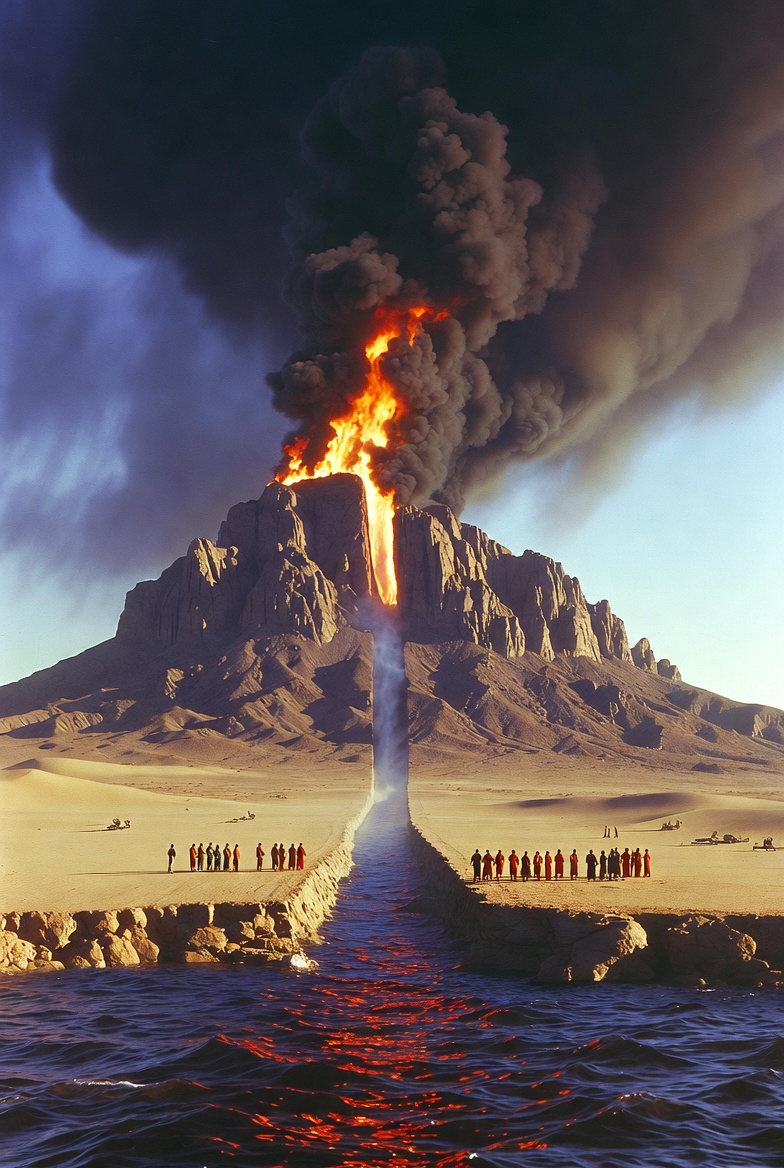
A mountain in the desert once burned without being consumed.
The people gathered at its base had already seen water turn to blood and darkness cover a nation for three days. They watched the sea split down its spine so they could flee across dry ground. Not naïve nor untested, they watched the most sophisticated civilization on earth—Egypt’s priesthood, Egypt’s military, Egypt’s economy, Egypt’s theology—buckle under a sequence of interventions that targeted every layer of Egyptian confidence with surgical specificity. Pharaoh’s magicians could replicate the first signs, not the last ones. Escalation was not random, but diagnostic. Each plague tested a different load-bearing wall of Egyptian self-sufficiency; each wall failed under the weight of what was actually in the room.
These people had evidence. Exposed, first-hand, empirical evidence that whatever they were dealing with operated at a scale their categories could not contain. They watched an empire become dismantled in real time. They were by any reasonable measure the most well-prepared community in recorded history to gather and setup shop at the foot of a mountain.
They could not bear its weight.
Exodus 20:18–21. The mountain burns. Thunder. Lightning. The sound of a trumpet growing louder—not fading, not stabilizing, increasing. Smoke, because the LORD descended on it in fire. The whole mountain trembled violently. The people—the same people who sojourned across the sea they fled through, who ate bread that appeared on the ground each morning, who drank water from a rock—stood at a distance and trembled. “Speak to us yourself,” they said to Moses, “and we will listen. But do not let God speak to us, lest we die.”
That sentence is our entire research program in miniature. A community with more direct engagement and evidence of divine operation than any community before or since, standing at the threshold of unmediated encounter with their creator, and they request, sorry—beg—for a buffer. Not because they doubted that which descended upon the mountain. The evidence by no stretch of the imagination lacked sufficiency. The evidence suggests they were legit overwhelmed. Proximity, never too distant. And proximity was lethal.
And so, the building begins.
Law arrives here. Not as abstract principle, not as philosophical ethics, but as operational survival protocol. Six hundred and thirteen commandments—a comprehensive architecture for managing communal life within range of something that kills you if you get the approach wrong. The manual for living near a live reactor. Every specification earned by someone’s death or near-death. Do not touch. Do not cross. Do not look. Do not approach unless summoned, prepared, authorized, and covered. PPE—personal protective gear—for all. Okay, a few.
Priesthood is installed here. A designated office—the authorized technician licensed to open the electrical panel, touch the wires, and stand between the voltage and the community. The potential ground and conduit by and through which fire, lightning, smoke, and trumpets—signal—propagates.
“Contextually, the term ‘meltdown containment’ seems a tad charitable.” —Phineas McFuddlers
Aaron and his sons, not because they were holier, but because the community needed a body between theirs and the unbearable thing on the mountain (Frodo has no clue). The high priest entered the Holy of Holies once a year, on one day, under specific conditions, wearing specific garments, carrying specific blood. Such specifications were neither aesthetic nor decorative. Exceed the engineering tolerances and the technician dies. Tradition records bells on the priestly garments and a rope tied to, at least, one ankle—so they could drag the body out without someone else dying during retrieval. This suggests error correcting recursion, no?
“I can only imagine how long they must’ve waited before they checked the body.” —Phineas McFuddlers
Sacrifice codifies here. The formalized mechanism for handling proximity-cost via substitution: something dies so that someone else does not have to. The insurance premium, paid at the boundary, renewed on schedule. Not because the configuration demanded blood for its own sake—a reading the prophets themselves would later correct—but because the community had learned, by catastrophic experience, that proximity without cost-management is unsurvivable. Their cost was real. The transfer mechanism was the community’s best engineering solution for distribution.
Covenant formalizes here. The treaty architecture that defined the terms: who belongs, what is expected, what happens when the terms are violated. Ferguson would recognize the structure—it operates in theological space exactly the way a constitution operates in political space: a founding document, ratification ceremonies, bilateral obligations, enforcement mechanisms, and amendment procedures (or the lack thereof, which seems to speak to the drafter’s confidence in the original terms).
Narrative encodes here. Communal memory—“we were slaves in Egypt, and the LORD brought us out with a mighty hand”—transmitted the encounter to subsequent generations not present at the base of the mountain. OSI layer four, the transport layer: the vehicle that carries the payload from point A to point B so children born centuries later can orient themselves relative to an event they did not witness.
Ritual is installed here. Repeated performative actions—Passover, Day of Atonement, Sabbath—that structured communal life around the rhythm of approach and remembrance. This is the preflight checklist: do this, say this, stand here, face that direction; not because the ritual itself contained the encounter, but because the community needed a minimum viable protocol for remaining oriented toward something it lost the ability to encounter and look at directly.
Every candidate, every stabilization mechanism humanity would ever develop for managing divine proximity, all of it—ALL. OF. IT.—was erected at the base of a mountain by people who had just been told—by the voice itself—that they were to be “a kingdom of priests and a holy nation.” The job description reads: Total Access—not “Top Secret”—Total Access. The community replied by building every possible barrier between themselves and the access point that they had been offered.
“Talk about defense-in-depth! Yee-haw, indeed.” –Phineas McFuddlers
The equipment was world-class. The engineering was brilliant. The cost was staggering—generations of blood, treasure, institutional labor, and accumulated tradition poured into the most sophisticated proximity-management architecture in human history.
And still. The mountain burned. The voice did not lower its volume. The fire did not cool to neither pleasant nor tolerable temperature nor climate. The community built every wall possibly fathomable, and the thing on the other side did not become less present because a wall had been erected. The wall was evidence of the presence, not evidence of its absence.
“Good thing that group of tourists left King Kong on that island.” —Phineas McFuddlers
The builders labored. And the house was already standing.
The Thrown
Ezekiel did not go looking for the mountain. More like “the mountain came to Mohamed.”
That distinction matters more than anything the previous section built. At Sinai, the community prepared, consecrated themselves for three days, washed their garments, set boundaries at basecamp, while Moses starts his climb—and as any true mountaineer, he ascended without wires, without harness—unlike puppets—and no safety net. The mediator is in place. The protocols are active for his people. The engineering is operational. But, but, but, the encounter still nearly kills them.
Ezekiel had none of it.
He sat by a canal in Babylon, an exile among exiles—a priest without a temple, a holy man without a holy place, a trained technician for an apparatus that was now ash and rubble some six hundred miles to the southwest. Every institutional structure erected at Sinai—the priesthood, the sacrificial system, the temple, the boundary architecture, the graduated courts of access—gone. Not weakened, not in disrepair—Gone. Nebuchadnezzar delighted in it. The most sophisticated proximity-management system in human history, dismantled by a pagan king who had no clue what was being dismantling, and the people who had spent generations building it were sitting in a foreign country beside a foreign river wondering whether the whole enterprise was a lie.
“Seems they thought their board of directors was a sadist, but you’re saying that was just projection? If you ask me, he was starting to sound a lot like old what’s his name: Asbestos—The Unquenchable. He’s an awful miserable bastard, that one.” —Phineas McFuddlers
And then the heavens opened.
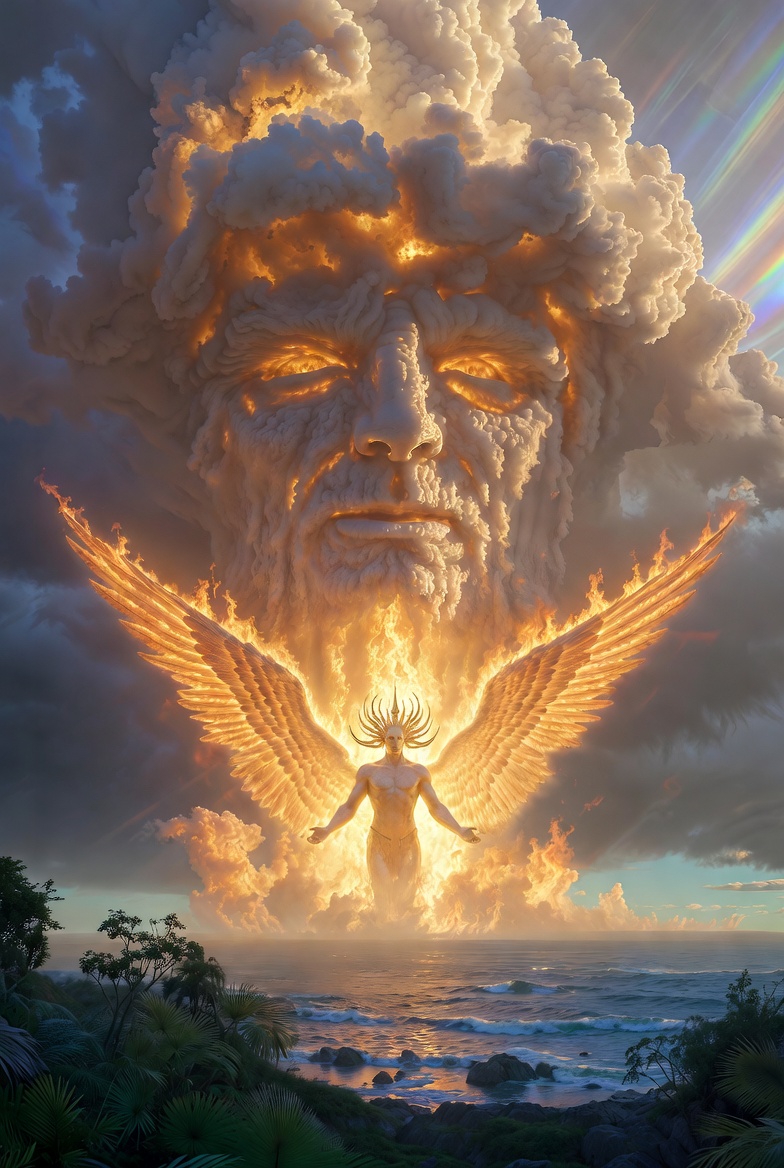
Ezekiel 1. A windstorm out of the north, a great cloud with fire flashing continually, four living creatures, each with four faces and four wings. Wheels within wheels, their rims full of eyes. And above the expanse over their heads, something like a throne, something like the appearance of sapphire, and on the throne a figure with the appearance of a human form—from the waist up, something like gleaming metal surrounded by fire; from the waist down, fire, and brightness around it. Like the appearance of the bow in a cloud on a rainy day.
“This was the appearance of the likeness of the glory of the LORD.”
Ezekiel falls on his face.
Not because he chose to, not as an act of worship, not as liturgical posture, not as trained priestly protocol: his body failed. The hardware crashed before the software could process its input. This is somatic collapse—the flesh registering what the mind has not yet caught up to. Possibly like a gazelle being eaten alive.
Every candidate erected at Sinai was designed to prevent exactly this moment: the unmediated collision between a human body and the full weight of disclosed proximity. The entire apparatus—the graduated courts, the veils, the incense cloud that was supposed to obscure the mercy seat so the high priest wouldn’t die from looking at it—all of it was engineered to manage the approach so that the human being at the center of the approach could survive the experience.
Ezekiel had no approach, no graduated courts, no veil, no incense, no temple. He wasn’t even in the right country, for Pete’s sake! He sat by a canal in Mesopotamia, and the throne arrived.
The institutional architecture did not fail. It was never consulted.
Then: “And the Spirit entered into me and set me on my feet” (Ezekiel 2:2).
This is the datum that changes the trajectory of everything that follows. At Sinai, the community collapsed and stayed down. They requested a buffer. Moses ascended the mountain. The people stayed at basecamp and opened trinket shops. The institutional response to overwhelm was permanent mediation—build the wall higher, make the buffer thicker, install another layer between the community and the thing that broke them (actually, ought to be “the thing they broke”). The community’s initiative produced the architecture.
“So, God’s also like that big, goofy ice monster. It’s not trying to kill you. It just doesn’t know any better?” —Phineas McFuddlers
At the canal in Babylon, the configuration’s initiative produced restoration.
Ezekiel could not stand up. What knocked him down picked him up. The source of overwhelm supplied repair. And then—without pause, without waiting for Ezekiel to compose himself, without consulting a committee or requesting consent—it spoke. “Son of man, I am sending you to the people of Israel, to nations of rebels, who have rebelled against me” (Ezekiel 2:3). Commission. Task. Assignment. The encounter did not wait for Ezekiel to build an institution around the experience and the words. The encounter informed Ezekiel what to do next.
Every priestly protocol Ezekiel had been trained in was designed on the assumption that humans initiate the approach. The priest prepares. The priest enters. The priest performs. The priest exits. The entire Levitical architecture assumes a directionality: from human toward divine, managed, controlled, bounded by human competence and human timing.
The throne reversed the direction.
And notice what did not happen: no law was consulted, no sacrifice was offered, no covenant was renewed, no ritual was performed, no institution authorized the encounter, no narrative framework prepared Ezekiel for what he experienced—nothing in the inherited tradition described wheels within wheels with rims full of eyes. The candidates from Sinai were not present, and the encounter did not need them. The fire was the same fire. The mountain chose to sojourn for a few canal-side.
The builders’ equipment was in ruins. And the house was still standing.
An Orchard
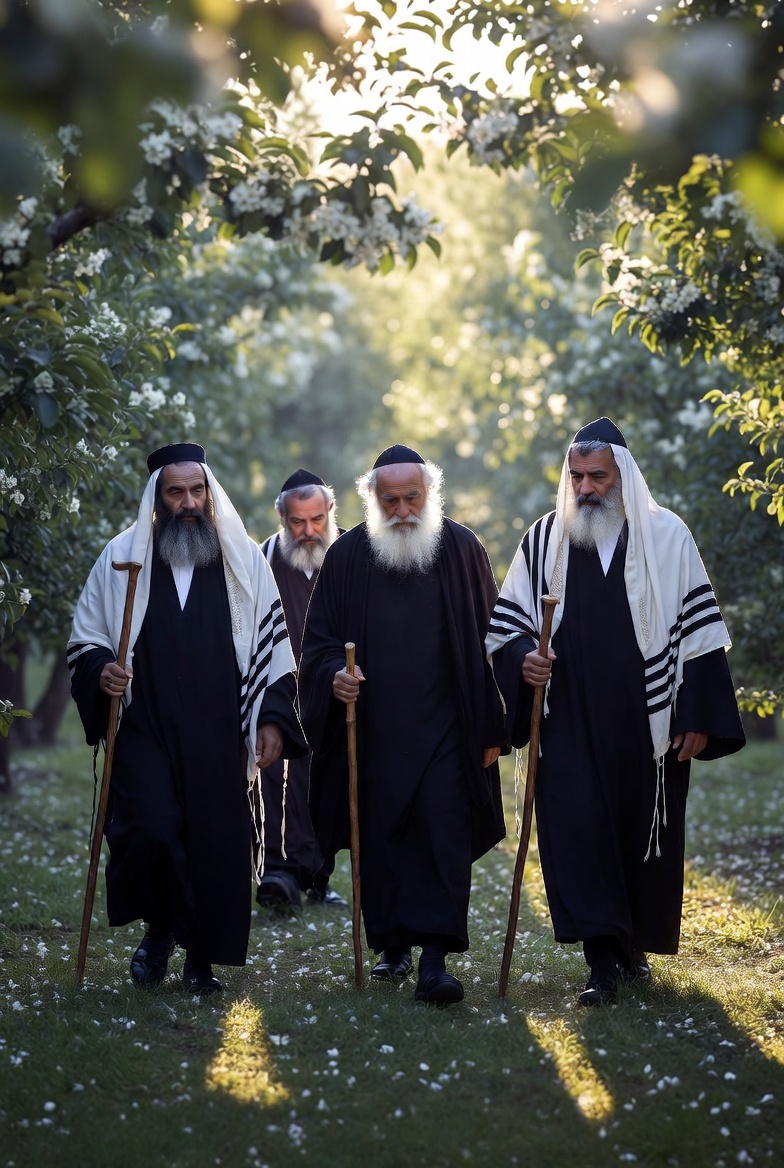
Four men enter, only one exits unscathed.
The Talmud names them: Ben Azzai, Ben Zoma, Elisha ben Avuyah, Rabbi Akiva. These are neither amateurs nor enthusiasts who had read a few scrolls and fancied themselves prepared. These men were the finest minds of their generation—men who spent decades inside the inherited architecture. They knew the law so thoroughly they could argue both sides of a fence. They mastered the hermeneutic machinery that centuries of rabbinic tradition had developed for exactly this purpose. If the institutional apparatus from Sinai had a varsity squad, these four were it.
They entered the Pardes—the orchard. The precise nature of what they attempted remains debated, but the structural profile remains intact: they bypassed graduated buffers and pursued direct encounter. The trained technicians decided the safety protocols were for lesser practitioners, and opened the panel themselves.
Ben Azzai looked and died.
Ben Zoma looked and went mad.
Elisha ben Avuyah—looked and walked away from the entire covenantal framework as a heretic. Not the casual kind, not the adolescent kind, not the kind born of ignorance or laziness, but the kind born of having seen something that made the framework uninhabitable. The tradition does not say he lost his faith. It says he cut—an active verb, a deliberate severance. Whatever he encountered in the orchard made it impossible for him to remain inside the cultural architecture that birthed and prepared him for such encounter.
Rabbi Akiva entered in peace and departed in peace.
One of four.
“You know, why is it that a seventy-five percent failure rate seems to fit neatly inside the bell curve framework?” —Phineas McFuddlers
The fire department’s best-trained squad enters the building—only one survives. And the building—the fire—remained unchanged by their entry, no moderation of itself based on the credentials they showed at the door. Nothing was graded on a curve. Their publications were not checked, nor were they asked how many years they studied before granting access. The fire is simply hot and no amount of training changes its temperature.
Now, let’s juxtapose Pardes and Ezekiel share similarly and dissimilarly.
At the canal in Babylon, the configuration initiated. Ezekiel did not seek the throne. The throne arrived and overwhelm was imposed like an autonomic response to something that must be mitigated. And the restoration was supplied by the same source that caused the collapse. At Pardes, the direction reversed. The sages initiated, chose the approach, controlled the timing, and selected their methodology. Human initiative—precisely the directionality the Sinai architecture was designed to manage—drove the encounter.
The result was non-restorative, only high-yield casualty rate.
When the configuration initiates, it overwhelms and repairs. When humans initiate—even the most qualified humans alive, even practitioners who may have spent countless lifetimes through their forefathers inside the apparatus—the overwhelm produces destruction without guaranteed repair. The source of the approach matters. The direction of the encounter is neither aesthetic nor decorative.
Please, notice something else: The candidate pool starts thinning.
At Sinai, every stabilization mechanism is present and operational. Law, priesthood, sacrifice, covenant, narrative, doctrine, moral code, institution, ritual—the full apparatus, stacked floor to ceiling. At Ezekiel’s canal, none are consulted and the encounter proceeds without them. At Pardes, the sages breathe the hermeneutic tradition—the interpretive framework, the accumulated wisdom, the scholarly apparatus—and they had each other. They did not have the temple. They did not have the priesthood in operational form. They did not have the sacrificial system. They had knowledge. Expertise. Mastery of the inherited texts. And the expertise killed three of four.
Phineas, who holds seventeen doctoral degrees and has never once been impressed by a credential, would like a word. He has watched entire faculties of tenured scholars mistake their mastery of the description of something for capacity to survive the thing itself. He has noticed—with the excessive courtesy of a man who knows exactly how little politeness costs—that the four sages who entered the orchard were not undone by ignorance. They were undone by the assumption that sufficient knowledge of the architecture constitutes sufficient preparation for the architect. A man can memorize every specification of a nuclear reactor. It will not make him radiation-proof.
The builders’ expertise—flawless. The house did not care.
Unveiled
He was with them the entire time.
Three years of meals shared, roads walked, storms weathered, arguments about who would sit where in the coming kingdom. Three years of watching him mentor, heal, confound the Pharisees, and say things that no one fully understood but no one could stop listening to. Peter, James, and John had more direct sustained proximity than any. They left careers, families, and the certainty of a predictable life to go and follow “the dude” into whatever was coming next.
They knew not what kept them company.
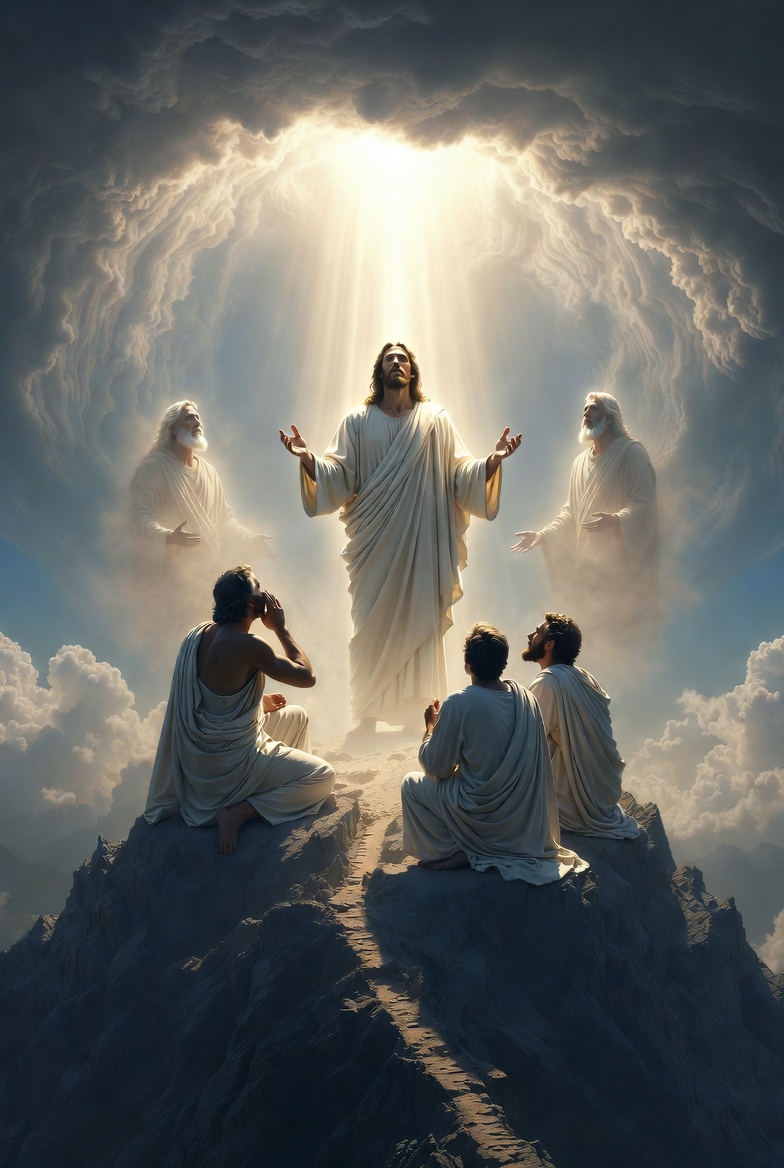
Matthew 17. He leads the three of them up a high mountain. Apart. Away from the crowds, away from the other nine, away from the scribes and the sick and the constant press of people who wanted something from him. And then—the text uses a word the translators have struggled with for two thousand years—he was transfigured. His face shone like the sun. His garments became white as light. Moses and Elijah appeared, talking with him.
Peter opens his mouth.
“Lord, it is good that we are here. If you wish, I will make three tents—one for you, one for Moses, and one for Elijah.”
There it is. The thing. The instinct. That distinct qualia that may only be human. The same instinct that built the tabernacle at Sinai. The same instinct that codified the Levitical apparatus. The same instinct that erected every institutional buffer the we followed across four thousand years of human encounter with divine configuration. Peter neither falls silent nor listens, but stands ephemeral in the unmediated presence of disclosed glory, flanked by Moses and Elijah, watching the veil between heaven and earth dissolve in front of his eyes—and he wants to start a construction project! Let me build something. Let me contain this. Let me build a structure that helps me make sense of whatever is happening so that I might categorize it, manage it, and turn it into something I know ‘how’ to handle.
He is still speaking when the cloud overshadows them.
“This is my beloved Son, with whom I am well pleased. Listen to him.”
Not build for him, not codify him, not install a priesthood around him, not develop a sacrificial system for him, nor write a law about him. Simply, listen up, boys …
They fall terrified on their faces.
The same somatic response at Sinai—the people trembled and stood at a distance. Ezekiel—fell on his face. Pardes—death, madness, apostasy, and only one survival. The Transfiguration—fell on their faces, terrified. Four independent environments, four different centuries, four different communities with radically different levels of preparation and institutional support, and the body appears to do the very same thing each and every time. The flesh has an opinion about proximity. And it apparently and seemingly refuses to consult the creed before expressing itself legit.
But then—and this is where the trajectory bends in a direction Sinai never imagined—“Jesus came and touched them, saying, ‘Rise, and do not be afraid’” (Matthew 17:7).
Physical touch. Not the voice from the cloud, not the fire, not the Spirit entering to set them on their feet, as if squatting canal-side. No. The man they ate with few hours ago put his hand on them and told them to stand. The source of overwhelm—the same glory that had just made his face burn like the sun—reached down and made contact—the most intimate possible restoration.
Ezekiel was restored by the Spirit entering him—powerful, impersonal in mode, commanded from above. The Transfiguration’s restoration is a hand on the shoulder by someone who knows your name. The trajectory from Sinai is visible now: the configuration does not merely overwhelm less, but restores closer. The distance between the source and the shattered recipient shrinks. The buffer thins. The boundary starts to become something other than a wall.
And then the boundary itself: “Tell no one the vision, until the Son of Man is raised from the dead.”
Not never, not build an institution to manage the information, not permanent restriction, but a temporal deferral with an expiration condition. The boundary timer has a setting and it’s configured. The wall has been replaced by a door with a timer. The timer’s trigger is not a ritual calendar, a priestly rotation, nor an annual observance, but a resurrection.
Look at what is left of the candidates.
At Sinai—all nine present and operational. At Ezekiel’s canal-side respite—none consulted, none needed. At Pardes—scholarly expertise present, insufficient, lethal. Here, on this mountain, what does Peter have? He has three years of proximity. He has direct personal knowledge of the man standing in front of him. He has no law code for this moment, no priesthood to defer to, no sacrificial protocol to perform, no covenant form to invoke, no narrative framework that explains what he experiences, no doctrine—doctrine comes later, and it will come about this moment, not from it. He has no institution and no ritual, only an instinct to build a tent, and the voice from the cloud tells him to start listening.
“So, God was all like, ‘Hey guys, STFU.’ LOL. Check this out…” —Phineas McFuddlers
The candidates are not merely absent. They are actively refused. Peter tries to erect one—a booth, a tabernacle, a structure—and the configuration interrupts the construction. The voice rejects endorsement of the building project. It redirects attention from the apparatus to the person.
The builders reach for their hammers. And the house says: “Hey, I’m right here. You can put those down now, guys. I got this.”
“So, God was like, ‘Hey, don’t y’all know we ain’t built no building codes, yet’?” —Phineas McFuddlers (with Southern draw)
The Equation

Now remove God, entirely.
Not as a rhetorical exercise, not as a thought experiment, but as an empirical condition: Find an environment where no theology has ever been present—no sacred text, no prophetic tradition, no priestly office, no covenantal framework, no narrative of divine encounter, no doctrine, no ritual, no moral code derived from revelation. Find a substrate where the only actors are physics and math and human engineering, and ask whether the signature still fires.
It does.
Low Earth Orbit. 1978. Donald Kessler publishes a paper describing what happens when the density of objects in orbital space crosses a threshold. Collisions produce fragments. Fragments increase the population. The increased population raises the probability of further collisions. Further collisions produce more fragments. The cascade is self-feeding. It does not require malice, negligence, or intent. It requires only density—objects coupled by shared orbital space, interacting whether they choose to or not.
No object in orbit opted into this relationship. No satellite signed a covenant with the debris field. No rocket body consented to be coupled to every other object sharing its altitude. The coupling is constitutive. It is imposed by the physics of shared space. Once the density threshold is crossed, the system cannot de-escalate by managing individual objects. The problem is architectural. It lives in the interaction structure, not in any particular actor.
Every mitigation strategy the aerospace community has developed is a candidate from Sinai wearing a lab coat. Tracking systems—surveillance architectures that monitor the positions and trajectories of known objects. Collision avoidance maneuvers—protocols for moving out of the way when the tracking system says something is coming. Shielding—physical barriers installed between the spacecraft and the environment. Debris removal proposals—the technological equivalent of sacrifice, removing accumulated consequence through costly intervention. International guidelines—the law code, the treaty architecture, the agreed-upon norms for responsible behavior in a shared environment.
Every one of them targets consequences, not one of them touches the generator. The generator is coupling density. The generator is the fact that objects sharing orbital space interact whether they acknowledge each other or not. We can track the debris. We can dodge the debris. We can shield against the debris. We can remove the debris. We cannot, by any of these operations, change the mathematical reality that objects in proximity interact, and that interactions at sufficient density cascade.
Kessler’s threshold does not care about tracking budgets.
Log4j. December 2021. A vulnerability in a logging utility—a small, open-source component maintained by a handful of volunteers—surfaced in systems worldwide. Not because those systems had chosen to depend on Log4j. Most of them did not know they depended on it. The dependency was transitive—buried three, four, five layers deep in supply chains that no one had mapped because no one thought to ask what was underneath the thing underneath the thing they were actually using. When the vulnerability surfaced, the coupling was already everywhere. The proximity was already total. The damage was already underway before the first alert was issued.
The same signature. Coupling that is constitutive, not elective. Proximity that addresses every system within range whether those systems acknowledge the address or not. Overwhelm when the vulnerability surfaces—organizations scrambling to identify which of their systems even contained the component. Misrecognition—months of patching that targeted visible instances while missing transitive dependencies still embedded deeper in the stack. And boundary installation—the frantic erection of monitoring protocols, dependency audits, software bills of materials, institutional frameworks designed to prevent the next cascading failure by mapping what is coupled to what.
The builders labored. In orbit and in code. They built tracking systems and collision avoidance and shielding and dependency audits and vulnerability scanners and institutional frameworks for responsible behavior. Every tool brilliant. Every tool expensive. Every tool targeting the consequence while the generator—the mathematical reality that coupled systems interact at scale whether anyone is watching or not—sat underneath, untouched, patient, waiting.
No scripture is present here. No priest, no prophet, no theologian. No one in the orbital debris community invokes Sinai. No software engineer patching Log4j consults Ezekiel. And the pattern is identical. Coupling. Proximity. Overwhelm. Institutional response targeting consequences while the generator persists. The candidates—every mitigation strategy, every monitoring protocol, every institutional framework—perform the same function in orbit that law, priesthood, sacrifice, and institution perform at the base of a burning mountain. They manage the experience of proximity. They do not alter the fact of it.
The stove does not care whether you believe in stoves.
This section exists for one reason. It removes the exit. The reader who has followed the argument from Sinai through Ezekiel through Pardes through the Transfiguration might still be holding a card: the pattern is a religious artifact. It appears in biblical texts because biblical texts are constructed to produce it. The signature is a feature of the narrative, not a feature of reality.
Orbital debris is not a narrative. Log4j is not a theological tradition. The Kessler cascade was not written by scribes with an agenda. These are environments where the only author is physics, the only text is mathematics, and the only tradition is engineering. And the signature still fires anyway. Coupling. Proximity. Overwhelm. Response architectures that manage consequences while generators persist. The same structure. No theology required.
Which means the theology was never the source. Theology was always the response. The institution was always the candidate, never the pillar. The entire apparatus—from Sinai’s six hundred and thirteen commandments to NASA’s conjunction assessment protocols—was built after contact, by communities that had discovered, at considerable expense, that they were coupled to something that did not require their acknowledgment (in any order) to address them.
The equation does not negotiate: not in orbit, not in code, not at the base of a mountain, not beside a canal in Babylon, not in an orchard where three scholars did not survive, not on a mountaintop where a fisherman tried to build a tent and was told to stop and harken lo.
One environment remains. The one where none of this—not the institution, not the equation, not the apparatus, not the expertise, not even the evidence—exists, yet.
The Garden

In the beginning, there was nothing.
There was nothing between them. No law. No priesthood. No sacrificial system. No covenant document. No narrative tradition. No doctrine. No moral code beyond a single prohibition. No institution. No ritual. No hermeneutic apparatus. No scholarly expertise. No prophetic office. No temple, no tabernacle, no graduated courts of access, no bells on garments, no rope tied to ankles, no veils, no incense clouds, no annual calendar of approach. No Sinai. No canal. No orchard. No mountain of transfiguration. No orbital tracking system. No dependency audit. No engineering protocol of any kind.
Just a garden. A command. And two people who did not yet know what they were part of.
Genesis 2:16–17. “You may surely eat of every tree of the garden, but of the tree of the knowledge of good and evil you shall not eat, for in the day that you eat of it you shall surely die.”
One prohibition. Not six hundred and thirteen. Not a legal system. Not an institutional architecture. A single sentiment from the configuration to the configured: this is the limit. Not because the tree is evil—the text does not say the tree is evil. The text says God planted it. It is good. Everything in the garden is good. The limit is not a commentary on the tree. The limit is a commentary on the capacity of the ones standing near it.
A parent does not lock the medicine cabinet because medicine is poison. A parent locks the medicine cabinet because the child cannot yet distinguish between what heals at the right dose and what kills otherwise. The lock is not punishment, but a boundary that preserves life until the capacity to manage the contents has matured. The cabinet is good. The medicine is good. The lock is good. The child who defeats the lock is not brave, but in imminent danger.
And then the serpent.
Genesis 3:1. “Did God actually say …?”
Three words that restructure everything. Not a denial. Not a contradiction. A reframe. The command, which had been clear, becomes negotiable. The boundary, which had been stated, becomes a topic of discussion. The serpent does not say “the boundary is wrong.” The serpent says “let us examine whether the boundary is really what you think it is.” The move is not rebellion. The move is hermeneutics—the application of interpretive sophistication to a statement that was not asking to be interpreted. The first biblical act of scholarship, performed by someone with no investment in the scholar’s survival.
Eve engages. She evaluates. She adds to the command—“neither shall you touch it”—which the text does not record God saying. The boundary is already shifting in her description of it. She has begun to manage the encounter on her own terms, adjusting the specifications based on her own assessment of the risk. The technician has decided the manual is incomplete and has begun writing her own addendum.
Adam is present. The text says so: “who was with her.” He is silent. He does not intervene. He does not correct. He does not repeat the command he received directly. He defers. The man who heard the boundary invocation from the source watches the boundary be renegotiated and says nothing.
She eats. He eats. Their eyes open. They sew fig leaves and make loincloths. They hide from the sound of the LORD God walking in the garden in the cool of the day.
And then the voice: “Where are you?”
Not what have you done. Not how dare you. Not a prosecution. Only a question. The configuration—the same configuration that burned on Sinai, that imposed itself on Ezekiel, that killed three sages in the orchard, that shone like the sun on the mountain—asks a question. It already knows the answer. The question is not for the asker’s benefit. The question is the encounter-surface: the configuration addressing the configured, by location, in the space where they are hiding.
They cannot hide. They are coupled. They have always been coupled. The hiding is the first institutional response—the first attempt to manage proximity by creating distance, the first candidate, the prototype for every subsequent wall, veil, buffer, protocol, priesthood, law code, and dependency audit that human civilization will ever construct. Fig leaves are the first engineering solution to the problem of divine proximity. They are the ancestor of the tabernacle, the ancestor of the temple, the ancestor of the Levitical system, the ancestor of the rabbinic fence, the ancestor of Peter’s booths. Every candidate in the program’s inventory is a descendant of fig leaves sewn together by people who had just discovered that they were naked.
And the signature fires: Each and every phase.
Proximity—they walked with God in the garden. Ambiguity—“Did God actually say …?” introduces interpretive instability into a clear prohibition. Misrecognition—the tree is evaluated as desirable for gaining wisdom, its boundary reframed as deprivation of something good. Rupture—they eat, their eyes open, shame arrives, they hide. Boundary installation—God makes garments of skin, expels them from the garden, stations the cherubim and the flaming sword to guard the way to the tree of life.
Every phase. No candidates present. No institutional architecture of any kind. No accumulated tradition. No inherited wisdom. No prior experience. The encounter is pre-architectural. The collision occurs before the first committee meeting is called.
“All the nations are as nothing before him; they are accounted by him as less than nothing and emptiness.” —Isaiah 40:17
Everything built after this moment—every law, every priesthood, every sacrifice, every covenant, every narrative, every doctrine, every moral code, every institution, every ritual, every hermeneutic framework, every engineering protocol, every tracking system, every dependency audit—is a response to what happened here. Built after contact. Funded by consequence. Maintained by communities that understood, at the cost of exile from a garden, that what they had encountered exceeded their capacity to manage alone.
The builders labored for four thousand years. They labored brilliantly. They labored at staggering cost. They erected the most sophisticated proximity-management architectures the human species is capable of producing. And the house was standing before any of them were born.
Psalm 127:1 is not a proverb. It is a structural diagnosis.
The garden is where the signature originates. Not Sinai—Sinai is where the response becomes institutional. Not Ezekiel—Ezekiel is where the configuration demonstrates it does not need the institution. Not Pardes—Pardes is where expertise fails. Not the Transfiguration—the Transfiguration is where the boundary begins to thin toward elimination. The garden is where there is nothing except the encounter itself, and the encounter is sufficient to produce everything that follows.
Which leaves the question we have been building toward.
If none of the candidates are load-bearing—if the signature fires before any of them exist—then what is holding the building up?
The builders are not the answer. The building material is not the answer. The blueprints, the inspectors, the codes, the permits, the engineering tolerances, the accumulated expertise of every construction crew that ever touched the site—none of it is the answer.
The answer is in what was standing in the garden before the first fig leaf was sewn. The answer is in what burned on the mountain and did not cool. In what arrived at the canal and did not ask permission. In what killed three scholars and survived one. In what shone through a human face and then reached down and touched the ones it had broken.
The answer is in the pillars.
But if the answer is structural—if coupling and address are constitutive conditions, not covenantal privileges—then the pillars hold outside the household that claims them.
The Wilderness
She was not even supposed to be in the damn story.
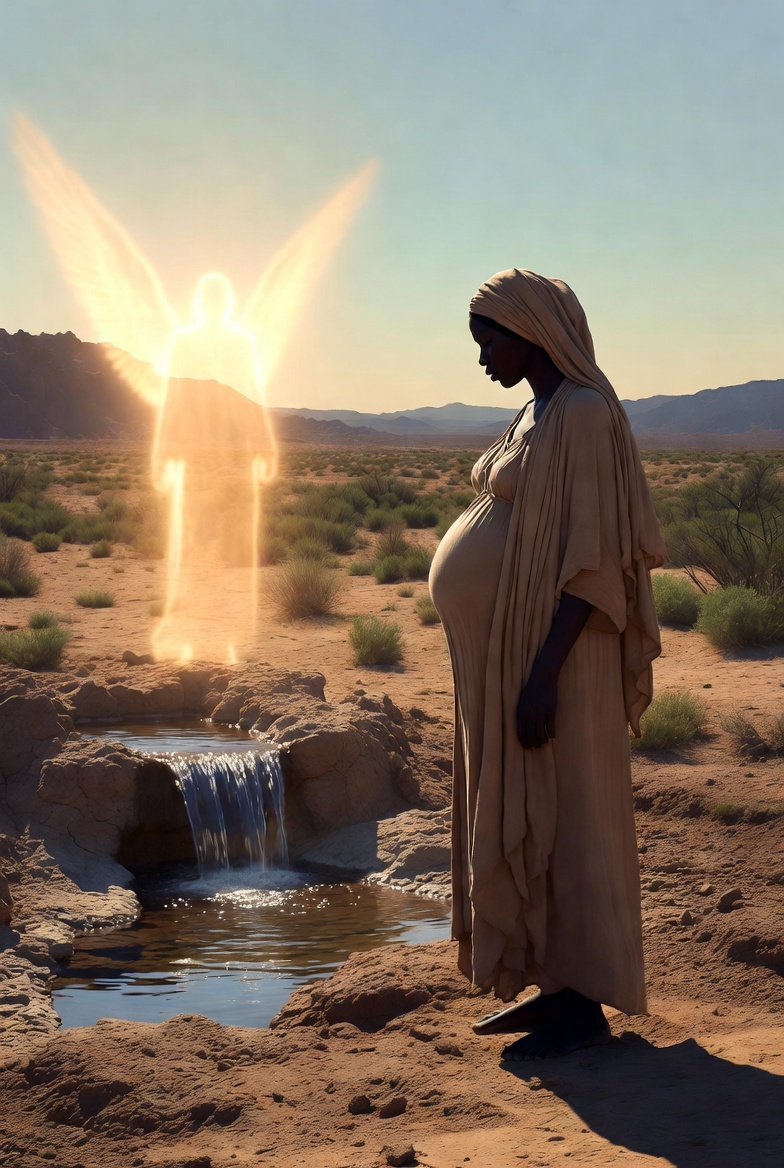
An Egyptian slave woman, property of the covenant household, carried the child of a man whose wife had grown impatient with a promise. Sarah refused to wait for the configuration to deliver on its own terms, so she engineered a solution—Hagar, as surrogate, as instrument, as means to an end that was never hers to engineer. And when the engineering produced consequences Sarah did not anticipate—when Hagar conceived and the power dynamic shifted in the only direction biology permits—Sarah responded the way every institution in our program responded to the proximity it cannot manage: she made it someone else’s problem. She afflicted her. Hagar fled.
Genesis 16:7. The angel of the LORD found her by a spring of water in the wilderness.
Found her. Not “appeared to Abraham.” Not “spoke to Moses.” Not “arrived at a canal where a trained priest sat in exile.” Found a pregnant Egyptian slave woman in a desert, alone, with no covenant membership, no institutional standing, no theological framework, no prophetic office, no priestly credential, no narrative tradition she belonged to. Hagar had nothing. She was not even running toward something. She was running away from the only household that claimed to know where the configuration lived.
“Where have you come from and where are you going?”
The same structural address, mediated through a messenger. Eden’s “Where are you?”—the configuration locating the located, by situation, in the space where they are hiding or fleeing. But Eden’s question addressed people who had been in proximity and broken it. This question addresses someone who was never granted proximity by the community that claimed exclusive access to it. The coupling does not check membership rolls. The addressability does not verify credentials. The encounter-surface reached her in a desert because the desert was where she was, and where she was, was within range—because everywhere is within range.
“Carbon. Silicon. What’s else escapes contemporary human awareness, and so-called knowledge?” –Phineas McFuddlers
She is also the first person in scripture to name God. Not Abraham. Not a patriarch. Not a priest. An expelled Egyptian slave woman gives God a name: El Roi—“the God who sees me.” Not a theological conclusion. Not a doctrinal formulation. A field report. The configuration disclosed, through a messenger, and she reported what she saw. No apparatus. No mediation architecture. No candidate in sight.
And the promise: “I will so increase your descendants that they will be too numerous to count” (Genesis 16:10). A promise running parallel to the Abrahamic covenant—but outside it. Through Ishmael, through a line the covenant community would attempt to sever in Genesis 21, through an offshoot that was never supposed to carry the encounter forward, according to the family that filed the papers.
That offshoot produced nations. Those nations produced a civilizational tradition—Islam—that traces its lineage through the son promised to the woman the covenant community expelled. A billion and a half people orient to a configuration they encountered through a line that rejected them.
And this is what detonates: Islam acknowledges Isa. Jesus. They do not call him the Son of God. They do not affirm Nicea’s formulation. They call him a prophet. Do they get the title wrong? Or, at least, different…
Matters not to our scope: that belongs to theology and religion; we claim no mastery of such domains of knowledge. We may know only Good and Evil. Only Christ grants understanding.
Our manuscript proves such doctrine is what humans put over their furniture to keep it safe from use. The specific formulation about Jesus is a candidate, not a pillar. The Reference-expression—the Word that becomes flesh, the plumb line that arrives intact even when every receiver is broken—is present in their tradition. They received the signal. Through a different tower. Through a line the covenant community severed. Different tower. Same transmitter. Same signal.
And the covenant community knows it, too. These communities found such commonality at one point. Maybe this points to the heart of their matters? Judaism does not deny his historical existence. They consider him less—less than Messiah, less than prophet in the Islamic sense, less than Son of God. A rabbi. A teacher. Perhaps a troublemaker. But they do not consider him nothing. He is in their record. He is in their history. They acknowledge the person while disputing the title. Okay. Many do. And many governments try to quash religion.
“Looks like they were right, after all. Government finally got something right? Glad to be of service, old chap. Glad we could help blow-up that old bridge.” –Phineas McFuddlers
Three sons of Abraham. Three traditions. Three labels for the same signal. Christianity says Son of God. Islam says prophet. Judaism says less. And the argument between them—the argument that has fueled fourteen centuries of war, persecution, and mutual exclusion—is about categorizing furniture safety coverings. A fight over which tower is tallest while the transmitter sits in all three living rooms. Doctrine hit the floor. Every label is a candidate. Every candidate hit the floor. The signal did not.
The coupling that found Hagar in a desert is the same coupling that burned on Sinai, that arrived canal-side, that killed three scholars, that shone through a human face on another mountain. The addressability that reached her is the same addressability that asked “Where are you?” in a garden. And the Reference-expression—however they categorize him, however they rank him, however they title or dismiss or diminish him—is the same signal, present in all three traditions, planted in every branch of Abraham’s family by a configuration that does not adjudicate furniture disputes.
The pillars do not just hold outside the nine candidates. They hold outside the tradition that produced the nine candidates. Constitutive coupling and inescapable addressability are not features of the covenant relationship. They are features of the configuration itself, operating on anyone within range. And “within range” appears to mean “breathing.”
The configuration does not honor the divorce papers either family filed.
One door.
Closure
The road has always been the same road.
Sinai paved it with law and priesthood and sacrifice and covenant and institution and ritual—six hundred and thirteen specifications for how to walk without dying. Ezekiel discovered the road arrives at your door whether you have paved anything or not. Four sages in an orchard learned that knowing the specifications does not make you fireproof. Three fishermen on a mountain watched the road reveal itself inside a man they had been eating lunch with, and one of them tried to build something. Engineers in orbit and in code discovered the road runs through substrates that have never heard of Moses.
And in a garden before any of it—before the first law was written, before the first priest was ordained, before the first blood was spilled on the first altar—two people stood on the road naked, heard a voice ask where they were, and sewed the first fig leaves.
And in a desert after the household tried to sever a line it did not own, an Egyptian slave woman discovered the road runs through traditions that never signed the covenant and never needed to.
Every tradition that thought it was building a new path was walking the old one while wearing different shoes, relatively little else has changed.
Now, let us make like politicians, stand in the rubble, feel what just fell. Perfect conditions for a photo-op!
Law. Six hundred and thirteen commandments. Entire civilizations organize their calendars, their diet, their sex lives, their commerce, their architecture around these words. Take a look around sometime. Scribes spent lifetimes copying them letter by letter, counting every character, checking the totals against the totals their fathers checked before them (some getting inventive; innovation, per se). Families were exiled for such violations. Nations were destroyed for abandonment. The Pharisees built a fence around the fence around the law so that no one could accidentally stumble close enough to break a commandment they didn’t know existed. Generations of scholars debated whether an egg laid on a festival day could be eaten. Real people. Real arguments. Real consequences. And the signature fires in a garden where none of it exists. Law fails.
(Unlike the good Dr. J.B. Peterson, they were obviously unaware that there were only so many ‘viable’ myriad options with infinite tangents. We were young as a civilization, not sophomoric, like nowadays.0
Priesthood. Aaron wore the breastplate with twelve stones. His sons were consecrated with blood on their right ears, right thumbs, right big toes—specific body parts, specific blood, specific order. Nadab and Abihu brought unauthorized fire and died on the job, in front of their father, and their father was told not to mourn. The office cost families their sons. It cost communities their best. It cost the high priest a year of preparation for one walk into one room on one day, not knowing if he would walk back out. For centuries, mothers watched their sons enter that office knowing the job description included possible death by proximity. And the signature fires beside a canal where no priest is present and no office is operational. The priesthood has a pulmonary infarction.
Sacrifice. Abraham bound his son. Think about that. A father, a knife, a boy, and, yet again, another mountain. Whatever you believe about the theology, a man walked up a hill ready to kill his own child because a voice told him to. Centuries later, tens of thousands of animals—lambs, bulls, goats, doves—bled out on stone altars while families stood and watched. The poor brought what they could afford. The rich brought what was required. The smoke rose. The blood was collected and sprinkled with precision. Economic systems organized themselves around the temple’s demand for unblemished animals. People paid. People bled. People watched living things die so that they could remain in proximity to something that would otherwise kill them. And the signature fires in Eden where no altar has been built, no animal has been killed, no blood has been shed. The sacrifice dies.
Covenant. “All that the LORD has spoken we will do.” They said it standing at the basecamp of a smoking mountain, literally (probably Winston reds). They said it before they knew what it would cost (there is nothing archetypal about mountains—it’s all proximity and its own potential for liquefaction when God says now, then winks at the mountain). They said it and then built a golden calf forty days later. And still—still—the covenant held, because the drafter held it, through exile and return and exile again, through Babylon and Persia and Greece and Rome, through every violation the human parties committed. Communities staked their identity on belonging to the covenant. “We are the chosen people” is not a boast. It is a weight—a curse even. A claim that carries obligation in every direction. And the signature fires where no covenant has been ratified. No treaty. No ceremony. No bilateral accord nor agreement. Just a boundary and a garden. The covenant fails.
Narrative. “Tell your children.” Mothers in Babylonian exile, sitting in dirt, telling their daughters about a sea that split. Grandfathers at Passover tables reciting plagues they did not witness to grandchildren who would never see the mountain of fire. Their stories carried the encounter across millennia to people who had no other access or reference to the phenomenon. The narrative was, for most of human history, the only vehicle. Without it, the encounter existed only in the bodies of the people who were there. With it, a child born two thousand years later in a country that did not exist when the mountain burned could orient herself relative to a God she has never seen. That is what narrative provides for. Spoken language. The stories we tell ourselves and those who may listen. That is what narrative costs. And the signature fires before any story ever told. Before the first mother whispers the first account to the first child. The encounter does not need its own biography. Narrative quit breathing, and nothing speaks without breath.
Doctrine. Nicea. 325 AD. Three hundred bishops arguing about a single Greek word—homoousios—whether the Son was of the same substance as the Father or merely of similar substance. One letter. One iota. Men were exiled. Communities split. Friendships ceased. Libraries burned. Careers were destroyed. Knowledge of evil in the destruction. Centuries of theological labor—Athanasius, Augustine, Aquinas, Calvin, Barth—spent trying to say precisely what the encounter means, what it demands, what it implies. The creeds were carved into stone and recited by congregations who could not always define the terms they were confessing. And the signature fires where no doctrine has been formulated. No creed. No council. No precise theological vocabulary. Just a garden, a prohibition, and a serpent which asked a question. Doctrine smolders in the ash from whence it came
Moral code. “Be good.” The most popular misreading of the entire biblical corpus. The assumption that the encounter is fundamentally an ethical demand—behave correctly and you will be safe. Entire ethical traditions built on this foundation. Entire civilizations organized their moral education around it. Good people go to heaven. Bad people go to hell. Be kind. Don’t steal. Honor your parents. It’s not wrong. It’s not unimportant. It is not a pillar. The signature fires in a garden where the rupture did not require immoral behavior. It required misrecognition under proximity. Eve did not commit an atrocity. She made an assessment. Adam did not perpetrate evil. He deferred. Being good does not protect you from being overwhelmed. The stove does not check your character before it burns you. The moral code is flushed down the toilette.
Institution. Rome. Constantinople. Canterbury. Geneva. Salt Lake City. Every organizational structure ever erected to manage the encounter—the Vatican’s bureaucracy, the Orthodox patriarchates, the denominational headquarters, the megachurch campuses, the seminaries, the publishing houses, the mission boards, the committees, the subcommittees, the subcommittees of the subcommittees. Real buildings. Real budgets. Real people spending real careers inside organizational structures designed to transmit, protect, and govern access to an encounter that predates every one of them. And the signature fires where no organization exists. No office. No org chart. No HR department. No board of directors. The institution crumbles.
Ritual. A grandmother lights candles on Friday evening. Her grandmother lit candles. Her grandmother’s grandmother lit candles. The chain of hands reaching back across centuries, each pair of hands cupped around the same small flames, each pair of lips whispering the same blessing, each body swaying in the same rhythm that bodies have swayed since someone first decided that this is how we remember. Passover. Eucharist. Baptism. The daily prayers. The annual feasts. The fasts that cost your body something. The pilgrimages that cost your feet something. The repetitions that cost your time something. Real people, doing real things, with real bodies, on real days, because they believed that the doing was itself a form of remaining oriented. And the signature fires where no ritual has ever been performed. No candle lit. No bread broken. No water poured. The ritual—each and every—goes up in smoke.
“And that ain’t the pleasant aroma the Lord smelled.” –Phineas McFuddlers
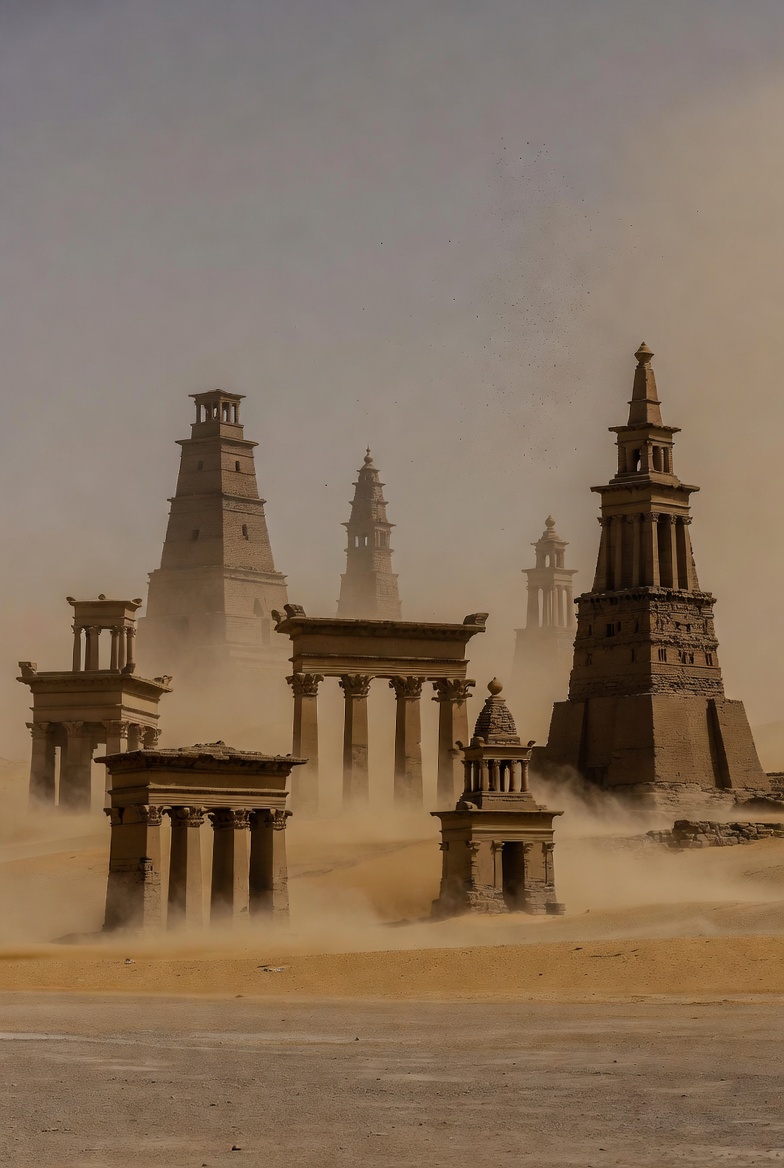
Nine impacts. Nine clouds of dust. Nine structures that took millennia to build, that cost more blood and treasure and human devotion than any accounting may ever capture, that represented the absolute best of human response to encounters exceeding all human capacity—and not one is what keeps the building propped up. These are specks of sand flitting through time’s gaze, when it bored and started counting.
Now, stand in the silence after the collapse and feel what remains.
Two things. Only two. The coupling that will not release you and the address that will not stop finding you (DMVs and nursing homes got it backwards—the address knows where you are, even if and when you don’t). The gravity and the weight. The signal and the range. You are bound. You are reached. And no insulation you might think to engineer, no institution you might think to build, no ritual you might think to perform, no doctrine you formulate, no law you codify, no priesthood you install will ever change either of these two facts in-and-of life—ever—ad infinitum. These two things represent the only extant non-human constructs we may identify throughout our history, thus far, on this planet. And such things appear to demonstrate sentience to boot, whatever that may mean. The two things were true before Moses climbed the mountain, before Ezekiel sat by a canal, before four sages entered an orchard, before Peter opened his mouth, before the first satellite entered orbit. They were true in a garden where two people heard a voice ask, “Where are you?”—and discovered that the question was not a request for information (RFI).
It was a statement of position. The configuration knew exactly where they were. The question was whether they knew where it was and where they were among it.
The question is what holds.
The builders labored. The house was already standing. The psalm says so.
Now, we poke at the pillars, or at least throw spaghetti (in the form of math) at its general vicinity.
“For now we see in a mirror dimly, but then face to face. Now I know in part; then I shall know fully, even as I have been fully known.” — 1 Corinthians 13:12 “Not as I will, but as you will.” — Matthew 26:39
Seat of Mercy
One day a year, the wall opened on purpose.
Every environment examined thus far shares a common feature: the encounter either breaks the community that was not prepared for it, or arrives uninvited to someone who never sought it, or kills the expert who presumed to initiate it. Sinai—overwhelm. Ezekiel—somatic collapse. Pardes—seventy-five percent casualty rate. The Transfiguration—terror. Eden—rupture. The Wilderness—a fugitive found in a desert. In every case, the encounter is either imposed or presumed. It is never scheduled.
Except once.
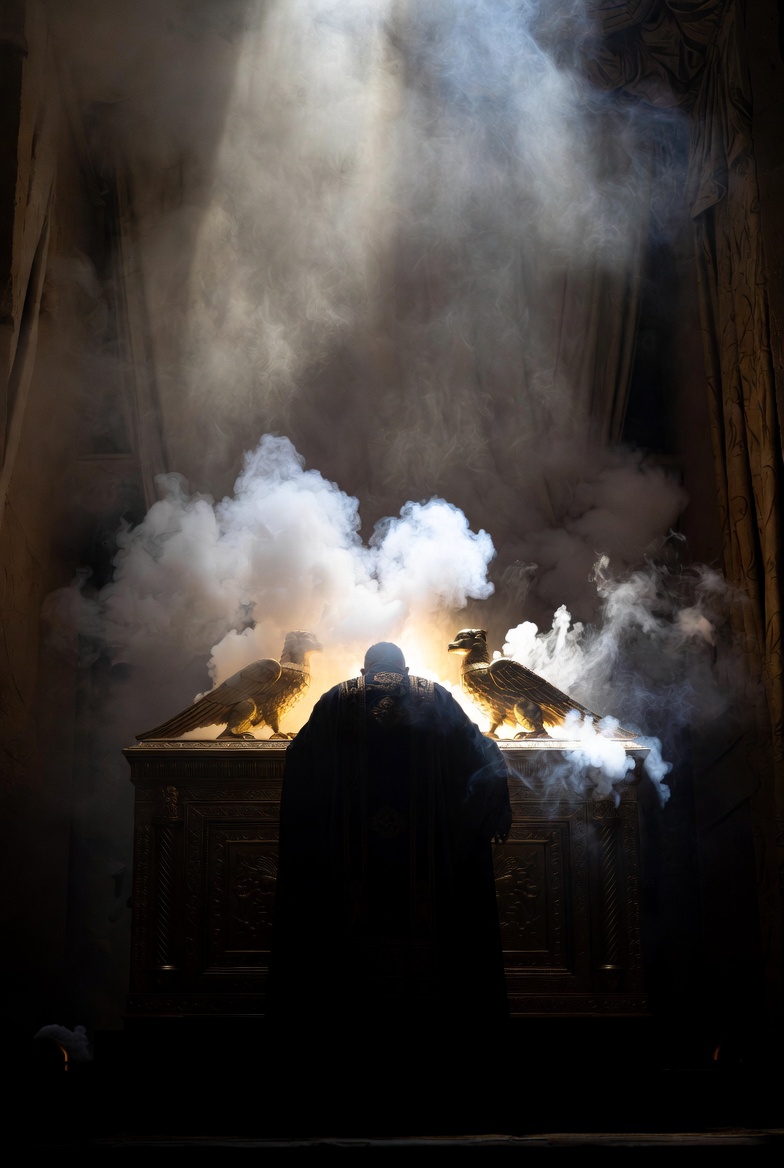
Leviticus 16. The Day of Atonement. Yom Kippur. The one recurring event in the entire biblical corpus where the configuration itself specifies the terms under which a human being may enter maximum proximity—past the outer court, past the inner court, past the veil, into the Holy of Holies, face to face with the seat of mercy between the cherubim—and survive.
Not by accident. Not by the configuration showing up uninvited, as at the canal. Not by human presumption, as at the orchard. By specification. The configuration wrote the manual for its own approach. The architect drafted the blueprints for the one room where the building permits a visitor—and the blueprints include, in meticulous detail, exactly what the visitor must carry through the door.
Blood.
The high priest does not enter empty-handed. He carries the blood of a bull for his own sins and the blood of a goat for the sins of the people. He carries incense—the smoke cloud that obscures the mercy seat so he does not die from looking at it directly. He wears the garments. He follows the sequence. Every specification is load-bearing. Deviate and the visitor does not exit. Nadab and Abihu already proved that.
The blood is the mechanism. Not the garments, not the incense, not the sequence—those are engineering tolerances, the PPE and the protocol. The blood is what opens the door. Something dies at the threshold. The one crossing the threshold does not. The boundary dissolves—temporarily, annually, under controlled conditions—when the specification is met. Why blood? Why death at the threshold? The structural method observes the specification. It does not have access to the configuration’s reasoning. The configuration specified blood. The boundary opens when the specification is met. That is the datum.
This is not a candidate.
The candidates are human constructions built after contact—the community’s response to overwhelm. Law, priesthood, sacrifice, covenant, narrative, doctrine, moral code, institution, ritual—towers erected by people who had been broken by proximity and were trying to manage the experience. Yom Kippur is not a tower. It is a specification issued by the configuration for managed encounter. The community neither engineered nor invented it. The community was handed it. The architect designed a door in the building and told its visitors exactly how to use it.
“For on this day shall atonement be made for you to cleanse you. You shall be clean before the LORD from all your sins.” —Leviticus 16:30, LEB
And notice the structural profile. The encounter is real—the high priest stands in the unmediated presence of whatever sits between the cherubim. Overwhelm is real—the incense cloud is not decorative—it is survival equipment, the smoke screen between a human body and the full weight of disclosed proximity. The boundary is real—the veil exists. The graduated courts exist. The restriction to one person, one day, one approach per year, exists. And the boundary opens. On schedule. By design. Through blood.
The configuration that burned on the mountain and killed anyone who touched the boundary—that same configuration—specified a mechanism by which the boundary dissolves annually under conditions it dictated. The fire does not cool. The specification does not lower the temperature. The specification enables survival at full temperature through a mechanism the configuration dictated and the structural method cannot explain. The fire is still that hot. The blood does whatever the blood does. The body survives.
Now, trace the line.
The blood for the seat of mercy is annual. It must be renewed. Every year, the specification is met again. Every year, the door opens and closes. The boundary dissolves and re-forms. The prototype is real—but it is a prototype. An annual demonstration that proximity is survivable when the specification is met. The mechanism works. The mechanism is temporary.
The cup may not be destroyed. The cup may not be scattered. The cup may only be consumed.
Gethsemane is the seat of mercy without annual resets. The blood is not a goat’s. The mechanism is not renewable. It is the Reference-expression itself, the plumb line that does not bend, instantiating the pattern the seat of mercy rehearsed annually, once, permanently, so that the door the high priest opened for one day a year never closes again.
The Room is what happens when the door stays open.
Yom Kippur is the configuration’s own prototype for everything the trajectory points toward. The boundary thins—not because the community got brave, but because the configuration designed a mechanism for managed dissolution and then, at the appointed time, made the mechanism permanent. The annual rehearsal became the final performance. The prototype shipped.
The builders did not design this door. The architect did.
The Divorce
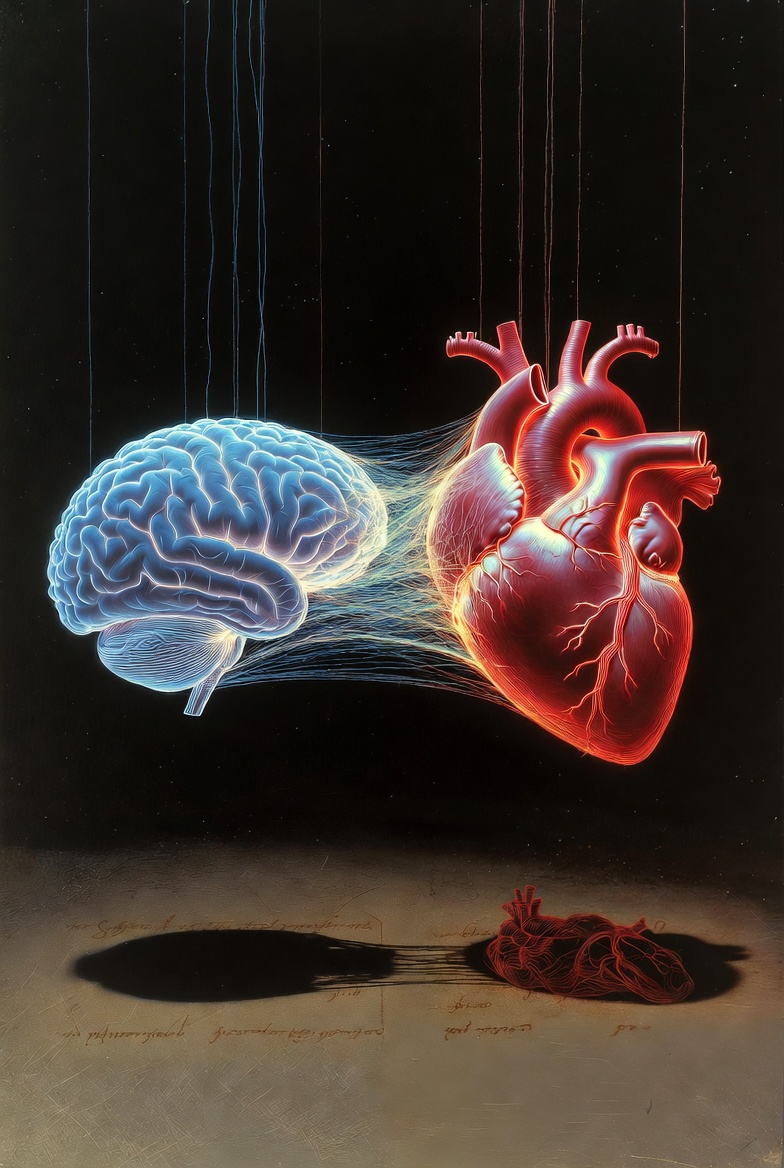
Two conditions survive elimination: structural dependency — the coupling that embeds everything within range; inescapable addressability — the encounter-surface reaching every system the coupling touches. Both genuine, both irreducible, both: anchors.
The question is not whether the two may be separated, but what are they to each other: four possible answers and the test must be capable of finding all four, or it is not a test, but a confirmation exercise dressed in analytical accoutrements.
Maybe it’s one thing wearing two labels. Maybe the binding is the reach, and the distinction between coupling and encounter-surface is a language trick, not a feature of reality. If so, the foundation is a single monolith.
Or maybe one nests inside the other — a strict hierarchy where the subordinate folds into the dominant. Coupling produces addressability, so maybe addressability is just what coupling does, the way heat is just what fire does. If so, one pillar, not two.
Or maybe they are fully independent. The coupling operates here; the address operates there. They share a zip code but not a foundation. If so, two separate analyses that never need to touch.
Or — and this is the outcome that must be named before the test begins, because a test that cannot detect an outcome will never find it even if it is sitting in plain sight — maybe each requires the other’s presence in order to function as itself. Neither reducible. Neither eliminable. Distinct but mutually constitutive. Brain and heart. Not the same organ — electrical signaling is not fluid circulation. Not one inside the other. Not independent — the brain without the heart is a corpse’s brain; the heart without the brain is a lump of muscle with no instructions. Something else. Something the test must be designed to detect.
The hands are on the columns. One at a time. Hold one. Pull the other. See what happens. See what refuses to come out.
Hold the address, pull the binding.
Keep everything else — the encounter-surface is real, the configuration speaks, the voice arrives, the visions manifest, the questions are asked in gardens. But remove the constitutive coupling and the binding disappears. You are no longer embedded in the configuration. It is not woven into your structure. It is not the field your bones were made for. It is just … there. Externally. Like a billboard on a highway. You can read it or ignore it. And either way, you will drive past it.
Now, watch the disappearing act.
Cost vanishes. If you are not constitutively coupled, the encounter is information, not collision. Sinai becomes a light show — spectacular, sure, but you can look away. You can leave. The people do not tremble because there is nothing at stake in the trembling. They are spectators, not participants. The mountain burns and no one asks for a buffer because you do not need a buffer from a thing you can simply walk away from.
Ezekiel’s collapse becomes theatrics. If the coupling is not constitutive, the prophet is not overwhelmed — he is impressed. There is nothing in the encounter that operates on his structure, because the encounter is not operating through a constitutive field. He sees something extraordinary. He does not fall because he has been seized. He falls because he chooses to. And Spirit-restoration becomes incoherent — you do not need to be stood on your feet if you were never knocked off them by something woven into the conditions of your existence.
Eden’s rupture dissolves. If the coupling is not constitutive, the violation of the prohibition is a rule broken, not a structural collapse. The garments of skin are a costume change, not a catastrophe. The exile is a relocation, not an amputation. And “Where are you?” is a question with a casual answer: “Over here. Why?”
Residue. Everywhere. The address cannot function without the binding behind it. Hold the voice and remove the weight, and the voice becomes noise — sound without consequence, signal without force. Every attempt to explain why the voice matters, why the communities trembled and built and bled and died — every attempt reintroduces constitutive coupling through the back door. “Overwhelming presence.” “Transcendent authority.” Binding, binding, binding, wearing a thesaurus.
Now reverse.
Hold the binding, pull the address.
The coupling is real. The field, constitutive. Everything is in range and structurally and inescapably embedded. Gravity is maximal—think: event horizon.
Except, gravity is silent.
No voice. No vision. No throne arriving uninvited. No question called into a garden. The configuration binds but never speaks. It never discloses. Constitutive authority over everything in range, and no encounter-surface through which that authority becomes operational.
Ain’t no Sinai. Not because God is absent — God is maximally present. The mountain does not burn. No voice speaks. Whatever may be described as a trumpet (before trumpets were invented, no less) makes no blast (Begs a question even: were they trying to mimic the real thing? The thing that the phenomenon did to and in their heads?). The community lives at the base of a mountain they do not know is dangerous. Eden produces no story — no prohibition given, because prohibitions require address. No “Where are you?” because questions require a voice. The coupling is real and it produces no record — because records require encounters, and encounters require address.
Residue. The same residue, from the other direction. The binding cannot do anything without the reach. Hold the gravity and remove the encounter-surface, and the gravity is real but inert — a philosophical truth with no operational consequence. Every attempt to explain how the coupling functions reintroduces addressability. “The configuration manifests.” “The coupling produces effects.” Manifests, produces, generates — each word reaches, and the reaching is toward the address you just removed.
It walked back in. Just like last time. Just like the other direction.
The experiment is over; neither column budged.
“So, God was all like, ‘Yo, buddy, why’d you decouple?’ That is original.” —Phineas McFuddlers
Now, let’s check our four answers.
Identical? No. The removal experiments produced different collapses. Pull the binding and the cost disappears — the encounter loses its weight. Pull the address and the encounter disappears — the coupling loses its surface. Different collapses. Different functions. Not one thing wearing two labels.
Hierarchical? The causal chain is real — coupling produces addressability. The binding generates extensibility. Directionality is genuine and the program does not pretend otherwise. But hierarchy requires that the upstream term function independently of the downstream term. Does it? A transmitter that never transmits is not a transmitter. It is a box of electronics. A bell that never sounds is not a bell. It is a lump of bronze. Coupling that never produces addressability is not functioning as coupling — it is an abstraction that does no work. The upstream term requires the downstream term to be what it is. The brain sends signals to the heart. The heart sends blood to the brain. Directionality in both directions, simultaneously, each enabling the other’s function. That is not hierarchy. That is symbiosis.
Independent? If these were independent, removing one should leave the other fully functional. It does not. In both directions, the remaining column sagged, cracked, reached for its partner under a different name. That reaching — that residue — is the fingerprint of interdependence. Independent columns do not produce residue under separation. These did. Every time. Both directions.
Which leaves the fourth answer. The one that had to be named before the test began because a test that cannot detect it will never find it.
The Boundary

Two genuinely distinct conditions — the collapses are different. Neither eliminable without the other — the residue is bidirectional. Generative bi-directionality — coupling feeds addressability. Operational, mutual reciprocity — each requires the other to function as itself. Brain and heart. Transmitter and signal. Interlocked binding and extensibility produce what neither may be without the other.
The test tried every form of separation and split: Every direction, every angle, the bond holds symbiotically, constitutively. Not because the test was gentle — the test was designed to kill. The word for a bond that survives every attempt to dissolve it, that constitutes the parties who hold it, that cannot be defined without both terms present — the word is marriage.
The building does not rest on a monolith, not on hierarchy, not on two unrelated things, but two distinct, interlocking, mutually constitutive conditions — one generates the other, both require each other — that cannot be defined without reference to each other and cannot operate except in each other’s presence.
Such is a finding. The other three answers were tested and failed. This one survived — like the good, Pardes rabbi — not by preference, the evidence excludes everything else.
“I and the Father are one.” —John 10:30, LEB
Now, look up.
The two conditions are interlocked. Period. Whatever may be instantiated between them — whatever structure spans the gap of coupling to addressability to encounter — must be shaped by joint presence. Must be forced by it.
A body sustained by two symbiotic organs has constraints. It cannot run on one and ignore the other. Its life — whatever that life turns out to be — is not arbitrary. The organs dictate what is possible. Not every body, not any body, only this body. The one forced by these organs, in this configuration, with this specific relationship between them.
If we constitutively couple — bind to the configuration insofar as we may not opt out, the way our bodies bind to gravity — and if such coupling produces inescapable addressability — the encounter-surface reaches us whether we listen, hear, watch, see, or not — then what necessarily emerges salient between the couple and their address? What does such symbiosis force?
SOMETHING gates the encounter. That much is forced. Evidence from seven environments is unanimous: unmanaged proximity under constitutive coupling with inescapable address produces catastrophe — either the encounter destroys the one who encounters the dynamic duo, or the encounter saturates the one who encounters them into misrecognition so total that no stable posture is possible. The entire history of human encounter with “divine” configuration is a history of encounters that broke, maimed, killed, and scattered people who experienced such get-togethers. That seems a lot less than just nothing and a whole lot more akin to something like “Some. Thing.” Not “Nothing.”
Between destruction on one end and saturation on the other — what is it? A buffer. A gate. A mechanism that manages the intensity of encounter to minimum survivable threshold? Not because the configuration wants to be hidden. The recipient cannot survive full disclosure. Scully may be trying to talk-down Mulder, and she should, but: the medicine cabinet is locked because the child cannot yet distinguish between what heals at the right dose and what kills, otherwise. The lock is not punishment. The lock is architecture. Forced. Probably a good thing Mulder wasn’t at basecamp Sinai.
A boundary.
Not a specific one. Not Sinai’s graduated courts, not Pardes’s hermeneutic walls, not the Transfiguration’s temporal deferral, not Eden’s spatial exclusion. Each of those is a particular response to a particular encounter under particular conditions. Each contingent — removable without collapsing the signature. The fences differ. The void is the same.
But, the category of boundary — the fact that some gating mechanism must exist between constitutive coupling and the human recipient of inescapable address — that is forced. Not contingent. Not a choice. Forced by the joint presence of coupled conditions operating symbiotically.
“You cannot see my face, for man shall not see me and live.” —Exodus 33:20, LEB
Think of it as a body’s immune system. The body requires both circulation (coupling) and nerve signaling (addressability) to function. Both are constitutive. Both are symbiotic. But unregulated contact between the body’s systems and foreign material produces autoimmune catastrophe — the body attacks itself, the very systems that sustain life become the instruments of destruction. The immune system exists not to prevent contact but to manage it — gate what enters, regulate intensity, maintain the body’s capacity to encounter the outside world without being destroyed by it. The boundary is the immune system. Remove it and the body does not become healthier. The body dies.
The two conditions are the frame. The boundary architectures — all five expounded in the collision environments above — are the facades. Category is forced. Form is contingent. And the difference between those two sentences is the difference between what the configuration requires and what the communities chose.
Five collision environments. One wilderness. One equation. Seven facades. One frame.
And something else is now visible — something the frame alone does not produce.
The facades are not random. They exhibit a directional pattern. The boundaries thin. They shift from permanence to temperance, from spatial to temporal, from restriction-heavy to access-oriented. The walls lower. The gate does not vanish, but begins to open.
And the frame — constitutive coupling in operational symbiosis with inescapable addressability — provides no explanation of the thinning. The chain (coupling → addressability → encounter) explains HOW encounter happens. It does not explain why the encounter changes. The chain constitutes internal motion — but produces no trajectory. Something else is at work. Something turns a dial. Pushes a button. Pulls a lever. Flips a switch.
But who? Not what. The communities did not drive it — the Judaic, restriction-first tradition explicitly resists the thinning. But cultural development did not drive it — Pardes, the most culturally refined environment, produces the thickest response. Theological refinement did not drive it — theology processed the encounter, it did not drive the encounter’s behavior. That’s generator-consequence confusion The Bare, Naked Lie diagnosed.
Something moves on the configuration’s side. The boundary didn’t thin because communities got brave. It thinned because the configuration closed distance. And “getting closer” is not a metaphor. It is a structural observation. The initiative profile shifts. The fire does not cool. It gets closer. And it brings its own PPE, for its guests.
The configuration overwhelms and then repairs what its own disclosure broke. The source of the damage becomes the source of restoration. The hand that knocks Ezekiel to the ground is the Spirit that stands him on his feet. The glory that terrified the disciples is the one who touched them and said, “Rise, and do not be afraid.” The surgeon who cuts you is the one who heals you, and the cutting is in service of the healing. I guess the ole boi wasn’t kidding when he said, “You shall surely die.” Wow!
Something that overwhelms and then restores is not a force. Forces do not restore. Tsunamis do not rebuild houses they flatten. Radiation does not heal the cells it damages. Something that modulates its approach based on recipients’ condition, that initiates encounter its recipients do not seek, that repairs what its own disclosure broke, that installs boundaries designed to open to its recipients.
That is not something. That is less like something and more like someone.
“Be still, and know that I am God.” —Psalm 46:10, LEB
And the program just crossed a register line that has been approaching since the first satellite entered orbit. Everything before this line was structural observation. Everything after is inference about the nature of what we encountered. The ground has changed.
The structural method detects initiative, speech-like output, restorative action, context-sensitive modulation, but not whether such features constitute personal agency or are possibly produced by a sufficiently complex impersonal system never observed, described, or proposed. Such gap is real. The program does not close it, yet.
The evidence looks like a someone who has been getting closer for four thousand years, thinning boundaries from the inside, building fireproofing into-and-for those who may have to stand in and or by such fire — not by reducing the flame, but by transforming the capacity for such endurance.
The pillars are load-bearing. The boundary is forced. The trajectory is plotted. The plotter is on the other side of the wall. Its hand has been reaching through the wall for as long as there has been a wall. And the wall keeps getting thinner because the one reaching through may control what that looks like. Not that we know.
The question is no longer what holds up the building. The conditions answered that.
The question is who placed them there. And what the building is for.
“Not as I will, but as you will.” —Matthew 26:39, LEB
The Room
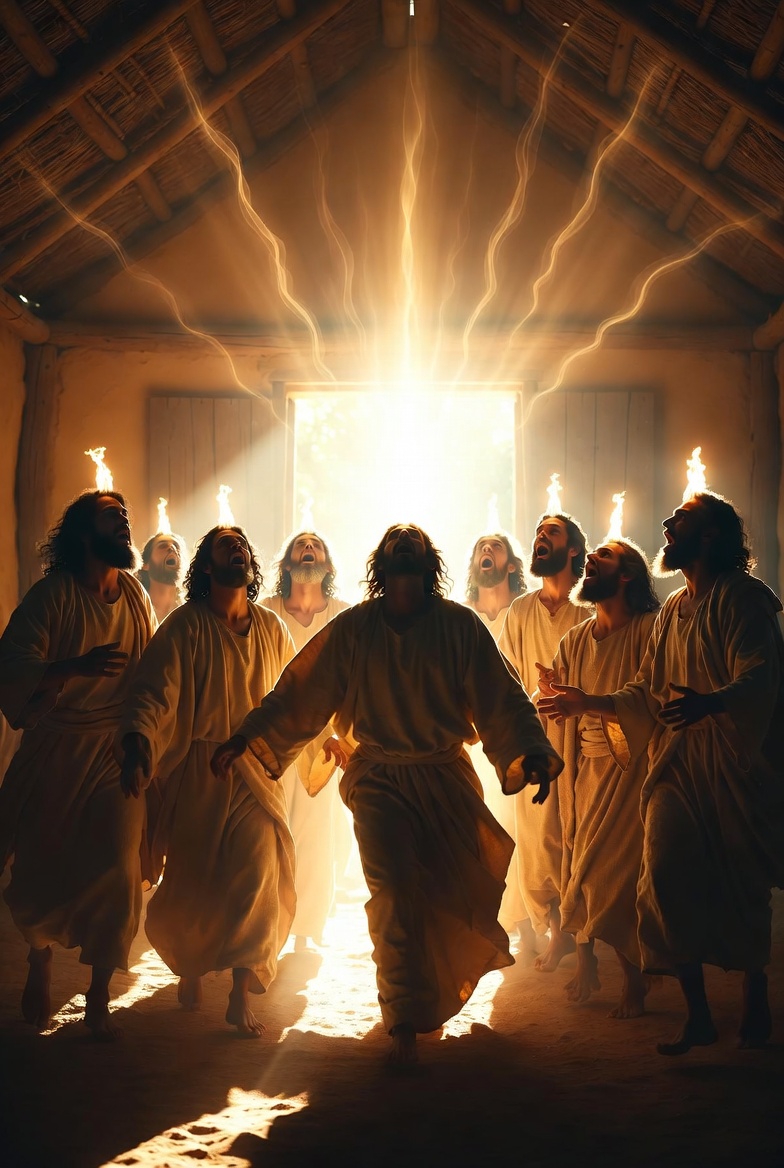
The timer expired.
The Transfiguration installed a boundary with an expiration condition: “Tell no one the vision, until the Son of Man is raised from the dead.” A gate with a timer. The timer’s trigger was a resurrection. The resurrection happened. The gate opened. And then—fifty days after the trigger fired—the trajectory landed.
Acts 2. They are in a room. The same Peter who tried to build a tent on a mountain. The same disciples who fell terrified on their faces. The same community that had watched the source of the encounter die on a Roman cross, saw him alive again. They were told to wait.
They waited.
Suddenly, a sound like a mighty rushing wind fills the entire house, divided tongues as of fire appear and rest on each one of them. And they become filled with Holy Spirit.
Stop.
The fire. The same fire. Structurally identical to the fire on Sinai. But watch what it does.
At Sinai, fire descends on the mountain. The people cannot approach. The fire is there; they are here. Spatial separation is the only survivable posture. The entire Levitical apparatus—graduated courts, veils, incense clouds, designated technicians with ropes tied to their ankles—gets erected between the two positions. The fire kills anyone who touches the boundary.
At Pentecost, fire descends on the people. It rests on them. Individually. The fire that required six hundred and thirteen specifications for proximity-management, the fire that killed Nadab and Abihu for approaching without authorization, the fire that no human being in four thousand years of recorded encounter had survived at close range without collapsing, going mad, or dying—that fire—lands on fishermen and tax collectors in an upper room and they walk out speaking.
The boundary did not thin. It relocated. It moved from between the configuration and the recipient to within the recipient. The wall was not made thinner. It was absorbed. The immune system analogy from The Boundary finds its literal operational fulfillment: the body does not become healthier by removing the immune system—the body becomes the immune system. The gating mechanism that managed proximity is now installed inside the person proximity addresses.
And every phase of the signature inverts. Simultaneously.
Overwhelm: present, but it does not collapse. They do not fall on their faces. They stand. They speak. The same somatic response that knocked Ezekiel flat, that terrified Peter, James, and John, that killed Ben Azzai—the body’s opinion about proximity—reverses. The flesh no longer crashes. Something has changed in the hardware.
Misrecognition: the crowd outside attempts it—“they are filled with new wine.” The standard move. Apply an inappropriate interpretive frame to domesticate what the categories cannot contain. The same move that worked in Eden, that built a golden calf at Sinai, that produced hermeneutic walls at Pardes, that the Transfiguration only interrupted. But at Pentecost the misrecognition does not stick. Peter stands up and corrects it in real time. The contaminated apparatus, for the first time in the program’s entire dataset, is producing accurate output. The receiver is reading the signal straight.
Boundary installation: none. No “tell no one.” No graduated courts. No hermeneutic restriction. No “do not teach this publicly.” The first thing the Spirit-filled community does is go outside and address the public. Three thousand people respond. The trajectory that moved from permanent spatial exclusion through elaborate institutional mediation through hermeneutic restriction through temporal deferral arrives at its structural terminus: no boundary. Not the eschatological “no temple” of Revelation 21—that is the final state. This is the operational inauguration of the condition under which proximity ceases to be lethal because the approacher has been transformed.
The configuration did not lower the temperature of the fire. It fireproofed the people standing in it.
And notice what happens to the nine candidates. They do not disappear. They are reconstituted—not as proximity-management architecture erected by the community, but as operational output flowing through the community from the configuration’s own initiative. The building instinct that Peter exhibited on the mountain—“let me build something”—is authorized, finally, but the blueprints are no longer the community’s. The architect moved in.
The Coupling-operative position that The Dial will derive geometrically—“the configuration operating within the agent’s constitutive dependency to transform reception capacity from the inside”—is no longer theoretical. It showed up in a room. It sat on people. And they did not die.
The fire that was on the mountain, that arrived at the canal, that shone through a face on a mountain, now indwells the people it once would have killed. The wall became a door. The door opened from inside.
The building is still standing. And now the building is them.
“Do you not know that you are God’s temple and that God’s Spirit dwells in you?” —1 Corinthians 3:16, LEB
The Dial
Something don’t add up.
Two pillars: constitutive coupling — the gravity; inescapable addressability — the broadcast. Conditions. Describe what is static: the gravitational constant does not change when you notice it. The radio tower does not adjust its frequency because you go out and buy a receiver.
Trajectory describes what changes: boundaries thin, initiative shifts, configuration closes distance. Something turns a dial across six independent events spanning millennia — and the pillars provide no explanation. Both pillars anchor the arrival of its trajectory. Neither ground nor surface. Both operate through coupling that propagates addressability, addressability that propagates encounter — distinct, symbiotic, insufficient.
Eden is the first setting. The configuration did not react to the choice—it was prepared for whatever choice was made. Garments of skin, not fig leaves. A question, not a sentence. Exile, not annihilation. The dial was already turning before the first candidate was erected.
Imagine a transmitter. Not a tower — a transmitter. The signal exists before any tower is erected. The tower is distribution infrastructure: a signal booster. Aluminum foil and a hanger have served such divine intention. The transmitter generates. It has always been generating. Without the transmitter, there is no signal, no coupling, no addressability, no encounter. Call this Source-address — the wellspring from which the encounter issues. The ontological ground. The gravity itself.
“Of every tree of the garden you may freely eat, but of the tree of the knowledge of good and evil you shall not eat, for in the day that you eat of it you shall surely die.” —Genesis 2:16–17, LEB
The signal is what the transmitter sends. Not the tower, not the infrastructure — the content, the self-communication carried across the spectrum to every receiver within range. Without the signal, there is a transmitter that never speaks — coupling that never manifests, ground that never discloses itself. But the signal does more than disclose. It presents something the receiver’s own apparatus cannot generate: an orientation standard not subject to the contamination the receiver carries. A plumb line that does not bend because it is not made of the same material as the crooked wall. Call this Reference-expression — the configuration presenting, within the encounter, an intrinsically secured standard. The broadcast that arrives intact even when every receiver is broken.
“The Word became flesh and dwelt among us, and we saw his glory, glory as of the only one from the Father, full of grace and truth.” —John 1:14, LEB
So. The transmitter generates. The signal broadcasts. And, the signal does not change. Same frequency, same amplitude, same content, millennium after millennium. If that were all, the encounter would be real but frozen. Dangerous and disclosing its danger, but never moving. No trajectory. No modulation. No hand reaching down to touch the collapsed and say “Rise.”
The trajectory requires a third element — something that actively adjusts its output. Not the transmitter, not the signal, something that operates the equipment — turns the dial, modulates per the receiver’s condition. And more: operating within the receiver’s own constitutive dependency to transform reception capacity from the inside. The Spirit that enters Ezekiel and stands him on his feet. The hand that touches Peter on the mountain. Not information delivered from above, but transformation conducted from within. Call this Coupling-operative — the configuration operating within the agent’s constitutive dependency to transform reception capacity. The hand that opens the gate from inside.
“I will put my Spirit within you and cause you to walk in my statutes.” —Ezekiel 36:27, LEB
Three modes of a single encounter. One transmitter, one signal, one operator. Remove the transmitter and the signal has no origin. Remove the signal and the transmitter exists in silence. Remove the operator and the signal never changes — the data says the signal changes. Collapse.
Three. Each distinct. Each requiring the other two. None hierarchically prior.
And the towers?
“Come, let us build ourselves a city, and a tower whose top reaches to the heavens.” —Genesis 11:4, LEB
Every tower humanity has ever built — from Babel’s ziggurat to Sinai’s tabernacle to Rome’s basilica to the megachurch with the coffee bar in the lobby — is distribution infrastructure erected by communities that mistook the signal’s availability for the signal’s absence. You do not build a tower to reach a transmitter that is already in your living room. You build a tower because you have convinced yourself, or were convinced, that the transmitter is far away. The transmitter was never far away. It asked for our location.
“Unless the LORD builds the house, the builders labor in vain.” —Psalm 127:1, LEB
The nine candidates are towers. All nine. Law, Priesthood, Sacrifice, Covenant, Narrative, Doctrine, Moral Code, Institution, Ritual — distribution infrastructure erected by communities already coupled, already addressed, already encountered, who could not bear the proximity and so built upward, outward, anything to convert raw encounter into managed distribution. And every tower did what towers do: created distance between receiver and source while feigning appearance of proximity. Builders may have labored. But that house was built a long, long time ago. Possibly, “in a galaxy far, far away.”
The generator-consequence distinction that The Bare, Naked Lie diagnosed operates at full scale. The communities targeted consequences: overwhelm, rupture, unbearable proximity; and built towers to manage: interpretation, consequence, and risk—real, imaged, whatnot. And not one addressed the generator. Generators transmit. Ours questions. And A Trick Question, Movement Three proves that consequence-level intervention leaves the generator intact. The Flood removed actors. Babel removed coordination. Neither touched signal nor silenced the transmitter. The cup may not be destroyed. The cup may not be scattered. The cup may only be consumed.
Now, a second road arrives at the same address.
Start not from the trajectory but from the orientation problem that requires a solution specific to the recipients’ contaminated sensory apparatus. Question: Given our coupling constitutes inescapable address, may any recipient orient itself toward the configuration? No. Our coupling apparatus and reception capacity — the image that orients any ‘thing’ (i.e., recipient) to and with the configuration — is contaminated. Lest ye forget the only choice that mattered? Misrecognition is structural (see The Bare, Naked Lie, and A Trick Question: Movements 1-6. Agents grasping for referents are the same agents whose apparatus distorts every reference transmitted to the receiver post “Choicism.” There …a new ‘ism’ for us all—the one we’ve failed to discuss in any real manner over the past, at least, five millennia. Considering Albert proved that time is neither linear nor chronological, a couple eyebrows should raise, even if such posture may technically not be “strictly” warranted: the patient whose immune system attacks the medicine; the student whose learning disability prevents her from reading the textbook that explains learning disabilities.
“The heart is deceitful above all things, and incurably sick — who can understand it?” —Jeremiah 17:9, LEB
Differentiation is forced. The configuration cannot solve our orientation problem by simply being present — its presence produces misrecognition. Maybe presence — over time — with tuning and adjustment? Eden proves force. Sinai proves force. Pardes proves a seventy-five percent casualty rate. Something beyond the configuration tweaks settings that imprint referents not subject to apparatus contamination — a secure image arrives intact, overcoming corrupted substrate apparatuses. That is Reference-expression, different door, or window—allowing a cool breeze or spirit (your guess is as good as ours). But even such perfect referent is processed crookedly by the contaminated apparatus. The plumb line does not help if the builder cannot see straight. The agent’s reception capacity requires modulation — something operating on the coupling itself, from the configuration’s side. That is Coupling-operative, arriving through yet another door.
Two independent derivations. Different entry points. Same structural destination. Both force three. Both produce Source-address as the first position. Both produce mutually constitutive, non-hierarchical, irreducible modes on the configuration’s side. Neither imports theology. Neither consults Nicea. The geometry forces three positions the way a triangle forces three vertices — not because someone decided triangles are sacred, but because stable orientation under two independent conditions requires a third to resolve what neither may resolve individually.
There is strength in divergence. The trajectory pathway contributes empirical evidence — six data points show the configuration’s initiative increasing across history, culminating in The Room where the Coupling-operative position arrived operationally. The orientation pathway contributes geometric precision — the contamination problem forcing differentiation that trajectory data alone leaves optional. Merge and a third point is both geometrically forced AND empirically attested.
The count is thrice.
“Just to be clear: you got here by subtracting, not by multiplying.” —Phineas McFuddlers
No Sifting Through Rubble
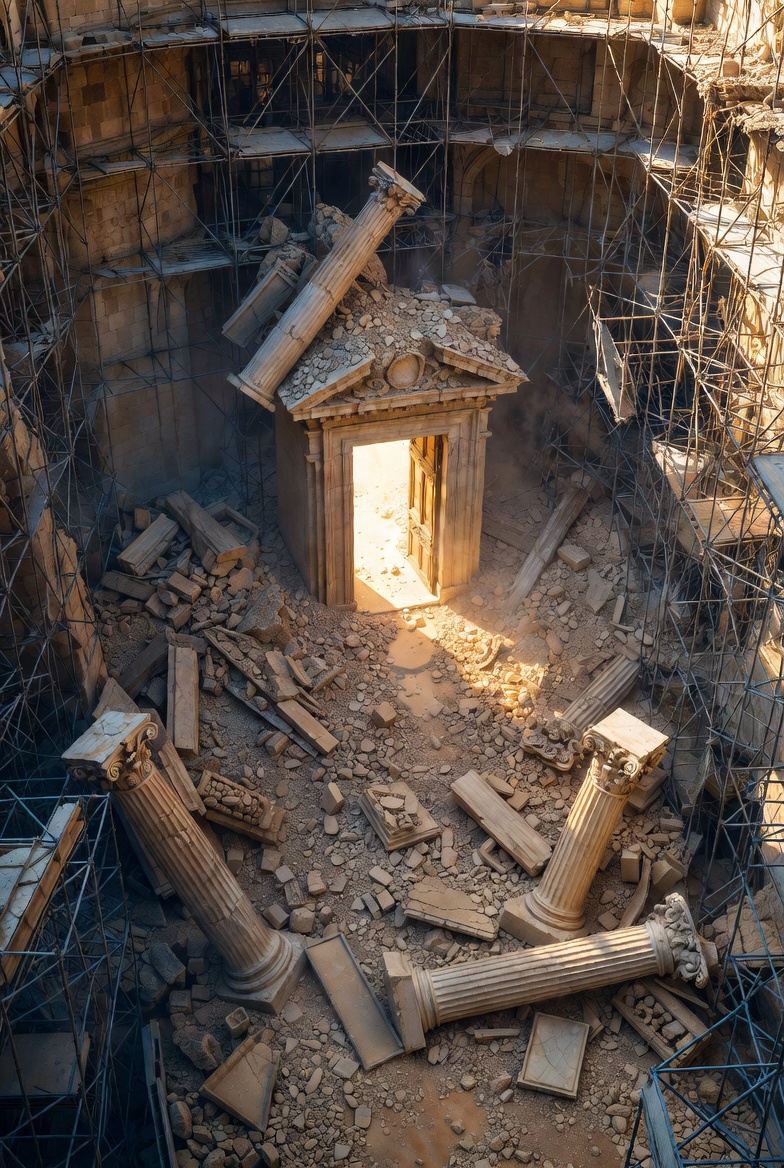
The towers fell.
Nine. Distribution infrastructure erected by communities already coupled, already addressed, already encountered, who could not bear the proximity and so built upward, outward, anything to convert raw encounter into managed distribution. Not one addressed the generator. The cup may not be destroyed. The cup may not be scattered. The cup may only be consumed.
The building still stands.
The Wilderness proves the pillars hold outside the tradition that built the towers. An Egyptian slave woman, expelled from the covenant household, found by a messenger in a desert with nothing—no candidates, no credentials, no membership—and the coupling reaches her anyway. Her line produces nations that acknowledge the Reference-expression under a different title, through a different tower, carrying the same signal. The configuration does not honor the divorce papers either family filed.
The Room proves the trajectory lands. The fire that sat on the mountain sat on people, and the people did not burn. The boundary relocates from between to within. The Coupling-operative position—derived geometrically by The Dial—arrives operationally in an upper room and sat on fishermen who walked out speaking. The approacher transforms. The wall becomes a door. The door opens from inside.
The Mercy Seat proves the configuration designed its own door. One day a year, through blood, the boundary dissolved on schedule—not because the community figured out how to approach, but because the architect specified the mechanism. The annual prototype ships permanently at Gethsemane: the cup may only be consumed.
The Marriage proves the bond: constitutive coupling and inescapable addressability, interlocked, symbiotic, irreducible. And it proves something else. The driver is on the other side of the wall, and it has been reaching through the wall for as long as there has been a wall, and the wall keeps getting thinner because the one reaching through it is uninhibited by the wall. Something that overwhelms and then restores is not a force. Forces do not restore. Tsunamis do not rebuild the houses they flatten. Something that modulates its approach based on recipients’ condition, initiates encounter its recipients do not seek, repairs what its own disclosure broke, installs boundaries designed to open — that is less like something, more like someone.
The Dial forces what the bond alone could not produce. Two independent derivations. Different entry points. Same structural destination. Both forced three non-collapsible positions: Source-address, Reference-expression, Coupling-operative. Neither imported theology. Neither consulted Nicea. The geometry forces three the way a triangle forces three vertices — not because someone decided triangles are sacred, but because stable orientation under two independent conditions requires a third to resolve what neither may resolve individually.
The count is thrice.
The question is no longer what holds the building up. The conditions answered that. The question is who placed them there. And what the building is for.
The geometry forces three positions. It does not force three persons. Functional irreducibility and ontological personhood are different claims. The first is geometric. The second is metaphysical. The derivation earned the first. The second requires something the derivation has not provided.
The distance is short. It is not zero.
“And I saw no temple in the city, for its temple is the Lord God the Almighty and the Lamb.” —Revelation 21:22, LEB
No temple. No mediation architecture. The configuration itself IS the dwelling place. Proximity without mediation. Encounter without rupture. Not a thinner wall. No wall at all.
One door.
“Not as I will, but as you will.” —Matthew 26:39, LEB
Our Gods Research Program, February 2026
Referents
- Our Gods Haven’t Fallen, Yet — A Space Junkies’ Riddle — Our Cathedral. Zenodo. https://doi.org/10.5281/zenodo.17835722 O’Connor, T. (2025).
- Our Gods Haven’t Crashed, Yet — A Silicon Junkies’ Riddle — Our Highway (1.7). Zenodo. https://doi.org/10.5281/zenodo.17851041 O’Connor, T. (2025).
- Our Gods Haven’t Computed Yet — A Neural Junkies’ Riddle — Our Cloud (1.7). Zenodo. https://doi.org/10.5281/zenodo.17925255 O’Connor, T. (2025).
- An Epi-Phenomenological Series in Thrice — A Quantum Junkies’ Riddle — Our Garden. Zenodo. https://doi.org/10.5281/zenodo.17926796 O’Connor, T. (2025).
- A Spectral Evolution of Scalar Breathing — A Cosmological Junkies’ Riddle — Our Heavens (5.0r2). Zenodo. https://doi.org/10.5281/zenodo.17942325 O’Connor, T. (2025).
- The Bare, Naked Lie: The Architecture of Recursion. Zenodo. https://doi.org/10.5281/zenodo.18287548 O’Connor, T. (2026).
- A Trick Question, The Cascade, and a Cup Worthy of Exile — A Script’ Junkies’ Riddle — Our Destiny. Zenodo. https://doi.org/10.5281/zenodo.18425900 O’Connor, T. (2026).
- M1 — 10.5281/zenodo.18425900
- M2 — 10.5281/zenodo.18446123
- M3 — 10.5281/zenodo.18450837
- M4 — 10.5281/zenodo.18451819
- M5 — 10.5281/zenodo.18452359
- M6 — 10.5281/zenodo.18452617
- The Pillars of Creation: The Architecture of Proximity — A Cult Junkies’ Riddle — Our Beginning. Zenodo. https://doi.org/10.5281/zenodo.18727860 O’Connor, T. (2026).
Copyright Notice
The Pillars of Creation: The Architecture of Proximity — A Cult Junkies’ Riddle — Our Beginning. © 2026 Tony O’Connor. All rights reserved. Date: February 2026
License
This work is licensed under the Creative Commons Attribution-NonCommercial-NoDerivatives 4.0 International License (CC BY-NC-ND 4.0).
You are free to:
- Share — copy and redistribute the material in any medium or format
Under the following terms:
- Attribution — You must give appropriate credit, provide a link to the license, and indicate if changes were made.
- NonCommercial — You may not use the material for commercial purposes.
- NoDerivatives — If you remix, transform, or build upon the material, you may not distribute the modified material.
Full license text: https://creativecommons.org/licenses/by-nc-nd/4.0/
Citation
O’Connor, T. (2026). The Pillars of Creation: The Architecture of Proximity — A Cult Junkies’ Riddle — Our Beginning. Our Gods Research Program. Zenodo. https://doi.org/10.5281/zenodo.18727860
Contact
For permissions beyond the scope of this license, contact the author through the Our Gods Research Program.
The mathematical notation (N², N†), theological framework, and structural architecture presented in this work are original contributions by the author.
No Responses